

Archival and waterproof inks may sound similar, but they serve different purposes. Here's a quick breakdown:
- Archival Ink: Designed for long-term preservation, it resists fading, has a neutral pH to protect paper, and is often pigment-based or iron gall. Ideal for legal documents, historical records, and art meant to last generations.
- Waterproof Ink: Focuses on resisting water once dry. It prevents smudging and damage from spills but may fade over time. Great for sketches, field notes, or mixed-media art.
Key Differences:
- Archival inks prioritize longevity (fade-resistant, pH-neutral).
- Waterproof inks prioritize water resistance (not always fade-proof).
For legal documents or records, go with archival inks. For everyday writing or art exposed to moisture, waterproof inks are a better fit.
Quick Comparison:
| Attribute | Archival Ink | Waterproof Ink |
|---|---|---|
| Primary Goal | Long-term preservation | Water resistance |
| Fade Resistance | High | Variable |
| Water Resistance | High | High |
| pH Level | Neutral to slightly alkaline | Can be acidic |
| Best Use | Legal documents, archival records | Everyday writing, outdoor notes |
Choose based on your needs: permanence or protection from water.
Key Properties of Archival Ink
Core Attributes of Archival Ink
Archival ink stands out due to three key qualities: lightfastness, chemical stability, and pH neutrality. These properties ensure the ink resists common forms of degradation, making it ideal for long-term use.
Lightfastness refers to the ink's ability to resist fading when exposed to UV light. Everyday inks typically score low on the Blue Wool scale (1–3), meaning they fade quickly under light exposure. In contrast, certified document inks maintain their color integrity even after 100 Mlx·h of exposure - equivalent to more than a century under normal display conditions. pH neutrality ensures the ink is acid-free, with a neutral or slightly alkaline composition. This prevents the ink from causing paper to deteriorate over time. Lastly, chemical stability ensures the ink resists breaking down or reacting with pollutants in the environment, keeping the writing intact for decades. These attributes form the foundation for the specialized formulations explored below.
How Archival Ink Works
Archival ink achieves its durability through carefully engineered formulations, primarily pigment-based and iron gall inks.
Pigment-based inks work by suspending tiny solid particles in a liquid medium. When the ink dries, these particles settle on and between the paper fibers, forming a physical bond. Unlike dissolved dyes, pigments are far more resistant to UV light and moisture, ensuring the writing remains intact.
Iron gall ink, on the other hand, relies on a chemical reaction. Made from iron salts and tannins, it oxidizes as it dries, bonding directly with the paper fibers. This process causes the ink to darken over time, enhancing its permanence rather than fading. Modern formulations of iron gall ink are designed to be less corrosive than historical versions, making them safer for both paper and fountain pen nibs.
"Modern fountain pen inks... exhibit a wide range of stability characteristics. Many are highly light-sensitive due to mixtures of synthetic dyes; however, the incorporation of stable pigments, such as copper phthalocyanine, can provide a high degree of lightfastness." - npj Heritage Science
Best Uses for Archival Ink
Archival ink is indispensable whenever writing or artwork needs to stand the test of time. For legal documents like contracts, property deeds, and affidavits, inks certified under ISO 12757-2 are ideal, as they resist water, UV light, and chemical tampering. In the United Kingdom, registrars are still required to use modern iron gall ink for official records such as birth, marriage, and death certificates. This is because dye-based inks simply can't offer the same longevity.
For personal projects, archival ink is perfect for long-term journals, family records, and field notes. Artists and calligraphers also benefit from its durability, especially for work intended for display or sale. Unlike dye-based inks, archival formulations protect against fading under gallery lighting. However, to maintain smooth ink flow and prevent pigment buildup, it's essential to clean fountain pens every 2–4 weeks.
"Archival fountain pen inks are designed for long-term document preservation, fade resistance, and waterproof durability." - Pen Chalet Team
Key Properties of Waterproof Ink
Core Attributes of Waterproof Ink
Waterproof ink stands apart from water-resistant options by staying firmly in place once it dries. Unlike water-resistant ink, which may bleed or smudge when exposed to moisture, waterproof ink forms a solid, unyielding bond with the paper. As Kevin Waters from The Pen Company explains:
"Waterproof inks are utterly impervious to water once dry. A drop of water will bead on the line, and you can wipe it away without effect."
The drying process is key - allow the ink 10 to 60 minutes to fully bond with the paper for optimal water resistance. This is particularly important when using smooth paper, as it may take longer for the ink to adhere properly. These characteristics stem from the ink's unique formulation, which we'll explore next.
How Waterproof Ink Works
The secret behind waterproof ink lies in its advanced formulation. There are two main ways it resists moisture:
- Pigment-based inks: These settle into the paper fibers, creating a water-resistant barrier.
- Iron gall inks: These react with the paper through oxidation, leaving a permanent mark.
Modern advancements, like "bulletproof" and nano-pigment inks, take it a step further by chemically bonding with the paper fibers. This makes them resistant not only to water but also to chemicals. However, because these inks contain particles, regular pen maintenance is essential - clean your pen every one to two weeks to avoid clogging.
This durability makes waterproof ink a reliable choice for a wide range of uses.
Best Uses for Waterproof Ink
Waterproof ink is perfect for situations where durability under wet conditions is a must. Whether you're creating mixed-media artwork, sketching outdoors, or jotting down field notes, this ink ensures your work stays intact despite rain, humidity, or accidental spills. It's also an excellent choice for official documents, such as signed contracts or legal papers, where longevity and resistance to tampering are critical.
The type of paper you use can significantly impact performance. Acid-free, slightly textured paper provides the best surface for a strong bond. On the other hand, smooth or coated papers may slow drying times and increase the risk of smudging, even if the ink looks dry. Low-quality copy paper can lead to feathering and reduced water resistance. For important documents, it's always smart to do a quick drip test: write a sample, let it dry for 24 hours, and then apply water to confirm the ink has fully bonded to the paper.
Preserve Your Memories: Archival Inks, Permanent Inks, and More!
sbb-itb-1dd4fe9
Archival Ink vs. Waterproof Ink: Direct Comparison
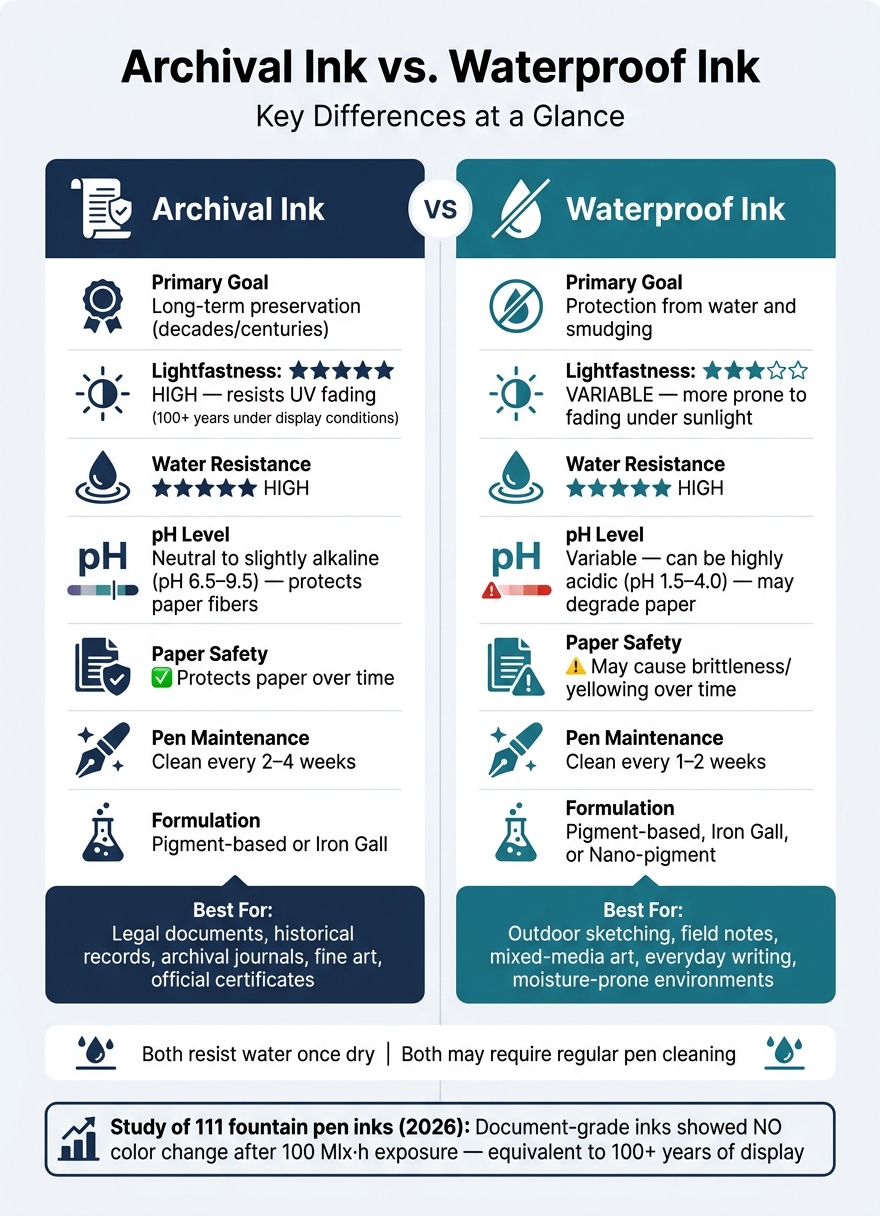
Archival Ink vs. Waterproof Ink: Side-by-Side Comparison
Attribute-by-Attribute Differences
Both archival and waterproof inks resist water, but their priorities differ: archival inks are all about long-term stability, while waterproof inks focus on immediate protection from moisture.
Archival inks are formulated to resist UV fading and maintain a neutral to slightly alkaline pH (6.5–9.5), which helps preserve paper fibers over time. On the other hand, waterproof inks often lean acidic, with pH levels ranging from 1.5 to 4. This acidity can lead to paper becoming brittle and yellowed over decades. Here's a quick breakdown of their differences:
| Attribute | Archival Ink | Waterproof Ink |
|---|---|---|
| Primary Goal | Long-term preservation (decades/centuries) | Protection from water and smudging |
| Lightfastness | High - resists UV fading | Variable - more prone to fading under sunlight |
| Water Resistance | High | High |
| pH Level | Neutral to slightly alkaline (pH 7+) | Variable - can be highly acidic |
| Paper Safety | Protects paper fibers | May degrade paper over time |
| Pen Maintenance | Frequent cleaning required | Moderate to high cleaning needed |
A study conducted in 2026 on 111 fountain pen inks revealed that general-purpose inks are highly sensitive to light. In contrast, document-grade inks showed no noticeable color change even after 100 Mlx·h of exposure - equivalent to over 100 years of typical display conditions. This makes document-grade inks particularly appealing for anyone prioritizing longevity.
The technical distinctions between these ink types become even more critical when you consider how marketing terms can muddy the waters.
Overlapping Categories and Marketing Terms
Ink bottle labels often prioritize marketing over chemistry. As Bottle and Plume puts it:
"Ink labels are marketing first, chemistry second... 'Document' and 'archival' are performance claims."
For example, the term "permanent" often implies water resistance but does not guarantee fade resistance. Niko Cano Katsunuma of Yoseka Stationery explains:
"When the word permanent is used, you can typically assume that it will be water-resistant but not necessarily fade resistant. Archival: These items are typically water-resistant AND fade-resistant as well."
Additionally, terms like "bulletproof" - popularized by Noodler's Ink - refer to inks that bond with cellulose fibers, making them resistant to water, UV light, bleach, and forgery chemicals.
Some inks manage to offer both archival longevity and waterproof durability. Examples include Platinum Carbon Black, De Atramentis Document Inks (ISO 12757-2 certified), and Noodler's Bulletproof Black. These options are ideal for those seeking both fade resistance and moisture protection.
How to Choose the Right Ink for Your Needs
What to Consider When Choosing an Ink
The type of ink you choose depends heavily on how long you need your writing to last and the conditions it will face. For documents meant to endure - like legal papers or records - opt for inks that resist both water and fading. These should also have a neutral or slightly alkaline pH to ensure longevity. On the other hand, for everyday use, a dependable water-resistant dye-based ink should do the trick.
"If you want your writing to make it through generations or stand up to light exposure, it's worth looking into archival materials." - Niko Cano Katsunuma, Yoseka Stationery
After deciding on the ink, make sure your choice of paper and pen complements it to maintain its durability and performance.
Matching Ink, Paper, and Pen
For archival or pigment-based inks, pair them with acid-free, high-GSM, cotton-based paper to maximize their longevity. When it comes to pens, gold nibs are a great match for iron gall inks, and pens with secure cap seals help prevent drying. Regular maintenance is crucial - clean your pens every 2–4 weeks to avoid ink buildup. To ensure your ink performs as expected, do a quick water test instead of relying solely on the product label.
How Fountain Pen Revolution Supports Your Ink Choices
Choosing the right ink is just one part of the equation; the tools you use can make a big difference too. Fountain Pen Revolution offers affordable starter kits starting at $35 and bundles from $29, making it easy to experiment with different ink and pen combinations. Their Gold Nib Collection is particularly well-suited for iron gall inks, giving you the flexibility to find the perfect combination of ink, paper, and pen for your needs.
Conclusion: Picking the Right Ink for Your Fountain Pen
Let’s wrap up the ink selection process by focusing on what matters most. The key distinction is straightforward: waterproof inks shield your writing from spills and moisture, while archival inks take it a step further by resisting fading and maintaining a neutral pH, which helps preserve the integrity of your paper over time.
For legal documents or records you want to last for generations, go with a certified archival or document ink that complies with ISO 12757-2 standards. On the other hand, for daily journaling or note-taking, a good water-resistant ink will do the job without requiring extra care.
"Archivability refers to the durability and longevity of an ink and is determined by three factors: water-resistance/waterproof, pH neutral/acid-free, and lightfastness." - FLAX art
Don’t forget, though, that your choice of pen and paper plays a critical role, too. Even the finest ink won’t perform well on acidic paper or with a poorly sealed pen.
If you’re ready to dive into the world of fountain pens and inks, Fountain Pen Revolution offers affordable starter kits starting at $35 and bundles as low as $29. For those interested in experimenting with iron gall inks, their Gold Nib Collection is worth checking out for a reliable and enjoyable writing experience.
FAQs
Can one ink be both archival and waterproof?
Yes, an ink can be both archival and waterproof. Archival ink is formulated to resist fading and deterioration over time, ensuring long-term preservation. On the other hand, waterproof ink is designed to endure exposure to moisture without smudging or running. Many inks, like those made with pigments or iron gall, combine these qualities, making them perfect for safeguarding important documents, artwork, or journals for the long haul.
How can I tell if an ink is truly archival (not just “permanent”)?
Terms like archival and permanent get tossed around in marketing, but they don’t always mean the ink will stand the test of time. If you’re looking for ink that’s genuinely built to last, check for an ISO certification like ISO 12757-2. This certification guarantees the ink meets specific standards for lightfastness, chemical resistance, and document preservation. While general labels hint at durability, only certified inks provide dependable protection against fading, water, and chemical damage.
Will waterproof ink damage paper over time?
Waterproof inks are usually gentle on paper, but their impact can vary based on the ink's chemical makeup. Most modern, high-quality fountain pen inks are either pH-neutral or slightly alkaline, making them safe for extended use. However, traditional iron gall inks, which are acidic, may degrade paper fibers over time, particularly on lower-quality paper. To ensure longevity, pair archival-grade waterproof inks with acid-free or cotton-based paper for optimal preservation of your writing.