

Portable writing desks solved one simple problem: how to write anywhere without losing track of paper, pens, ink, and letters.
If I had to sum up this guide in a few lines, I’d say this: portable writing desks started as small storage boxes, grew into writing slopes and lap desks for home use, and later split into tougher field desks for travel and military use. Across each stage, the goal stayed the same - keep writing tools organized, protected, and ready to use.
Here’s the short version:
- Early forms were boxes for quills, parchment, ink, seals, and drying sand.
- Writing slopes and lap desks became common in the 1700s and 1800s for home letter writing.
- Campaign desks were built for movement, with hard wood, brass fittings, locks, and spill-resistant inkwells.
- Interior layout mattered most: divided compartments, ink control, paper storage, and hidden spaces for private letters.
- Tool changes shaped design: as quills gave way to steel nibs in the 19th century, desk interiors shifted too.
- The same logic still works today for fountain pen users: carry pens, ink, paper, and a firm writing surface in one compact setup.
A few facts stand out:
- By the mid-1800s, letter writing was a normal part of home life.
- Civil War officers used compact writing cases to keep up correspondence in the field.
- Older desks often stored 5+ types of items at once: pens, ink, paper, seals, drying tools, and private documents.
If you want the plain answer, it’s this: portable writing desks were the old version of a mobile writing kit, and many of their best ideas still fit modern pen carry.
Making The Declaration Desk with Ed Zappen
Quick Comparison
| Type | Main Use | Usual Setting | Key Features |
|---|---|---|---|
| Early writing box | Carry writing tools | Monastic, merchant, scholar use | Compartments for quills, ink, seals |
| Writing slope | Letter writing | Home | Slanted lid, paper slots, lock |
| Lap desk | Writing on lap or table | Home | Compact case, portable surface |
| Campaign desk | Travel and field use | Military, naval, colonial travel | Brass hardware, strong lock, secure inkwells |
| Compact writing case | Tight travel carry | Shipboard or battlefield use | Small enclosed form, lidded ink storage |
What I like most here is the design lesson: good portable writing gear is less about looks and more about function. That idea runs through the full history covered in this guide.
Early Origins and the Rise of the Writing Slope
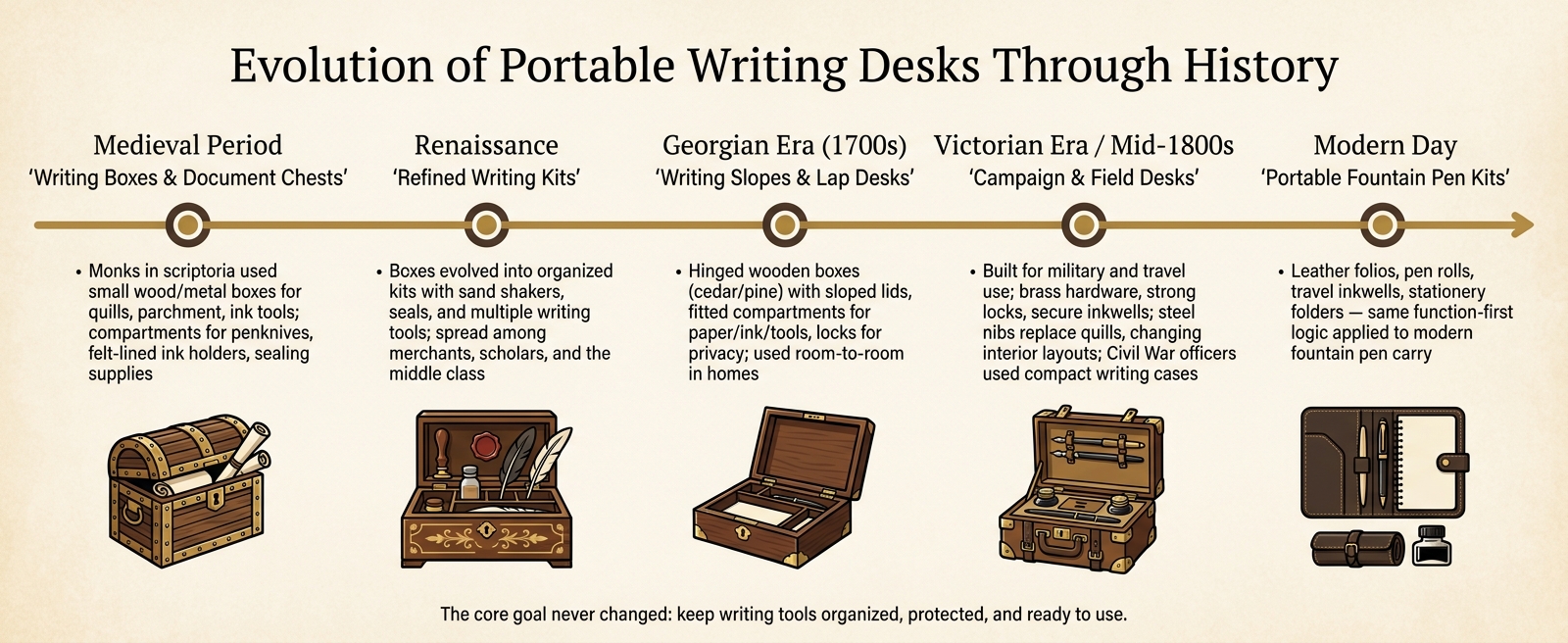
Evolution of Portable Writing Desks: From Medieval Boxes to Modern Pen Kits
Portable writing cases started as movable lecterns, document chests, and Bible boxes. Over time, those practical containers turned into the hinged writing slopes that came later.
From Lecterns and Bible Boxes to Portable Writing Chests
The first portable writing kits were boxes, not desks. In medieval monastic scriptoria, monks used small wood or metal boxes to hold quills, parchment, and ink tools. By the Renaissance, those boxes had become more refined kits, with spaces for sand shakers, seals, and other writing tools.
What made these boxes so useful was the way they were arranged inside. A well-made writing kit had separate compartments for penknives, a felt-lined ink holder to help stop spills during travel, and room for sealing supplies. That setup kept paper, ink, and seals ready for fast letter writing on the move. As letter writing spread among merchants, scholars, and the middle class, these organized kits spread with it.
That small, compartmented layout became the blueprint for the writing slopes and lap desks that followed.
Georgian to Victorian Portable Desks: Writing Slopes, Lap Desks, and Campaign Desks
From the 1700s to the late 1800s, portable writing furniture changed a lot. Earlier box-and-chest forms gradually gave way to more clearly defined types shaped by home life, travel, and military use. The basic purpose stayed the same: keep writing supplies safe and make it possible to write letters almost anywhere.
Domestic Writing Slopes and Lap Desks for Everyday Correspondence
The writing slope became a common household writing tool in Georgian and Victorian England and America. At its simplest, it was a hinged wooden box, often made of cedar or pine, with a sloped lid that gave the writer a steady angled surface. Inside, these desks usually had fitted compartments for paper, ink, and small tools.
What made them so useful was their flexibility. A writer could carry one from room to room, set it up in the warmest corner of the house, or move it near the best light. It could also rest on the lap, which made private letter writing much easier in a busy home. Most included locks, mainly to protect personal correspondence.
By the mid-1800s, letter writing had become a routine part of life in many households.
Campaign and Field Desks Built for Travel and Military Use
Campaign desks served a very different need. Officers, naval administrators, and colonial officials needed writing setups that could survive travel, shipboard conditions, and military movement. These desks were made with hard-wearing wood and metal, brass hardware, strong locks, and fitted interiors that kept supplies from sliding around in transit. Brass handles made them easier to carry, while secure inkwell housings helped stop spills when the desk was in motion.
During the American Civil War, demand increased for compact writing cases - enclosed boxes that held lidded inkwells and other writing supplies - so officers could maintain battlefield correspondence.
The contrast between these desk types was pretty clear:
Portable Desk Types Compared: 18th and 19th Centuries
| Feature | Writing Slope | Lap Desk | Campaign Desk | Compact Writing Case |
|---|---|---|---|---|
| Portability | Room-to-room use | Lap or table use | Rugged travel | Highly compact |
| Durability | Light domestic use | Light domestic use | Built for transport | Built for rough conditions |
| Privacy / Security | Lock for correspondence | Lock for correspondence | Secure lock for transit | Lidded, enclosed design |
| Best For | Home letter writing | Flexible home use | Officers and administrators | Battlefield or shipboard use |
Another shift came from changes in writing tools. As quills gave way to factory-made steel nibs during the 19th century, the interiors of these desks changed too. Quills needed a penknife and frequent resharpening. Steel nibs did not, which opened up space inside for other fitted supplies.
sbb-itb-1dd4fe9
Interior Features and Letter-Writing Practices Across Eras
Common Interior Features That Supported Writing
As these desks turned into writing slopes, lap desks, and campaign cases, the smartest changes happened inside. Their interiors brought writing, sealing, and storage together in one small case. That setup helped with three daily problems: spill control, fast access, and privacy.
Most had dedicated spots for pens, inkwells, sealing tools, paper, and finished letters. Before blotting paper became common, many also came with a sand shaker, or pounce pot, to help ink dry faster. Some higher-end kits included penknives and other tools used to maintain reed or quill pens.
For travel, inkwells had to be tough and tightly sealed. Makers often used pewter, brass, or leather-covered glass. Many inkwells also used wool or felt inside to steady the ink and cut down on spills. It’s a small detail, but it mattered. If you were writing on a moving coach or a ship, a loose inkwell could turn a letter into a mess in seconds.
Merchants and officials often wanted more privacy, so locked compartments and hidden drawers became common. They kept pens close by while protecting private papers at the same time.
Why These Desks Fit the Letter-Writing Culture of Their Time
Rising literacy, longer business travel by rail and steamboat, and the growth of the middle class all pushed demand for portable writing tools upward.
"This evening came a letter about business... and with it a silver pen he promised me to carry inke in, which is very necessary." - Samuel Pepys, British Naval Administrator
Portable desks also helped professional scriveners, who used small portable desks in public places to write letters for a fee for people who were not fully literate. That made these cases more than travel gear. They were working tools for business, personal correspondence, and public writing alike.
Their layouts matched a world where letters moved with people. Ink stayed more manageable, paper stayed in order, and private documents stayed protected wherever the writer happened to be.
Those same design choices still show up in modern portable fountain pen kits.
What Modern Fountain Pen Users Can Learn from Historic Desk Designs
The lesson isn’t to copy the object itself. It’s to copy the job it did.
Applying Historic Desk Features to a Modern Portable Writing Setup
Historic writing desks dealt with the same portable-writing headaches fountain pen users still run into now. You still need a stable writing surface, a clean way to carry pens, a safe way to transport ink, and room for paper and mail.
A stiff leather folio or portable writing board can stand in for the angled surface of an old desk. For pen storage, a multi-pen roll or pouch keeps things neat and stops pens from knocking into each other. For ink, travel inkwells or silicone-sealed sample vials do the same job as older sealed containers. And an internal folio pocket or stationery folder can hold paper, envelopes, and stamps, much like the document slots found in campaign desks.
That function-first mindset is why the old design logic still holds up.
Historic Desk Features Mapped to Modern Fountain Pen Kit Components
| Historic Desk Feature | Modern Equivalent | Practical Benefit |
|---|---|---|
| Divided compartments | Multi-pen leather pouches, rolls, or fitted case slots | Prevents pens from touching and scratching; organizes by nib size |
| Sloped writing surface | Portable writing board or stiff leather folio | Provides an ergonomic angle and stable support for writing on the go |
| Sealed inkwell | Travel inkwell or silicone-sealed sample vials | Keeps ink sealed for travel |
| Document slots | Internal folio pockets or stationery folders | Keeps correspondence, stamps, and blotting paper flat and clean |
| Nib repair tools | Brass flossing sheets or micro-mesh smoothing sheets | Helps maintain nib feel and ink flow |
Building an Affordable Writing Kit with Fountain Pen Revolution
You can recreate those same functions with a small set of modern, lower-cost pieces.
For a travel pen, the FPR Guru is an affordable pick. If you want something closer to a desk-pen feel, the Ranga Desk Fountain Pen has an ebonite body and an extra-long 9.5-inch length. And if you like expressive line variation that feels a bit closer to a quill, the FPR Ultra Flex nib is a good fit.
Fountain Pen Revolution also sells affordable pens, nibs, ink, and cases, so it’s easy to put together a complete portable writing kit in one order.
Conclusion: What Portable Writing Desks Still Teach Us
Across writing slopes, lap desks, and campaign cases, the aim never changed: keep writing ready wherever you go.
These portable desks weren’t just boxes with lids. They were working tools made for letter writing, with spaces set aside for pens, ink, paper, and the small items needed to keep everything in order. As writing tools changed, the layouts changed too. Less upkeep, tougher storage, and a simpler setup became part of the design.
That idea still holds up. Good design keeps the main items close, shields them during travel, and makes day-to-day writing feel easy instead of fussy.
You can see the same thinking in the way fountain pen users put together portable kits now. Fountain Pen Revolution offers affordable pens, nibs, ink, stands, and cases for a compact, portable kit.
FAQs
How did writing slopes differ from lap desks?
Both were portable, but they weren’t quite the same thing.
A writing slope was usually a slanted box or writing surface that sat on top of an existing table or desk. Its main job was simple: make writing easier and more comfortable.
A lap desk, by contrast, was built to rest on the user’s knees while seated. It often had a boxy shape with a hinged top, which made it handy for writing away from a fixed desk.
Both could also hold small writing items, including inkwells and nibs.
Why were campaign desks built differently?
Campaign desks were built with travel in mind. They needed to be mobile, durable, and practical for people who were constantly on the move.
Unlike stationary furniture, they often included collapsible parts or lidded compartments that closed securely. That setup kept writing tools stable, easy to reach, and protected during travel.
As a result, writers and military personnel could manage correspondence and record-keeping in different locations without much fuss.
What features matter most in a modern portable writing kit?
Focus on dependability, protection, and easy daily carry.
A durable, well-fitted pen case or sleeve with a soft lining helps guard your fountain pen from scratches, dents, and loose movement during the day. If you carry your pen in a bag, this kind of protection matters a lot.
For refilling on the go, leak-proof portable inkwells or converters can make life much easier. They help you top up ink without turning your desk, hands, or backpack into a mess.
It also helps to keep a few cleaning tools nearby, along with fountain pen-friendly paper. That combo can cut down on bleeding and feathering, which means a cleaner writing experience and less frustration in everyday use.