

Peregrine Williamson, a jeweler from Baltimore, revolutionized early writing tools in the 1800s by creating one of the first practical steel pens. Frustrated by the fragility of quill pens, he developed a steel nib with a three-slit design, improving flexibility and durability. This design not only solved the common issues of quills but also became a commercial success, earning him $600 per month - a significant income for the time. His 1809 patent for the steel pen laid the foundation for modern pen manufacturing and influenced the global writing instrument industry, particularly in England. Williamson’s contributions bridged the gap between quills and the precision nib sizes we use today.
The History of Dip Pens - Fun Facts for Kids!
sbb-itb-1dd4fe9
The Quill Era and the Push for Better Writing Tools
Before the advent of steel pens, quills - crafted from feather tips - were the standard for writing. For centuries, this method was simply accepted, but by the early 19th century, the challenges of using quills became hard to ignore. These frustrations opened the door for new innovations in writing tools.
The Problems with Writing Using Quills
Using quills was far from convenient. They required constant maintenance - frequent nibbing and trimming to ensure they worked properly - but even then, results were often inconsistent. Rev. E. Smedley, editor of the Encyclopaedia Metropolitana, once shared his disdain for the process:
"The process of nibbing and shaving is one which I always abominated, and for years past I have taken refuge under the Perryian pens."
Quills were also notoriously fragile. In the 1820s, a banking house in London reportedly discarded nearly 90% of the 6,000,000 quills it used annually because they were unsuitable for writing. On top of that, the constant dipping into ink disrupted focus and slowed down the writing process, making it a tedious tool for anyone who needed to write extensively.
Why Metal Pens Were a Step Forward
Steel pens offered a practical solution to the shortcomings of quills. Unlike their feathered predecessors, metal pens didn’t need reshaping and were far more durable. They maintained a consistent tip and resisted wear and tear. Johann Janssen, Magistrate of Aix-la-Chapelle, praised their reliability:
"If kept clean and free from rust and ink, they will continue fit for use for many years. Indeed, a man may write twenty reams of paper with one, and the last line would be written as well as the first."
These features made steel pens a game-changer, allowing writers to focus more on their work and less on the tools they used. Today, enthusiasts can still find a wide variety of modern writing instruments that build on these historical innovations.
How Peregrine Williamson Became a Pen Maker
From Jewelry Craft to Pen Design
In 1800 Baltimore, Peregrine Williamson, a jeweler frustrated by the unreliability of quill pens, decided to put his metalworking expertise to use. He crafted a steel pen, marking the beginning of a significant innovation in writing tools. As the Journal of Commerce recounted:
"In the year 1800, Mr. W., then a working jeweler, at Baltimore, while attending an evening school, made one of steel."
However, his first attempt fell short - while durable, the pen lacked the natural flexibility of a quill. Determined to improve, Williamson modified his design by adding side slits to the nib, creating an early flex nib that was more functional:
"After a while he made an additional slit on each side of the main one, and the pens were so much improved that Mr. W. was called to make them in such numbers as to eventually occupy his whole time."
The improved design quickly gained popularity, and demand soared. Williamson hired a journeyman to help meet production needs, and his operation began generating a monthly profit of $600 - a considerable sum at the time. With his design proving both effective and profitable, Williamson decided to protect his invention by securing a formal patent.
The 1809 Patent and What It Meant for Writing Tools
In 1809, Williamson's steel pen design earned a patent, making it one of the earliest recorded innovations in this field. While others had experimented with metal pens, these early attempts were often described as "thick and hard", which made them difficult to use. Williamson’s three-slit nib design solved this problem by offering the flexibility of a quill with the added durability of steel. This combination was a game-changer, setting a new standard for writing tools.
The impact of his invention extended far beyond the United States. English manufacturers quickly adopted his design:
"The English soon borrowed the invention, and some who first engaged in the business realized immense fortunes."
Williamson’s work may not have brought him the fame he deserved, but his innovation played a key role in shaping the future of pen manufacturing. His design laid the foundation for the industrial pen-making boom that later flourished in Birmingham, England.
How Williamson's Steel Pens Performed in the Market
Early Sales and Commercial Reach
When Williamson addressed the flexibility issue with his innovative three-slit nib design, demand for his steel pens took off. Writers who had grown frustrated with the limitations of quills quickly embraced his pens as a more dependable alternative. Henry Bore highlighted this success in The Story of the Invention of Steel Pens (1890):
"At first the business was very profitable and enabled Mr. W. to realize for the labor of himself and journeyman a clear profit of six hundred dollars per month."
Earning $600 in monthly profit - a significant amount at the time - demonstrated the strong market appeal of Williamson's pens. This success not only established him as a leading pen manufacturer in the United States but also laid the groundwork for his designs to influence markets overseas.
How His Work Shaped Later Pen Design
Williamson's achievements at home soon gained international attention. His three-slit nib design became a model for pen manufacturers abroad, particularly in England. Early adopters of his concept in the UK reaped substantial financial rewards, and his innovations played a key role in shaping the Birmingham pen-making industry. This region would go on to dominate global pen production, cementing Williamson's lasting influence on the evolution of pen manufacturing.
Williamson's Legacy and the Long Arc of Writing Instrument History
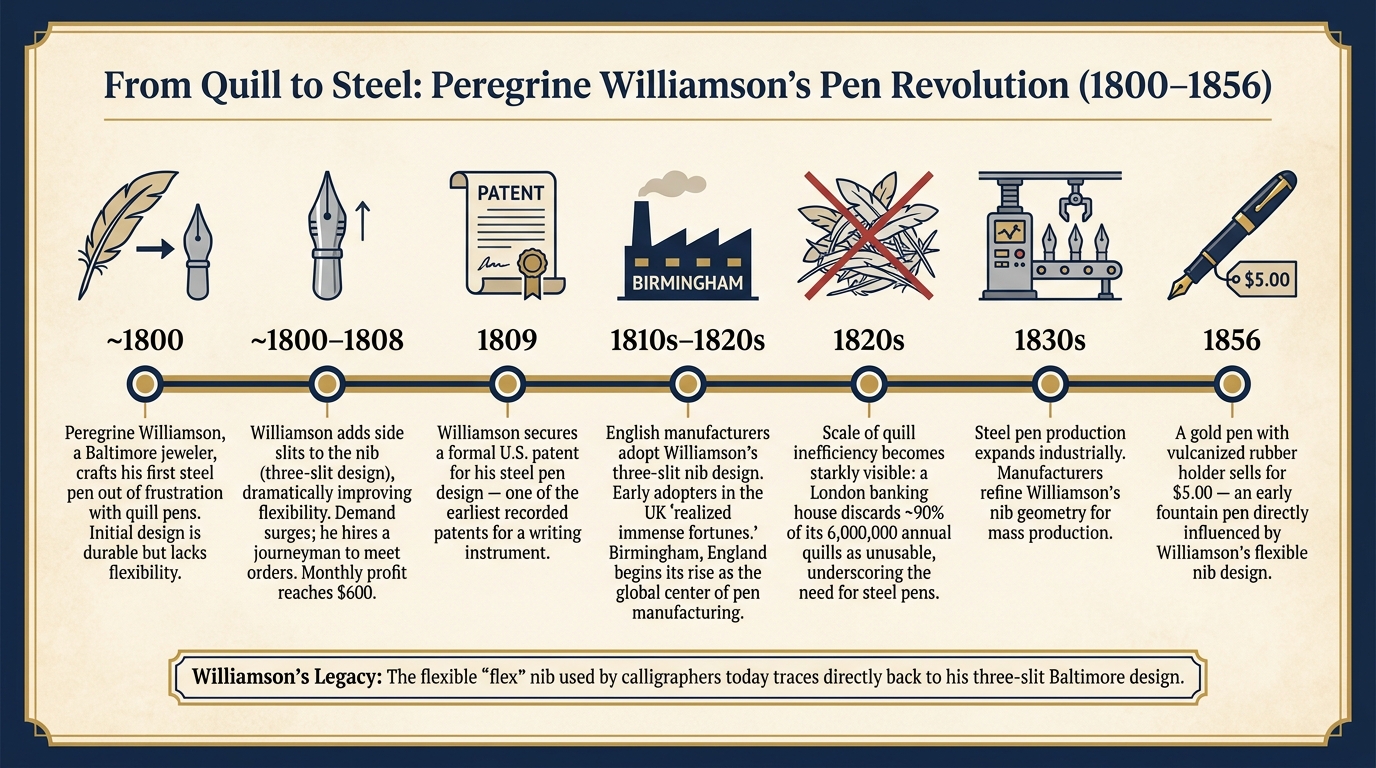
From Quill to Steel: Peregrine Williamson's Pen Revolution (1800–1856)
The Road from Steel Pens to Fountain Pens
Williamson's three-slit design tackled the limitations of quills and laid the groundwork for future pen advancements. His nib design, featuring side slits, improved ink flow and flexibility - key features that shaped the development of metal pens throughout the 19th century. This innovation not only enhanced performance but also set the stage for the creation of pens with integrated ink systems.
As steel pen production expanded in the 1830s, manufacturers refined Williamson's design. The next major leap combined flexible nibs with self-contained ink reservoirs. By the mid-19th century, early fountain pens began to replace traditional inkstands. For instance, in 1856, a gold pen with a vulcanized rubber holder was sold for $5.00 - a design directly influenced by Williamson’s work. Over time, gold replaced steel in many nibs due to its resistance to acidic inks, though Williamson’s flexible slit design remained central. Even today, flexible nibs prized by calligraphers trace their lineage back to Williamson's pioneering efforts.
Why Williamson Still Matters to Pen Enthusiasts
Williamson's innovations laid the foundation for modern pen design. His contributions marked a shift, transforming pens from simple curiosities into refined tools of craftsmanship. For today’s fountain pen community, Williamson represents that pivotal moment when precision metalworking elevated the pen beyond the quill.
His influence endures in modern pen culture. The "flex" nib, adored by calligraphers and writing enthusiasts for its ability to create varied line widths and add expressive flair, is a direct descendant of Williamson's three-slit design. When collectors and enthusiasts discuss nib flexibility, they are celebrating the very characteristic Williamson worked to perfect.
"The inventor of steel pens... was an American and a well-known resident of our city (New York), Mr. Peregrine Williamson." - Journal of Commerce, as cited in the Boston Mechanic (August 1835)
Williamson's legacy reminds us that today’s sophisticated writing instruments are the result of relentless innovation and craftsmanship. That same spirit thrives today at Fountain Pen Revolution, where enthusiasts can explore fountain pens that honor the timeless pursuit of precision and quality.
Conclusion: Remembering a Pen Pioneer
Peregrine Williamson’s journey began with a jeweler's frustration over the limitations of quills. Starting his career as a jeweler in Baltimore around 1800, he sought a solution to the impracticality of quills. His answer? A simple yet groundbreaking adjustment: adding a slit on each side of the central slit in metal pens. This small modification introduced the flexibility needed to transform writing instruments forever.
This idea quickly grew into a thriving business. Williamson, alongside a journeyman, turned his innovation into a profitable enterprise, proving that metal pens were more than just a passing trend - they were the future. His work even caught the attention of English manufacturers, who expanded on his designs, propelling the pen trade in Birmingham to new heights.
Williamson’s dedication to precision and quality mirrored his background as a jeweler. He carefully balanced material, tension, and form, much like choosing the right fountain pen nib size, creating pens that combined functionality with craftsmanship. For today’s fountain pen enthusiasts, the responsive nibs they admire still trace their lineage back to Williamson’s Baltimore workshop. His side-slit design remains a key feature in modern nib geometry.
Williamson’s story is a testament to how transformative ideas often begin with a single person tackling a single problem. His thoughtful solution not only revolutionized writing instruments but continues to influence their design centuries later.
FAQs
How did the three-slit nib improve writing?
The three-slit nib transformed handwriting by boosting ink flow and flexibility. This design made writing smoother and more consistent, giving writers better control over their strokes. It was particularly useful for calligraphy and fast-paced writing, allowing for greater precision and expressive detail in every line.
Was Williamson really the first to make a usable steel pen?
Peregrine Williamson is credited with crafting the first practical steel pen in the United States around 1806. He enhanced the pen's flexibility by incorporating slits to make it less rigid. In 1809, he secured a patent for his "Three Slit Pen", marking the first steel pen patent in the nation.
Why did England adopt Williamson’s pen design so quickly?
England was quick to embrace Williamson's pen design, thanks to his progress in steel pen manufacturing and the improved shapes he introduced. His innovations caught on rapidly, especially as English manufacturers adopted and promoted his creation, leading to a fast shift in the market.