

Fountain pens are evolving thanks to 3D printing. This technology is reshaping how pens are designed, produced, and customized, offering possibilities that were previously unattainable with conventional methods. Here’s what’s changing:
- Design Freedom: 3D printing enables intricate patterns, vibrant colors, and complex internal structures without the need for expensive molds.
- Small-Batch Production: Unlike traditional manufacturing, it’s cost-effective to produce limited editions or even single units.
- Material Advancements: Multi-material resins used in 3D printing combine aesthetics and functionality in a single process.
- Customization: Personalized designs and one-of-a-kind pieces are now more accessible.
While conventional methods excel in mass production and durability, 3D printing offers unmatched flexibility for creativity and personalization. The revival of brands like Duchessa 1935 showcases how these advancements are revitalizing the luxury pen market, valued at over $2.3 billion.
Artcraft Egyptian Temple Column and River Nile 3D Printed Pens
1. Conventional Fountain Pen Manufacturing
The art of making fountain pens has evolved over centuries, blending refined materials with meticulous craftsmanship. From the ebonite bodies of the 1880s to the cast acrylic (PMMA) barrels seen in today's luxury pens, each material brought its own strengths and compromises, shaping the look and durability of the pens.
| Material | Era of Peak Use | Key Trade-Off |
|---|---|---|
| Ebonite | 1880s–1950s | Resistant to ink but offered limited color choices |
| Casein | 1920s–1940s | Showcased vibrant, iridescent colors but required formaldehyde hardening |
| Celluloid | 1920s–1960s | Known for smooth, patterned finishes but replaced by injection molding |
| Cast Acrylic (PMMA) | Modern | UV-resistant, recyclable, and color-stable - used in today's premium pens |
These materials reflect how the available resources of an era shaped the possibilities for pen design.
Take Conway Stewart, a British penmaker with over 1,000 glowing reviews (averaging 4.9 out of 5 stars). They favor cast acrylic for their pens, explaining:
"We have found that this material [PMMA] provides us with everything we need for our pens: it holds its color, it is weather and UV radiation resistant, and it can be easily cut, drilled and shaped and, most importantly, it is recyclable."
Design Flexibility
Traditional pen-making methods, like injection molding and CNC machining, prioritize consistency over creativity. Injection molding requires costly molds - ranging from $2,000 to over $50,000 - which lock in the design from the outset. CNC machining, while precise, imposes its own restrictions. Complex features like internal channels or organic shapes are difficult or prohibitively expensive to produce. As a result, most pens share similar structures, with aesthetics being the primary way to stand out.
The choice of manufacturing techniques and materials directly impacts both the pen's durability and its visual appeal.
Materials and Durability
The evolution of pen nibs mirrors the shift in materials. Historically, gold was the go-to choice for its resistance to ink corrosion. However, rising costs led manufacturers to switch to stainless steel, often tipped with iridium for added durability at the writing point. As EndlessPens explains:
"Gold was more commonly used in the past because it provided a good balance between cost and durability. It eventually became too expensive to produce in larger quantities, which is why manufacturers turned to lower-cost alternatives such as stainless steel."
High-end pens still incorporate premium materials like brass, silver, or gold for their barrels, sometimes finished with Urushi lacquer to enhance both protection and aesthetics.
Cost and Accessibility
Traditional manufacturing methods are most cost-effective when producing in bulk. For instance, injection molding only makes financial sense for production runs of 1,000 to 10,000 units, while CNC machining can waste up to 70% of the material used. This translates to higher costs for consumers, especially for unique or small-batch designs. A Conway Stewart Marlborough Vintage Black Ebonite Gold pen, for example, retails for around $780.
Such manufacturing constraints make bespoke or highly personalized pens difficult to produce at an affordable price.
Customization Options
Personalization has always been a challenge for traditional pen-making. Small production runs are rarely cost-effective, and creating one-off designs is often prohibitively expensive. This limitation in material and production diversity means most traditional pens rely on aesthetic variations rather than structural or functional customization. The infrastructure of conventional manufacturing was built for mass production, not individual creativity.
2. 3D-Printed Fountain Pens
3D printing has transformed the way fountain pens are designed and manufactured. Unlike the rigid nature of injection molding - which requires expensive, fixed molds - this technology allows for quick iterations from concept to finished product. The result? Faster production and exciting possibilities for both design and material quality.
Design Flexibility
One of the biggest advantages of 3D printing is its ability to push design boundaries. Take the Stratasys J8 Series PolyJet technology, for example - it offers Pantone Verified colors and over 640,000 color and texture combinations, far surpassing the capabilities of traditional casting methods.
In February 2023, Italian artisan penmaker Il Pennaio teamed up with parts manufacturer Florenradica to revive the historic Duchessa 1935 brand. Led by Co-Owner Fabio Moricci and Florenradica's Katia Stanzani, the team harnessed this cutting-edge technology to create an initial collection of 250 pieces. Designs like "Zhulong", inspired by Chinese mythology, and "The American Dream" showcased the intricate patterns and vibrant colors made possible only with advanced 3D printing.
"The new designs – featuring vibrant color combinations and intricate patterns – would have been unachievable even with other 3D printers, let alone via traditional manufacturing methods." – Fabio Moricci, Il Pennaio
Materials and Durability
3D-printed pens are crafted using multi-material resins that meet both aesthetic and functional demands in a single print. This includes critical features like threading and ink delivery systems. While standard desktop printers often fall short in terms of color precision and structural quality, high-end systems like the Stratasys J8 Series overcome these limitations. These advancements ensure that the pens are not only visually striking but also durable and functional, making production more efficient without compromising on quality.
Cost and Accessibility
Traditional manufacturing becomes cost-effective only when producing large quantities. In contrast, 3D printing makes small-batch production - and even single-unit runs - economically viable. For example, a single print tray can produce up to 50 complete pens in one go, opening the door for one-off creations without breaking the bank.
"The fundamental versatility of 3D printing also makes it possible – and profitable – to produce the pens in very small quantities, even down to single units." – Stratasys
This approach proved crucial for the Duchessa 1935 revival, as the collection quickly gained traction and secured a partnership with La Couronne du Comte, one of Europe's largest pen retailers.
Customization Options
3D printing takes personalization to a whole new level. It enables the creation of unique designs, one-of-a-kind pieces, and limited editions - all without the excessive costs tied to custom molds or large-scale production. This shift from mass production to micro-manufacturing highlights the growing emphasis on craftsmanship, giving customers access to truly individualized fountain pens and reshaping the landscape of modern pen design.
sbb-itb-1dd4fe9
Pros and Cons
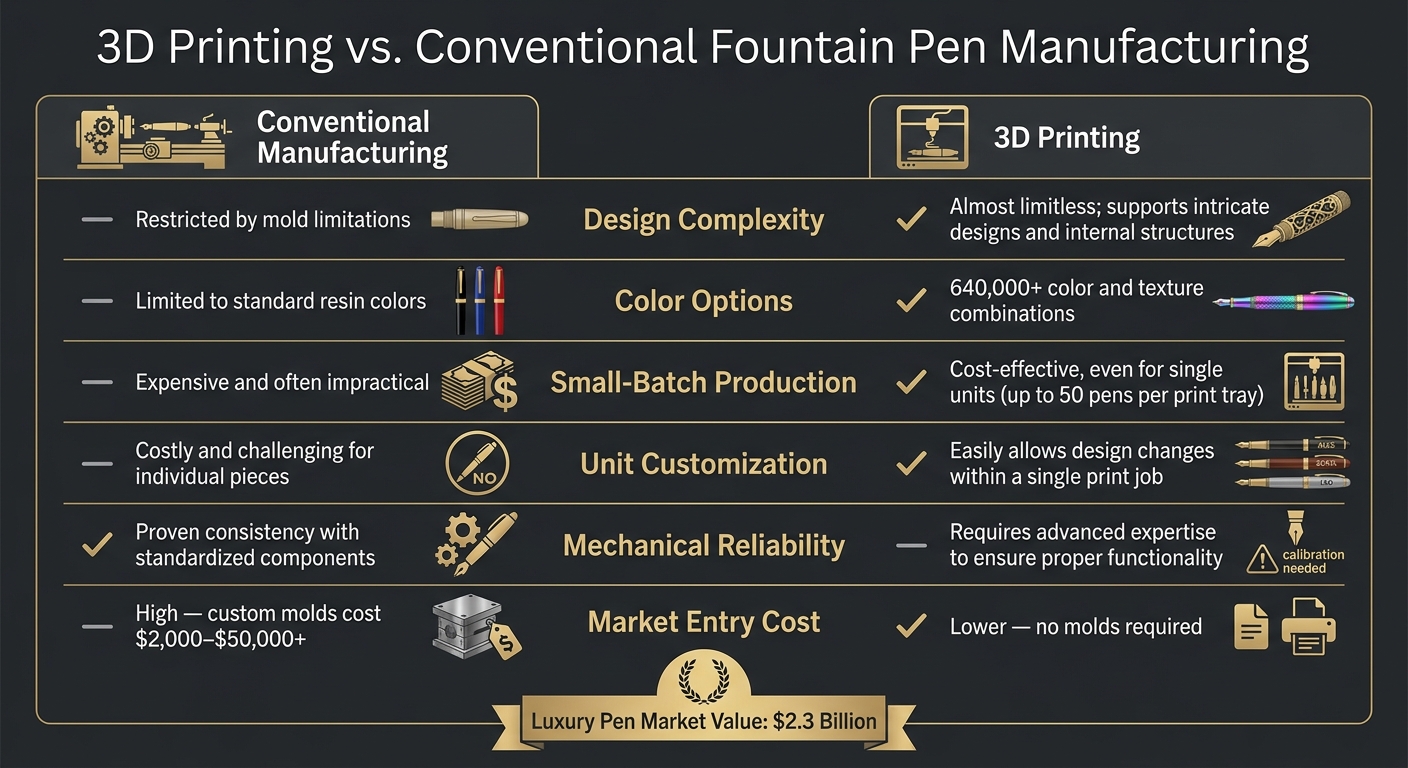
3D Printing vs. Conventional Fountain Pen Manufacturing: Key Differences
Let’s take a closer look at how conventional manufacturing and 3D printing stack up against each other. Each method has its own strengths and challenges, and the best option depends on the specific goals of a maker or brand.
| Feature | Conventional Manufacturing | 3D Printing |
|---|---|---|
| Design Complexity | Restricted by mold limitations | Almost limitless; supports intricate designs and internal structures |
| Color Options | Limited to standard resin colors | Offers over 640,000 color and texture combinations |
| Small-Batch Production | Expensive and often impractical | Cost-effective, even for single units |
| Unit Customization | Costly and challenging to customize individual pieces | Easily allows design changes within a single print job |
| Mechanical Reliability | Proven consistency with standardized components | Requires advanced expertise to ensure proper functionality |
| Market Entry Cost | High due to custom mold requirements | Lower, as no molds are needed |
These comparisons highlight some key trade-offs. Conventional manufacturing shines when producing large volumes, as the cost per unit decreases significantly with scale. However, it struggles with flexibility, especially for small batches or customized designs. On the other hand, while 3D printing offers unparalleled design freedom and customization, ensuring the mechanical reliability of printed components often demands specialized knowledge and expertise.
Fabio Moricci, Co-Owner of Il Pennaio, emphasizes this gap in quality assurance:
"Having tested the same designs, other 3D printers weren't able to produce results that were even near comparable; we truly believe Stratasys is the only provider that can deliver the exceptional quality that luxury, high-end brands demand." – Fabio Moricci
Conventional manufacturing is excellent for creating durable, consistent products at scale. However, it often limits creative possibilities - a significant drawback in industries like the luxury pen market, which is valued at over $2.3 billion. As consumer demand for customization and innovation grows, these limitations are becoming harder to overlook.
Conclusion
3D printing has become a powerful ally to traditional manufacturing, offering new ways to bring creative designs to life. While conventional methods excel in delivering consistency and durability for large-scale production, 3D printing shines when it comes to creating limited editions, one-of-a-kind pieces, and imaginative designs that were once out of reach.
The revival of Duchessa 1935 is a prime example of this transformation. After being dormant since 1958, the brand made a stunning comeback in February 2023, quickly securing a partnership with La Couronne du Comte.
As Katia Stanzani from Florenradica expressed:
"We are very proud to have played a part in this project, which has brought the historic Duchessa 1935 brand into the modern day, changed the trajectory for Il Pennaio, and breathed new life into the industry."
Looking ahead, cutting-edge innovations like voxel-level material control, AI-driven design processes, and multi-material metal printing promise to push the boundaries of fountain pen craftsmanship even further. With the luxury pen market valued at over $2.3 billion, brands that skillfully combine time-honored techniques with modern technology are poised to shape the future of the industry.
FAQs
Will 3D-printed fountain pens last as long as traditional pens?
3D-printed fountain pens can hold up well over time, especially when made from high-quality recycled plastics designed to meet durability standards. That said, their longevity is heavily influenced by the specific materials chosen and the rigor of testing for strength and resistance to wear.
Can 3D printing change a pen’s ink flow or writing feel?
3D printing has the potential to affect a pen's ink flow and writing experience by enabling the customization of internal parts like feeds and nib housings. These tailored components can change how ink is distributed and adjust the pen's responsiveness during use.
What should I look for when buying a 3D-printed fountain pen?
When picking a 3D-printed fountain pen, think about the materials. Acrylic resin, for instance, is known for being lightweight and available in vibrant colors, while metals like brass or titanium bring sturdiness and a high-end touch. Also, pay attention to the pen’s structure - make sure it accommodates standard nib sizes and offers personalization options like engraving. Lastly, consider the pen’s weight, size, and design to ensure it feels comfortable in your hand and suits your writing style. This balance can make writing more enjoyable and practical.