

When choosing a fountain pen, weight and balance are two factors that can significantly impact your writing experience. Weight refers to how heavy the pen feels in your hand, while balance is about how that weight is distributed along the pen’s length. Here's a quick breakdown:
- Pen Weight: Heavier pens can reduce hand pressure and feel luxurious, but may cause fatigue for extended use. Lighter pens are easier to handle for long writing sessions but may require more effort to keep steady.
- Pen Balance: A well-balanced pen feels natural in your grip, with its weight evenly distributed. Poor balance can make the pen tip forward or backward, causing discomfort or strain.
Quick Comparison
| Feature | Heavier Pens | Lighter Pens |
|---|---|---|
| Pros | Easier nib glide, suits larger hands | Reduces fatigue, ideal for long use |
| Cons | Can feel bulky, tiring for long sessions | Requires more pressure, less stable |
| Best For | Short tasks, signatures | Long writing sessions, quick notes |
To find the right pen, test how it feels in your hand, both with and without the cap posted. A pen that fits your hand size, grip style, and writing habits can make all the difference in comfort and control.
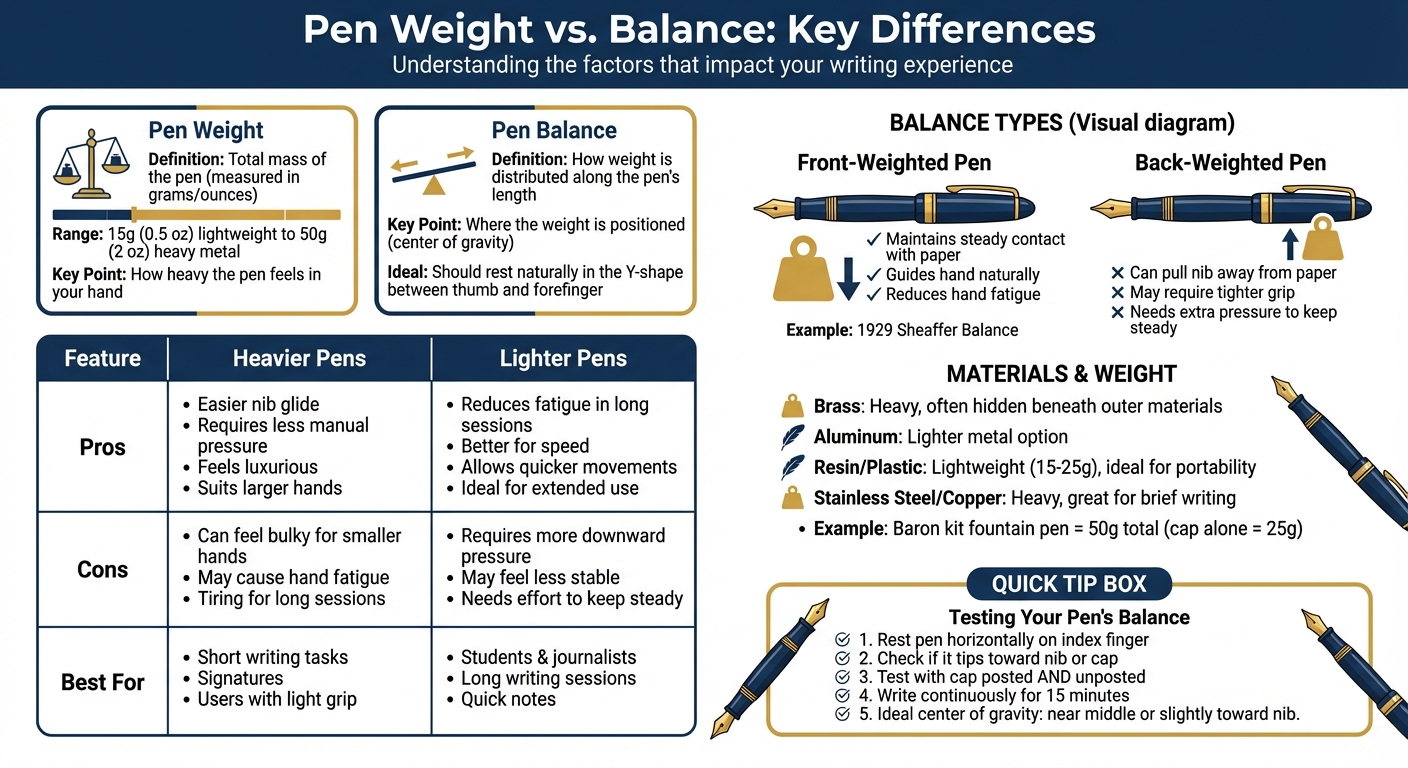
Fountain Pen Weight vs Balance Comparison Guide
Delta Write Balance fountain pen demonstration and writing sample
What Is Pen Weight?
Pen weight refers to the total mass of a pen, usually measured in grams or ounces. This can vary significantly based on the materials used to construct the pen. For instance, a fountain pen might weigh as little as 15 grams (about 0.5 oz) for a lightweight design, while a heavier metal model can tip the scales at around 50 grams (nearly 2 oz).
What feels like the "perfect" weight is highly personal. It depends on factors like hand size, grip style, and writing habits. There's also a perception factor - many people associate a heavier pen with higher quality, while lighter pens are sometimes seen as less durable.
Let’s dive into how a pen’s weight impacts writing and how materials influence that weight.
How Weight Affects Your Writing
Heavier pens often allow the nib to glide across the paper with less effort, as the pen’s weight naturally drives the nib. This can reduce the need to apply pressure and may help prevent hand fatigue, especially for those who grip their pens tightly.
"If it feels like you will have to press hard to write the body is probably too light."
- Smitty37, In Memoriam, The International Association of Penturners
On the flip side, overly light pens may require more pressure to maintain steady contact with the page. This extra effort can lead to discomfort during long writing sessions.
Pen maker Russ Fairfield explains it well:
"The fountain pen should be used without having to press the point into the paper to make a line. The weight of the pen should be enough to make the line."
- Russ Fairfield, Pen Maker
Ultimately, the materials used in a pen’s design play a significant role in determining its weight and how it performs.
Materials That Determine Weight
The weight of a pen is largely dictated by the materials chosen for its construction. Metal components, for example, add considerable heft compared to plastic or resin options.
Brass is a common choice for internal components or as a base layer, sometimes hidden beneath outer materials like carbon fiber. Aluminum, on the other hand, offers a lighter metal option. For those seeking a lightweight pen, resin and plastic barrels are popular choices, as they keep the overall weight low - ideal for portability or extended writing sessions.
"Metal trim adds weight to a pen. Metal body... Again the only way to add weight is through the choice of barrel material or the addition of metal to the trim hardware."
- ashaw, Member, The International Association of Penturners
Take the Baron kit fountain pen as an example. It typically weighs around 50 grams, with the cap alone contributing about 25 grams. However, custom designs that eliminate certain components can significantly reduce weight, resulting in pens as light as 15 to 25 grams. Knowing these details can help you choose a pen that aligns with your comfort and writing needs.
What Is Pen Balance?
Pen balance refers to how the weight of a pen is distributed along its length. It’s not about how heavy the pen is overall, but where that weight is positioned - its center of gravity. Ideally, a well-balanced pen should naturally settle into the "Y" shape formed by your thumb and forefinger without tipping forward or backward.
To illustrate, imagine two pens, each weighing 30 grams (about 1 oz). One might feel stable and easy to control, while the other could feel awkward or prone to tipping. The key difference lies in how the weight is distributed - whether it’s near the nib, evenly spread, or concentrated toward the back. This distribution significantly affects how the pen handles, complementing discussions about overall weight by focusing on control and comfort.
"The back of the pen should fall naturally between your thumb and forefinger."
- ashaw, Member, The International Association of Penturners
Good balance enhances stability and control while writing. A poorly balanced pen might force you to grip it tighter or repeatedly adjust your hand to maintain contact between the nib and the paper. On the other hand, a well-balanced pen rests comfortably on your second finger, with your thumb and first finger holding it lightly.
Balance is also subjective. People with larger hands might prefer heavier pens for a comfortable grip, while those with smaller hands could find such pens cumbersome.
Front-Weighted vs. Back-Weighted Pens
Front-weighted pens concentrate most of their weight near the nib and section. This design helps the pen maintain steady contact with the paper, guiding your hand naturally as you write. A classic example is the 1929 Sheaffer Balance, which was designed to be lightest at the back and heaviest near the nib to reduce hand fatigue during long writing sessions.
In contrast, back-weighted pens have more mass toward the cap or rear. This imbalance can pull the nib away from the paper, potentially requiring you to grip the pen more tightly or exert extra pressure to keep it steady.
"If it feels like it is going to fall backwards the top end (usually a posted cap) is too heavy."
- Smitty37, In Memoriam, The International Association of Penturners
A front-weighted pen often feels more stable and effortless to use, while a back-weighted pen might make the nib lift off the page unless you actively press down.
How Posting the Cap Changes Balance
Posting - attaching the cap to the back of the pen while writing - can affect balance significantly. While it might make the pen feel longer and more comfortable to hold, it also shifts weight toward the rear, potentially disrupting the balance.
The impact of posting depends on the cap’s material and design. A heavy cap, when posted, can make the pen feel like it’s tipping backward, requiring you to press harder to keep the nib steady.
To test this, try writing with the cap posted. If the pen feels unbalanced or you find yourself applying more pressure, it might be better to write with the cap off. You can also check the balance point by resting the pen on your index finger. If it tips toward the nib or the cap, you’ll know where the weight is concentrated. This simple test can help you understand how the pen’s balance suits your writing style.
sbb-itb-1dd4fe9
Weight vs. Balance: How They Compare
Weight is all about a pen's mass, while balance focuses on how that weight is distributed. In simpler terms, weight tells you how heavy the pen feels, and balance reveals whether that weight is concentrated near the nib, evenly spread, or leaning toward the back. Interestingly, even a heavy pen can feel effortless if it's well-balanced, but a light pen with poor balance might leave your hand feeling tired.
These two factors work together to shape your writing experience. A poorly balanced pen, no matter how light, forces you to adjust your grip to compensate for the imbalance, often leading to extra strain. On the flip side, a well-balanced pen - regardless of its weight - reduces the effort needed for smooth, comfortable writing.
"I tend to prioritize the weight, balance, and overall 'feel' of a pen over the nib. Unless the nib is absolutely god-awful, it can be adjusted. The size and heft of the pen can't."
Pros and Cons of Weight vs. Balance
| Feature | Heavier Pens | Lighter Pens |
|---|---|---|
| Pros | Requires less manual pressure, feels luxurious, and suits larger hands | Better for speed, reduces fatigue in long sessions, and allows quicker movements |
| Cons | May feel bulky for smaller hands and cause hand fatigue | Needs more downward pressure and may feel less stable |
| Best For | Short writing tasks, signatures, and users with a light grip | Students, journalists, and lengthy writing sessions |
When it comes to overall comfort, balance often takes the lead over weight. A well-balanced pen ensures you can write for extended periods without strain. For instance, pens with a front-heavy design (often due to metal sections) help keep the nib steady on the page, offering better control. On the other hand, pens that are back-heavy - especially when a cap is posted - can make the nib lift off the paper, causing skipping and an awkward writing experience. Understanding these nuances helps you pick a pen that aligns with your writing needs.
Choosing Based on Your Writing Style
Weight and balance aren’t just technical details - they’re personal. Your hand size, grip style, and writing habits all play a role in deciding which factor matters more. If you have larger hands, a heavier pen might feel more stable and balanced, while smaller hands may struggle with the same pen, especially if posting the cap shifts the weight too far back.
For those with a light grip, a heavier pen can assist by applying the necessary pressure on the page without extra effort. Meanwhile, fast writers or those who spend hours taking notes will likely prefer lighter pens, often made from materials like resin or polycarbonate, to avoid fatigue. For short tasks like jotting down notes or signing documents, heavier pens can feel more luxurious and stable. But for long-form writing, a lightweight, well-balanced pen becomes the better choice.
Pens made from metals like brass, copper, or stainless steel tend to be heavier and are great for brief writing or carrying in your pocket. Lighter options, such as those crafted from Makrolon or high-quality resins, are better suited for extended use, offering comfort without sacrificing balance.
How to Find the Right Pen for You
Testing Weight and Balance Before You Buy
When searching for your perfect pen, testing its weight and balance is crucial. Here's a practical way to do it: write continuously for about 15 minutes. A pen that feels great at first might strain your hand or thumb over time, revealing whether it's truly a good fit for your writing style.
Pay close attention to the pen's center of gravity while writing. Ideally, a well-balanced pen will rest naturally near the web of your hand - the area between your thumb and forefinger. If the pen feels like it’s resisting your natural grip or drifting away from the paper, its balance might not suit you.
Don’t forget to test the pen both posted (with the cap attached to the back) and unposted. Posting can shift the center of gravity, often making the rear heavier. As Smitty37 from The International Association of Penturners explains:
"If it feels like it is going to fall backwards the top end (usually a posted cap) is too heavy. If it feels like you will have to press hard to write the body is probably too light."
If you notice you’re gripping too tightly or pressing harder than usual, the pen’s balance may not be right for you.
A quick way to assess balance is to rest the pen horizontally on your index finger. Most people prefer a center of gravity near the middle or slightly toward the nib. For those with larger hands, pens with a wider grip diameter often provide more comfort than simply adding weight. A thicker grip can reduce strain and improve your overall writing experience.
Once you’ve identified your ideal weight and balance preferences, there are affordable options available to test without risking too much money.
Fountain Pen Revolution's Affordable Options

Fountain Pen Revolution offers an excellent selection of pens that cater to different weight and balance preferences, allowing you to experiment without spending a fortune. For example, the Muft (priced around $7.00) is an ultra-lightweight option, perfect for testing how minimal weight feels during extended writing sessions. If you prefer something more substantial but not overly heavy, the Himalaya V2 ($35.00–$45.00) features materials like ebonite or acrylic, which provide a warm, comfortable feel in a larger size.
For those with larger hands, the Ambassador ($40.00–$50.00) offers a wider grip diameter, while the Jaipur V2 ($40.00–$55.00) is a lightweight piston filler designed for longer writing sessions. Ebonite models are especially popular for their ability to offer oversized designs without the fatigue often caused by heavier materials like brass or stainless steel. This gives you the thickness and comfort you need without unnecessary bulk.
Starter sets begin at $35 and include everything you need to explore different writing styles. Premium options, starting at $44, feature handmade craftsmanship that encourages further experimentation. With these budget-friendly choices, you can test various pens to figure out if you prefer a front-weighted feel, neutral balance, or the featherlight touch of resin - all without the financial risk of costly trial and error.
Conclusion
Understanding how weight and balance influence writing can make all the difference when selecting the right pen. Weight refers to the pen's overall mass, while balance is about how that weight is distributed. A pen might feel sturdy and substantial, but if the balance is off, it could lead to hand fatigue. As ashaw from The International Association of Penturners explains, "The back of the pen should fall naturally between your thumb and forefinger." A well-balanced pen reduces the need for a tight grip, helping to ease strain during extended writing sessions.
Of course, personal preference plays a huge role. Some writers enjoy the solid, grounded feel of a heavier pen, while others favor the nimbleness of a lighter one. The key is finding what suits your writing style best. Testing pens with different weight and balance profiles - whether the cap is posted or unposted - can help you discover your ideal match.
If you're ready to explore, Fountain Pen Revolution offers affordable options to experiment with. Their starter sets, starting at $35, include pens made from materials like ultra-light resin and warm ebonite, giving you the chance to try out various combinations until you find the one that fits your hand and writing rhythm perfectly.
FAQs
Which matters more: pen weight or balance?
Balance plays a key role in creating a comfortable writing experience. A well-balanced pen evenly distributes its weight in line with your grip, helping to minimize fatigue and giving you better control. While the pen's weight does matter - lighter pens can ease strain, and heavier ones can provide more stability - these aspects take a backseat to balance. Prioritizing a pen with proper balance can make a big difference in both comfort and precision while writing.
How can I quickly test a pen’s balance point?
To find a pen's balance point, start by holding and supporting it at various spots along its length. If the pen has a cap, attach it (or "post" it) to factor in its weight. Look for the spot where the pen naturally balances. Ideally, this balance point should match where you grip the pen, ensuring a comfortable writing experience. You can also hold the pen lightly to sense if it feels heavier toward the front or back and adjust accordingly for better balance.
Should I write with the cap posted or unposted?
Writing with the cap posted can help improve the balance and comfort of a pen, particularly if you’re using a smaller or shorter model. That said, it’s all about personal preference and how the pen is designed. Posting the cap might shift the weight and alter how the pen feels as you write. The best approach? Try it out and see what feels right for you.