

Fountain pens last for decades, while disposable pens are used briefly and discarded. Americans throw away 1.6 billion disposable pens annually, contributing to landfill waste and microplastics. Disposable pens are made from petroleum-based plastics and metals, requiring significant energy and resources to produce. Most are non-recyclable, breaking down into harmful microplastics over centuries.
Fountain pens reduce this waste. They are refillable, durable, and use biodegradable, water-based inks. A 50 ml ink bottle can replace 71 disposable cartridges, offering thousands of written pages. Affordable options make it easy to switch, saving money and cutting waste. Proper care and cleaning extends their lifespan, making them a practical solution for reducing pen-related waste.
Quick Comparison
| Feature | Disposable Pens | Fountain Pens |
|---|---|---|
| Lifespan | Weeks to months | Years to lifetime |
| Waste | 1.6 billion/year (US) | Minimal with refills |
| Ink Type | Petroleum-based | Water-based, biodegradable |
| Recyclability | Rarely recyclable | Durable, reusable |
| Cost Over Time | High due to frequent replacements | Lower with reuse |
Switching to fountain pens reduces waste, saves resources, and promotes long-term use.
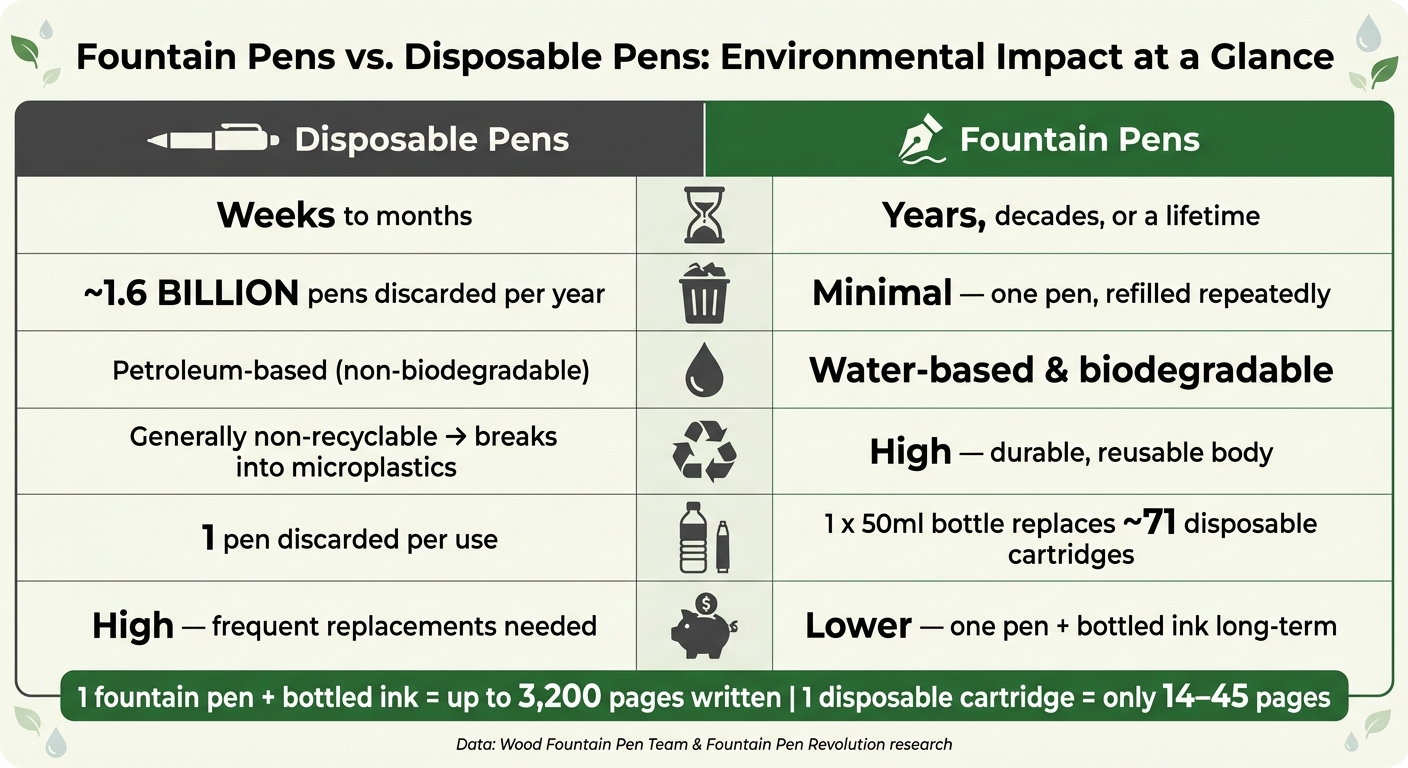
Fountain Pens vs. Disposable Pens: Environmental Impact at a Glance
The Environmental Impact of Disposable Pens
Materials and Energy Used to Make Disposable Pens
Disposable pens might seem small and harmless, but their production tells a different story. They are typically made from a combination of petroleum-based plastics, steel, and aluminum. Extracting and processing these raw materials require a significant amount of energy and release harmful greenhouse gases into the atmosphere. On top of that, the petroleum-based inks used in these pens add to their environmental toll.
"The extraction and processing of these materials [petroleum-based plastics and metals] lead to further environmental degradation and resource depletion." - Wood Fountain Pen Team
This heavy reliance on finite resources and energy sets the stage for a cascade of environmental issues, especially when these pens are discarded.
Waste and Pollution from Disposable Pens
The trouble with disposable pens doesn't end with their production. Their design - featuring plastic casings, metal clips, and ink cartridges - makes them difficult to recycle. Most end up in landfills, where they remain for centuries without breaking down completely.
"Once they are discarded, they sit in landfills for centuries, slowly breaking down into microplastics that pollute our soil and water." - Wood Fountain Pen Team
These microplastics don’t just stay put. Over time, they seep into the soil, contaminate waterways, and even enter the food chain, creating a long-lasting environmental hazard that’s tough to reverse.
Per-Unit Environmental Costs of Disposable Pens
While a single disposable pen might not seem like a big deal, the environmental cost quickly adds up when you consider the sheer volume used. In the United States alone, around 1.6 billion disposable pens are consumed and discarded every year. Each pen, though used for a short time, contributes to resource depletion, emissions, and waste that linger for generations. This staggering number underscores the need for more durable and sustainable writing tools to reduce the environmental burden. For those ready to switch, there are many affordable fountain pens for beginners that offer a high-quality writing experience without the waste.
sbb-itb-1dd4fe9
How Fountain Pen Longevity Reduces Environmental Impact
Durability and Long-Term Use of Fountain Pens
Disposable pens might be convenient, but they come with a hefty environmental cost. Fountain pens, on the other hand, provide a durable and sustainable alternative. These writing tools are designed to last for decades with proper care. Unlike their disposable counterparts, fountain pens allow for maintenance and repair - nibs can be swapped out, converters serviced, and even dried-out pens brought back to life with a little attention.
Toby Litt captures this perfectly:
"Refillable fountain pens are the most environmentally sustainable means of writing I know of... If of decent quality to begin with and looked after, they will outlast you."
This longevity shifts the equation entirely. Instead of frequently replacing pens, a single fountain pen can serve a lifetime, significantly cutting down on waste. Add to this the eco-friendly ink systems, and the environmental benefits become even more apparent.
The Environmental Case for Refillable Ink Systems
Fountain pens don’t just stand out for their durability; the way they’re refilled also makes a big difference. A single 50 ml bottle of ink can provide around 50 refills, translating to anywhere from 1,000 to 3,200 pages of writing, depending on the nib size. Compare that to a 0.7 ml disposable cartridge, which only lasts for 14 to 45 pages, and the impact is clear. Using refillable systems like converters or piston fillers eliminates the need for single-use plastic cartridges entirely.
Take piston-fill pens, for instance. A model like the TWSBI can hold enough ink to produce 20,000 to 25,000 words on just one fill. That’s a massive reduction in waste over time.
| Nib Size | Pages per 50 ml Bottle | Estimated Words |
|---|---|---|
| Fine | 3,214 | ~378,571 |
| Medium | 1,250 | ~165,000 |
| Broad | 1,000 | ~144,444 |
Source:
These refillable systems not only reduce waste but also make fountain pens a practical, eco-friendly choice for anyone looking to minimize their environmental footprint.
Affordable Fountain Pens as a Practical Eco-Friendly Choice
One common myth about fountain pens is that they’re expensive. While there are high-end options, entry-level pens prove you don’t need to break the bank to make an environmentally conscious switch. Many affordable models offer excellent performance and durability. As Hester Thomas, a verified user, points out:
"Inexpensive fountain pens can have excellent nibs, while the seriously expensive may not."
Brands like Fountain Pen Revolution provide budget-friendly options, with starter kits and calligraphy sets — including a pen, ink, and accessories — starting at just $35. For those seeking something a bit more advanced, premium models are available from $44. These accessible price points make it easier for anyone to transition away from disposable pens without a significant financial commitment.
In short, whether you choose a budget-friendly fountain pen or a more premium option, you’re investing in a tool that reduces waste and promotes sustainable writing habits. It’s a small change with a big impact.
Fountain Pens vs. Disposable Pens: A Side-by-Side Environmental Comparison
Key Metrics for Measuring Environmental Impact
When it comes to understanding the environmental toll of fountain pens versus disposable pens, a few critical factors stand out: waste generation, raw material usage, ink composition, recyclability, and overall carbon footprint.
Disposable pens are typically constructed from petroleum-based plastics that are not recyclable and eventually degrade into harmful microplastics. In contrast, fountain pens are crafted from durable, reusable materials and use water-based inks that are biodegradable. Disposable pens often add to the problem with their plastic-heavy blister packaging, while fountain pens rely on refillable ink bottles - one glass bottle can replace a significant number of single-use plastic cartridges.
"Fountain pens use pigment or dye ink with pure water as a solvent, which is not pollutive and is biodegradable." - Wood Fountain Pen Team
These differences highlight how fountain pens, by design, offer a more eco-conscious alternative. Their longevity and reuse potential further shift the environmental balance in their favor.
The Impact of Pen Lifespan on Environmental Costs
The lifespan of a pen plays a huge role in its environmental footprint. Disposable pens generate a steady stream of waste because they are used for a short time before being discarded. By contrast, a fountain pen can last for years - or even a lifetime - spreading out its manufacturing impact over decades of use. This longevity eliminates the need for constant replacements, significantly reducing waste and resource consumption.
Ink usage further amplifies this advantage. A single 50 ml bottle of fountain pen ink can provide around 71 cartridge refills or 25 piston filler refills. On the other hand, disposable cartridges, which hold just 0.7 ml of ink, only cover 14–45 pages before needing replacement. Some high-capacity fountain pen systems, like eyedropper pens, can hold up to 2.5 ml of ink and produce around 161 pages with a fine nib. This efficiency reduces both the frequency of refills and the associated waste, addressing many of the environmental concerns linked to disposable pens.
Comparison Table: Environmental Costs at a Glance
| Metric | Disposable Pens | Fountain Pens |
|---|---|---|
| Lifespan | Weeks to months | Years, decades, or a lifetime |
| Annual US Waste | ~1.6 billion pens discarded | Minimal - one pen, refilled repeatedly |
| Ink Type | Petroleum-based | Water-based, biodegradable |
| Recyclability | Generally non-recyclable | High - durable materials, reusable body |
| Plastic Waste per Refill | One pen per use | One bottle replaces ~71 cartridges |
| Material Use | Virgin plastics and metals | Metal, acrylic, wood, or recycled plastics |
| Packaging | Plastic blister packs | Glass ink bottles, minimal packaging |
The data makes one thing clear: fountain pens, with their long lifespan and refillable design, are a far more eco-friendly option compared to disposable pens. Over time, they significantly reduce waste and resource use, making them a smarter choice for those looking to minimize their environmental footprint.
How are fountain pens environmentally-friendly?
Practical Tips for Eco-Conscious Fountain Pen Users
Fountain pens already offer an eco-friendly alternative to disposable pens, but with a few thoughtful practices, you can extend their lifespan even further and reduce waste even more.
Cleaning, Repairs, and Maintenance to Extend Pen Life
Taking care of your fountain pen not only keeps it writing smoothly but also reduces the need for replacements, which helps cut down on waste. A well-maintained pen can replace dozens - if not hundreds - of disposable pens over its lifetime. The upkeep is simple: flush the nib and barrel with warm water at least once a month. This prevents ink buildup and clogging, keeping your pen in top shape and avoiding unnecessary damage.
If your pen develops an issue, like a bent nib or a worn-out seal, don’t toss it. Most fountain pen parts - like nibs, converters, or seals - are replaceable. A quick repair can often breathe new life into a pen that seems unusable. As Toby Litt aptly puts it:
"If of decent quality to begin with and looked after, they will outlast you unless you write Joyce Carol Oates amounts of words."
By focusing on regular cleaning and repairs, you can significantly extend the life of your pen and reduce waste.
Using Bottled Ink and Refillable Converters
Switching to bottled ink is one of the easiest ways to cut down on plastic waste. For example, one 50ml bottle of ink can replace 71 short cartridges (0.7ml each) or 34 long cartridges (1.45ml each). That’s a lot of single-use plastic you can avoid, and the glass bottle itself is recyclable.
Another way to maximize efficiency is by using a fine nib. fine nibs consume less ink per page compared to broader nibs, which means your ink lasts longer and you refill less often.
If your pen uses cartridges, consider switching to a refillable converter. This simple change allows you to use bottled ink and eliminates the need for disposable cartridges entirely. For even better efficiency, piston-filler pens or eyedropper conversions hold more ink per fill, meaning fewer refills and less waste over time.
Choosing Durable, Affordable Pens That Last
Durability and affordability are just as important as maintenance and ink efficiency. A pen doesn’t need to be expensive to last a long time. In fact, as writer Hester Thomas points out:
"When you buy a fountain pen, the most important part is the nib not the brand name. Inexpensive fountain pens can have excellent nibs, while the seriously expensive may not."
Look for pens that prioritize repairability and nib quality. Brands like Fountain Pen Revolution offer well-constructed pens starting at $29, with options that include converters for bottled ink. These pens are designed for long-term use and are an excellent choice for beginners who want a sustainable alternative to disposable pens.
Conclusion
Fountain pens stand out as a smarter choice for reducing plastic waste and conserving resources. Their durability and refillable design make them a more eco-friendly option compared to disposable pens.
As highlighted earlier, refillable ink systems and sturdy pen construction offer measurable environmental advantages. Plus, making the switch to fountain pens is not only environmentally conscious but also budget-friendly.
All you need is a reliable fountain pen, bottled ink, and a refillable converter to significantly cut down on pen-related waste. It's worth noting that nib quality often outweighs cost - affordable options can last just as long and perform just as well as high-end models when it comes to reducing waste.
FAQs
How long does a fountain pen need to last to be greener than disposables?
A fountain pen generally needs to be used for around 3 to 5 years to offset its impact compared to disposable pens. Its refillable design helps cut down on waste and reduces its carbon footprint over time, offering an eco-friendlier alternative.
Are fountain pen inks really biodegradable and safe for waterways?
Yes, most fountain pen inks are biodegradable and safer for waterways, especially those that are water-based or soy-based. These inks decompose naturally without introducing harmful chemicals, making them a more eco-friendly option.
What’s the easiest low-waste way to start using bottled ink?
The easiest way to reduce waste when using bottled ink is to switch to a refillable fountain pen equipped with a converter or a piston-filling system. These pens let you draw ink straight from a glass bottle, significantly reducing plastic waste. Pair your pen with environmentally-friendly ink, and you’ll have a more sustainable and budget-friendly writing option - no need for disposable cartridges.