

Twist and screw filler pens are fountain pens with unique mechanisms for drawing ink. The main types include piston fillers, screw converters, and vacuum fillers, each offering different ink capacities, maintenance needs, and travel suitability. Here's what you need to know:
- Filling Mechanisms: Piston fillers hold more ink but need more upkeep. Screw converters are easy to clean and replace. Vacuum fillers are leak-resistant and ideal for travelers.
- Ease of Use: Piston converters are simple to clean and refill, while vacuum fillers offer fast refills but are harder to maintain.
- Build Quality: Smooth, reliable mechanisms are crucial. Check for durable seals and easy servicing options.
- Ink Capacity: Choose based on your writing habits. Vacuum fillers hold the most ink, while piston converters are better for frequent ink changes.
- Nib and Writing Performance: Larger nibs consume more ink, making high-capacity pens a better match for broader nibs.
- Budget and Support: Pens range from under $40 for basic models to over $150 for luxury options. Check warranties and available replacement parts.
Quick Tip: Test the pen's balance and mechanism before buying, and inspect it for defects upon arrival.
| Price Range | What to Expect |
|---|---|
| Under $40 | Basic pistons, steel nibs, plastic bodies. |
| $40–$150 | Better materials, smoother mechanisms. |
| Over $150 | Premium finishes, gold nibs, brand prestige. |
This guide simplifies the process of finding a pen that aligns with your needs, ensuring smooth writing and easy maintenance.
TWSBI Fountain Pen Filling Video - Twist piston vs vacuum fill
sbb-itb-1dd4fe9
Evaluating the Filling Mechanism
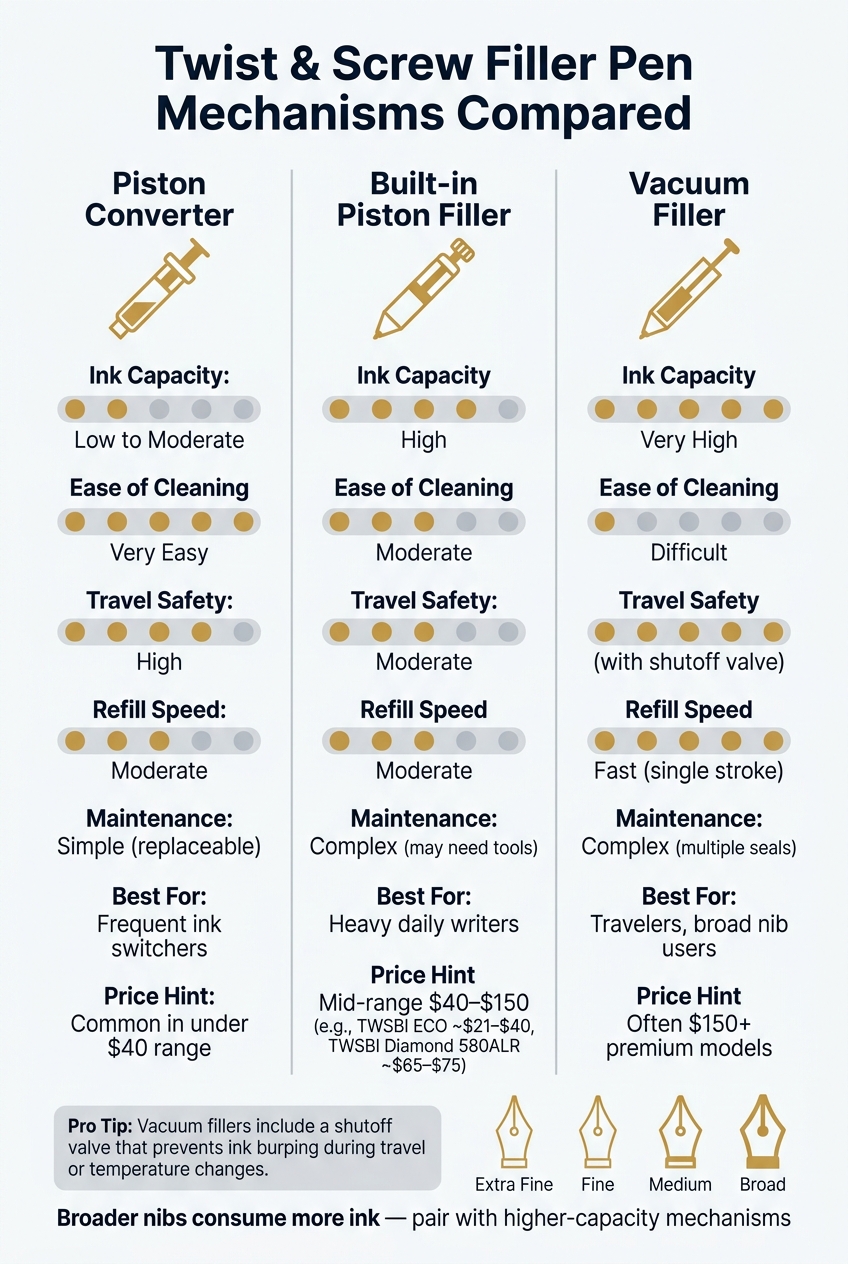
Twist & Screw Filler Pen Mechanisms Compared
Types of Filling Mechanisms and Their Features
Fountain pens come with different filling mechanisms, each offering its own set of advantages and trade-offs. Piston converters are detachable reservoirs with a twist-knob design, making them very easy to clean. On the other hand, built-in piston fillers and vacuum fillers hold more ink but require more effort to maintain. A feature that stands out for some users is the shutoff valve. Found in vacuum fillers and certain eyedropper pens, this valve physically separates the ink reservoir from the feed. Why does this matter? It prevents "burping" - a messy ink leak caused by air expanding due to heat or pressure changes. If you frequently carry your pen in a bag or travel by plane, this feature can be a game-changer.
| Feature | Piston Converter | Built-in Piston | Vacuum Filler |
|---|---|---|---|
| Ink Capacity | Low to Moderate | High | Very High |
| Ease of Cleaning | Very Easy | Moderate | Difficult |
| Travel Safety | High | Moderate | Excellent (with shutoff valve) |
| Refill Speed | Moderate | Moderate | Fast (single stroke) |
| Maintenance | Simple (replaceable) | Complex (may need tools) | Complex (multiple seals) |
When deciding, it’s important to think about how the refilling process of each mechanism fits into your daily routine.
Ease of Use and Refilling
All filling systems require you to dip the nib into an ink bottle, but they vary in how easy they are to clean and refill. Piston converters are the most convenient for quick cleaning since you can remove and rinse them separately. In contrast, built-in pistons and vacuum fillers require more effort, often involving several cleaning cycles. However, vacuum fillers shine in terms of refill speed - just one stroke draws in a full reservoir of ink. This speed comes at a cost: their intricate design makes thorough cleaning a bit of a headache.
If you like to switch ink colors often, a cartridge/converter (C/C) system with a good piston converter is your best bet. Being able to easily remove the converter for rinsing saves both time and frustration.
But it’s not just about practicality - how the twist mechanism feels in your hand can also influence your overall experience with the pen.
Build Quality and Durability
A high-quality twist mechanism should feel smooth and precise, without any grinding or slipping.
"The piston should move smoothly without grinding or sudden slipping." - Fountain Pens for Beginners
Over time, seals in built-in pistons and vacuum fillers can wear out, leading to ink flow issues or leaks. Fixing these problems often requires specialized tools or professional servicing.
"Pistons have seals that can wear; servicing can require tools or a technician." - Bottle and Plume
For those on a budget, pens in the $21–$40 range, like the TWSBI ECO, offer reliable piston systems that are easy to maintain. If you’re willing to spend a bit more, models like the TWSBI Diamond 580ALR (priced around $65–$75) feature sturdier materials and include tools for disassembly, making upkeep more straightforward. If you prefer a C/C pen, pay close attention to the converter's quality - an unreliable converter can ruin the experience, even if the nib itself is excellent.
"A great nib with a mediocre converter can still become 'that pen that always feels slightly off.'" - Bottle and Plume
Ultimately, the smoothness of the twist action is a key factor in ensuring your pen remains dependable over time.
Ink Capacity and Maintenance
Choosing the Right Ink Capacity
Once you've decided on a filling mechanism, it's time to think about ink capacity and how it matches your writing habits. Ink capacities vary widely: twist converters hold less ink compared to integrated piston fillers. If you write a lot, you'll want something with a larger capacity. Vacuum fillers are the heavyweight champions in this category, holding the most ink, while piston fillers offer a balanced option for everyday use. Keep in mind, though, that piston fillers only fill about half the barrel because the mechanism takes up space.
"Going from converter to piston/vac can feel like upgrading from a teacup to a canteen." - Bottle and Plume
And don't forget - how the filling system is designed will also impact how easy it is to clean and maintain.
Cleaning and Flushing the Pen
The cleaning process can vary quite a bit depending on the type of filling mechanism your pen uses. For integrated piston fillers, you'll need to repeatedly cycle clean water through the pen until the water runs clear. This can take a little longer compared to rinsing out a detachable converter.
For twist filler pens, you need to be extra careful to avoid damaging the internal rubber sac. Dirck de Lint offers a helpful reminder:
"Twist fillers will take it highly amiss if you crank them around in the same way as a piston. These pens work by wringing the sac to compress it, and too much wringing is always a bad thing." - Dirck de Lint
When cleaning a screw piston pen, it's a good idea to express a few drops of water from the feed after flushing. This helps clear out any leftover liquid and reduces the risk of leaks when you start writing again.
Long-Term Upkeep and Parts Availability
Maintenance doesn’t stop at cleaning - consider the durability and availability of replacement parts for your pen. Converters are straightforward to replace if the seal wears out, making them a low-maintenance option. On the other hand, integrated twist mechanisms can be trickier. These often rely on internal seals and rubber sacs that degrade over time, and finding compatible replacements can be a challenge - especially for pens that require proprietary parts.
For twist filler pens, pay close attention to how the knob rotates before attempting any servicing. Some vintage models use left-hand threads, which means you’ll need to turn the knob clockwise to fill. If there’s no directional arrow on the knob, apply light clockwise pressure first to test it. Once the mechanism is released, submerge the nib in ink for about ten seconds to ensure it fully reinflates.
Nib, Feed, and Writing Performance
Nib Options and Compatibility
In twist and screw filler pens, the nib and filling system are designed to work together for smooth performance. Most piston fillers come with a fixed nib unit, meaning the nib and feed are permanently attached to the pen's body. This setup allows manufacturers to fine-tune the nib for the specific needs of the pen's filling system.
Nib size plays a big role in how much ink you use. Broader nibs, like medium, broad, or stub nibs, tend to use up ink faster than finer nibs. If you prefer a broader nib, a twist piston or screw vacuum filler could be a good fit. These pens have larger ink reservoirs, which means fewer refills even with higher ink consumption.
Now, let’s look at how these designs influence ink flow and overall writing quality.
Ink Flow and Feed Performance
The feed, usually made from plastic or ebonite, sits under the nib and regulates how ink moves from the reservoir to the paper. In built-in piston systems, the large ink reservoir creates a steady pressure environment, ensuring smooth and consistent ink flow. This helps prevent the feed from running dry, even during long writing sessions.
"A large reservoir can support wetter writing without starving." - Bottle and Plume
Screw-operated vacuum fillers often feature a shutoff valve. This is a small knob at the back of the pen that you unscrew slightly when writing to allow ink to flow to the feed. If you forget to open the valve, the pen might write dry until it’s adjusted. Occasionally, worn or loose seals can let air into the feed, leading to skipping or uneven ink flow.
"A loose converter or slightly off seal can cause inconsistent flow (rare, but it happens)." - Bottle and Plume
Comfort and Balance While Writing
Apart from ink delivery, the pen’s weight and internal design also impact writing comfort. The mechanisms inside piston and vacuum fillers add extra components to the barrel, which can influence the pen’s weight and balance. For example, a pen with a brass piston assembly will feel heavier than one with a simpler cartridge system. While this added weight might not matter for quick notes, it can become noticeable during longer writing sessions like journaling or drafting.
It's a good idea to test the pen’s balance before buying. A pen with its weight centered near the grip will feel more comfortable for extended use compared to one that feels top-heavy or unbalanced. However, keep in mind that pens with large ink reservoirs can sometimes "burp" - this happens when the barrel warms from your hand, pushing a small amount of ink through the feed. This is more common with high-capacity pens and could lead to an unexpected ink drop during lengthy writing sessions.
Budget, Brand Support, and Final Checks
Price Range and Value
Twist and screw filler pens come in a wide range of prices, and understanding what each tier offers can help you make a smarter purchase. Just like filling mechanisms, the quality of these pens often aligns with their price.
- Under $40: Pens in this range typically feature steel nibs, plastic or basic metal bodies, and simple piston mechanisms. While they can write well, nib consistency and overall craftsmanship may vary. For example, Fountain Pen Revolution offers piston-filler pens priced between $15 and $35, making them a good option for beginners exploring twist fillers.
- $40–$150: This midrange is a sweet spot for many enthusiasts, balancing cost and quality. Pens in this category often feature better materials, more reliable pistons, and consistently tuned nibs. A 2023 poll from the r/fountainpens community revealed that most buyers prefer spending between $30 and $150, noting that beyond this range, improvements in writing performance tend to plateau.
- Over $150: At this level, you're paying for luxury touches like premium resins, gold vs steel nibs, and brand prestige. While these pens offer top-notch quality control, their writing performance may not significantly surpass that of a well-made midrange steel-nib pen.
| Price Tier | What to Expect |
|---|---|
| Under $40 | Steel nibs, plastic bodies, basic pistons; variable quality |
| $40–$150 | Better materials, consistent nib performance, smooth pistons |
| Over $150 | Premium materials, gold nibs, brand prestige, top QC |
Warranty and Brand Support
When buying a twist or screw filler pen, warranty coverage is just as important as the price. These pens rely on moving parts like pistons, seals, and threaded components, so knowing what’s covered can save you headaches later. Look into warranty duration and whether specific issues - like leaking pistons or broken internal rods - are included. For instance, Pelikan offers a 3-year warranty on many pens in their Souverän line, which is a good benchmark for premium brands.
Equally important is the accessibility of customer support. Choose brands or retailers that clearly explain their claims process, including details like repair timelines, return shipping responsibilities, and how nib defects are handled. Fountain Pen Revolution, for example, provides a 60-day guarantee on new pens and offers replacement parts, so a damaged nib or worn seal doesn’t mean replacing the entire pen.
Buying Logistics in the U.S.
For U.S. buyers shopping online, it’s worth considering practical details like shipping and return policies. Many retailers offer free shipping for orders over $35–$50, but it’s a good idea to double-check their return policies. For instance, some stores may charge restocking fees for non-defective returns or have different rules for inked versus un-inked pens. Delivery times within the continental U.S. generally range from 3–7 business days via carriers like USPS or UPS.
If you’re ordering internationally, you’ll need to account for longer transit times, possible customs delays, and the added complexity of international returns. Fountain Pen Revolution states: "If your pen has been inked and is without defect but you are unhappy with it contact us and we can discuss options."
Once your pen arrives, inspect it right away. Check for smooth operation and any visible defects. A good tip is to test it with water first to ensure there are no leaks before filling it with ink. Reviewing these details carefully can help you make a confident purchase.
Conclusion: Your Pen Buying Checklist
By now, you've explored the key aspects of purchasing a twist filler pen - everything from how the mechanism operates to aligning it with your budget. Here's a quick checklist to make sure you've covered all the bases.
Final Checklist for Buyers
- Filling mechanism: Confirm that the pen uses a twist-filler with a rubber tube mechanism. For vintage models, double-check the thread type, as some may require left-hand rotation.
- Ink capacity: Pick a pen with an ink reservoir that fits your writing needs. A larger capacity reduces refills but might leave ink unused if you frequently switch pens.
- Ease of use: Test if the filling knob automatically resets or if manual adjustment is needed. Older pens with high-friction mechanisms might require extra effort.
- Nib and feed: Choose a nib size that complements your writing style and ensures smooth, consistent ink flow without interruptions or overflows.
- Maintenance: Verify that replacement parts are available, particularly for pens with rubber tube mechanisms, to avoid future repair headaches.
- Budget and support: Make sure the pen fits within your budget and check the warranty and return policies before purchasing.
A well-chosen twist filler pen should feel effortless, dependable, and simple to care for.
FAQs
Which filler type is best for air travel?
Vacuum fillers are a great choice for air travel. Most come with a shut-off valve that seals the ink reservoir from the feed, helping to prevent leaks caused by changes in cabin pressure. For piston fillers or eyedropper pens, it's best to keep them either completely full or completely empty. This minimizes the amount of air inside the barrel, reducing the risk of leaks as the air expands during flights.
How can I tell if a piston feels 'smooth' enough?
A piston should glide smoothly, without any stiffness or gritty sensation during use. When you twist the knob, the movement should feel easy and fluid. If you experience resistance or a rough texture, it might be time for some maintenance. Try applying a small dab of silicone grease to the piston to bring back its smooth operation. Consistent care and occasional lubrication are key to keeping the mechanism reliable and ensuring steady ink flow.
What parts should I confirm are replaceable?
When shopping for pens with twist or screw fillers, it's a good idea to check if they have removable components like piston converters. These can be replaced when seals eventually wear out. Another feature to look for is pens with interchangeable nibs, which let you switch nib sizes or materials without needing to purchase an entirely new pen. Brands like Fountain Pen Revolution provide budget-friendly options that include these features, making it simpler to maintain and personalize your fountain pen collection.