

If you want a pen that looks cleaner longer, pick a matte, satin, brushed, or lightly textured body. In most cases, glossy dark finishes and clear bodies show marks fastest, even when the base material is the same.
Here’s the short version:
- Best at hiding scratches: matte ebonite, brushed metal, satin resin, satin ABS/polycarbonate
- Worst at hiding scratches: glossy resin, polished metal, glossy lacquer, clear acrylic
- Color matters: light and patterned finishes hide marks better than solid dark colors
- Wear shows first: posting area, cap edge, clip contact points, and section-to-barrel area
- Main rule: finish matters more than hardness for how scratched a pen looks day to day
A glossy black pen can show thin gray scratch lines after normal desk or pocket use. A matte or brushed pen often picks up wear too, but those marks blend into the surface instead of standing out.
Quick Comparison
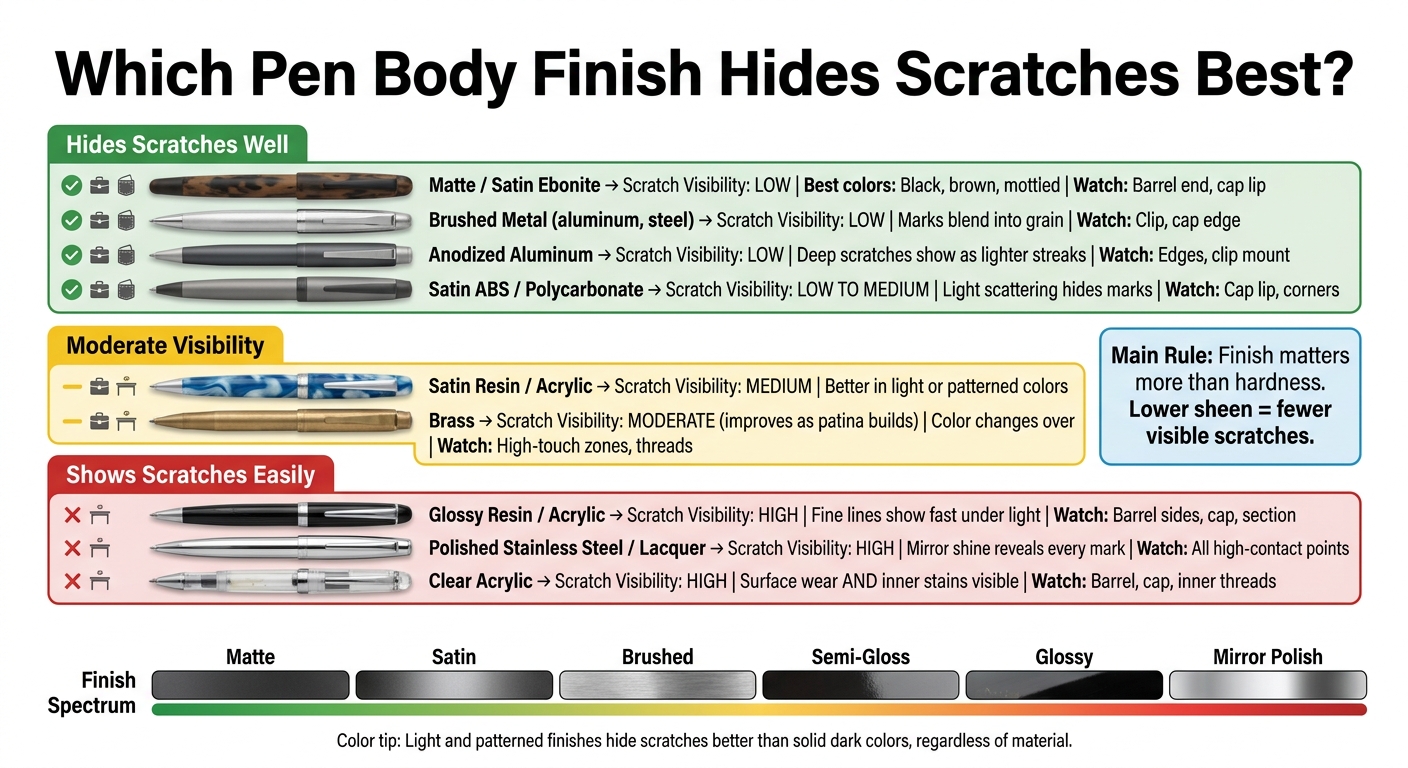
Pen Body Finishes: Scratch Visibility Ranked from Best to Worst
| Pen body type | How well it hides scratches | What to watch for |
|---|---|---|
| Matte/satin ebonite | High | Polished spots can show more wear |
| Brushed metal | High | Edge wear can still show |
| Satin ABS/polycarbonate | Medium to high | Corners and cap lip take hits first |
| Satin resin/acrylic | Medium | Better in light or patterned colors |
| Brass | Medium | Look changes as patina builds |
| Glossy resin/acrylic | Low | Fine lines show fast under light |
| Polished metal/lacquer | Low | Mirror shine makes every mark stand out |
| Clear acrylic | Low | Surface wear and inner stains are easy to see |
If I were buying for daily carry, I’d start with low-sheen finishes and lighter or patterned colors. That simple choice does more to hide wear than chasing one base material over another.
sbb-itb-1dd4fe9
Which Pen Materials Hide Scratches Best in Normal Use
When it comes to hiding scratches, finish matters more than hardness.
Ebonite: Low Scratch Visibility in Matte or Satin Finishes
Ebonite tends to hide wear well because it’s often made with a matte or satin finish. Small scratches usually blend into that surface texture instead of jumping out right away.
Polished ebonite is a different story. Like any glossy surface, it shows fine swirls and hairline marks much more easily. Light scratches from fingernails, clips, or the edge of a hard case can show up as thin lines that catch the light, especially around the cap and grip.
And that same idea applies to ebonite and acrylic pens, resin, and metal too: the finish often matters more than the base material.
Acrylic, Resin, ABS, and Polycarbonate: Gloss Level Changes Everything
Glossy acrylic and resin tend to show fine scratches early. The reason is simple: reflections make even small marks stand out. On glossy dark resin, this gets even more obvious, because the deep color and reflected light make each abrasion easier to see.
Textured ABS and polycarbonate do a better job hiding wear. Their surfaces scatter light, so minor marks from day-to-day handling don’t stand out as much. Patterned or marbled acrylic can also hide wear well, since the surface pattern pulls your eye away from any one scratch.
Metal Bodies: Brushed and Anodized Finishes vs. Polished Metal and Lacquer
With metal pens, the finish does most of the work. Brushed aluminum and stainless steel can hide light scratches well because those marks blend into the grain of the brushed surface. Everyday wear from rings, desk edges, or carrying the pen in a pocket often fades into that texture instead of showing up right away. Anodized aluminum adds a colored outer layer, but if a scratch goes deep enough to cut through it, the mark can show as a lighter streak against the color.
Polished metal and glossy lacquer are much less forgiving. Scratches show up fast because they interrupt the reflection. A small mark on a mirror-like surface is hard to miss, especially near the clip, cap band, and posting area where the pen gets the most contact.
Brass can hide fine scratches better once it starts to develop patina, though the tradeoff is that the color changes over time.
Color and surface texture can shift the pecking order again.
How Color, Texture, and Polish Affect Scratch Visibility
Dark Solid Colors vs. Light or Patterned Finishes
Color changes how easy it is to spot scratches, even when the pen is made from the same material.
Dark, even colors - especially black, deep navy, and dark burgundy - tend to show fine scratches much more clearly. The reason is simple: any small mark breaks the reflected light against that solid background. On glossy black pens, hairline scratches often show up as gray or white lines.
Light colors like white, cream, and pale gray do a better job of hiding fine scratches. They don't create the same sharp contrast, so those tiny marks blend in more.
Patterned and marbled bodies help even more. Swirled or cracked-ice acrylics, for example, add visual noise that helps mask fine surface wear. Because the surface already has variation, small scratches are less likely to stand out as clear lines.
Matte, Satin, Brushed, and Mirror-Polished Surfaces Compared
After color, finish is the next big factor.
Research using 3D optical analysis found that the same scratch can look very visible on a glossy sample, quite visible on a semi-gloss sample, and almost invisible on a matte sample with higher surface roughness. That lines up with what you see in day-to-day use. Matte, satin, and brushed surfaces scatter light in many directions, so a small scratch doesn't change the look of the surface much. Mirror-polished surfaces reflect light more directly, so even a tiny break becomes easy to notice.
Put plainly: lower sheen hides scratches better.
For daily carry, light or patterned colors paired with matte, satin, or brushed finishes do the best job of hiding micro-scratches from bags, desks, and regular handling, which is why it's important to clean and maintain your fountain pen to keep it looking its best. That's why the same material can look clean in one finish and worn in another.
Side-by-Side: Which Pen Body Looks Newer Longer
These tables make the finish and color guidelines easier to use when you're choosing a pen.
Comparison Table: Scratch Visibility by Material and Finish
| Material & Finish | Typical Texture | Scratch Visibility | Best Color Choices | Common Wear Points |
|---|---|---|---|---|
| Ebonite, matte or satin | Warm, low-sheen, lightly textured | Low | Black, brown, deep green, mottled | Barrel end from posting, cap lip, threads |
| Glossy acrylic or resin | Smooth, reflective | High | Swirled or patterned finishes instead of solid black | Barrel sides, cap, section, clip contact |
| Clear acrylic | Transparent, highly polished | High | No color choice helps; clarity shows every mark | Barrel, cap, inner threads, clip area |
| ABS or polycarbonate | Molded plastic, usually satin | Low to Medium | Solid matte blacks, grays, navy | Cap lip, corners, barrel ends |
| Anodized aluminum | Anodized, usually matte or satin | Low | Dark anodized tones, muted metallics | Edges, clip mounting hardware, barrel end |
| Brushed metal | Linear grain, satin | Low | Gunmetal, brushed silver, dark brushed finishes | Clip, cap edge, barrel end |
| Polished stainless steel | Mirror-like | High | Lighter or patterned finishes help slightly | All high-contact points, especially clip and cap |
| Brass | Solid metal, may patina with use | Moderate, then lower as patina develops | Bare brass or patina-friendly finishes | High-touch zones, cap edge, threads, grip area |
Use-Case Table: Office Carry, Pocket Carry, Posted Use, and Desk-Only Use
How you carry the pen matters just as much as the material. A pen that looks fine on a desk all week can pick up marks fast in a pocket or bag.
| Use Pattern | Bodies That Hide Wear Best | Bodies That Show Wear Fastest |
|---|---|---|
| Office carry | Matte or satin resin, brushed metal, anodized aluminum, ebonite | Glossy black resin, polished metal, lacquered finishes |
| Pocket carry | Textured ebonite, satin ABS/polycarbonate, brushed metal | Polished stainless steel, clear acrylic, glossy lacquer |
| Frequent posting | Ebonite, satin resin, brushed or anodized metal with good cap fit | Glossy resin, polished metal, lacquered bodies |
| Desk-only use | Matte and satin age most discreetly | Deep black mirror-polish, high-gloss acrylic, polished brass |
Frequent posting puts wear in one main spot: a ring on the barrel. If that kind of mark bugs you, this is worth paying attention to.
Buying Takeaways for Beginners and Daily Writers
For daily use, the safest pick is still a low-sheen body. It doesn't need babying, and small marks tend to blend in instead of jumping out at you.
Bottom line: Matte, satin, brushed, and lightly textured bodies hide scratches best; glossy and mirror-polished bodies show them fastest.
If you like glossy resin or polished metal for looks, that's still fine. Just keep the pen in a soft sleeve or case when it goes into a bag. That won't stop every mark, but it can cut down on abrasion. In plain terms, material and finish are still your best tools if you want a pen to look newer for longer.
Conclusion: The Best Pen Body for Fewer Visible Scratches
When it comes to how a pen looks over time, scratch visibility matters more than scratch resistance. A mirror-polished stainless steel pen may pick up wear at the same pace as other materials, but it tends to look more worn because every mark catches the light. Matte ebonite, on the other hand, can hide that same day-to-day wear much better.
Glossy dark finishes tend to show marks the most. That’s especially true around high-contact spots like the grip, clip, and cap, where small scratches build up faster and stand out more.
The safest picks are matte or satin ebonite, brushed metal, and satin-finish resin or acrylic in lighter or patterned colors. These finishes scatter light instead of bouncing it back in a sharp glare, so fresh scratches blend into the surface texture instead of jumping out at you.
For a daily carry pen, finish and color are your most useful tools. A matte or satin body in a lighter or patterned colorway will usually hide scratches better than a glossy solid-color option, no matter what the base material is. If you’re shopping Fountain Pen Revolution, look for terms like matte, satin, brushed, textured, or ebonite. It also helps to pick variegated or lighter colorways instead of solid glossy black.
FAQs
Do posted pens scratch faster?
Yes. Posting a pen by putting the cap on the back of the barrel can increase the chance of surface scratches.
When the cap slides onto the barrel, it creates friction. Over time, that friction may leave circular marks or tiny micro-scratches, especially on high-gloss acrylic or resin. The marks are usually surface-level, but they tend to stand out more on polished finishes.
Can a sleeve prevent surface scratches?
Yes. Keeping your pen in a soft-lined case helps prevent surface scratches and protects the finish from day-to-day wear.
This matters even more for resin or acrylic pens. A soft interior helps keep those glossy surfaces from rubbing against rough materials, dust, or small bits of debris that can leave fine scratches.
Which finish is best for pocket carry?
For pocket carry, pick a finish that hides scratches well. Your knife, pen, or lighter is going to rub against keys, coins, and whatever else ends up in your pocket. That daily friction adds up fast.
High-gloss finishes tend to show fine scratches much more easily. The upside is that acrylic can be polished, so you can bring back its shine if it starts to look scuffed.
Plain urushi lacquer is a smart pick for daily carry. It’s durable, smooth, and wears well with regular use. On the other hand, raised-pattern finishes like Taka Maki-e are more likely to show wear over time.