

Oversized fountain pens are more than just writing tools - they're built for comfort, style, and performance. But the filling system you choose, piston or cartridge/converter, can significantly impact how the pen feels and functions.
Key Takeaways:
- Piston Fillers: Higher ink capacity (1.2–2.5 ml), ideal for long writing sessions. However, they require more maintenance and cleaning.
- Cartridge/Converter Systems: Easier to clean and maintain, with the flexibility to switch inks quickly. But they hold less ink (0.5–1.1 ml on average).
Quick Comparison Table:
| Feature | Piston-Filling System | Cartridge/Converter System |
|---|---|---|
| Ink Capacity | 1.2 ml – 2.5 ml | 0.5 ml – 1.1 ml |
| Cleaning | Time-consuming | Quick and easy |
| Portability | Requires ink bottles | Travel-friendly cartridges |
| Durability | Built to last | Converters may wear out |
| Weight | Heavier | Lightweight |
If you write for long periods and need high ink capacity, piston fillers are a solid choice. For ease of use and frequent ink changes, cartridge/converter systems are more practical. Affordable options like TWSBI ($32) and Pilot Metropolitan make it easy to try both systems before investing in a premium pen.
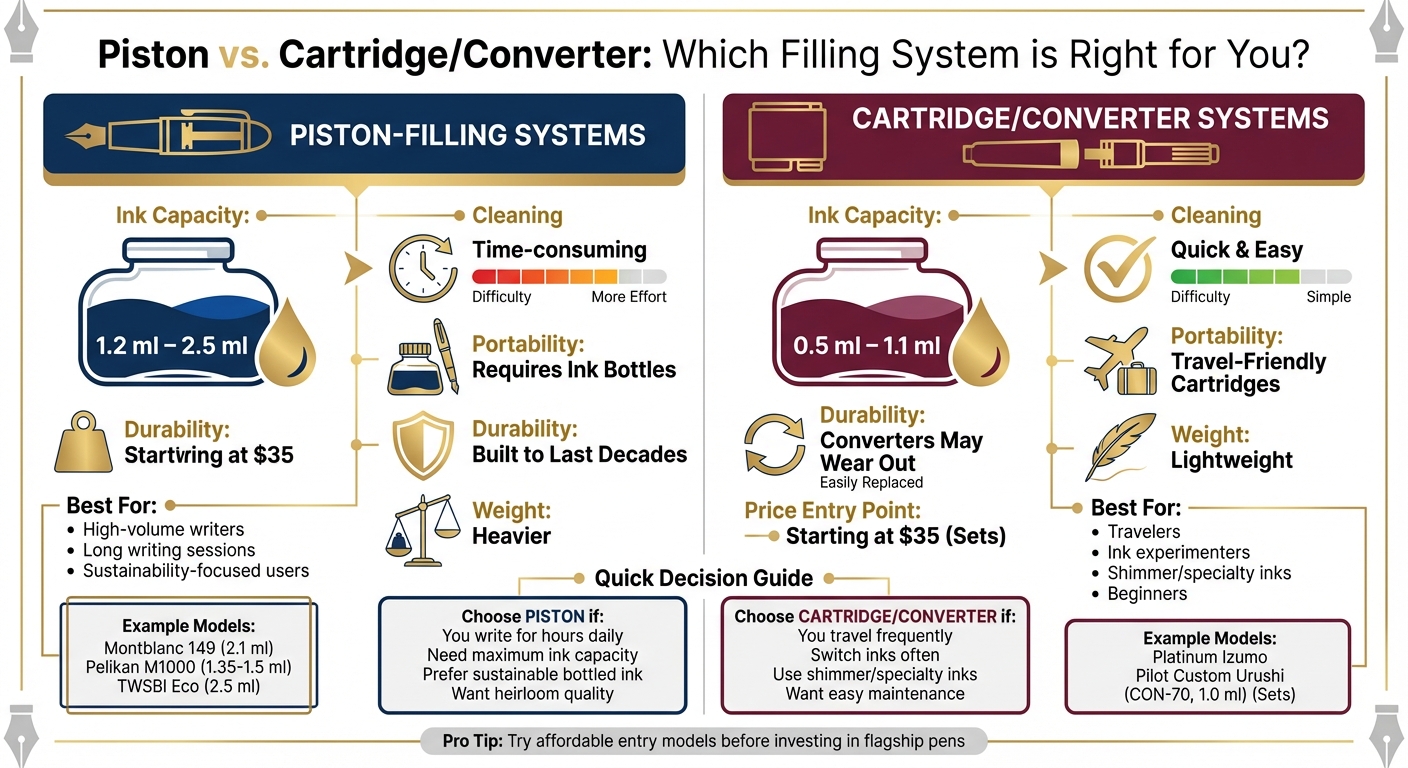
Piston vs Cartridge Fountain Pen Systems Comparison
Piston-Filling Systems in Oversized Pens
How Piston Mechanisms Work
A piston-filler operates much like a syringe. By twisting the knob at the end of the pen's barrel, a plunger moves forward to push out air and then creates a vacuum to draw ink through the nib and feed.
What sets piston-fillers apart is that the barrel itself doubles as the ink reservoir. There’s no need for a removable cartridge or converter - ink is stored directly in the pen body. This design traces back to early advancements in piston mechanisms.
Top-tier models like the Montblanc Meisterstück 149 and the Pelikan Souverän M1000 highlight this system's elegance. The 149 measures about 5.7 inches when closed and 6.9 inches when posted, while the M1000 has similar dimensions, with a barrel diameter of roughly 0.6 inches. Many oversized piston pens include features like translucent ink windows or striped barrels, allowing users to check ink levels without taking the pen apart. This thoughtful design boosts both ink capacity and durability.
Benefits of Piston Systems in Large Pens
Piston fillers hold significantly more ink than cartridges - typically between 1.2 ml and 2.1 ml, compared to the 0.7 ml capacity of standard international cartridges. For example, the Pelikan M1000 offers an ink capacity of about 1.35 ml to 1.5 ml.
This larger capacity pairs perfectly with the wet-writing nibs often found on oversized pens. The M1000, known for having the largest nib in Pelikan's lineup, is celebrated for its smooth and generous ink flow.
"When you buy Pelikan, you get wide and wet nibs and the M1000 embodies that characterization", says Joshua, Editor at The Pelikan's Perch.
Additionally, piston mechanisms are built into the pen's structure, often using brass components that add a premium feel and extra durability. These pens are designed to last for decades, and since they exclusively use bottled ink, there's no waste from disposable cartridges.
However, these benefits come with some additional upkeep requirements.
Drawbacks and Maintenance of Piston Fillers
Caring for a piston-filler pen takes more effort than maintaining a cartridge-based system. Instead of simply swapping out a cartridge, you’ll need to refill the pen with bottled ink, which can be messier and more time-consuming. Cleaning involves repeatedly drawing in and expelling water until the ink residue is gone, as most piston systems aren’t designed for easy disassembly.
Over time, the piston seal can stiffen or start leaking. Some users of Montblanc 146 and 149 models have reported ink seeping into the turning knob area after prolonged use. To keep the mechanism running smoothly, it’s recommended to apply 100% silicone grease to the barrel interior every three years.
Certain pens, like some Pelikan models, feature removable nib assemblies, making thorough cleaning easier. But if leaks develop around the piston knob, professional repair may be needed to replace the seals. With the Pelikan M1000 priced between $475 and $550 (around €730), regular maintenance is crucial to protect such a valuable investment.
Cartridge/Converter Systems in Oversized Pens
How Cartridge/Converter Mechanisms Work
Cartridge and converter systems provide a removable solution for ink storage. A cartridge is a disposable, pre-filled tube of ink, while a converter is a refillable reservoir that allows you to draw ink directly from a bottle.
Many high-end pens rely on proprietary systems rather than the standard international format. For instance, brands like Pilot, Platinum, and Sailor design their own cartridges and converters. The Pilot Custom Urushi, for example, uses the CON-70 - a push-button vacuum converter with a capacity of about 1.0 ml. Similarly, the Platinum Izumo is paired with Platinum's proprietary system.
These systems are designed for easy cleaning, as the nib and feed can be fully disassembled and flushed with a bulb syringe. This flexibility makes it convenient to switch between cartridges while traveling and converters at home, where you have access to a wider range of bottled inks.
This setup offers a unique combination of convenience and versatility, but it also invites comparisons to the piston-filler mechanism in terms of benefits and limitations.
Benefits of Cartridge/Converter Systems in Large Pens
The design of cartridge/converter systems brings several advantages:
- Versatility: Cartridges are perfect for travel, offering a leak-resistant, pre-filled option, while converters let you explore a wide variety of bottled inks at home.
- Ease of Maintenance: The modular design allows for quick disassembly, making cleaning straightforward.
- Affordable Repairs: If a converter wears out or breaks, replacing it is both inexpensive and hassle-free.
This combination of adaptability and simplicity is why many users gravitate toward cartridge/converter systems.
Drawbacks of Cartridge/Converter Systems in Large Pens
Despite their benefits, these systems have some notable downsides:
- Limited Ink Capacity: Cartridge/converter systems typically hold less ink - usually under 1 ml - compared to the 1.2–2.5 ml capacity of piston-fillers. Even the higher-capacity Pilot CON-70 converter, which holds about 1.1 ml, falls short of most piston-fillers. This limitation becomes especially noticeable with nibs like Music or Double Broad, which consume ink quickly during extended use.
- Proprietary Design: Brands like Pilot, Platinum, and Sailor require brand-specific converters, limiting compatibility and interchangeability.
- Restricted Ink Variety: Using cartridges confines you to the colors offered by the manufacturer, often excluding boutique, shimmer, or archival inks.
For those who want more flexibility, there's a workaround: refilling empty cartridges with a blunt-tip syringe. This allows you to enjoy the convenience of cartridges while still using bottled inks of your choice.
Here’s a quick comparison of key features:
| Feature | Cartridge/Converter | Piston-Filler |
|---|---|---|
| Ink Capacity | 0.5 ml – 1.1 ml | 1.2 ml – 2.5 ml |
| Cleaning | Quick module removal | Requires cycling ink |
| Travel | Pre-filled, leak-resistant | Requires ink bottles |
| Maintenance | Inexpensive, replaceable | May need professional repair |
While cartridge/converter systems may not match the ink capacity of piston-fillers, their ease of use and adaptability continue to make them a popular choice for many pen enthusiasts.
Piston vs. Cartridge: Direct Comparison
Ink Capacity and Flow
One of the biggest differences between piston fillers and cartridge/converter systems is how much ink they can hold. Piston fillers use the entire barrel of the pen as an ink reservoir, typically holding between 1.2 ml and 2.5 ml of ink. For example, the Montblanc 149 holds about 2.1 ml, while the TWSBI Eco can hold up to 2.5 ml. On the other hand, standard converters generally hold less than 1 ml.
This larger capacity in piston fillers supports longer writing sessions without needing a refill. However, cartridge/converter systems have an edge when it comes to using inks with heavy saturation or shimmer. These types of inks can be tricky to clean out of piston mechanisms, making cartridges and converters a more practical choice for frequent ink changes.
The difference in ink capacity also impacts the pen's handling and balance, which can influence the overall writing experience.
Weight, Balance, and Comfort
Piston fillers are heavier due to their internal mechanisms, which include plungers, gaskets, and rods. This added weight gives the pen a distinct balance compared to the lighter, more portable cartridge/converter pens. Vacuum fillers are even heavier, as noted by Unsharpen:
"The steel interior rod adds a lot of weight to the overall pen body."
For those who write for long periods, the higher ink capacity of piston fillers means fewer interruptions. As The Gentleman Stationer explains:
"Piston fillers and vacuum filler fountain pens can easily hold up to 2ml of ink per fill... For me, that means I'm good to go for at least two full days of writing."
While the added weight may not suit everyone, it can provide a more balanced feel for users who prefer a heftier pen.
Maintenance and Long-Term Use
Maintenance is another key area where these systems differ. Cartridge/converter pens are much easier to clean. Their modular design allows for quick disassembly, and tools like a bulb syringe or simple soaking can make cleaning a breeze.
Piston fillers, on the other hand, often cannot be taken apart for cleaning. As Gemma Plumbridge from Pen Heaven points out:
"Many [piston fillers] can't be disassembled so you'll be repeatedly cycling water to get a thorough clean."
This can make cleaning more time-consuming, especially when switching between different ink colors.
When it comes to durability, piston systems tend to hold up better over time. According to The Gentleman Stationer:
"A piston or vacuum filling system is typically built to withstand the test of time, whereas I've had converters wear out or break in less than a year."
Although converters are easy and inexpensive to replace, a damaged piston mechanism may require professional repairs. This makes piston fillers a more durable but potentially higher-maintenance option in the long run.
| Feature | Cartridge/Converter | Piston-Filling System |
|---|---|---|
| Typical Capacity | 0.4 ml – 0.9 ml | 1.2 ml – 2.5 ml |
| Cleaning Ease | High (bulb syringe method) | Low (requires multiple cycles) |
| Travel Utility | High (portable cartridges) | Low (requires ink bottles) |
| Durability | Converters can wear out; easily replaced | Built for longevity |
| Weight | Lightweight | Heavier (integrated parts) |
| Best For | Shimmer inks, frequent color changes | High-volume writing sessions |
sbb-itb-1dd4fe9
Choosing the Right Filling System
When to Choose Piston-Filling Systems
Piston fillers are a great fit for those who write a lot and need their pen to go the distance. With an ink capacity of about 2 ml, these pens allow for long writing sessions without frequent refills. If you're someone who spends hours writing daily, a piston-filling pen can be a reliable companion.
Another reason to consider piston fillers is their focus on sustainability. Since they work exclusively with bottled ink, you can avoid disposable plastic cartridges altogether. Plus, these pens often have a heft and refined feel that can elevate the writing experience. However, keep in mind that this weight and design may not appeal to everyone.
When to Choose Cartridge/Converter Systems
If convenience and flexibility are your priorities, cartridge and converter systems might be a better option. These pens are particularly well-suited for writers who enjoy experimenting with different types of ink. As The Gentleman Stationer explains:
"If you enjoy using highly saturated or shimmer inks that might stain or otherwise be hard to clean out of a pen, cartridge/converter pens are typically the way to go."
Cartridges are easy to use, portable, and perfect for travel. Their lightweight design also makes them an excellent choice for beginners who are just getting into fountain pens.
Affordable Options for Testing Both Systems
If you're unsure which filling system suits you best, there are affordable ways to try both before making a bigger investment.
For those curious about piston fillers, TWSBI offers models starting at around $32, giving you a chance to experience high-capacity pens without breaking the bank. On the other hand, entry-level cartridge pens like the Pilot Metropolitan are budget-friendly and widely available.
For even more versatility, Fountain Pen Revolution provides affordable sets starting at $35, allowing you to experiment with both systems. If you're interested in handmade options, their premium models start at $44. These entry-level choices are a great stepping stone toward understanding your preferences and potentially upgrading to high-end flagship pens later.
Fountain Pen Filling Mechanisms: Cartridge-Converter | Piston | Lever Filler | Crescent | Button
Conclusion
After examining the differences between piston-filling and cartridge/converter systems in oversized flagship pens, the choice ultimately depends on what matters most to you as a writer. Piston fillers, with their impressive ink capacities of up to 2 ml or more, are ideal for those who write for long stretches or prefer a refill system that's more sustainable. On the other hand, cartridge/converter systems shine when it comes to convenience and versatility - especially for travelers or anyone who frequently switches between specialty inks that require regular cleaning.
If you enjoy the tactile experience of a well-crafted flagship pen and spend hours writing each day, a piston filler might feel more rewarding. But if ease of maintenance and portability are higher on your list, a cartridge/converter pen could be the smarter choice.
The good news? You don’t have to dive straight into a high-end model to figure out what works for you. Affordable options let you test the waters without breaking the bank. Entry-level piston fillers start at around $32, and cartridge pens are often available for even less. Companies like Fountain Pen Revolution offer starter sets for as little as $35, giving you a budget-friendly way to explore both systems before committing to a premium pen. Take some time to reflect on your writing habits, and you’ll find the filling system that truly enhances your experience.
FAQs
What’s the difference in maintenance between piston fillers and cartridge/converter pens?
The key difference between these systems lies in the level of maintenance they require. Piston fillers come with an integrated ink reservoir within the barrel. Cleaning them involves repeatedly flushing water or a cleaning solution through the nib and piston chamber until the liquid runs clear. Additionally, the piston mechanism may occasionally need lubrication to keep the seals functioning properly. While piston fillers can hold more ink and don't need cleaning as frequently, the process is more time-consuming when it’s necessary.
On the other hand, cartridge pens are much simpler to care for. Once a cartridge is empty, you just replace it. If you’re switching ink colors or dealing with a leak, cleaning is straightforward - just rinse or soak the nib and feed since there’s no built-in reservoir to worry about. Converters, which act as reusable cartridges with a small piston mechanism, also require periodic flushing. They might need light cleaning of the seals and interior, but they’re easy to remove and clean separately from the pen.
In essence, piston fillers involve more in-depth maintenance, while cartridge and converter systems are quicker and easier to clean.
What impact does ink capacity have on writing with oversized pens?
Ink capacity is a key factor when it comes to using oversized pens. Piston-fill pens, for instance, can hold 1.2 to 2.5 ml of ink, which is significantly more than the 0.7 to 1.5 ml found in most cartridge or converter systems. This larger capacity means fewer interruptions for refilling, making them perfect for long writing sessions like journaling or taking extensive notes.
A bigger ink reservoir also ensures a steadier ink flow and consistent line quality over time. However, it’s worth noting that the added ink increases the pen's weight, which can impact its balance. Interestingly, many writers appreciate this extra weight, as it gives the pen a solid and comfortable feel, helping to reduce hand fatigue during extended use. Plus, with such a generous ink supply, the pen can stay ready for weeks, sparing you the hassle of carrying extra cartridges or converters.
What filling system is best if I frequently change ink colors?
If you're someone who frequently changes ink colors, a cartridge or cartridge-converter system might be your best bet. These systems are designed to make swapping ink a breeze - just pop in a new cartridge or rinse out the converter. It's quick, clean, and doesn't require much effort.
This setup is perfect for anyone who loves trying out different inks or needs to switch colors often, whether for professional tasks or creative endeavors.