

Journaling with fountain pens transforms writing into a mindful and enjoyable experience. These pens offer smooth ink flow, a comfortable grip, and a variety of ink colors, making them ideal for long writing sessions. If you're new to fountain pens, start with an affordable pen like the Pilot Metropolitan or Platinum Preppy, pair it with fountain pen-friendly paper, and choose dye-based inks for vibrant results.
Key tips for beginners:
- Choose a fine or extra-fine nib for better control.
- Use paper with 80–100 gsm to avoid ink bleeding.
- Practice holding the pen lightly at a 45°–55° angle.
- Clean your pen every 4–8 weeks to maintain performance.
Start small with simple journaling methods like gratitude lists or daily logs. Consistency is key - set aside 15 minutes a day and keep your tools organized. With proper care and practice, fountain pens can make journaling a relaxing and rewarding habit.
SUPER SIMPLE JOURNAL SETUP FOR BEGINNERS + Refill Fountain Pen (messy)
Choosing Your First Fountain Pen Setup
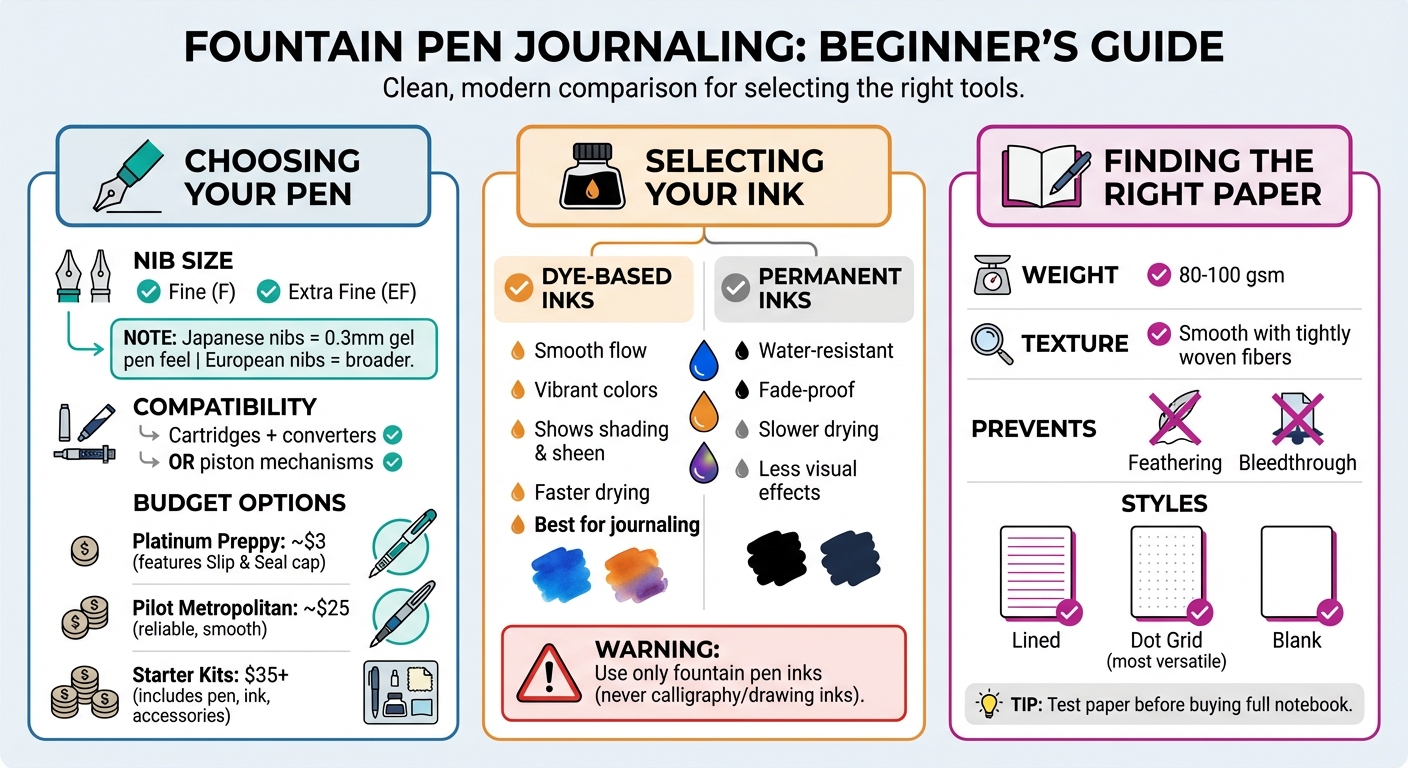
Fountain Pen Journaling Setup Guide: Pen, Ink, and Paper Comparison
Getting started with fountain pens involves three key components: the pen, the ink, and the paper. Each plays a role in ensuring a smooth writing experience without issues like ink bleeding or scratchy nibs. Here's how to select the right tools to kick off your journaling journey.
Picking a Beginner Fountain Pen
For beginners, it's best to start with a Fine (F) or Extra Fine (EF) nib, as these help minimize ink bleed and feathering on most papers. Japanese Fine nibs, like those on the Pilot Metropolitan, are known for their precision and feel similar to a 0.3mm gel pen. European nibs tend to be broader, so keep that in mind when choosing.
Look for pens that are compatible with cartridges and converters or have built-in piston mechanisms. This flexibility gives you access to a wide range of bottled ink colors. Affordable options include the Platinum Preppy (around $3), which features a "Slip and Seal" cap to keep the nib from drying out, and the Pilot Metropolitan (approximately $25), a favorite for its reliability and smooth writing.
If you'd rather skip the hassle of assembling your own setup, check out starter kits like those offered by Fountain Pen Revolution. These bundles, starting at $35, include a pen, ink, and accessories - perfect for beginners who want a no-fuss introduction to fountain pens.
Selecting Ink for Your Journal
Fountain pen inks generally come in two types: dye-based and permanent. Dye-based inks are known for their smooth flow and vibrant colors, often with shading (color variation within a stroke) or sheen (a metallic-like finish). Permanent inks, on the other hand, are water-resistant and fade-proof but tend to dry slower and lack the same visual effects.
For journaling, dye-based inks are a popular choice because they dry faster and create expressive, colorful lines. Your ink color is a personal preference - some prefer classic black or blue for clarity, while others use a variety of colors to categorize entries or match their mood. Keep in mind that fountain pen paper is less absorbent than regular paper, so while the ink takes longer to dry, it produces sharper lines.
Stick to inks made specifically for fountain pens. Calligraphy or drawing inks often contain particles that can clog your pen and damage it. Fountain Pen Revolution also offers a range of inks designed to pair seamlessly with their pens, ensuring compatibility and ease of use.
Finding the Right Paper
To avoid issues like feathering (when ink spreads out) or bleedthrough (when ink seeps through the page), opt for smooth, heavy paper in the range of 80–100 gsm. Fountain pen-friendly paper has tightly woven fibers that keep your writing crisp and legible.
Before committing to a full notebook, test the paper with your pen and ink combination. Write a few lines, flip the page, and check for bleedthrough. Run your finger gently over the ink to see how long it takes to dry - this will give you a sense of how the paper handles your setup.
When it comes to notebook styles, you can choose from lined, dot grid, or blank pages. Dot grid notebooks are particularly versatile, offering subtle guidance for writing or sketching without overwhelming the page.
Once you've chosen your pen, ink, and paper, you're all set to dive into the next step - learning how to use and care for your fountain pen properly.
Setting Up and Using Your Fountain Pen
Getting started with your fountain pen is a satisfying process. With the right setup and technique, you can avoid spills and enjoy a consistent writing experience.
Filling Your Pen with Ink
Start by setting up a clean workspace - paper towels are a must for easy cleanup. The way you fill your pen depends on its design.
- Cartridge Systems: Unscrew the barrel, insert the cartridge until you hear a click, and if the ink doesn’t flow immediately, give the cartridge a gentle squeeze to get things started.
- Converters: Submerge the nib into the ink, making sure the breather hole is covered, and twist the piston knob to draw ink into the reservoir. Covering the breather hole is key - it prevents a vacuum from forming, which could disrupt ink flow. Once filled, use a lint-free cloth to wipe off any excess ink from the nib and grip.
Once your pen is ready, it’s time to focus on how to hold it properly for smooth and effortless writing.
How to Hold and Position Your Pen
Fountain pens work best with a light touch. Use a tripod grip - rest the pen between your thumb and index finger while letting it sit comfortably on your middle finger. Unlike ballpoint pens, fountain pens require minimal pressure; pressing too hard can disrupt the ink flow and even damage the nib.
For the best results, hold the pen at an angle between 45° and 55°, with the engraved side facing up. This ensures you’re writing with the nib’s "sweet spot." Avoid rotating the pen as you write - this can cause the tines to lose contact with the paper, leading to skips or scratches. Instead of using just your fingers, guide the pen with your forearm and shoulder for smoother, more fluid strokes.
With these steps, you'll be well on your way to mastering your fountain pen and enjoying its elegant writing experience.
sbb-itb-1dd4fe9
Building a Regular Journaling Practice
Want to get into journaling? The trick to sticking with it is finding a method that feels natural and fits seamlessly into your daily life.
Picking a Journaling Method
The best journaling method is the one you’ll actually do. For instance, gratitude journaling is an easy and rewarding way to start. Each day, jot down something you’re thankful for using a simple format like, "I am thankful for ______ because ______." To keep things fresh, switch up your focus - one day, write about a person, the next about a skill, an experience, or even an object that made your day better.
If you’re drawn to the artistry of fountain pens, ink journaling might be your thing. This involves noting details like the ink’s color or properties and the pen you used. Not only does this give you a handy reference for future writing setups, but it also turns your journal into a creative catalog.
Another option? A straightforward daily log. Use it to capture small events, practice your handwriting, or even experiment with sketches or watercolor accents. The goal isn’t to create a flawless masterpiece - it’s to make your journal useful. As Adrianne from The Goulet Pen Company wisely says:
Perfection is not the goal, usefulness is. No matter if you do this first thing with a new pen and ink... find what works for you and what is fun.
Once you’ve picked a method, the next step is building it into your routine.
Making Journaling a Habit
Consistency is key when it comes to journaling. Carve out a specific time each day - whether it’s a quiet moment in the morning to reflect on gratitude or a calming session at night to unwind. Rachel Goulet from The Goulet Pen Company suggests:
New habits require discipline until it becomes routine. Set a fixed daily writing time.
Start with just 15 minutes and a few sentences. Keep your pen and accessories in plain sight - an organized setup, like those available from Fountain Pen Revolution, can make all the difference. Pair your journaling with something relaxing, like soft music or a favorite TV show, to make it more enjoyable. And if you miss a day? No big deal. Just pick up where you left off and keep going.
Caring for Your Fountain Pen
Keeping your fountain pen in top shape requires regular maintenance. A simple cleaning routine - using water, a towel, and a bulb syringe - can ensure it writes smoothly and consistently.
Basic Cleaning Steps
Start by taking your pen apart and removing the ink cartridge or converter. Flush the nib section with room-temperature water until the water runs clear. Using only room-temperature water is key to protecting the pen's internal components. For a deeper clean, a bulb syringe or the converter can help push water through the nib and feed until all ink residue is gone. If stubborn ink remains, soaking the parts for several hours or overnight can help.
After rinsing, place the parts on a lint-free cloth or paper towel with the nib facing down, allowing them to air dry completely. Let them dry overnight before reassembling your pen.
Daniel Whitehouse, CEO of Dayspring Pens, likens the process to a daily ritual:
"Cleaning a fountain pen can be kind of like making coffee in the morning. You go through a number of steps... and there's a satisfying feeling at every stage."
How often should you clean? A deep clean every 4 to 8 weeks is ideal, even if your pen seems to be working fine. For daily users, a quick rinse with water each week will do. Always clean your pen thoroughly when switching ink colors to prevent muddy mixtures. If you use inks like shimmer or iron gall, consider a weekly cleaning to avoid buildup.
These simple steps not only extend your pen's lifespan but also help prevent common problems.
Fixing Common Problems
Proper cleaning can resolve or even prevent many fountain pen issues. For instance, if your pen skips or the ink flow is inconsistent, a quick flush with room-temperature water often does the trick. If the nib feels scratchy, try gently cleaning it with a soft cloth or performing another rinse.
For more stubborn clogs, soaking the nib in a 10:1 water-to-ammonia solution can help, but avoid this method for pens with aluminum, brass, or copper parts.
Ink bleedthrough might mean your pen needs cleaning or that the paper you're using isn’t suitable for fountain pens. To prevent ink pooling or leaking into the cap, store your pens horizontally or with the nib pointing up.
To enhance your maintenance routine, consider affordable accessories and replacement nibs from Fountain Pen Revolution. And don’t forget - using your pen regularly is one of the simplest ways to keep it in good condition. Regular use helps maintain ink flow and prevents the ink from drying out.
Conclusion
Fountain pen journaling begins with a few simple steps: choose an affordable beginner pen, pair it with high-quality, bleed-resistant paper, maintain a comfortable 45–55° grip, and make writing a regular habit. The magic of this practice isn’t about achieving perfection - it’s about savoring the tactile, mindful joy that comes with putting pen to paper.
As Brian Goulet, Founder of The Goulet Pen Company, wisely says:
What really matters is that you enjoy the process and feel comfortable while you write.
Using a fountain pen elevates journaling from a mundane task to a soothing ritual. The smooth glide of the nib turns each stroke into a moment of quiet reflection - a rare and valuable pause in today’s fast-paced, digital world.
Getting started doesn’t have to break the bank. Companies like Fountain Pen Revolution offer beginner-friendly sets starting at $35, with premium options from $44. Their wide range of nibs, inks, and accessories allows you to build your collection gradually, tailoring your setup to fit your personal writing style.
FAQs
What makes fountain pens a great choice for journaling?
Fountain pens bring a whole new level of enjoyment to journaling by offering an incredibly smooth and effortless writing experience. Unlike ballpoint or gel pens, they glide across the page with minimal pressure, which means less strain on your hand and the ability to write comfortably for longer stretches. Plus, the way the ink flows and the subtle variations in line thickness from different nib sizes add a refined and personal touch to your handwriting, making every journal entry feel a bit more special.
These pens also encourage a slower, more thoughtful writing process, allowing you to truly immerse yourself in your thoughts. With their refillable designs and sturdy build, fountain pens are not only long-lasting but also a more budget-friendly choice over time - starter pens can often be found in the $15–$20 range. Combine your pen with quality paper and a selection of ink colors, and you can turn each journal page into a creative and meaningful expression of yourself.
How do I clean and take care of my fountain pen?
Keeping your fountain pen clean and in good condition is the key to smooth writing and long-term performance. Start by carefully disassembling the pen - remove the cap, barrel, and any cartridge or converter. Rinse the nib and feed under lukewarm water until the water runs clear. For stubborn ink residue, a mild pen-flush solution can help. When cleaning the barrel and converter, flush them repeatedly with water until no ink remains. Once all parts are clean, dry them thoroughly using a lint-free cloth and allow them to air-dry for about 10–15 minutes before reassembling.
Make it a habit to clean your pen every 4–8 weeks or whenever you switch ink colors. Proper storage is just as important - keep your pen upright with the nib pointing up or store it in a pen case to avoid leaks. If you’re putting the pen away for an extended period, empty the ink, give it a final rinse, and ensure it’s completely dry before storing. Following these steps will keep your pen in top shape, ready for your next writing session. For those looking to start or grow their collection, Fountain Pen Revolution offers an array of affordable pens and accessories to suit your needs!
What should I look for when choosing ink and paper for journaling with a fountain pen?
When choosing ink for your fountain pen, prioritize options that offer smooth flow, quick drying to reduce smudging, and compatibility with your pen’s filling system - whether it’s a cartridge, converter, or piston filler. If you’re new to fountain pens, starting with reliable, easy-to-maintain inks is a smart move. These inks deliver consistent performance and are simple to clean. For those seeking vibrant colors, wetter inks can add a bold touch, but make sure your pen can handle the increased ink flow without issues like leaking or skipping.
Equally important is selecting the right paper. Opt for paper designed for fountain pens - smooth, moderately thick (around 80–100 gsm), and resistant to feathering or bleed-through. Thin or overly absorbent paper can lead to ink spreading, while glossy paper may cause skipping. Many beginners find lined or dotted paper helpful for maintaining neat writing, while blank pages allow more freedom for creative expression. To ensure durability and a smooth writing experience, high-quality, acid-free notebooks are an excellent choice.