

Fountain pen nib width directly impacts how your handwriting looks and feels. Whether you’re aiming for precision or showcasing bold ink effects, the right nib can make all the difference. Here's what you need to know:
- Finer nibs (Extra Fine, Fine): Best for small handwriting, quick drying, and detailed work. Ideal for left-handed writers and absorbent paper.
- Broader nibs (Medium, Broad): Great for larger handwriting, smooth writing, and highlighting ink shading or sheen. Requires higher-quality paper to avoid bleeding.
- Specialty nibs (Stub, Italic): Add natural line variation for a calligraphy-like effect without needing pressure.
- Japanese vs. Western nibs: Japanese nibs are finer (e.g., a Japanese Medium equals a Western Fine).
Key takeaway: Match your nib width to your handwriting size, paper type, and desired ink effects. Beginners should start with Fine or Medium nibs for a balanced experience, while experienced users can explore broader or specialty nibs for creative expression.
In-Depth Comparison of Different Fountain Pen Nibs
Nib Width and Line Width Basics
Nib width is essentially the measurement of the pen tip that touches the paper. This determines how thick or thin your writing lines will be. A broader tip results in wider lines, while a narrower one creates finer, more precise strokes.
"The nib is the tip of the pen that comes into contact with the paper and creates the writing line."
– Ellington Pens
What makes things a bit tricky is that there’s no universal standard for nib widths across the fountain pen industry. Sizes can vary significantly depending on the manufacturer and even the region. For instance, Japanese nibs are generally finer than American ones, and American nibs tend to be finer than their European counterparts. This means a Japanese Medium nib often writes more like a Western Fine, which can be confusing for newcomers. Having a basic grasp of these measurements is key to understanding common nib sizes.
Common Nib Sizes
Fountain pens typically come in four main nib sizes: Extra Fine (EF), Fine (F), Medium (M), and Broad (B). Each size creates a distinct line width and caters to different writing styles:
- Extra Fine (EF): These nibs produce the thinnest lines - about 0.3 mm for Japanese nibs and closer to 0.5 mm for Western ones. They’re perfect for small handwriting, detailed work, or intricate characters. Plus, they use less ink, so drying times are shorter.
- Fine (F): A popular choice for everyday writing, Fine nibs usually create lines around 0.5 mm to 0.6 mm. They strike a nice balance between precision and smoothness, making them beginner-friendly. Compared to Medium nibs from the same brand, Fine nibs are typically about 0.2 mm thinner.
- Medium (M): Medium nibs are often seen as the standard size for many brands, with line widths ranging from 0.6 mm to 0.75 mm. They lay down more ink, which can bring out the shading and sheen of certain inks. This makes them a great choice for those who write with a heavier hand or have larger handwriting.
- Broad (B): Broad nibs create thick lines, usually between 0.8 mm and 0.9 mm, with some Double Broad nibs reaching up to 1.4 mm. Their higher ink flow offers a smooth writing experience but makes paper quality important to avoid feathering or bleeding.
While nib size plays a big role, the overall design of the nib also impacts how ink flows and how the pen feels when writing.
Nib Width and Ink Flow
Nib width and ink flow go hand in hand. Wider nibs have larger slits and more tipping material, which allows them to deliver more ink to the page. This extra ink provides lubrication, resulting in a smoother glide that many fountain pen users love.
"Broader nibs tend to be better lubricated with ink, whereas finer nibs have less surface area and can therefore be scratchier as they are drier."
– Lucy Williams, Lead Editor, The Pen Company
On the other hand, finer nibs use less ink, which means they dry faster - especially on absorbent paper. However, because they have a smaller surface area, they can sometimes feel scratchier on the page. Broader nibs, with their increased ink flow, not only feel smoother but also highlight ink properties like shading and sheen more vividly. The trade-off? Longer drying times and a need for high-quality paper to prevent issues like feathering. For many fountain pen enthusiasts, this “wetness” is part of what makes the writing experience so enjoyable.
How Nib Shape and Width Create Line Variation
When it comes to fountain pens, nib width sets the baseline for how thick your lines will be, while nib shape determines how much variation you’ll see in those lines. Together, these factors influence everything from subtle shifts to bold contrasts, shaping your overall writing style.
Round Nibs and Writing Pressure
Round nibs are the go-to for producing consistent, uniform lines. No matter the stroke direction, a standard round nib maintains the same width.
However, things change when you introduce flexible round nibs. With these, applying downward pressure causes the tines to spread apart - a process known as "deflection" - which temporarily widens the line. This effect allows for some line variation, but it requires careful control. Press too hard or move too quickly, and you might encounter "railroading", where the nib creates two thin parallel lines instead of one bold stroke.
"The pressure on the nib is the user's mechanism for controlling line variation."
– Amadeus W., Fountain Pen Design
For everyday use, most round nibs are rigid and don’t flex under normal pressure. This makes them dependable and beginner-friendly, though they won’t deliver the dramatic line variation offered by shaped nibs.
Stub, Italic, and Specialty Nibs
If you’re looking for built-in line variation, shaped nibs are the answer. Stub and italic nibs, for instance, have a flat, rectangular tip instead of a round one. This design creates natural variation based on stroke direction - no extra pressure needed. Vertical strokes engage the full width of the tip, producing thick lines, while horizontal strokes use the thin edge, resulting in narrow lines.
"Stub nibs mimic the look of calligraphy as they produce narrower lines on a cross stroke and broader lines on the downstroke. It gives handwriting a ribbon-like effect that makes it stand out."
– EndlessPens
Stub nibs are designed with rounded corners for smoother writing, making them more forgiving. Italic nibs, on the other hand, have sharper edges for a more dramatic contrast, though they demand more precision since the edges can snag the paper if the pen angle shifts.
Other specialty nibs create unique effects through their geometry. Architect nibs, for example, are ground to produce thick horizontal strokes and thin vertical ones, essentially reversing the effect of a stub nib. Fude nibs, with their upward bend, allow you to vary line width simply by adjusting the pen’s angle against the paper. Unlike round nibs, these shaped nibs rely entirely on their design, not pressure, to create line variation.
sbb-itb-1dd4fe9
Selecting the Right Nib Width for Your Writing
What to Consider When Choosing a Nib
When selecting a nib, it’s important to match the width to your handwriting size. If your letters are small, extra-fine (EF) or fine (F) nibs keep your writing crisp and prevent ink from blending together. For larger handwriting, medium (M) or broad (B) nibs are better suited. A helpful guideline is the 1:10 ratio - using a 0.5 mm line for letters that are 5 mm tall, for example.
The type of paper you use also matters. Standard office paper and legal pads tend to absorb ink quickly, which can cause feathering. In these cases, EF or F nibs are ideal. On the other hand, premium fountain pen paper is designed to handle more ink without bleeding, making it perfect for medium, broad, or stub nibs that highlight ink shading and sheen.
"The smaller the nib size, the thinner the line it puts down. Finer nibs put less ink on the paper, so it'll smear less and dry faster."
– Brian Goulet, Founder, Goulet Pens
If you're left-handed, finer nibs are a practical choice - they release less ink, which dries faster and reduces smearing as your hand moves across the page. For cursive writers, finer nibs help maintain clarity in connected strokes, while those who print may prefer broader nibs for a smoother experience.
It’s worth noting that Japanese nibs generally write finer than their Western counterparts. For example, a Japanese medium nib often feels like a Western fine. A Japanese EF can produce lines as thin as 0.3 mm, compared to a Western EF’s 0.5 mm.
Now, let’s explore recommendations based on your level of experience.
Guidance for Different Experience Levels
If you’re new to fountain pens, a medium nib is a great starting point. It provides a smooth, forgiving writing experience on most types of paper. For those transitioning from ballpoint pens, a fine nib may feel more familiar due to its similar line width. Beginners are often advised to start with stainless steel nibs - they’re durable, affordable, and easier to handle than gold nibs.
"If you're just starting out, stick with stainless steel nibs until you get more experience and can even tell the difference in the feel."
– Brian Goulet, Founder, Goulet Pens
Experienced writers might enjoy experimenting with broad and double broad nibs to showcase ink properties like shimmer or dramatic shading. Gold nibs, while pricier (typically $150 more than steel nibs), offer a softer, springier feel. For those interested in creative line variation, flex nibs or specialty grinds like architect or fude nibs can add a unique flair - but they require precise pressure control and are best suited for those confident in their skills.
Before committing to a nib, make sure to test it thoroughly. Don’t just dip the nib into ink for a quick test - fill the pen and write a few sentences. Dipping can create an artificially heavy ink flow that doesn’t reflect how the nib will perform in regular use.
Nib Width Comparison
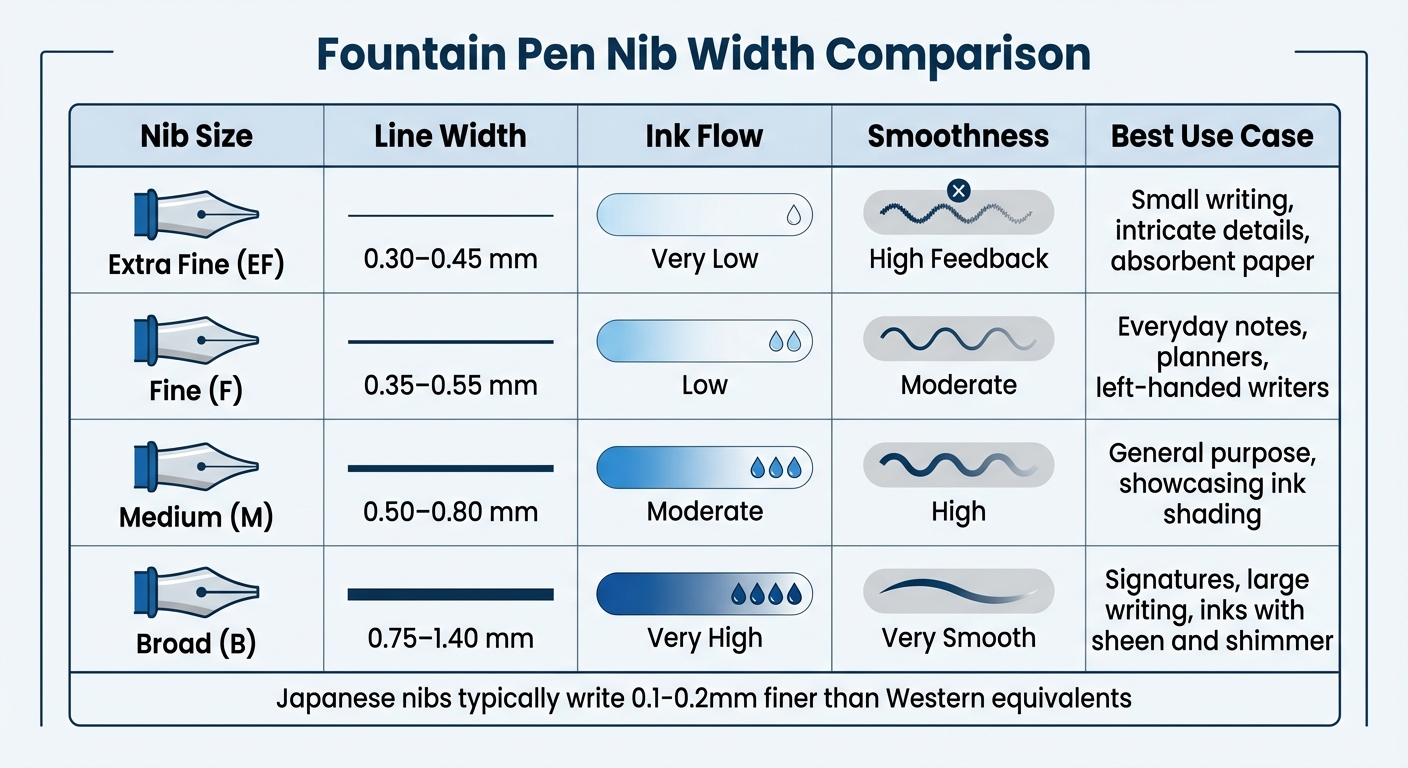
Fountain Pen Nib Width Comparison Chart: Line Width and Best Uses
Extra Fine, Fine, Medium, and Broad Comparison
Here’s a quick breakdown of how the most common nib sizes stack up when it comes to line width, ink flow, and overall usability.
| Nib Size | Line Width | Ink Flow | Smoothness | Best Use Case |
|---|---|---|---|---|
| Extra Fine (EF) | 0.30–0.45 mm | Very Low | High Feedback | Small writing, intricate details, absorbent paper |
| Fine (F) | 0.35–0.55 mm | Low | Moderate | Everyday notes, planners, left-handed writers |
| Medium (M) | 0.50–0.80 mm | Moderate | High | General purpose, showcasing ink shading |
| Broad (B) | 0.75–1.40 mm | Very High | Very Smooth | Signatures, large writing, inks with sheen and shimmer |
Extra fine nibs are perfect for those who need precision, like when writing tiny details or working on highly absorbent paper. They do come with more feedback, which some writers enjoy, while others might find it less smooth.
Fine nibs strike a balance between precision and smoothness, making them a great choice for everyday writing tasks, especially for left-handed writers who prefer quicker drying times. On the other hand, medium nibs are more versatile, offering a comfortable experience for general-purpose writing and showcasing the shading properties of inks.
For those who enjoy bold and expressive writing, broad nibs are ideal. They deliver a smooth glide with a generous ink flow, making them perfect for signatures or showing off inks with sheen or shimmer. However, they do consume more ink, so keep that in mind.
One thing to note is the difference between Japanese and Western nibs. Japanese brands like Pilot, Sailor, and Platinum tend to write finer than their Western counterparts. For example, a Japanese medium nib often feels like a Western fine, with line widths around 0.6 mm compared to the 0.75 mm typical of Western mediums. This distinction can help you choose the right nib for your specific writing needs.
Conclusion
Nib width plays a key role in shaping the way your writing looks and feels. The combination of nib size, ink flow, and your personal writing style can significantly influence both legibility and the overall aesthetics of your handwriting. Finer nibs are ideal for small, detailed writing, while broader nibs highlight ink characteristics like shading and sheen, adding a bold and expressive touch to your work.
Understanding these differences helps you make an informed choice. The goal is to find a nib that complements your unique needs. As John from Fountain Pen Love wisely says, "Not using a new pen because you don't enjoy writing with it is not only sad, but entirely avoidable". Whether you're jotting down tiny planner notes or crafting dramatic signatures, there's a nib width that suits your style perfectly.
If you're new to fountain pens, starting with a Fine or Medium nib is a safe bet. These options provide a balanced writing experience and work well on various paper types.
Looking to discover your ideal nib? Check out Fountain Pen Revolution's collection, offering affordable choices from Extra Fine to Broad, along with specialty grinds. Starter sets are priced from $35, while premium options feature luxurious 14k gold nibs. Visit fprevolutionusa.com to find the nib that transforms your writing journey.
FAQs
How does nib width affect my handwriting, and how do I choose the right one?
Nib width significantly influences the appearance and feel of your handwriting. Narrow nibs, like extra-fine (EF) or fine (F), create delicate, thin lines, making them ideal for precise, small-scale writing. On the other hand, wider nibs, such as medium (M) or broad (B), deliver bold, expressive strokes, which are great for larger handwriting or decorative flair.
When selecting a nib, think about the size of your handwriting. If your letters are small and closely spaced, a finer nib will suit you best. For medium-sized writing, a medium nib offers a balanced, all-purpose option. If your handwriting is larger or more dramatic, a broad or extra-broad nib will complement it beautifully. Whenever possible, try out different nib sizes to discover what feels natural and aligns with your style. Brands like Fountain Pen Revolution provide a wide range of nibs, catering to both newcomers and experienced fountain pen users, making it easier to find the one that’s just right for you.
How do Japanese and Western nibs differ?
Japanese fountain pen nibs are known for their finer tips, which produce thinner, more precise lines with minimal pressure. Typically ranging between 0.3–0.5 mm in size, these nibs are perfect for small handwriting, detailed drawings, or scripts that require accuracy. In contrast, Western nibs often feature broader tips, usually around 0.7–1.0 mm or larger, making them ideal for bold strokes, larger handwriting, or a more expressive writing style.
The writing experience also differs between the two. Japanese nibs are often softer and more responsive, offering a smoother glide, while Western nibs tend to be firmer, providing more noticeable feedback on the page. These characteristics give writers the flexibility to choose a nib that aligns with their preferred style and desired line width. Fountain Pen Revolution offers a wide selection of both Japanese and Western nibs, giving you the chance to explore and find the one that feels just right for you.
How does nib width and shape influence line variation in writing?
The width and design of a fountain pen nib significantly influence the variation in your lines. For instance, stub or italic nibs are known for producing bold vertical strokes and finer horizontal ones, giving your writing a distinct and elegant touch. On the other hand, standard round nibs deliver uniform lines, no matter the direction, making them ideal for consistent handwriting.
If you're aiming to elevate your handwriting or dive into artistic calligraphy, selecting the right nib shape and width is crucial. Think about your writing style and the kind of effect you want to create when deciding on a nib.