

If you want the short answer: urushi is the lacquer base, maki-e adds metal powder art, and raden adds shell inlay. That one difference changes the look, feel, repair difficulty, and price.
Here’s the article in plain terms:
- Urushi = layered lacquer only
- Maki-e = urushi + gold or silver powder
- Raden = urushi + shell inlay
- Best for daily use: plain urushi
- Hardest to repair: raden
- Most art-focused: maki-e
- Most visually bold: raden
- Typical starting prices mentioned: about $1,000+ for plain urushi, about $347+ for simpler maki-e work, and $2,000+ for more complex decorated pieces
The process also affects upkeep. Plain urushi often uses 4 to 7+ layers, with each layer curing for about 24 to 72 hours in 60% to 90% humidity. Maki-e can involve far more build, with some relief work reaching up to 40 layers. Raden adds brittle shell, so damage is harder to fix and some acids or inks can be a problem.
If I were comparing them fast, I’d think about four things: appearance, surface feel, repair, and cost. Plain urushi is smooth and simple. Maki-e adds sparkle and pattern. Raden adds color shift from shell and usually needs the most care.
Quick Comparison
| Finish | What it is | Look | Feel | Repair | Best fit |
|---|---|---|---|---|---|
| Plain Urushi | Lacquer only | Deep gloss or soft sheen | Smoothest | Easiest | Frequent writing |
| Maki-e | Lacquer + metal powder | Metallic shimmer | Flat or slightly raised | Harder | Buyers focused on artwork |
| Raden | Lacquer + shell inlay | Iridescent shell glow | May have slight seams | Hardest | Buyers who want maximum visual effect |
If you’re shopping, I’d look past the finish name and check the build details: layer count, maki-e method, shell type, hand-applied work, and whether shell is sealed under urushi.
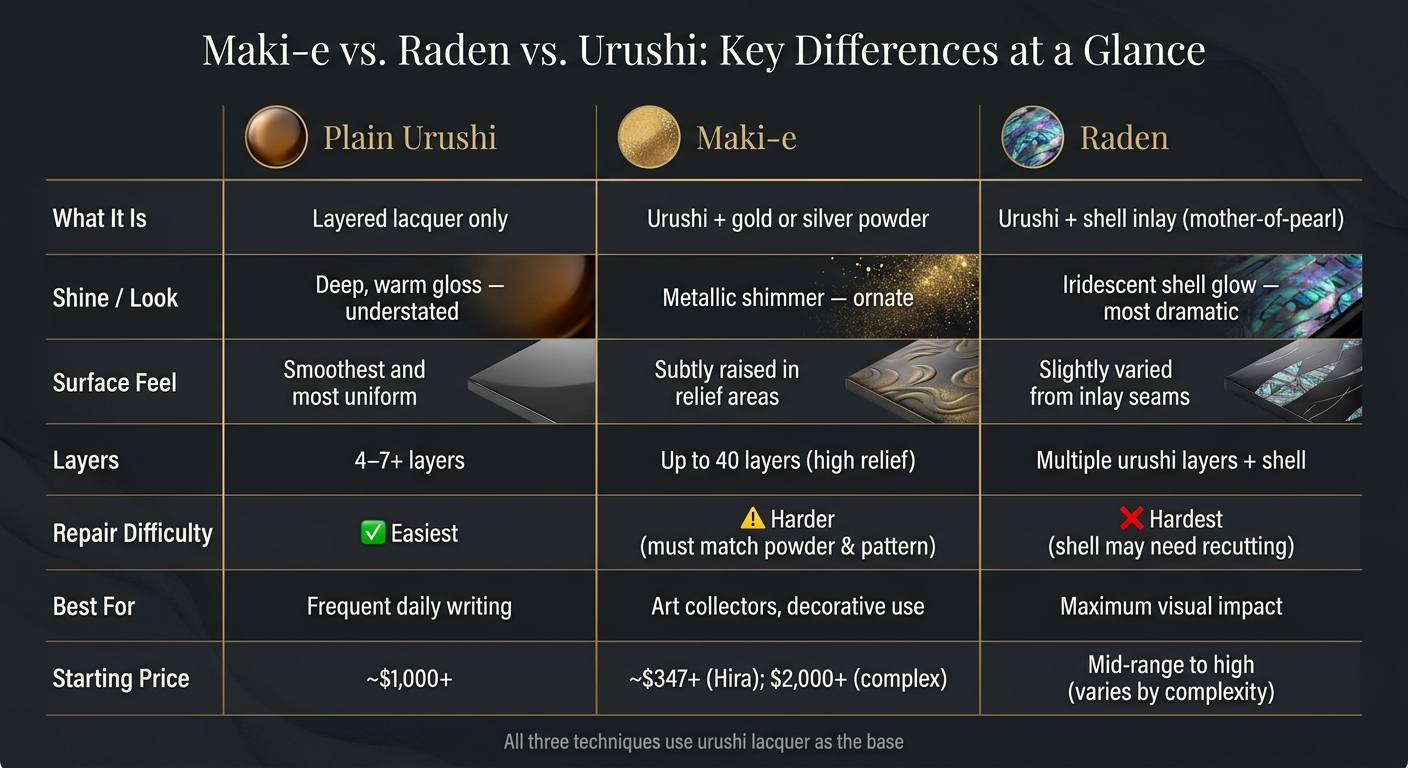
Maki-e vs Raden vs Urushi: Key Differences at a Glance
How Each Technique Is Made and What Goes Into It
All three use urushi, but what happens after that is where they split apart. Those later steps shape the pen’s shine, texture, durability, and how easy it is to repair. They also explain why each finish looks and feels so different in the hand.
Plain Urushi: Layered Lacquer With No Added Decoration
Plain urushi is all about repetition and control. A maker brushes thin coats of lacquer onto an ebonite or wood pen body, then places the piece in a curing cabinet kept at 60–90% relative humidity. Each layer may need 24 to 72 hours to cure before it is sanded and polished. A finished pen, such as the Pilot Custom 845 Urushi Fountain Pen, usually goes through 4 to 7+ layers of urushi, with sanding moving up to 2,500–5,000 grit between coats.
There’s no extra ornament here. No powder. No shell. So the finish depends fully on the depth of the lacquer and the quality of the polish. Final polishing brings out the gloss, and the end result is the most restrained of the three.
Maki-e: Urushi With Sprinkled Metal Powder
Maki-e begins with urushi, then the maker sprinkles gold or silver powder into the design. Hira maki-e stays flat, while taka maki-e adds raised relief. That one change affects both the look and the way the surface wears over time.
High-relief work can take as many as 40 lacquer layers before the powder and topcoats are added. That’s a lot of build for one pen, but it’s what gives some pieces their depth and sculpted feel. Maki-e is prized for its artwork, as seen in the FPR Tanoshii Urushi Art Fountain Pen.
Raden: Shell Inlay Set Into or Under Urushi
Raden uses shell inlay rather than metal powder. Makers cut mother-of-pearl, abalone, or similar shell into flakes, strips, or small motifs, then thin each piece so it can follow the curve of the pen.
From there, the shell can go one of two ways:
- It may be set into shallow recesses with urushi acting as the adhesive.
- Or it may be laid on the surface and buried under extra urushi layers.
After curing, the surface is leveled and polished until the iridescent shell shows through. That sounds simple on paper, but the shell is brittle, so the finishing work has to be careful. Raden pens often get extra urushi topcoats, and some also include maki-e details around or over the shell. In other words, one pen can blend both methods.
Raden is prized for its iridescent shell effect. That same shell structure is also what makes raden more delicate to finish and repair.
These build differences shape shine, texture, repair, and collector appeal.
sbb-itb-1dd4fe9
Shine, Texture, Repair, and Daily Use
How Each Finish Looks and Feels in Person
These finish differences stand out most when you see them in light and run a finger across the surface.
Plain urushi reflects light in a calmer way. It can look deeply glossy or show a soft satin sheen, and it usually feels evenly smooth from end to end. Maki-e shifts that experience quite a bit. The metal powder catches light from different angles, so the surface has more sparkle and movement. Raden goes even further. Its shell inlay throws off an iridescent effect that changes color as you move it, which makes it the boldest of the three.
Touch matters too. Shell inlay can leave tiny seams along the edges, so raden is the finish most likely to feel a little varied under your fingers.
That split in appearance also shapes what collectors tend to like: plain urushi for restraint, maki-e for artistry, and raden for shimmer.
Scratches tend to show the least on plain urushi. They stand out more on maki-e and raden, where they break up the decorated surface.
Repair and Durability: Which Finish Is Easiest to Restore
The main difference here isn't toughness. It's repair.
All three finishes hold up well when properly cured. Where they part ways is in how hard they are to restore after damage.
Plain urushi is the easiest to repair. If an area gets damaged, a craftsperson can often re-coat it and polish it so it blends back into the surrounding surface. Maki-e is harder because the repair has to match more than the lacquer color. The restorer also has to match the density and placement of the metal powder, along with the height of the built-up layers. Raden is the most difficult because a chipped or lifted shell piece may need to be cut again, fitted again, and finished to match the original iridescence, which is hard to reproduce exactly.
Raden also needs more care around acids and some inks, which can etch shell.
For daily use, plain urushi is the easiest to live with. Maki-e and raden call for a gentler touch.
Side-by-Side Comparison: Key Differences at a Glance
This table sums up what changes after the urushi base. Once the base urushi finish is in place, the added material shapes the final look, feel, and day-to-day handling. Use it as a quick side-by-side reference.
| Feature | Plain Urushi | Maki-e | Raden |
|---|---|---|---|
| Materials | Urushi lacquer only | Urushi + gold or silver powder | Urushi + shell inlay (mother-of-pearl) |
| Process steps | Multiple urushi layers, cured and polished | Powder applied to wet lacquer, then finished and polished | Shell cut thin, inlaid, covered with urushi, polished |
| Shine | Deep, warm gloss; understated | Metallic shimmer; ornate decoration | Iridescent shell glow; most visually dramatic |
| Texture | Smoothest and most uniform | Can be subtly raised | Slightly varied from inlay |
| Repair difficulty | Easiest to restore | Harder; powder and pattern must match | Hardest; inlay may need recutting |
| Daily-use practicality | Best for frequent writing and daily carry | Best with careful handling | Best for careful daily carry |
| Collector appeal | High for minimalists and urushi purists | Strong for art and technique collectors | Very high for visual drama and craftsmanship |
How to Use This Table for Buying Decisions
Pick the finish based on what matters most to you.
- Choose plain urushi if you want the smoothest feel and the best fit for frequent writing.
- Choose maki-e if you want decorative art with a metallic sparkle.
- Choose raden if your main goal is maximum visual impact.
A simple way to think about it: plain urushi puts the lacquer itself front and center, maki-e adds powdered metal for pattern and shimmer, and raden brings in shell inlay for a brighter, more dramatic look.
Which Finish to Choose and Final Takeaways
Now that the differences are clear, the choice mostly comes down to how you'll use the pen, what you want it to look like day to day, and how much you want to spend.
If you write a lot and want something you can use without babying it all the time, plain urushi is the practical pick. It usually needs the least attention and tends to be the lowest-priced option of the three. Well-known Japanese makers often start their plain urushi models around $1,000 for U.S. buyers. That's still a serious purchase, but it's far less than many decorated options.
If you want strong visual appeal without jumping straight to the top price bracket, raden deserves a close look. It often lands in the middle for both price and visual effect. Simpler shell inlay patterns can show up on pens priced well below complex maki-e pieces, while still giving you that striking iridescent look. When you read a product listing, watch for terms like sealed under urushi or smooth, flush inlay. Those details usually mean the shell is protected and a better fit for regular use.
Maki-e makes the most sense when the finish itself is the art. This is the route for buyers who care more about artistry, rarity, or collector appeal than daily carry. Custom maki-e work from independent Japanese artisans starts around $347 for simpler Hira Maki-e and can climb fast. More complex multi-technique pieces, including styles like Togidashi Raden Maki-e and Taka Maki-e, can cost $2,000 or more. Named techniques, well-known artisans, and limited runs often point to higher prices and stronger collector interest.
When you're reading a listing, don't stop at the finish name. Check the urushi layers, shell type, maki-e method, and whether the work is applied by hand. Those details tell you much more about what you're buying.
FAQs
Which finish is best for beginners?
For beginners, plain urushi is usually the best place to start. Maki-e and raden are beautiful, but they often cost more and need extra care to keep their delicate surface details safe.
Plain urushi still gives you what makes the material special: a smooth, warm, durable finish that stands up well to water and everyday wear. It’s a simpler, more accessible way to get to know natural lacquer before moving on to more elaborate, collectible styles.
How can I tell if shell inlay is well protected?
Look closely at how the shell inlay sits inside the urushi lacquer. In high-quality work, the shell is set beneath several layers of lacquer instead of being laid on top.
After polishing, the surface should feel smooth and even with the area around it. That’s a strong sign the inlay is sealed well inside a hard, glass-like finish.
Why do prices vary so much between these finishes?
Prices can swing a lot because the materials are rare and the work takes a huge amount of time. Urushi sap is hard to source, and artisans may spend months building up each finish layer by layer, then drying and polishing it by hand.
The cost climbs even more when raden inlays or precious metal powders are part of the process. So the final price comes down to two main things: rare materials and highly specialized craftsmanship.