

Maki-e, meaning "sprinkled picture", is a Japanese decorative art that uses lacquer and metal powders like gold or silver to create detailed designs. Originating 1,400 years ago during the Nara period, it evolved into a refined art form during the Heian period. Initially used on high-status items like furniture and inkstone boxes, it later adorned fountain pens when Namiki introduced the first Maki-e pen in 1925.
Today, Maki-e fountain pens are highly sought after for their craftsmanship and rarity. Techniques like Hira Maki-e (flat designs) and Taka Maki-e (raised designs) remain central to the art. However, the number of skilled artists has declined significantly - from 20,000 in the Edo period to just a few hundred today - making these pens even more exclusive.
Modern Maki-e pens blend age-old techniques with contemporary designs. Brands like Namiki and Platinum offer high-end options, while accessible alternatives, like Fountain Pen Revolution’s $149 models, make this art form available to more enthusiasts. Whether a collector or first-time buyer, owning a Maki-e pen means carrying forward a piece of history.
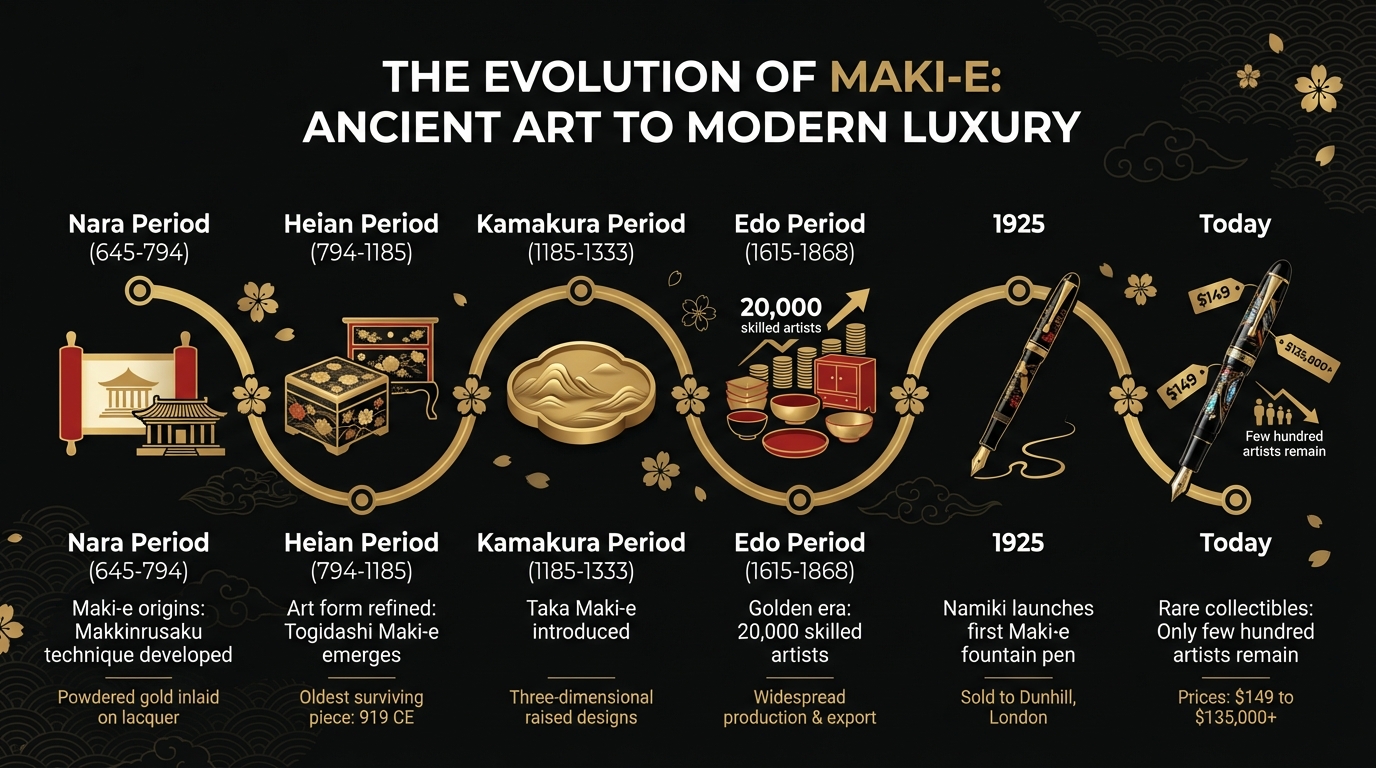
Evolution of Maki-e Art: From Ancient Japan to Modern Fountain Pens
The Art of Maki e
sbb-itb-1dd4fe9
The Origins of Maki-e in Ancient Japan
Maki-e traces its roots back to the Nara period (645–794), when artisans developed a technique called makkinrusaku. This method involved inlaying powdered gold onto lacquer surfaces. One of the earliest surviving examples of this craftsmanship can be seen on a Chinese T'ang-style sword scabbard, which is preserved in the Shōsō-in imperial repository. This foundational work set the stage for what would later become one of Japan's most sophisticated decorative arts.
By the Heian period (794–1185), the term "maki-e" began to appear in historical records, marking the evolution of the technique into togidashi maki-e. In this process, artisans used sticky urushi lacquer to outline intricate designs, applied gold or silver powder, and added multiple layers of lacquer. The surface was then burnished with charcoal to seamlessly integrate the design into the lacquer.
Maki-e was often used to adorn high-status items like ink-slab cases and furniture, symbolizing refinement and social prestige. The oldest surviving piece of Maki-e lacquerware, dating back to 919, still exists today and is celebrated as a national treasure in Japanese museums.
During the Heian period, aesthetic styles began to shift. Early works featured symmetrical designs influenced by Chinese patterns, but over time, a distinctly Japanese style emerged. This new approach embraced natural motifs, such as landscapes and seasonal themes. A prime example of this transition is the "wheels in flow" (katawaguruma) motif. The Kataguruma Paper Box, an 11th–12th century masterpiece housed at the Tokyo National Museum, exemplifies this style. This national treasure combines Maki-e with raden (mother-of-pearl inlay) to depict wheels floating in water, a design that became iconic in Japanese decorative arts.
The Heian period also saw significant technical advancements. Artisans introduced ao-kin, an alloy of gold and silver powder, and developed gradation techniques to create more subtle shading effects. Toward the end of this era, they began experimenting with hira maki-e (flat Maki-e), a method that would later be refined during the Kamakura period. These innovations not only expanded the artistic possibilities of Maki-e but also laid the groundwork for its later use in designs like those seen on Urushi fountain pens.
How Maki-e Techniques Developed Over Time
Over the centuries, Maki-e has undergone significant transformations, reflecting shifts in Japanese society and artistic innovation. During the Kamakura period (1185–1333), as samurai replaced aristocrats as the ruling class, Maki-e designs began to change. The art moved away from symmetrical patterns, embracing more lifelike landscapes and natural motifs. This era also saw the introduction of Taka Maki-e, a raised technique where designs were built up using a mix of lacquer with charcoal or clay, creating striking three-dimensional effects.
The Muromachi period (1332–1568) brought even greater sophistication. Under the patronage of samurai with a taste for luxury, artisans developed Shishiai Togidashi Maki-e, which combined raised elements with polished, smooth backgrounds. Techniques like Nashiji, which created a pear-skin texture using gold powder, and Kirigane, where cut gold flakes were applied, also emerged during this time. As Bernard Lyn, a pen expert, observed:
"Muromachi culture was also heavily influenced by the Zen sect... Artisans liked to use all possible Maki-e techniques for each design".
During the Momoyama period (1568–1615), the trend shifted toward simplicity. Artisans embraced Hira Maki-e, producing elegant, straightforward gold-on-black designs in what became known as the Kodaiji style. This approach prioritized efficiency, enabling faster production while maintaining the art's refined aesthetic.
The Edo period (1615–1868) marked a golden era for Maki-e. A thriving economy allowed more people to afford lacquerware, leading to widespread production and making Maki-e accessible to a broader audience. This period also saw the rise of Namban Shikki, lacquerware crafted for export to Europe. Artisans meticulously documented their techniques in the "Hyakko-hisho", preserving methods that would later influence modern applications, such as fountain pen decoration.
Taka Maki-e and Hira Maki-e: The Two Main Styles
Maki-e can be broadly categorized into two main styles, each offering distinct visual effects.
- Hira Maki-e: This is the simpler technique, where designs are drawn with lacquer, sprinkled with metal powder, and then polished to a smooth finish. Despite being called "flat", the design is slightly raised above the surface, creating clean, sharp lines. Its efficiency made it popular during the Momoyama and early Edo periods.
- Taka Maki-e: This style creates a dramatic, three-dimensional effect by building up patterns with a mixture of lacquer and materials like charcoal or clay (known as sabi-age). Afterward, layers of lacquer and metal powder are applied. This method, which began in the Kamakura period, reached its peak in the Muromachi and Edo periods. The raised designs bring subjects like birds, flowers, and landscapes to life, making them ideal for decorative objects like fountain pens, where the tactile depth enhances their appeal.
An even more intricate style, Shishiai Togidashi Maki-e, combines Taka Maki-e for raised foreground elements with Togidashi for smooth backgrounds, creating layered, dynamic compositions.
The Use of Gold, Silver, and Other Materials
As Maki-e techniques advanced, so did the range of materials used. Precious metals became a hallmark of the craft, adding both luxury and visual impact. Gold and silver powders were refined into different sizes and types, each offering unique effects. For instance:
- Marufun: Round grains that produce a brilliant shine when polished.
- Keshifun: Ground from gold leaf, easier to apply but with a softer, whitish finish.
- Hiragime: Medium-sized particles offering a balance of durability and luster.
By the Heian period, artisans had introduced ao-kin, a gold-silver alloy, and developed shading techniques for subtle gradations. The Edo period saw an expanded palette, including metals like copper, brass, platinum, and pewter, as well as non-metal materials like raden (mother-of-pearl), rankaku (quail eggshells), kohaku (amber), and bekko (tortoiseshell).
The value of these materials, combined with the skill required to use them, is reflected in the prices of modern Maki-e works. Pieces by master artisans, such as National Treasure Oba Shogyo, can command over $135,000 per square foot. Thanks to the durability of lacquer and precious metals, Maki-e creations can endure for centuries - some items over 2,000 years old remain remarkably well-preserved.
Maki-e Enters the World of Fountain Pens
Back in the early 1920s, fountain pens were typically made from ebonite, a material prone to discoloration and losing its luster over time. Ryosuke Namiki and Masao Wada discovered a solution: coating ebonite with Urushi lacquer. Not only did this protect the material, but it also provided an ideal surface for intricate Maki-e artwork. By 1925, the Namiki brand was officially launched, showcasing the craftsmanship of master lacquer artists Shisui Rokkaku and Gonroku Matsuda. That same year, the first Maki-e fountain pen was sold to Dunhill in London, marking its entry into Western luxury markets. This pivotal moment opened the door for Namiki to form strategic partnerships that would bring Maki-e into the global spotlight.
Namiki: The First Brand to Apply Maki-e to Fountain Pens
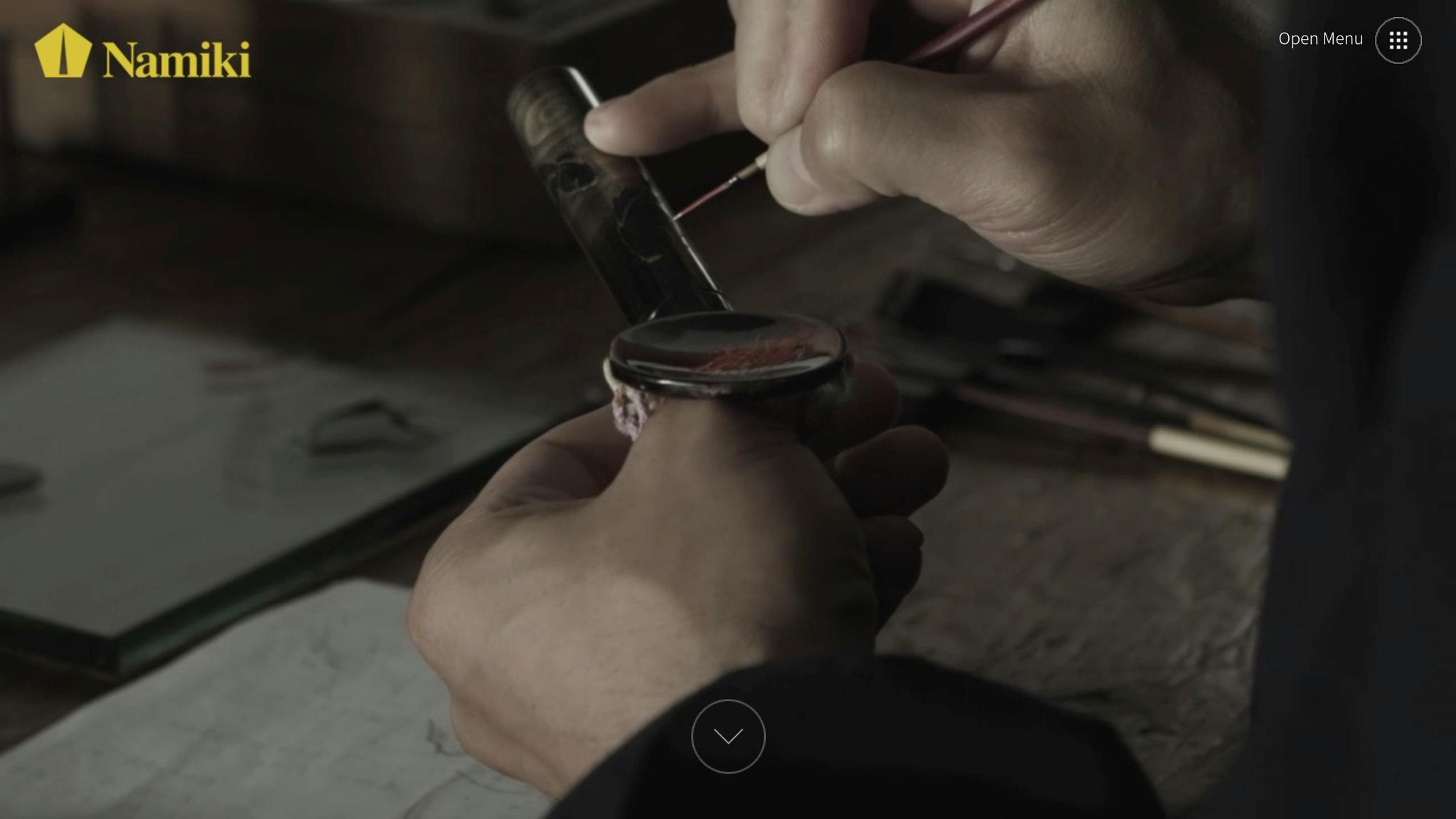
Namiki didn’t stop at innovation - they quickly expanded their reach. In 1930, the company signed a groundbreaking agreement with Alfred Dunhill Ltd., branding their pens as "Dunhill‐Namiki Made in Japan" and distributing them across major cities like London, New York, and Paris. This partnership introduced the elegance of Japanese lacquer art to the Western world, turning fountain pens into coveted collectible items rather than just writing tools. Namiki also secured a patent for their unique method of applying Maki-e to fountain pens, solidifying their place as pioneers in this craft.
Gonroku Matsuda's Contributions to Maki-e
While Namiki’s business strategies drove their global success, the artistry of individuals like Gonroku Matsuda played a crucial role in shaping their legacy. Matsuda (1896–1986) joined Namiki in 1926, bringing his expertise in traditional lacquer techniques to the brand. In 1931, Matsuda and Ryosuke Namiki co-founded the Kokkokai (National Light Society), a group of Maki-e masters dedicated to refining and promoting the art form.
The name Kokkokai symbolized their vision:
"Maki-e was the light of the country, and they aspired to making maki-e shine brightly all over the world".
Matsuda also introduced a tradition that continues today: skilled artists inscribe their names on the pens they create, adding a personal touch to each piece. This practice is still upheld at the Namiki Maki-e Atelier in the Hiratsuka Plant. In recognition of his extraordinary contributions, Matsuda was named a Living National Treasure in 1955, a testament to his role in blending time-honored Maki-e techniques with modern luxury craftsmanship. His work remains a cornerstone of Namiki’s reputation for excellence in the art of fountain pen design.
Maki-e Fountain Pens Today
Maki-e fountain pens have transitioned into coveted collectibles, where their artistic and craftsmanship qualities far outweigh their practical use.
Why Collectors Seek Maki-e Fountain Pens
Collectors are drawn to Maki-e pens for their extreme rarity and the painstaking effort involved in their creation. Crafting a single Maki-e pen can take anywhere from six months to several years, requiring incredible precision and patience. Adding to their exclusivity, these pens are often produced in very limited numbers - sometimes only a few times annually - and are rarely, if ever, reproduced.
The hallmark of a true Maki-e pen lies in its Urushi lacquer, derived from the sap of the Japanese Urushi tree. This lacquer not only becomes stronger over time but also develops a deeper, more radiant sheen as it ages. The dwindling number of skilled artisans capable of creating these masterpieces makes each pen even more precious in today’s market.
Beyond their craftsmanship, the designs themselves hold profound cultural meanings. For example, dragons symbolize strength, cranes represent longevity, and goldfish are associated with prosperity.
"Owning a Maki-e pen is not about owning a pen. It is about inheriting a tradition - and carrying it forward, one written word at a time."
– Makoba
These distinctive qualities have allowed Maki-e pens to evolve into modern masterpieces, blending traditional artistry with contemporary design.
Modern Maki-e Designs and Techniques
As the demand for heirloom-quality collectibles grows, modern Maki-e designs adapt to new tastes while staying true to their historical roots. Artisans continue to honor the 1,200-year-old "sprinkled picture" technique, often pairing it with modern design elements. One standout example is Pelikan's Maki-e editions, which use the German M1000 pen chassis as a base for Japanese artisans to showcase their craft. The Pelikan M1000 Maki-e Ivy & Komon, for instance, combines flowing ivy motifs with Komon textile patterns, celebrated for their subtle elegance.
Modern designs often lean toward understated luxury, focusing on nature-inspired themes rather than bold, traditional symbols like dragons or phoenixes. The Namiki Aya collection exemplifies this shift, emphasizing graceful patterns over literal representations. At the same time, brands like Platinum have introduced "modern maki-e" techniques, such as silk-screen printing or simpler inlays, to make these pens more accessible. These pieces, priced around $205, still offer the rich lacquer finish associated with traditional Maki-e, while high-end pieces can cost over $3,450, with museum-grade creations fetching even higher prices.
Artisans are also exploring new materials and techniques alongside traditional gold and silver powders. For example, the Rankaku method incorporates quail eggshell fragments to create striking white patterns, while Raden inlays use shimmering mother-of-pearl for a luminous effect. Some manufacturers even integrate modern innovations, like Platinum’s cap-sealing technology to prevent ink evaporation, ensuring these pens are as functional as they are beautiful. To maintain exclusivity, brands like AP Limited Editions limit their "Connoisseur" collection to just nine pens per theme.
These contemporary innovations ensure that Maki-e artistry remains relevant and appreciated, allowing this centuries-old tradition to thrive in the world of modern fountain pen design.
Affordable Fountain Pen Options for Maki-e Enthusiasts
Fountain Pen Revolution: Quality Pens at Lower Prices

Fountain Pen Revolution brings the elegance of Japanese Urushi art to a broader audience with its Tanoshii Urushi Art Fountain Pen series, starting at just $149.00.
"Each FPR Tanoshii Urushi Art pen is a masterpiece, combining the original Tanoshii design and filling system with expert Japanese Urushi artistry." – Fountain Pen Revolution
The series boasts eight traditional designs, including Red Phoenix, Blue Dragon, White Tiger, and Golden Clouds, crafted on premium acrylic bodies with gold-plated accents. For those seeking a more luxurious option, a 14k gold vs steel nib version is available starting at $415.00, with an impressive 4.8/5 rating from customer reviews.
To make these pens more affordable, buyers can opt for four interest-free payments of $37.25 every two weeks. Additionally, US orders over $65 and international orders exceeding $149 qualify for free shipping. However, to preserve the intricate, hand-painted designs, it’s recommended to avoid removing the cap while writing.
For those new to Maki-e art, bundled starter sets provide a great introduction before committing to a larger purchase. Reviewing a fountain pen buying checklist can also help ensure you choose the right model for your needs.
Starter Sets and Bundles for New Users
Fountain Pen Revolution offers thoughtfully curated starter sets designed for beginners. The Ambassador Starter Set, priced at $56.00, includes an FPR Ambassador pen, a Rhodia A5 notepad, blue ink, cartridges, and a leather pouch. Another option is the Founder's Bundle, available for $75.00 (discounted from $89.00), featuring the FPR Statesman pen and premium Clairefontaine paper, which has earned a perfect 5.0/5 rating.
For those ready to invest in a Tanoshii Urushi Art pen, "Frequently Bought Together" bundles are available. These combine the pen with Colorverse ink, personalized engraving, and a leather sleeve for around $188, saving buyers about $21 compared to purchasing items separately.
It’s worth noting that starter sets including paper products are only available domestically. International customers can opt for pen-only bundles instead.
These accessible options let enthusiasts embrace the timeless beauty of Maki-e, ensuring this exquisite art form continues to thrive in modern times.
Conclusion
Maki-e seamlessly blends over 1,200 years of Japanese craftsmanship with the sophistication of modern fountain pens. When Namiki introduced the first Maki-e fountain pen in London in 1925, it marked the beginning of a new chapter for this timeless art form. Yet, the tradition now faces a pressing challenge: the number of skilled artisans has dwindled to just a few hundred across Japan, highlighting the importance of preserving this art for future generations.
This sentiment is beautifully captured in the words of Makoba:
"Owning a Maki-e pen is not about owning a pen. It is about inheriting a tradition - and carrying it forward, one written word at a time." - Makoba
The survival of Maki-e depends on both maintaining demand and making it more accessible. While masterpieces by celebrated artists like Oba Shogyo - designated as a National Treasure - can command prices exceeding $135,000 per square foot, modern retailers are helping to bring authentic Urushi art within reach of a broader audience. For instance, Fountain Pen Revolution’s Tanoshii Urushi Art series offers hand-painted designs inspired by Japanese motifs, such as dragons, cranes, and koi, starting at $149.00. This makes it possible for enthusiasts to experience the beauty of Maki-e without the need for a museum-level budget.
Each Maki-e fountain pen is more than just a writing tool - it’s a piece of living history. The Urushi lacquer not only enhances the pen’s aesthetic but also matures over time, turning it into a cherished heirloom. By introducing these pens to new collectors, we contribute to keeping this extraordinary tradition alive in the modern era. From its ancient roots to its place in today’s collector markets, Maki-e continues to serve as a vibrant reflection of Japan’s artistic legacy.
FAQs
How can I tell if a Maki-e fountain pen is truly hand-made?
A genuine Maki-e fountain pen is a testament to masterful craftsmanship. These pens feature detailed lacquer designs, often enhanced with metal powders, showcasing traditional techniques like Togidashi and Taka Maki-e. Such methods demand years of dedication and precision, highlighting the incredible artistry behind each creation.
What’s the difference between Hira Maki-e and Taka Maki-e on a pen?
Hira Maki-e and Taka Maki-e are two fascinating techniques in Japanese lacquer art, each offering its own distinct visual and tactile qualities.
Hira Maki-e is all about creating a smooth, flat surface. Artists achieve this by carefully applying lacquer and sprinkling powdered materials like gold or silver. The result is a detailed, refined design that feels completely even to the touch.
In contrast, Taka Maki-e adds a three-dimensional element to the artwork. This technique involves building up the design using materials such as charcoal powder, giving it a raised, textured appearance. The tactile nature of Taka Maki-e makes it stand out, offering depth and dimension.
The main difference lies in the texture: Hira Maki-e is flat and sleek, while Taka Maki-e is raised and textured, offering a more dynamic feel. Both techniques showcase the artistry and craftsmanship of Japanese lacquer work in their own unique ways.
How do I care for an Urushi-lacquer Maki-e fountain pen?
To keep your Urushi-lacquer Maki-e fountain pen in great condition, treat it with care and respect for its delicate craftsmanship. Protect it from extreme temperatures, direct sunlight, and moisture, as these can harm the lacquer and intricate design. Use a soft, dry cloth for cleaning, steering clear of harsh chemicals or abrasive materials. If you need to use a damp cloth, make sure to dry the pen immediately afterward. Always store it in a protective case to avoid scratches or unnecessary wear.