

Flex nibs transform handwriting by allowing you to create dynamic line variations through controlled pressure. By pressing down, the nib’s tines spread apart, producing bold, thick strokes, while lighter pressure creates fine, delicate lines. This unique functionality is essential for calligraphic styles like Copperplate and Spencerian.
Key Takeaways:
- Flex nibs range from 0.5 mm (no pressure) to up to 2 mm (full pressure), offering more variety than standard fountain pen nib sizes.
- Proper pressure control prevents issues like uneven lines, "railroading", or nib damage.
- Exercises like vertical lines, figure-eights, and ovals help develop precision.
- Modern flex nibs, especially steel-alloy ones, are durable and beginner-friendly.
- Avoid overflexing to maintain nib performance and longevity.
For the best results, pair a flex nib with high-quality paper and maintain proper nib care. With practice, you can achieve stunning line variation and elevate your writing style.
How Flex Nibs Work
Flex Nib Structure
Flex nibs stand apart from rigid nibs thanks to their flexible design. Their defining feature is the slit running down the center of the nib, dividing it into two tines. Unlike rigid nibs, these tines are meant to spread apart when pressure is applied, giving flex nibs their signature functionality.
The breather hole, a small circular opening at the end of the slit, plays a crucial role. It acts as a stress-relief point, allowing the nib to bend and the tines to separate without risking permanent damage or breakage. Beneath the nib lies the feed, which has to supply a much larger volume of ink than standard feeds to ensure smooth and consistent ink flow during use.
Historically, 14k gold alloy was the material of choice for flex nibs. It provided an ideal mix of flexibility, durability, and resistance to the acidic inks commonly used in the early 20th century. Today, many modern flex nibs are crafted from specially treated stainless steel alloys, offering a more affordable option while maintaining resilience under pressure. Collectors often refer to the most flexible vintage nibs as "wet noodles" because of their ability to produce dramatic line variations.
This clever design is what enables flex nibs to modulate ink flow through pressure, as explained in the next section.
How Pressure Separates the Tines
When you press down during a stroke, the tines of a flex nib spread apart. This separation widens the gap between them, allowing more ink to flow through and onto the paper. The result? A bold, thick line. The harder you press, the wider the gap becomes, increasing the ink flow accordingly.
A hallmark of a high-quality flex nib is its "spring back" or "return." As Wikipedia notes:
Flex nibs used for the Spencerian or Copperplate writing styles should possess the property of 'spring back' or 'return', meaning that their tines should close back together extremely quickly when released.
This ability to snap back instantly is what allows for seamless transitions between thick downstrokes and fine, delicate hairlines. However, as the tines spread and make greater contact with the paper, friction increases. This requires slower, more deliberate strokes to maintain control and precision.
sbb-itb-1dd4fe9
HOW TO USE FLEX NIBS (and how not to break them)
Pressure Control Techniques and Practice Exercises
Flex Nib Pressure Control: Beginner to Advanced Exercises
Correct Grip and Pen Position
A light grip is key to mastering pressure control. Gripping your flex nib pen too tightly restricts the movement of the tines, making it harder to achieve those delicate, hairline strokes. Instead, rest your fingers lightly on the pen, guiding it rather than gripping it with force.
Hold the pen at a comfortable angle - this helps you control downward pressure and reduces unnecessary lateral friction as the tines separate. Once you’ve got the right grip and angle, you can move on to exercises designed to sharpen your pressure control.
Beginner Pressure Control Exercises
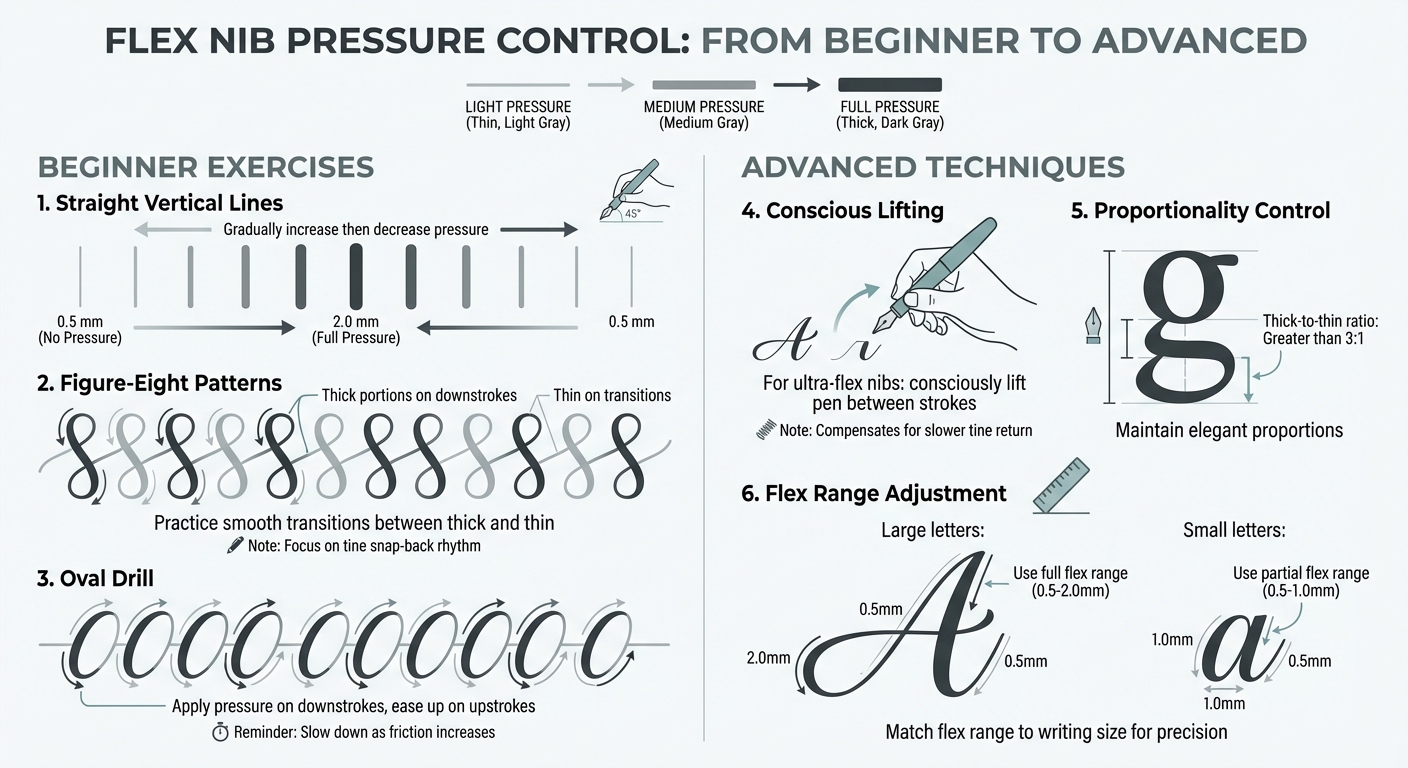
Start with straight vertical lines. Draw a series of vertical downstrokes, gradually increasing pressure to expand the line width from 0.5 mm (unflexed) to 2 mm (fully flexed). Then, ease off the pressure to return to a light stroke.
Next, try figure-eight patterns. These exercises help you transition seamlessly between thick and thin lines while maintaining a steady rhythm. Pay attention to how the tines snap back into position. Modern steel-alloy flex nibs are forgiving, which makes them great for practice without risking damage.
The oval drill is another effective exercise for building muscle memory. Draw a series of connected ovals, applying pressure on the downstrokes and easing up on the upstrokes. Keep in mind that friction increases as the tines spread, so slow down your strokes to stay in control.
Advanced Pressure Control Methods
Once you’ve nailed the basics, you can move on to advanced techniques to refine your skills further. One such method is conscious lifting, especially with ultra-flexible nibs. Calligrapher a‑z explains:
In the case of the superflex I almost feel that I have to consciously lift the pen. Then may lead to loss of rhythm if the writer does not have a good hand control.
This deliberate adjustment helps compensate for the slower return of ultra-flexible nibs.
Another advanced skill is proportionality control, which separates good flex writing from exceptional work. For instance, your thickest downstroke should be about 1/5 of your lowercase letter height. Overly wide strokes can make letters look "chubby" and less elegant. Aim for a thick-to-thin ratio greater than 3:1 to create a visually appealing contrast.
Lastly, adjust your flex range to match your writing size. As a‑z notes:
A ultra super‑duper wet noodle pen is useless to someone who writes with small letters. Also such a pen does not allow quick and precise control over short strokes.
For smaller scripts, use a smaller portion of your nib’s flex range to maintain precision and speed. This ensures your writing stays clean and controlled, even in compact lettering.
Common Flex Nib Problems and Solutions
Fixing Uneven Line Variation
Getting smooth, consistent line variation with a flex nib requires controlled pressure. Applying uneven pressure can lead to issues like railroading or timing errors. Railroading happens when a thick downstroke splits into two thin lines. This usually means the feed isn't delivering ink fast enough to fill the gap between the tines as they spread. If you notice this, stop increasing pressure immediately - this is your nib's limit based on your current ink and feed setup. Also, double-check that the nib is securely seated and the tines are close together when at rest. This helps maintain steady ink flow.
Another common issue is timing your pressure incorrectly. Flex nibs work best when pressure is applied only on downstrokes. Pressing on upstrokes or lateral strokes can lead to inconsistent lines or even cause the nib to snag. If your thick-to-thin transitions look muddy or blurred, you might be holding pressure too long as you move into an upstroke.
Lastly, to avoid damaging your nib, be mindful of overflexing.
Avoiding Overflexing Damage
While flex nibs are designed to create dramatic line variations, pushing them too far can cause permanent damage. Overflexing can deform the nib, preventing the tines from snapping back into place. Nib expert Richard Binder highlights the risks:
Flex nibs are a disaster in the making... Especially the "flexier" ones are prone to damage (permanent deformation of the tines, unacceptable tine opening, cracks at the breather hole etc.).
One sign of overflexing is sluggish spring-back, which indicates the nib is under too much stress . Modern steel-alloy flex nibs tend to handle accidental over-flexing better than gold nibs, but they aren't indestructible. Avoid sudden side-to-side movements when the nib is fully flexed, as the stress on the tines increases dramatically when they're spread apart. For smaller handwriting, stick to using only part of the nib's flex range. Overextending the nib for tiny letters can unnecessarily strain it.
Improving Your Flex Nib Experience with Fountain Pen Revolution
Getting the best out of your flex nib writing involves more than just technique - it’s about picking the right tools, maintaining them properly, and ensuring they’re set up to support precise pressure control.
Affordable Flex Nib Options
Fountain Pen Revolution offers a range of flex nibs at budget-friendly prices. For instance, the #6 Two-tone EF Flex Nib starts at just $9.00 and can create lines ranging from 0.5 mm to 2.0 mm. If you’re looking for something more advanced, the Steel EF Ultra Flex Nib is available for $19.00. At the premium end, the 14k Gold EF Ultra Flex Nib, priced at $299.00, delivers extraordinary line variation, reaching up to 2.5 mm when fully flexed.
What sets the Ultra Flex line apart is its unique design. These nibs feature a half-moon cutout on the shoulders, a detail inspired by various "ease my flex" experiments. As founder Kevin Thiemann explains:
This half-moon cutout from the shoulders of these nibs was inspired by various 'ease my flex' experiments... to reduce flex resistance while maintaining the integrity of the nib against tine springing.
This thoughtful design reduces the effort needed to flex the nib while ensuring the tines remain durable. One customer, Don, shared his experience with the gold nib:
has tremendous flex with very little pressure... Tremendous line variation with subtle pressure changes.
These features make it easier to achieve the kind of line variation that flex nib enthusiasts love.
Customizing Your Writing Setup
For a consistent and smooth ink flow during broader downstrokes, the #6 EF Ultra Flex Nib & Ebonite Feed Combo ($20.00) is a great choice. This combination helps prevent issues like railroading. Additionally, pens like the FPR Indus ($20.00) and Jaipur V1 ($21.00) are compatible with #6 nib units, allowing you to switch between standard and flex nibs as your writing skills evolve. The ebonite feed can even be heat-set to the nib, eliminating gaps that might disrupt ink flow.
To get the most out of your flex nib, pair it with high-quality paper like Rhodia or Clairefontaine Triomphe. These papers handle the increased ink flow from flexed strokes beautifully, ensuring smooth and clean results.
Keeping Your Fountain Pen in Top Shape
Proper maintenance is key to ensuring your flex nib performs well over time. Start by checking the tine alignment - the tines should sit close together with minimal gaps when the nib is at rest. If you notice inconsistent ink flow, you can gently widen the nib slit using a thin brass sheet (around 0.001 inches) to improve both hairlines and downstroke consistency.
Regular cleaning, especially when changing inks, is another must for maintaining consistent performance. Fountain Pen Revolution offers helpful troubleshooting video guides to address common issues. Plus, their 60-day guarantee covers defects and replacement parts if needed. With over 54,600 customers worldwide, the company’s support resources make it easier to master pressure control and achieve stunning line variation with your flex nib.
Mastering Flex Nibs Through Pressure Control
Flex nibs rely on a straightforward yet fascinating mechanism: applying pressure spreads the tines for bolder, thicker lines, while releasing it brings them back together for finer strokes. This dynamic allows for striking line variation, but it all hinges on your ability to control that pressure consistently.
Getting the hang of pressure control does more than just improve your writing - it helps you avoid costly mistakes. Improper technique can lead to permanent damage, like nib springing or cracks near the breather hole. It also prevents frustrating issues like railroading, which happens when the tines spread too far for the ink to flow evenly. Once you’ve refined your technique, you can explore timeless calligraphic styles like Copperplate and Spencerian or simply add a touch of personality to your everyday notes.
For example, Fountain Pen Revolution’s flex nibs create a 0.5 mm line with no pressure, but they can expand up to 2.0 mm when fully flexed. To achieve visually appealing results, aim for a thick-to-thin ratio of at least 3:1. For balance, keep your thickest strokes about one-fifth the height of your lowercase letters.
Here’s a tip: apply pressure only on downstrokes and slow your writing pace to help the ink feed keep up. Also, match the nib’s flex level to your handwriting size. Using an ultra-flex nib for small lettering can result in overly thick strokes that overwhelm the text. With practice, you’ll develop the rhythm and control needed to elevate your writing into an art form.
Fountain Pen Revolution makes this journey easier with affordable flex nib pens and instructional videos to guide you. Whether you’re a beginner or perfecting advanced techniques, mastering pressure control, paired with quality tools, will open the door to a more enjoyable and expressive writing experience.
FAQs
How do I know my flex nib’s safe pressure limit?
To figure out the safe pressure limit for your flex nib, you’ll need to determine how much force is required to open the nib to its widest safe point - without causing damage. Tools like a pressure gauge can be incredibly helpful in measuring this accurately. Be careful not to push beyond the nib's elastic range, as too much pressure can result in permanent damage and compromise its performance in the long run.
What should I change first when I get railroading?
If you're dealing with railroading - issues like ink starvation or incomplete line variation - the first thing to try is priming the feed. For cartridge or converter pens, this means advancing the converter piston slightly to push ink toward the nib. Another option is dipping the nib in distilled water, which can help improve ink flow.
You might also want to adjust your writing technique. Slow down your pace and ease up on the pressure you're applying. Pressing too hard can actually restrict ink flow, making the railroading problem worse.
Which flex level fits my handwriting size?
When choosing the right flex level, think about your handwriting size and the kind of line variation you want. If your handwriting is small, nibs like Extra Fine or Fine are often the best fit. On the other hand, if your handwriting is larger, broader or semi-flex nibs can help you create more expressive and dynamic lines. Your writing style and personal preferences will guide you to the ideal choice.