

If I want the short answer: laser engraving is best for most people, while hand engraving is best for a pen meant to last as a keepsake.
If I’m choosing between the two, I look at four things first: material, depth, price, and wait time. Laser engraving is more exact, adds about 1–5 business days, and usually costs $18.00 to $22.00. Hand engraving cuts deeper, shows the engraver’s touch, and often costs 2–3x more.
Here’s the article in plain terms:
- Laser engraving uses a machine to mark the surface with even lines.
- Hand engraving is cut by a person, so the lines are deeper and less uniform.
- Coated metal pens often look best with laser engraving because the laser reveals the metal under the finish.
- Resin, acrylic, and ebonite can look faint with standard laser marks, so color fill often helps.
- Hand engraving is used more for metal parts and pens meant for gifting or long-term display.
- Custom engraved pens may be final sale unless defective.
My quick takeaway: if you want a clean name or logo on a daily writer, laser is usually the better fit. If you want deeper cuts and a more hand-cut look on metal, hand engraving makes more sense.
Laser Engraving Vs Hand Engraving Metal
sbb-itb-1dd4fe9
Quick Comparison
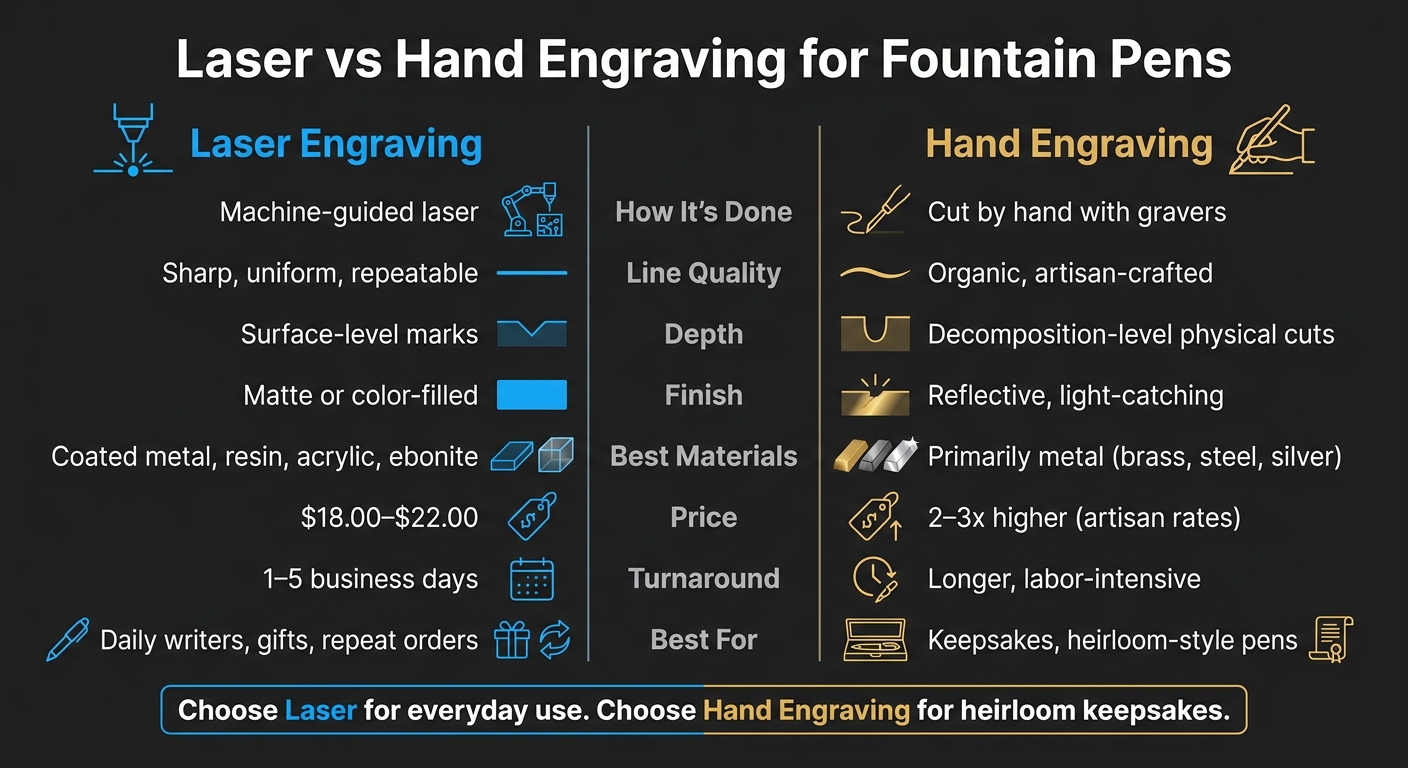
Laser vs Hand Engraving for Fountain Pens: Side-by-Side Comparison
| Feature | Laser Engraving | Hand Engraving |
|---|---|---|
| How it’s done | Machine-guided laser | Cut by hand with gravers |
| Look | Clean, even | Hand-cut, varied |
| Depth | Surface-level | Deeper cuts |
| Best materials | Coated metal, resin, acrylic, ebonite | Mostly metal |
| Price | $18.00–$22.00 | 2–3x higher in many cases |
| Turnaround | 1–5 business days | Longer |
| Best for | Daily use, gifts, repeat orders | Keepsakes, heirloom-style pens |
If I’m buying for daily use, I’d lean laser. If I’m marking a pen as a fountain pen gift or special date, I’d give hand engraving a close look.
How Each Engraving Method Works
Laser Engraving: Computer-Controlled and Repeatable
Laser engraving uses a focused beam to mark or remove the pen’s surface without making contact. You load the design into software, and the machine follows those instructions exactly. That’s why the results are so repeatable.
On paint-coated metal pens, the laser removes the outer paint layer and reveals the base metal underneath, often brass or silver. On ebonite or acrylic pens, the laser marks the surface itself. With those materials, color fill can help the design stand out more clearly.
This method works well for digital text, logos, and other designs that need to be produced the same way again and again. Those traits affect speed, wear over time, and how the finished engraving looks.
Hand Engraving: Deeper Cuts and Visible Craft
Hand engraving is done by a skilled artisan using gravers. Each cut comes from the engraver’s hand, so small variations are part of the final look.
It often cuts deeper than laser engraving, and the line width can vary slightly. That gives the work a clear hand-cut feel you can see right away. Hand engraving also takes much longer than laser work.
The contrast between the two methods stands out most when you compare line quality, depth, and finish side by side.
Laser vs Hand Engraving: Side-by-Side Comparison
Line Quality, Depth, and Surface Finish
Laser engraving keeps line weight and spacing even from one pen to the next. That makes it a strong pick for text and logos that need exact repeatability. On coated metal pens, the laser removes the outer layer and reveals the base metal underneath. On resin, acrylic, and ebonite, the mark is usually more subtle.
Hand engraving goes in deeper and leaves small variations you can actually see. That’s part of the charm. The cuts catch light because the engraver changes angle and pressure as they work, which gives the surface a reflective look. And in practice, the material shapes the final look almost as much as the method itself.
Turnaround Time, Durability, and Price
Laser engraving wins on speed. It usually adds just 1–5 business days to a standard order. Hand engraving takes longer and involves more labor because each pen gets one-on-one attention from a skilled artisan.
Price is where the difference becomes hard to miss. Standard laser engraving is $18.00, while color-filled engraving on resin or ebonite is $22.00. Hand engraving usually costs 2–3x more than standard laser options because of the labor involved.
Both methods hold up well over time, but they do it in different ways. Laser engraving handles everyday wear well. Hand engraving, with its deeper cuts, tends to stand up better to polishing and long-term fading. That starts to matter a lot once you factor in the pen’s body material.
Here’s the side-by-side view.
Comparison Table: Laser vs Hand Engraving for Fountain Pens
| Feature | Laser Engraving | Hand Engraving |
|---|---|---|
| Line Quality | Sharp, uniform, repeatable | Organic, one-of-a-kind, artisan-crafted |
| Depth | Shallow surface marks | Deeper, physical cuts |
| Finish | Matte or color-filled | Reflective, light-catching |
| Turnaround | Fast (1–5 business days) | Slower, labor-intensive |
| Cost | $18.00–$22.00 | Higher (artisan rates) |
| Durability | High (reveals base metal on coated pens) | Exceptional (resists polishing and wear) |
| Best Fit | Metal, resin, acrylic, ebonite | Primarily metals (brass, steel, silver) |
| Ideal Use Case | Daily writers and gifts | Heirloom keepsakes |
The best choice often comes down to the pen material: metal, resin, acrylic, or ebonite.
Which Fountain Pen Materials Work Best for Each Method
After finish and cost, material is usually the thing that settles the choice. Laser and hand engraving don't perform the same way on every surface. In many cases, the pen material tells you which method will look better.
Metal Barrels and Trim
Coated metal usually gives standard laser engraving the strongest contrast. Why? The laser removes the coating and exposes the base metal underneath. On uncoated metal, deeper hand engraving is often the better pick.
Fountain Pen Revolution notes that the engraving will appear as the metal color under the paint, usually brass or silver. On coated metal pens, color fill isn't available, so all of the contrast comes from that exposed base metal beneath the finish.
Metal and resin don't react the same way, so the best method shifts with the barrel material.
Resin, Acrylic, and Ebonite
Standard laser markings on acrylic, ebonite, and plastic can look faint. Fountain Pen Revolution states:
"Standard engraving is much more subtle and does not show up very well on most acrylics."
That's where color fill helps. It adds contrast and makes the engraving easier to read. On these materials, laser works when the contrast is already good enough. If readability is the main goal, color fill is often the safer choice.
With the material narrowed down, the next step is matching the method to the use case.
How to Choose the Right Engraving Method
Once you know how these methods work, the next step is simple: match the method to the pen material and the reason you're buying it. The main things to weigh are material, look, budget, and turnaround time.
Best Method by Use Case: Daily Writer, Gift, or Keepsake
If you're engraving a daily writer on coated metal, standard laser engraving is the practical pick at $18.00.
If the pen is meant to be a gift or keepsake, color-filled laser engraving at $22.00 gives you better contrast. On darker materials like ebonite or resin, gold color fill tends to stand out especially well.
Your font matters too. Decorative fonts fit gifts better, while clean serif fonts usually make more sense for a daily writer.
A couple of small but important details: engraving adds 1–5 business days, and custom-engraved pens are final sale unless defective.
So the choice comes down to a few plain questions: What material is the pen made from? How much contrast do you want? And is this pen for everyday use or for a moment you want to mark?
FAQs
Which engraving lasts longer?
Hand engraving is often seen as the top pick for pens made to last. It offers long-term wear and the kind of craftsmanship people tie to heirloom pieces.
Laser engraving gives you clean, exact results at a lower cost for standard designs. Rotary or CNC engraving, on the other hand, can cut deeper grooves into materials like stainless steel or titanium, which helps the engraving hold up well over time.
Can I engrave any fountain pen material?
Many fountain pen materials can be engraved, but the right method depends on what the pen is made of. Materials like acrylic, ebonite, plastic, and many metals usually work well with laser engraving.
There’s one common limit with paint-coated metal pens. These can only be engraved in the standard way, which removes the top coating and shows the metal underneath, such as brass or silver.
Some high-heat laser methods also aren’t a good fit for certain surfaces. And when it comes to hard nib-tip alloys, direct engraving is almost impossible.
Is color fill worth adding?
Yes, if you want your engraving to stand out more clearly. This helps most on ebonite, acrylic, and plastic pens, where standard laser engraving can look a bit subtle.
For $4.00, color fill adds contrast and makes the engraving easier to read. It isn't available for metal pens. If you choose it, you can pick your preferred fill color from the dropdown menu when ordering.