

If I journal often, I’d pick sheen for full entries and shimmer for short accents. That’s the short answer.
Here’s why: sheen inks give me a color shift with less pen upkeep, while shimmer inks add sparkle but usually dry slower, smear more easily, and need more cleaning. In many cases, shimmer also works better in medium or broader nibs, while sheen can still work in finer daily-writing setups.
Before I choose one, I’d look at five things:
- Page look: sheen = color shift; shimmer = sparkle
- Dry time: both can dry slowly, but shimmer often stays messy longer
- Paper behavior: smooth paper helps both; absorbent paper can mute sheen
- Pen cleanup: sheen needs a normal flush; shimmer often needs a deeper clean
- Best use: sheen for long writing, shimmer for headers, dates, and borders
A few details stand out fast:
- Some sheening inks can stay smudge-prone for 30 seconds to several minutes on smooth paper
- Shimmer particles can settle in the pen, so some people clean shimmer pens after 1–2 weeks
- Journal paper in the 80–100 gsm range often gives a better balance of bleedthrough control and show on the page
Sheen Ink vs Shimmer Ink - Which One Should You Buy?
sbb-itb-1dd4fe9
Quick Comparison
| Factor | Sheen | Shimmer |
|---|---|---|
| Buying Guide | What to consider | What to consider |
| --- | --- | --- |
| Main effect | Color shift | Sparkle |
| Best for | Long entries | Short accents |
| Dry time | Slow | Often slower |
| Smear risk | Medium to high on smooth paper | High if closed too soon |
| Pen cleaning | Normal flushing | More thorough cleaning |
| Nib match | Fine to broad, often medium+ for more show | Medium to broad |
| Paper match | Smooth, less absorbent paper | Smooth fountain-pen-friendly paper |
Bottom line: if I want my handwriting to stay readable across full pages, I’d use sheen. If I want dates, headers, or dividers to stand out, I’d use shimmer.
Sheen inks on journal pages
How sheen looks on the page
Sheen shows up as a second color along the edges of letters and in spots where ink pools. You’ll see it most in headings, titles, and broad strokes. Tilt the page, and a dark blue ink might show a red or bronze rim.
Paper makes a big difference. On smooth, slow-absorbing paper, sheen looks bold and easy to spot. On more absorbent notebooks, that same ink can look far more muted, with the second color only showing a little in broader strokes. And once shimmer enters the picture, paper choice matters even more.
Dry time, smear risk, and feathering
Because sheen sits on the surface of the page, it takes longer to dry. On smooth paper, broad-nib writing can stay smudge-prone for 30 seconds to several minutes. If you close your journal too soon, ink can transfer to the facing page or smear what you just wrote.
Wetter pens and broader nibs also make feathering and show-through more likely, especially on thin or absorbent paper. For long entries, a medium or fine nib usually keeps lines cleaner and cuts dry time, while still leaving some sheen in heavier strokes. Paper at 90 gsm or higher with a smooth or lightly coated surface tends to work well for daily writing.
Cleaning needs and use for long entries
Sheen comes from the dye itself, so sheening inks have no glitter or particles. That means pens filled with them usually need only routine flushing with clean water when you switch inks or after several weeks of use.
That makes sheen a good fit for long journal entries and daily logs. A moderately wet pen, a medium nib, and fountain-pen-friendly paper can keep sheen usable in day-to-day writing.
Shimmer behaves differently because its particles create a new set of page and cleanup issues. Some inks, like Cosmic Pink Shimmer, even combine sheen and sparkle in one bottle.
Shimmer inks on journal pages
How shimmer looks on the page
Shimmer adds easy-to-see sparkle from suspended mica or metallic particles that rest on the page surface and catch the light. In plain terms, shimmer is a visual accent first, not the kind of ink most people want for everyday writing.
You’ll notice that sparkle most in broader strokes, like titles, headers, dividers, and flourishes, because more particles land on the page at the same time. In fine-nib writing or packed body text, the shimmer is still present, but it won’t stand out as much. For journaling, the practical takeaway is simple: shimmer fits short visual breaks on a page better than full-page writing.
Dry time, smearing, and paper behavior
Shimmer ink usually takes longer to dry than standard ink, especially in wet pens or broad nibs. If you close your journal too soon, the shimmer layer can still transfer.
Thinner paper can also be a problem. Ghosting and bleedthrough are common concerns, and a saturated shimmer ink used with a broad nib may show on the back side of the page. Smooth, fountain-pen-friendly paper helps the particles stay on the surface and can cut down on bleedthrough, but there’s a tradeoff: drying may take longer.
Cleaning needs and use for short accents
Shimmer asks more from your pen and from you. Since the ink contains solid particles, those particles settle inside the pen - in the feed, the converter, and around the nib. Many writers let the pen run dry within 1–2 weeks, then clean it well before refilling.
A quick rinse often isn’t enough. Feed fins and channels tend to hold onto particles, so a soft toothbrush and a thorough flush are usually needed to clear them out. That’s why many journalers keep a separate pen just for shimmer instead of using it in their daily journaling pen. It’s extra work, and that’s a big part of why shimmer makes more sense for short uses.
In practice, shimmer works best for:
- date stamps
- headers
- cover pages
- border lines
Those tradeoffs stand out even more in the side-by-side comparison that follows.
Sheen vs shimmer: side-by-side for journal use
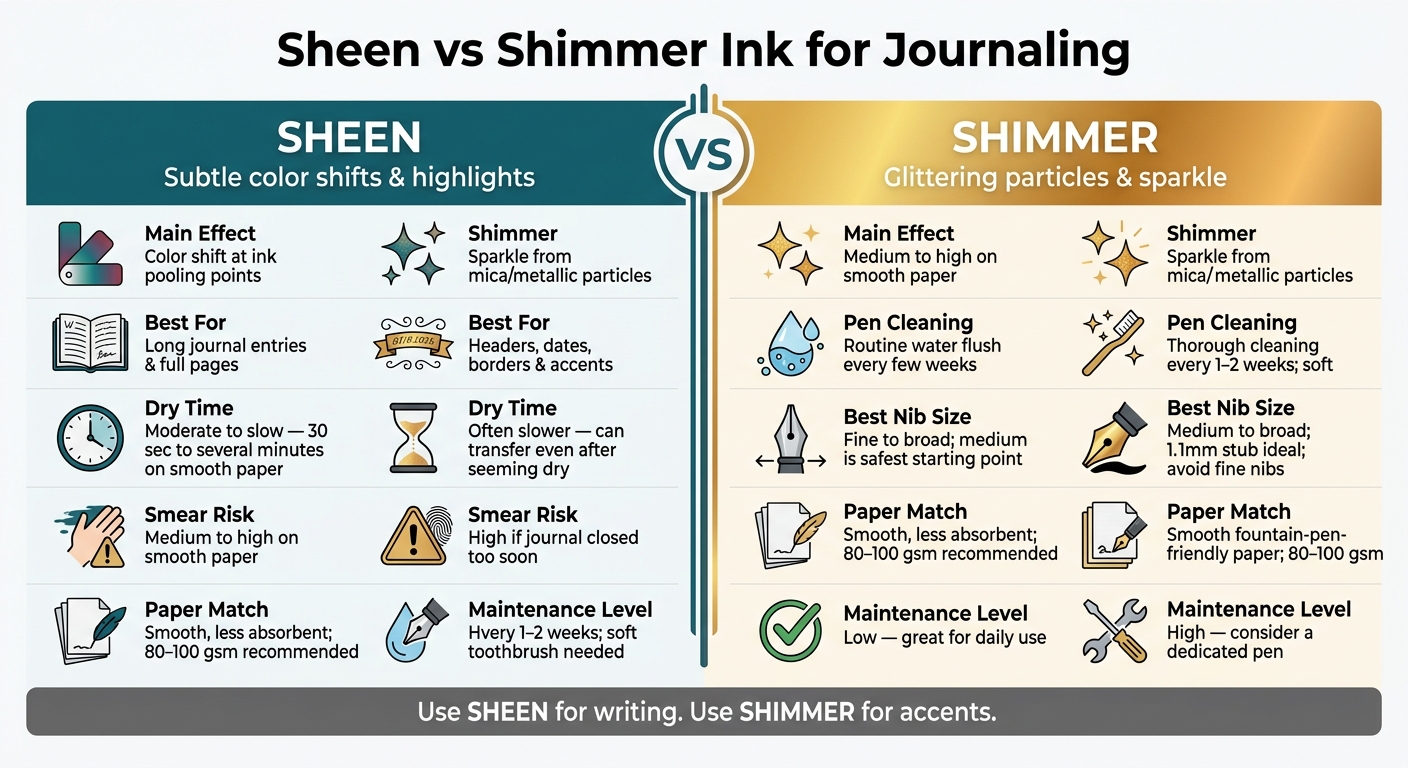
Sheen vs Shimmer Ink: Journal Writer's Quick Comparison Guide
Page look, dry time, and feathering compared
Now that the basics are clear, the day-to-day difference comes down to how each ink acts on an actual journal page.
Sheen creates a color shift where the ink pools. Shimmer adds visible sparkle from tiny particles. That sounds simple enough, but on paper the gap is pretty obvious. Shimmer can still transfer even after the page seems dry to the touch. And if your paper is rough or absorbent, sheen tends to fade while shimmer can look patchy.
| Factor | Sheen | Shimmer |
|---|---|---|
| Page appearance | Color shift in pooled strokes | Sparkle across writing |
| Dry time | Moderate to slow | Often slower |
| Feathering tendency | Best on smooth paper | More likely on rough paper |
| Cleaning effort | Normal flush | Thorough cleaning |
| Best use case | Long entries | Short accents |
Cleaning effort and daily writing practicality
Sheen is much easier to live with in a daily journal pen. A normal water flush is usually enough, so maintenance stays pretty simple.
Shimmer asks for more work. The particles can settle in the feed, converter, and nib channels, which means you need a more thorough cleaning. If you like low-fuss writing tools, that difference matters fast.
Which one fits long entries and which fits accents
For text-heavy journal pages, sheen is the better default. It gives your writing more depth and a subtle color shift without making the page feel crowded or tough to read. A full page written with a sheening ink still looks like handwriting - just a bit richer, with more character.
Shimmer works best in short bursts. A sparkly header, a decorated date entry, or a border line grabs attention right away. That’s where it shines, no pun intended. But across a full page of body text, the sparkle can start to feel busy. The particle load can also leave the page slightly rough to the touch or transfer to the opposite side if there’s pressure.
So the split is pretty clear: use sheen for pages you plan to write through, and use shimmer for the parts you want to highlight. Next, match each ink to the right pen and paper.
Pen and notebook setup for each ink type
The practical part comes down to pairing each ink with the right pen and paper.
Pen traits that work well with sheen inks
Sheen needs enough ink on the page to show up. Wet-writing pens with medium, broad, or stub/italic nibs are the safest picks. For journal writing, a medium nib is a smart place to start. It lays down enough ink to create a visible sheen halo, but not so much that your lines get thick and crowded.
Stub and italic nibs take that effect up a notch. Their wide cross-strokes leave more ink at the edges of each letter, and that’s usually where sheen shows best. The catch? They can feel a bit heavy for small handwriting or tight planner layouts.
Fine nibs can still work for daily journaling. You’ll just get a quieter effect. On very smooth paper, even a fine nib can show some color shift at stroke crossings and on letter dots. The trade-off is simple: less drama, but faster dry times and less smearing. For left-handed writers, that can be a pretty good deal.
For sheen, a wetter pen usually gives you more color shift. Medium nibs are the safest starting point, while broad and stub nibs make the effect easier to see.
Shimmer is a different beast because the particles change how the pen writes and how you need to clean it.
Pen traits that work well with shimmer inks
Start with at least a medium nib. Broad nibs and 1mm stub nibs are even better because they lower the chance of clogging and skipping. Fine nibs can trap particles, which often leads to hard starts or patchy flow in the middle of a writing session.
Nib size is only part of it, though. Steady ink flow is what keeps shimmer inks behaving. Pens with generous feeds - often piston-fillers, eyedroppers, and cartridge/converter pens that are easy to clean - help keep particles moving instead of settling in the channels. Pens that come apart without a fight are also much easier to flush and clear.
A lot of writers make life easier by giving shimmer inks their own pen. That cuts down on deep cleaning across the rest of your collection, and it helps avoid stray shimmer particles ending up in a pen you use every day. A low-cost pen from Fountain Pen Revolution works well as a dedicated shimmer pen.
Notebook paper that reduces feathering and smudging
If you write on both sides of the page, 80–100 gsm paper is a solid range. Papers like Rhodia and Clairefontaine in the 80–90 gsm range handle wet inks without much bleedthrough and keep feathering low. If you want the strongest sheen, Tomoe River S 52 gsm is known for it. But there’s a catch: ghosting is noticeable, so using both sides of the page becomes a trade-off.
Cheap, absorbent paper tends to flatten sheen and dull shimmer sparkle. The easiest way to check a notebook is to test one line, wait your normal dry time, and then look at the back of the page.
If you want to try both ink types before putting them in a premium pen, the next section looks at budget-friendly options.
Affordable pen options for testing sheen and shimmer
If you want to try these setups before putting them in your main pen, a cheap model will do the job. You're not looking for anything fancy here. You just need a low-cost test pen that lets you compare how ink behaves on journal paper.
For that kind of setup, Fountain Pen Revolution is a good place to look. It sells low-cost fountain pens and replacement nibs. Replacement #5.5 and #6 nibs cost about $4–$9. That makes it pretty easy to put together a dedicated test pen for sheen or shimmer in your journal without spending much.
A simple setup works best:
- Use one pen just for shimmer inks, since the particles can change how the pen writes.
- Use a separate, wetter pen for sheen testing.
When a dedicated pen makes sense
Shimmer works well for headings, dates, borders, and other short accents. Sheen makes more sense in a separate pen when you want to use it for longer entries.
Conclusion: Choosing the right ink style for your journal
After looking at how each ink behaves on the page, the choice comes down to how you plan to use it. Sheen gives you a color shift. Shimmer gives you sparkle.
Key takeaways for journal writers
Your final pick should rest on four practical factors: paper quality, dry time, cleanup, and entry length.
Sheen is the lower-maintenance option for daily journaling on smooth paper. If you're filling page after page with longer entries and want things to stay easy to read, sheen is the smarter choice.
Shimmer is better for parts of the page that are meant to stand out, not for dense blocks of text. Titles, date stamps, short quotes, and decorative borders all look better with that reflective sparkle. Just expect to clean your pen more often, since the particles can settle in feeds and converters over time.
Sheen for writing; shimmer for accents.
Test both inks on your journal paper before choosing a permanent setup.
FAQs
Can I use shimmer ink in a fine nib?
Yes, but it’s usually not the best experience.
Fine nibs have narrower channels, so shimmer particles are more likely to clog the feed. They also lay down less ink on the page, which means the shimmer is harder to see than it would be with a broader nib.
If you decide to use shimmer ink in a fine nib, expect to clean the pen more often. A good rule of thumb is to flush it every 1 to 2 weeks.
Which paper shows sheen best?
High-quality, coated fountain pen paper shows sheen best. Tomoe River is widely seen as the gold standard because its coating keeps ink on the surface instead of letting it sink into the fibers.
Clairefontaine and Rhodia are also strong picks. And if you want something easier on the wallet, HP Premium 32 lb. Laser Paper can be a good option.
How do I stop shimmer from clogging my pen?
Shake or roll the bottle before you fill the pen, then give the pen a gentle move now and then while writing. That helps keep the shimmer particles floating instead of sinking to the bottom.
Those particles can also settle in the feed and nib over time, so flush the pen with water or pen cleaning solution every 1 to 2 weeks. If shimmer flow feels a bit fussy, try a broad or stub nib. The extra width usually gives the particles more room to move.