

A bigger ink bottle is not always the better deal. I’d judge these bottles by landed cost per mL, not shelf price, and I’d only buy the big one if I knew I’d use it before part of it went to waste.
Here’s the short version:
- Lowest cost per mL: Noodler’s 4.5 oz (about 133 mL) at about $0.17/mL
- Low-cost daily-use picks: Diamine 80 mL and Pilot Standard 70 mL at about $0.19 to $0.23/mL
- Middle of the pack: Pelikan 4001 62.5 mL and Pilot Namiki 60 mL at about $0.22 to $0.26/mL
- Higher cost per mL: Waterman 50 mL at about $0.28 to $0.32/mL
- Higher-cost permanent inks: Platinum Carbon Black 60 mL at about $0.33 to $0.42/mL, and Diamine Registrar’s 100 mL at about $0.21 to $0.24/mL
- Shipping can change the ranking fast, especially on single-bottle orders
- If 20% of a large bottle goes unused, your effective cost per mL jumps by 25%
So if you write a lot, a large bottle can cut your ink cost. If you use one color now and then, a 50 to 70 mL bottle is often the safer buy. And if you want waterproof or archival ink, the bottle may cost more in both money and pen cleaning time.
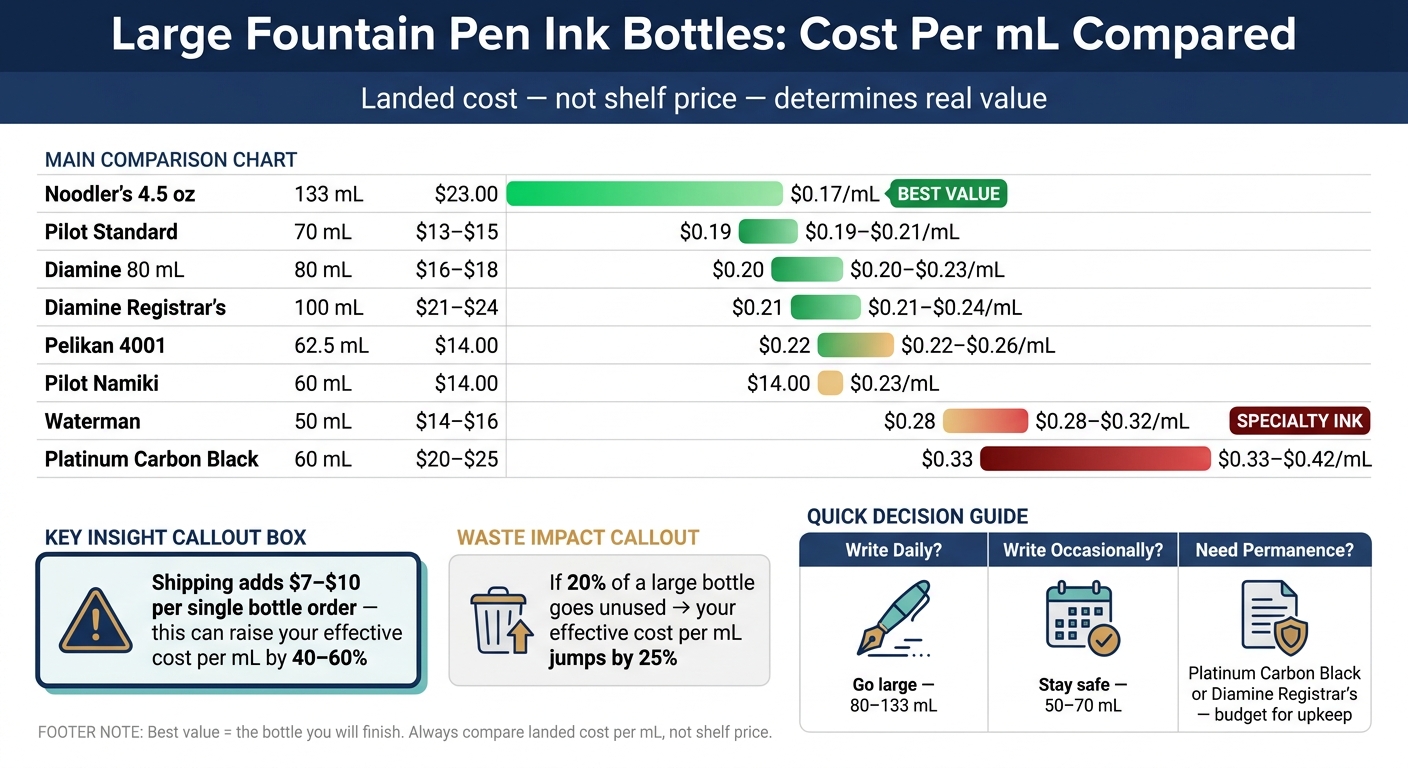
Large Fountain Pen Ink Bottles: Cost Per mL Compared
When Does Fountain Pen Ink Become Too Expensive?
sbb-itb-1dd4fe9
Quick Comparison
| Bottle | Usual Price | Volume | Approx. Cost per mL | Main Point |
|---|---|---|---|---|
| Diamine 80 mL | $16.00–$18.00 | 80 mL | $0.20–$0.23 | Low-cost dye ink for frequent use |
| Pelikan 4001 | $14.00 | 62.5 mL | $0.22–$0.26 | Dry-flowing daily-use ink |
| Pilot Namiki | $14.00 | 60 mL | $0.23 | Solid everyday option |
| Pilot Standard | $13.00–$15.00 | 70 mL | $0.19–$0.21 | One of the better deals here |
| Waterman | $14.00–$16.00 | 50 mL | $0.28–$0.32 | Easy bottle shape, but pricier |
| Noodler’s 4.5 oz | $23.00 | 133 mL | $0.17 | Lowest raw cost per mL |
| Platinum Carbon Black | $20.00–$25.00 | 60 mL | $0.33–$0.42 | Pigment ink with more upkeep |
| Diamine Registrar’s | $21.00–$24.00 | 100 mL | $0.21–$0.24 | Permanent ink at a fair per-mL cost |
My takeaway: if you want the plain answer, the best value is the bottle you’ll finish. Price per mL matters, but so do shipping, bottle design, and maintenance.
1. Diamine 80 mL
Price per mL
Diamine’s 80 mL bottle usually sells for $16.00–$18.00, which works out to about $0.20–$0.23 per mL.
Landed Cost
The bottle price looks low at first, but shipping can eat into that deal fast. A $17.00 bottle with $7.00–$10.00 shipping pushes the effective cost up by 40% to 60%. If you’re buying just one bottle, that stings a bit. It makes more sense to bundle your order and aim for free shipping.
Bottle Volume
At 80 mL, this glass bottle gives you a lot more ink than Diamine’s 30 mL option. If you write often, that bigger size drops your cost per mL and gives you more room before you need to restock.
Ink Type and Value
Diamine is a well-behaved dye ink. It works nicely on different paper types and usually asks for less upkeep than more saturated inks. If you write on a regular basis, Diamine 80 mL is a low-cost, low-maintenance pick.
Next up: Pelikan 4001 62.5 mL.
2. Pelikan 4001 62.5 mL
Price per mL
In the U.S., Pelikan 4001 62.5 mL usually sells for about $14.00. That puts it at roughly $0.22–$0.26 per mL.
Landed Cost
If you buy just one bottle, shipping can change the math fast. It often adds 50%–70% to the bottle price, which eats into much of the savings that come with the larger size.
Bottle Volume and Ink Type
The 62.5 mL bottle is Pelikan’s larger standard size, so people who write a lot get more ink each time they buy. Pelikan 4001 is a dry-flowing dye ink, which makes it a good fit for absorbent paper and day-to-day writing.
Next up: Pilot Namiki 60 mL.
3. Pilot Namiki 60 mL
Price per mL
Pilot Namiki 60 mL usually sells for about $14.00, which works out to around $0.23 per mL. That puts it in the middle of the pack for daily-use ink. It’s not the lowest-cost option here, but it still offers solid value for a dependable dye ink.
Landed Cost
With a single bottle, shipping can eat into the value pretty fast. If you bundle your order, the landed cost usually looks a lot better.
Bottle Volume and Ink Type
This 60 mL glass bottle comes with an internal plastic reservoir, which makes it easier to reach almost every last drop. It’s a small touch, but it helps you get more out of the bottle over time. The ink itself is a standard dye ink made for everyday writing, similar to the formula found in Pilot ink cartridges.
Next, Pilot Standard Ink 70 mL comes in a slightly larger bottle.
4. Pilot Standard Ink 70 mL
Price per mL
Pilot Standard Ink 70 mL is a step up from the Namiki 60 mL in both size and value. At about $13.00–$15.00, a 70 mL bottle comes out to roughly $0.19–$0.21 per mL.
That’s a pretty solid deal. The larger bottle helps cut the cost per mL compared with the more common 30–50 mL sizes, which is where a lot of fountain pen inks tend to sit.
Landed Cost
Shipping can wipe out the savings if you buy just one bottle. Bundle a few items together, and the landed cost usually looks a lot better.
Bottle Volume and Ink Type
With 70 mL of ink, this bottle gives you more room than the usual 30–50 mL range. It also includes an internal ink well, which makes filling easier once the ink starts getting low.
The ink uses a dye-based formula, so it’s low-maintenance and fountain-pen friendly.
Next: Waterman 50 mL.
5. Waterman 50 mL
Price per mL
Waterman 50 mL usually sells for $14.00–$16.00, which works out to about $0.28–$0.32 per mL. That puts it near the top of this group in cost per mL.
So while Waterman is known for reliable performance and easy filling, it doesn't offer the lowest cost per mL in this comparison. There's also a small shipping wrinkle here: when you buy just one bottle, the landed cost can jump fast. Bundle it with other items, and the per-mL math tends to look better. In plain terms, the bottle design can matter just as much as the bottle size.
Bottle Volume and Ink Type
The hexagonal bottle is one of those small design choices that makes a big difference. As the ink level drops, you can tilt the bottle onto its angled sides so the remaining ink pools near the opening. That makes filling a lot less fussy, though you can also use an inkwell for low bottles.
The ink itself is low-maintenance and safe for modern and vintage pens.
You might also consider FPR fountain pen ink for high-value alternatives. Next, compare that convenience with a larger bottle format.
6. Noodler's 4.5 oz (approx. 133 mL)
Price per mL
Noodler's 4.5 oz bottle, or about 133 mL, usually sells for around $23.00 in the U.S. That works out to about $0.17 per mL, which makes it the lowest-cost option in this group. On price alone, this bottle sets a new low for the set.
Landed Cost
Add $7.00 for shipping on a single bottle, and the landed cost comes to about $0.23/mL.
Bottle Volume
The 4.5 oz bottle is Noodler's largest standard format. That larger size works well for heavy daily use and means fewer bottle changes. If you write a lot, having more ink on hand pushes back the next restock and gives you more for your money over time.
Ink Type and Value
That larger volume matters most when you go through ink fast. So this bottle makes the most sense for high-volume writers who are likely to use it up without much delay.
Next: a specialty ink with a higher per-mL cost, but a different job to do.
7. Platinum Carbon Black 60 mL
This bottle costs more per mL, but it does a different kind of work.
Price per mL
A 60 mL bottle of Platinum Carbon Black usually sells for $20.00 to $25.00 in the U.S. That puts the cost at about $0.33 to $0.42 per mL. So yes, it sits well above the other bottles here. It’s about twice the per-mL cost of Diamine 80 mL at around $0.20/mL.
Landed Cost
Shipping matters more with this one than you might expect. A single glass bottle can add $5.00 to $8.00 to the order. If you buy it with other items, that shipping cost gets spread across the whole cart, which brings down the effective cost per mL.
Bottle Volume and Ink Type
The bottle comes with a built-in ink miser. It’s a small plastic insert inside the bottle that helps you fill a pen even when the ink level is low. In plain English: you can use almost all of the ink instead of leaving the last bit stuck at the bottom.
Platinum Carbon Black is a pigment ink, unlike a standard dye-based black ink. It’s waterproof, smudge-proof, and highly lightfast. That makes it a strong pick for artists who put watercolor washes over line work, and for anyone signing documents that need to hold up over time.
The downside is upkeep. Pigment can settle and clog pens. Flush the pen every 2–4 weeks, and flush it before storage if it will sit for more than a week.
Next, compare that specialty value with a larger dye-ink bottle. You can also browse our 1oz ink collection for more affordable daily options.
8. Diamine Registrar's 100 mL
This is the largest bottle in the guide, and it's also one of the more specialized options.
Price per mL
If you want permanence without dealing with pigment-ink upkeep, Registrar's is the other strong value pick. A 100 mL bottle usually sells for $21.00 to $24.00 in the U.S., which works out to about $0.21 to $0.24 per mL. That's only a bit higher than standard Diamine 80 mL at around $0.19 per mL, yet you're still getting a permanent ink at a competitive price.
Put simply, shipping often becomes the thing that swings the deal on small orders.
Landed Cost
Diamine Registrar's comes in a tall plastic bottle, so it's less fragile during shipping. If you're ordering from the UK, international shipping can add around $10.00 to $15.00, which means the landed cost can climb fast. Buying from a U.S. seller helps keep that in check.
Bottle Volume
Compared with the 30 mL bottle, this one gives you 3.3x more ink for about twice the price. That comes out to roughly 40% less per mL.
Ink Type and Value
Diamine Registrar's is a traditional iron gall ink made for archival writing. It goes down blue-black and dries to black. That chemical reaction makes it waterproof and lightfast. It also helps the ink behave well on lower-quality paper, with less feathering than many dye-based inks.
The downside is maintenance. Iron gall ink can be acidic, so it may clog or corrode a pen if it dries inside. Flush the pen every 2 to 4 weeks, and don't use it in vintage pens with plated steel nibs. That's the main reason this bottle belongs in a price guide: permanence here comes with a real ownership cost beyond the per-mL price.
Next, the shipping math shows when the bigger bottle actually wins.
Shipping Costs, Break-Even Math, and When a Bigger Bottle Saves Money
Shelf price only tells part of the story. Shipping, taxes, and store fees can change the ranking fast. So when you compare bottles, look at the landed cost, not just the sticker price.
The Landed-Cost Formula
Landed cost per mL = (ink price + shipping + taxes/fees) ÷ bottle volume
Simple enough. But this is the number that shows whether a bottle is a deal or just looks like one.
Worked Example: Diamine 80 mL vs. Noodler's 133 mL
| Bottle | Bottle Price | Shipping | Total Landed Cost | Landed Cost per mL |
|---|---|---|---|---|
| Diamine 80 mL | $17.00 | $8.00 | $25.00 | $0.31/mL |
| Noodler's 133 mL | $23.00 | $8.00 | $31.00 | $0.23/mL |
| Noodler's 133 mL | $23.00 | $0.00 | $23.00 | $0.17/mL |
With the same shipping charge on both bottles, Noodler's still comes out ahead on cost per mL. If Noodler's gets free shipping, the difference gets even bigger.
That’s the key point: a bigger bottle doesn’t need to be cheaper up front to be the better buy. It just needs to deliver more ink at a lower landed cost per mL.
Break-Even Math
Here’s the shortcut:
Smaller-bottle landed cost per mL × larger-bottle volume = maximum landed price for the larger bottle.
| Small Bottle Cost/mL | Larger Bottle Volume | Max Landed Price for Larger Bottle |
|---|---|---|
| $0.31/mL (Diamine 80 mL) | 133 mL (Noodler's) | $41.23 |
| $0.28/mL (Waterman 50 mL) | 80 mL (Diamine) | $22.40 |
| $0.23/mL (Pilot Namiki 60 mL) | 70 mL (Pilot Standard) | $16.10 |
This gives you a clean ceiling. If the larger bottle’s total landed cost goes above that number, the smaller bottle gives better value.
For example, if a 133 mL bottle has a break-even ceiling of $41.23, any landed price under that keeps it ahead of the 80 mL option on a per-mL basis. Go over that line, and the math flips.
When a Bigger Bottle Actually Saves Money
A larger bottle tends to make sense when:
- You use that ink often
- The order hits a free-shipping threshold or you buy ink bundles
- The landed cost per mL is clearly lower
There’s one catch, and it matters more than people think. If 20% of a large bottle goes to waste before you finish it, the effective cost per mL jumps by 25%. That can wipe out the savings in a hurry.
So yes, the big bottle can save money. But only if you’ll use enough of it to make the lower per-mL cost count.
Once the price side is settled, the next step is figuring out whether the bottle format is worth the tradeoff.
Pros and Cons of Each Bottle Format
Once the price-per-mL math makes sense, the next thing that matters is simple: Will this bottle actually work well for the way you write? A low-cost bottle on paper isn't much of a bargain if it's awkward to fill from or sits half-used on your shelf for years.
| Bottle | Main Advantages | Main Drawbacks | Best For |
|---|---|---|---|
| Diamine 80 mL | Good value when shipping is shared across a larger order | Heavy glass can increase shipping cost | Frequent users who bundle orders |
| Pelikan 62.5 mL | Angled bottle lets you tilt and pool ink when levels get low | Less useful if you don't tilt the bottle | Users who want to reduce waste at low levels |
| Pilot Namiki 60 mL | Internal plastic reservoir keeps ink accessible for filling | No major drawback | Users who want easy filling |
| Waterman 50 mL | Angled shape reduces waste at low levels | Higher cost per mL than most options here | Users who want to reach low ink levels easily |
| Noodler's 4.5 oz (approx. 133 mL) | Lowest cost per mL in this guide; large volume | High upfront cost; waste risk if you don't finish the bottle | Heavy daily users with a favorite color |
| Platinum Carbon Black 60 mL | Waterproof, pigmented, archival-quality ink | Requires more frequent pen cleaning | Document work and permanence-focused writing |
| Diamine Registrar's 100 mL | Iron-gall formula with water-resistant, archival qualities | Requires more frequent pen maintenance | Legal, archival, or professional document writing |
That’s why the best-value bottle isn’t always the one with the lowest sticker price per mL. Bottle design changes the day-to-day experience more than many people expect. A tilted base or built-in reservoir can make the last bit of ink much easier to use. And that can matter just as much as the raw math.
The specialty inks - Platinum Carbon Black and Diamine Registrar's - earn their higher price if you need permanent writing. But there’s a trade-off. You’ll want to flush your pen every 2 to 4 weeks with a pen cleaning kit to help avoid clogging or corrosion.
Big dye-based bottles work best when you go through a lot of ink. That’s when the lower per-mL cost starts to pay off. If it’s a color you only use once in a while, that big bottle can turn into money sitting on a shelf in liquid form.
Conclusion
For large ink bottles, landed cost per mL is the clearest way to judge value. The sticker price can throw you off. Shipping can change which bottle is the better buy once the full cost is on the table.
The smart move is simple: compare bottles using the same units, then look at landed cost. From there, two things should drive the decision:
- Cost per mL
- Your actual usage rate
If you write only now and then, 30–60 mL bottles usually make more sense. If you write a lot and know you'll use it up, a larger bottle can be the better buy. But that lower cost per mL only matters if you finish the ink.
In plain English: the best value is the bottle you will finish.
FAQs
How do I calculate landed cost per mL?
Add the ink bottle price and shipping to get the total cost. Then divide that amount by the bottle size in mL.
Example: a 50 mL bottle that costs $15.00 plus $5.00 shipping has a total cost of $20.00. Then divide $20.00 by 50 mL to get $0.40 per mL.
When is a larger ink bottle worth buying?
A larger ink bottle makes sense if you use the same ink all the time. In most cases, buying more at once brings down the cost per milliliter.
That said, it's smart to test an ink sample first. You want to make sure it plays nicely with your pens, nibs, and paper before you commit to a big bottle.
Big bottles are best for inks you use every day. For new colors or specialty formulas, samples or smaller bottles are usually the safer bet.
How much does shipping affect ink value?
Shipping can change ink value a lot because it pushes up the effective price per mL. The fix is simple: add the shipping cost to the bottle price first, then calculate the true cost per milliliter.
If you want better value, try to skip shipping fees when you can. One easy way is to use a free U.S. shipping threshold, like Fountain Pen Revolution’s $65 minimum.