

Ink viscosity determines how smoothly your fountain pen writes. Thin inks flow faster, creating wetter lines but may leak or dry out quickly. Thicker inks flow slower, producing sharper lines but can cause skipping or hard starts. Temperature also affects viscosity - heat thins ink, increasing flow, while cold thickens it, slowing flow.
To optimize your pen's performance:
- Use lower-viscosity inks for fine nibs and higher-viscosity inks for broader nibs.
- Test ink drying time and flow at home to match your writing needs.
- Clean your pen regularly to maintain consistent ink flow.
Understanding viscosity helps you choose the right ink for your pen and environment, ensuring smoother, more reliable writing.
Ink Viscosity: What It Is and Why It Matters
What Is Ink Viscosity?
Viscosity refers to how much a liquid resists flowing. When it comes to fountain pen inks, they are designed to have a low viscosity - comparable to water - so the ink can easily travel from the reservoir to the nib through the pen's intricate feed system.
As one patent explains:
"Inks used for fountain pens are required to have low viscosity because ink is guided by capillary action to a nib through a pen core including a comb groove to temporarily store ink, an ink passageway, and an air passageway."
Fountain pen inks typically have viscosities ranging from 1.5 to 60 mPa·s (millipascal-seconds). For comparison, ballpoint pen inks are much thicker, with viscosities between 300 and 10,000 mPa·s. This significant difference makes ballpoint inks unsuitable for the capillary action that fountain pens rely on. To understand viscosity's role better, it helps to look at how it differs from other ink properties.
Viscosity vs. Related Ink Properties
While viscosity often gets grouped with other ink characteristics, each property influences writing performance in its own way. For instance, surface tension is the force that pulls ink toward the nib via capillary action, while viscosity deals with the resistance that slows or regulates that flow.
Other factors, such as cohesion (how strongly ink molecules stick to each other) and adhesion (how well ink clings to surfaces like the feed and nib), also play a part. For example, if cohesion is too strong, the ink might retract from the nib slit during writing, causing issues like railroading or other common writing problems.
How Viscosity Affects Nib Performance
Viscosity directly impacts how consistently ink flows and, by extension, the quality of the lines produced. When an ink's viscosity aligns well with a pen's feed design, the ink flows smoothly, creating even lines. But if the viscosity is too far off, performance problems arise.
Inks with lower viscosity flow more freely, but as Sivanpillai Murugan et al. noted:
"Lower viscous ink may not provide good lubrication and may be susceptible to leakage."
On the other hand, inks with higher viscosity flow more slowly, which can result in the nib running dry, causing skipping or hard starts. The best viscosity strikes a balance - allowing steady ink flow without flooding or interruptions.
sbb-itb-1dd4fe9
Research on Measuring Ink Viscosity
How Ink Viscosity Is Measured
The process of measuring ink viscosity depends on the specific conditions of the test. Since viscosity plays a big role in how ink performs in a fountain pen nib, researchers carefully choose the right instruments based on the ink type and testing environment.
For fountain pen inks, two tools are commonly used. Rotational viscometers, like the Brookfield LVDT, are ideal for measuring viscosity at low shear rates (0.01 to 10 sec⁻¹). This mimics the ink's behavior when it’s at rest inside the pen. For higher shear rates (16 to 10,000 sec⁻¹) - which better represent the stresses of actual writing - cone and plate viscometers, such as the Ferranti Shirley, are the go-to choice. Parker Pen (Benelux) B.V. explained their testing procedure as follows:
"The viscosities of inks were measured over the shear range 0.01 to 10 sec⁻¹ on a Brookfield LVDT viscometer with small-sample adaptor. Over the range 16 to 10,000 sec⁻¹, ink viscosities were determined with a Ferranti Shirley cone and plate viscometer."
Additionally, some researchers rely on microviscometers, like the Lovis 2000 ME, for highly precise measurements of dynamic and kinematic viscosity. This is especially helpful when comparing inks with different colors or formulations.
These methods provide a clear picture of the narrow viscosity range that fountain pen inks typically fall into.
Typical Viscosity Ranges for Fountain Pen Inks
Fountain pen inks generally have viscosities ranging from 1.0 to 5.0 cP (centipoise). While this is only slightly thicker than water, the difference comes from the inclusion of additives like glycerin or ethylene glycol, which help regulate ink flow and prevent it from drying out too quickly.
Interestingly, the color of the ink can have a surprising impact on its viscosity. Using a Lovis 2000 ME microviscometer, researchers found that black ink had a dynamic viscosity of 5.751 mPa·s at 68°F (20°C) - over five times higher than red ink (1.114 mPa·s) or blue ink (1.123 mPa·s) at the same temperature. This indicates that pigment concentration and dye composition significantly influence how the ink flows through the nib.
| Ink Color | Temp | Dynamic Viscosity (mPa·s) |
|---|---|---|
| Black | 68°F (20°C) | 5.751 |
| Red | 68°F (20°C) | 1.114 |
| Blue | 68°F (20°C) | 1.123 |
Dynamic viscosity of select ink colors at 68°F (20°C).
These findings highlight the importance of understanding viscosity differences when working with various ink colors.
How Temperature Affects Ink Viscosity
Temperature has a major effect on ink viscosity. For example, black ink measured at 5.751 mPa·s at 68°F (20°C) dropped to just 2.460 mPa·s at 122°F (50°C) - a decrease of 57%. Similarly, red and blue inks, which started around 1.1 mPa·s, thinned to just above 0.6 mPa·s at the higher temperature.
This means that a pen performing well at room temperature might behave unpredictably in extreme heat or cold. Warmer temperatures can cause ink to thin, increasing the risk of leaks, while cooler temperatures make it thicker, potentially leading to sluggish flow or hard starts. For this reason, researchers emphasize the need to maintain consistent temperature and humidity conditions when conducting ink performance tests.
Next, we’ll explore how these viscosity changes influence nib performance.
How I Test Ink Viscosity Fountain Pen Ink #fountainpenink #fountainpens
How Viscosity Levels Change Nib Performance
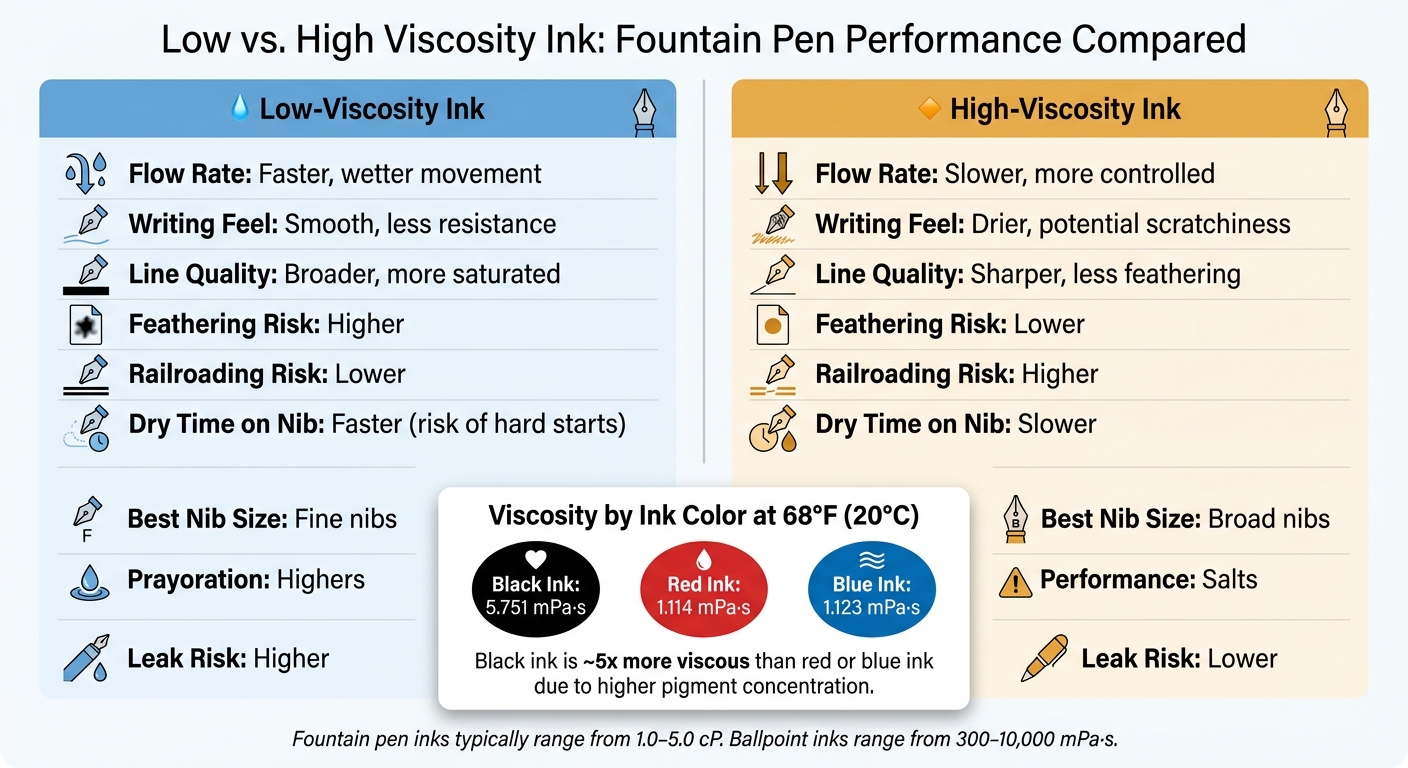
Low vs. High Viscosity Ink: Fountain Pen Performance Compared
Low vs. High Viscosity: How Ink Flows
The viscosity of ink plays a big role in how it moves through the nib. Low-viscosity inks flow more freely, creating wetter, more saturated lines. On the other hand, high-viscosity inks move more slowly, producing drier, sharper strokes.
| Feature | Low-Viscosity Ink | High-Viscosity Ink |
|---|---|---|
| Flow Rate | Faster, wetter movement | Slower, more controlled |
| Writing Feel | Smooth, with less resistance | Drier, with potential scratchiness |
| Line Quality | Broader and more saturated | Sharper, with less feathering |
| Feathering Risk | Higher | Lower |
These differences in flow impact how the ink behaves on the nib, which can lead to issues like start-up delays, skipping, or railroading.
Viscosity and Start-Up, Skipping, and Railroading
High-viscosity inks can struggle in certain conditions, such as cooler temperatures or low humidity. This can cause delays when starting to write, skipping, or even clogging. Both Ferris Wheel Press and newji Editorial Department have noted these challenges.
Railroading, a problem where two thin parallel lines appear instead of a single, solid stroke, happens when ink fails to travel quickly enough to fill the space between the nib tines during fast or flexible writing. High-viscosity inks are more prone to this issue because they move more slowly through the feed. This can disrupt the smoothness and reliability of your writing, particularly with flexible nibs.
But viscosity doesn’t just affect flow - it also changes how the ink dries on paper.
Viscosity and Ink Dry Time
Low-viscosity inks tend to absorb rapidly into paper, but they can also dry quickly on the nib itself, leading to start-up problems that can be resolved with a high-quality nib unit.
Pseudoplastic inks, which thin under pressure during writing and regain viscosity once on the paper, offer a solution. These inks reduce feathering and smearing, making them ideal for fast writers or left-handed users who need ink to dry quickly without smudging. This balance helps ensure a smoother and more dependable writing experience.
Practical Tips for Fountain Pen Users
When it comes to fountain pens, balancing ink viscosity and nib performance is key to a smooth writing experience. Here are some tips to help you get the most out of your pen.
Picking the Right Ink for Your Pen
The relationship between ink viscosity and your pen's nib is crucial. Fine nibs, which rely on narrower channels to create stronger capillary pressure, usually work better with inks that have moderate to lower viscosity. On the other hand, broader nibs can handle thicker inks more effectively.
Surface tension also plays a role in how wet the ink feels. If you're using a low-surface-tension ink that flows more freely, make sure the pen's inner cap is tightly sealed. These inks tend to dry out on the nib faster.
Testing Ink Performance at Home
You can easily test how an ink performs with a few simple tools:
- Absorption Test: Use a strip of 2 mm filter paper marked at 10 mm intervals. Dip the strip into the ink and measure how long it takes for the ink to travel between the marks.
-
Drying Time Test: With a 0.5 ml graduated glass pipette, place a consistent 0.05 ml drop of ink onto filter paper from a height of about 10 mm. Time how long it takes for the drop to change from shiny to matte. As Amadeus W., an engineer, explains:
"The drying time I determined by timing the change of reflection; wet ink has a much higher light reflection than dry."
- Flow Test: Use narrow glass tubes (0.3–0.5 mm in diameter) to observe capillary action. Distilled water typically rises about 56 mm in these tubes, so inks that rise less have lower surface tension and will likely flow wetter on paper. Be sure to conduct these tests under consistent conditions.
Once you've tested your ink, using a fountain pen cleaning kit ensures that your pen stays in top shape.
Cleaning and Maintaining Your Fountain Pen
Regular cleaning is essential to avoid issues caused by ink residue. Leftover ink can thicken over time, disrupting the flow of new ink.
- Flush your pen with room-temperature water until the water runs clear, especially when switching inks.
- If your pen has been unused for a while, soak it for 15 to 30 minutes to loosen dried or thickened ink in the feed channels.
Keeping your pen clean not only preserves the ink's flow but also ensures the nib performs as it should.
Key Takeaways: Ink Viscosity and Nib Performance
The viscosity of ink plays a major role in how a fountain pen performs. Low-viscosity (thin) inks flow more easily, resulting in wetter, more saturated lines. On the other hand, high-viscosity (thicker) inks create sharper and more controlled lines but can sometimes cause issues like skipping or hard starts.
"The most significant outcome was the primary dependence of „ink wetness" on surface tension, followed by viscosity and conductivity with unexpected and partly counter-intuitive correlations."
External factors also affect ink flow. Heat can make ink thinner, increasing the risk of overflow, while cold temperatures can thicken it, potentially stopping the flow altogether. It’s essential to choose fountain pen inks that work well with your typical environment.
The choice of ink also depends on the type of paper you use. For absorbent paper, thicker inks help maintain clean, controlled lines. Conversely, thinner inks work better on coated or premium paper, allowing for vibrant colors without excessive spreading.
FAQs
How can I tell if my ink is too thick or too thin for my nib?
You can figure out if your ink is too thick or too thin by watching how it behaves when you write. Thin ink tends to gush, feather, or bleed through the paper. On the other hand, thick ink might cause skipping, hard starts, or uneven lines because it doesn't flow smoothly. Fountain Pen Revolution provides a range of nibs and inks to help you find the perfect balance for your writing.
Why does my pen write differently in hot or cold weather?
Temperature fluctuations can significantly impact ink viscosity, directly influencing how smoothly it flows. In warmer conditions, ink tends to thin out, which can result in faster flow, smudging, or even "ink burping" as expanding air inside the pen pushes ink out. On the flip side, colder temperatures cause ink to thicken, leading to slower flow, hard starts, or skipping issues. To maintain optimal performance, Fountain Pen Revolution suggests keeping pens and ink stored within a temperature range of 64°F to 72°F.
Can I change ink viscosity to fix skipping or railroading?
Adjusting ink viscosity can make a difference, but it’s often wiser to start by trying a different ink or inspecting for mechanical problems. High-viscosity ink, which is thicker, can lead to skipping or hard starts, while thinner, low-viscosity ink flows more easily but might result in feathering on the page. Skipping or railroading is frequently caused by issues like nib misalignment, poor paper quality, or feed problems - fixing these is usually a better first step.