

When using vacuum filler fountain pens like the TWSBI Vac700R ($72.99–$88.99) or Pilot Custom 823 ($416.00), ink selection is critical for smooth operation and long-term reliability. These pens have large reservoirs and complex mechanisms, including rubber gaskets and shut-off valves, which interact directly with the ink. Using inappropriate inks can lead to clogs, damage, or staining.
Key Takeaways:
- Best Inks: Use water-soluble, dye-based inks (e.g., Pilot Iroshizuku, Diamine standard line) for smooth flow, easy cleaning, and gasket protection.
- Avoid: Shimmer, pigmented, waterproof, and iron gall inks; they can clog, stain, or damage internal parts.
-
Ink Properties:
- Viscosity: Thinner inks flow better and prevent feed dryness.
- Lubrication: Helps gaskets glide smoothly, reducing wear.
- Drying Time: Manage ink flow by loosening the shut-off valve during long writing sessions.
-
Nib Pairing:
- Fine nibs: Pair with drier inks for precision.
- Broad nibs: Use wetter inks for shading and smooth writing.
- Maintenance: Flush regularly with distilled water to avoid residue buildup. Avoid mixing inks from different brands to prevent clogs.
Quick Tips:
- Avoid shimmer or highly saturated inks to prevent staining.
- Stick to easy-to-clean inks for hassle-free maintenance.
- Regularly clean and lubricate pens like the TWSBI Vac700R, but avoid disassembling pens like the Pilot Custom 823 to prevent damage.
Proper ink selection and care ensure your vacuum filler delivers consistent performance and lasts for years.
How to Fill a Fountain Pen: Part V (Vacuum Fillers)
sbb-itb-1dd4fe9
Key Ink Properties for Vacuum Fillers
When it comes to vacuum fillers, not all fountain pen inks perform equally. The unique mechanics of these pens - featuring a large reservoir, a gasket-and-rod system, and rubber seals - mean that the ink's formulation plays a bigger role compared to simpler filling systems.
How Viscosity Affects Ink Flow
Viscosity, or the thickness of the ink, directly impacts how smoothly it flows. Thinner inks tend to move more freely, ensuring smooth plunger operation and consistent ink delivery to the nib. On the other hand, thicker inks can restrict flow, potentially leaving the feed "dry" during longer writing sessions. Thanks to their larger reservoirs, vacuum fillers are designed to deliver a steady, wet ink flow. As Bottle and Plume observed:
"A large reservoir can support wetter writing without starving."
This means wetter inks that fall on the thinner side of the viscosity spectrum generally perform better in vacuum fillers.
How Ink Lubrication Affects Pen Wear
The rubber gasket inside a vacuum filler needs to glide smoothly along the barrel walls during filling. Without proper lubrication, friction can degrade the gasket, leading to issues like vacuum seal failure. Inks with good lubricating properties - often due to their surfactants or wetting agents - help reduce this friction, extending the lifespan of the gasket and internal rod.
Studies suggest that fountain pen inks perform best when their surface tension falls between 38 and 45 dyn/cm. This range strikes a balance between smooth flow and lubrication. Inks that fall outside this range, particularly "dry" inks, may cause the gasket to stick or misalign, leading to uneven wear.
| Component | Role in the Vacuum Filler | Effect of Low-Lubricity Ink |
|---|---|---|
| Rubber Gasket | Creates vacuum and seals reservoir | May wear faster, stick, or tear |
| Internal Rod | Moves the gasket during filling | Increased risk of bending |
| Barrel Walls | Acts as the plunger's cylinder | Gasket may clash or misalign |
Aside from mechanical wear, an ink's drying time also plays a key role in writing performance.
How Drying Time Affects Writing
Drying time can significantly impact your overall writing experience. In a vacuum filler, the shut-off valve regulates ink flow from the reservoir to the nib. When the valve is tightened, only the ink stored in the feed is available for writing. Typically, this is enough for about two pages before the feed dries out. As Drew Brown from The Goulet Pen Company explains:
"Initially, you've got a couple of pages worth of ink to write with because of the ink in the feed, but eventually, it dries up. Then, you're in a writing desert until you loosen that knob again."
To ensure smooth writing during longer sessions, it's crucial to periodically loosen the knob, allowing fresh ink from the reservoir to flow into the feed. This simple step can make a big difference in maintaining consistent performance.
Matching Ink to Your Nib and Writing Style
Pairing Ink Flow with Nib Size
Vacuum fillers are known for delivering a consistently wet ink flow. As The Gentleman Stationer explains:
"Piston Fillers, Vacuum Fillers, and Eyedroppers generally write a wetter line than cartridge-converter pens."
The nib size you use plays a big role in how that flow translates to the page. Fine and extra-fine nibs are particularly sensitive to ink volume, as the extra ink can make lines appear thicker than intended. To keep things precise, these nibs work best with drier inks, like iron gall or blue-black.
On the other hand, broad and stub nibs thrive with wetter inks. The steady flow from a vacuum filler ensures these nibs don’t "railroad" (skip or run dry during a stroke). Plus, wetter inks enhance shading, bringing out more color depth and variation with these nib types.
Nib material also makes a difference. Gold nibs, which are more flexible due to their softer tines, release additional ink when pressure is applied. To maintain control, pairing them with a drier ink is usually a smart choice. Steel nibs, being stiffer, provide consistent ink flow and work well with most standard bottled inks. However, if a steel nib feels scratchy, a well-lubricated ink can often smooth things out.
| Nib Type | Vacuum Filler Behavior | Best Ink Match |
|---|---|---|
| Fine / Extra-Fine | Writes wider/wetter than expected | Dry inks (iron gall, blue-blacks) |
| Broad / Stub | High flow prevents skipping | Standard or wet inks; high-shading inks |
| Gold Nibs | Softer tines increase flow further | Drier inks for better line control |
| Steel Nibs | Stiffer, more consistent flow | Most standard bottled inks |
Your writing style and paper choice also play a big part in selecting the right ink.
Choosing Ink Based on Pressure and Paper
Writing pressure and the type of paper you use are just as important as nib and ink flow. If you write with a light hand, wetter inks help ensure consistent flow, even with less pressure, which is ideal for flex nib pens. Heavy-handed writers, however, naturally push more ink through the nib, so using a drier ink can help avoid over-saturation and feathering.
Paper type is another key factor. Coated papers or those designed for fountain pens, like Rhodia or Tomoe River, don’t absorb ink quickly. This allows the ink to sit on the surface, enhancing shading and sheen. On these papers, even fine nibs can produce thicker lines if the ink is too wet. Meanwhile, absorbent papers, like standard office copy paper, soak up ink quickly, which can dull colors and cause feathering with wetter inks. For everyday paper, stick to a moderately dry ink that behaves well to keep your writing clean and avoid bleed-through.
Safety and Compatibility Checks
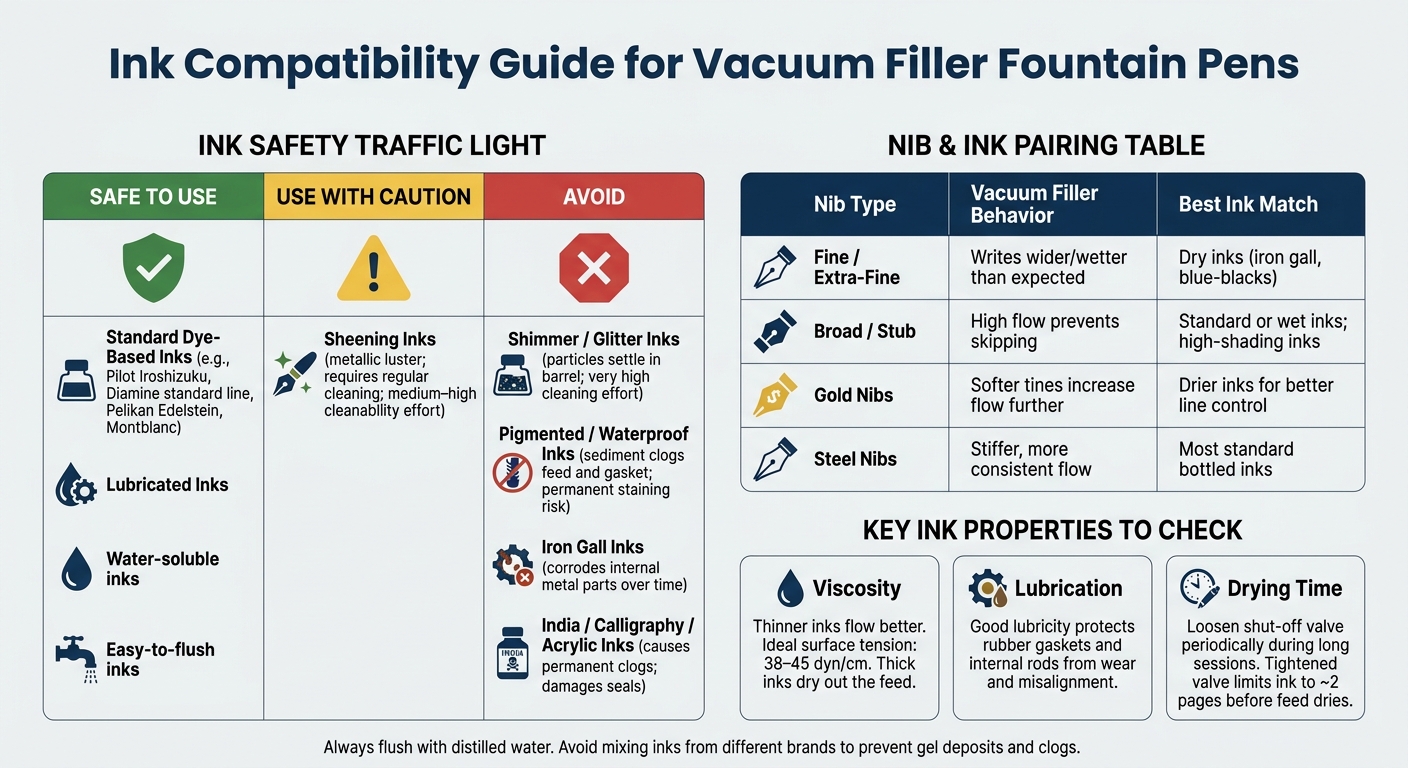
Ink Compatibility Guide for Vacuum Filler Fountain Pens
When it comes to vacuum fillers, ensuring safety and compatibility of the ink is just as important as performance. These pens have more delicate mechanisms than cartridge or converter pens, so choosing the right ink is essential.
Inks to Avoid in Vacuum Fillers
Not all fountain pen inks are suitable for vacuum fillers. The internal mechanism - featuring a rubber gasket sealed against the barrel wall and connected to a plunger rod - is more sensitive and prone to damage. Using the wrong ink can lead to clogs, damaged seals, or cleaning nightmares.
"The MOST IMPORTANT RULE IS TO Only Use Fountain Pen Inks in Fountain Pens"
This means you should steer clear of India inks, calligraphy inks, and acrylic-based drawing inks. These types of inks often contain binders like gum arabic or shellac, which can dry like paint inside the barrel, permanently ruining the filling system.
Here are specific ink types to avoid:
| Ink Type | Risk | How to Identify |
|---|---|---|
| Shimmer / Glitter | Particles settle in the barrel; hard to flush | Look for "Shimmer" or "Sparkling" on the label |
| Pigmented / Waterproof | Sediment builds up in feed and gasket area | Labels include "Pigmented", "Nanoparticle", or "Waterproof" |
| Iron Gall | Can corrode internal metal parts over time | Keywords like "Iron Gall" or traditional "Blue-Black" |
| India / Calligraphy | Causes permanent clogs; damages seals | Look for "India Ink", "Document Ink", or "Calligraphy" |
Shimmer inks, in particular, can be problematic. The particles tend to settle in the barrel, making them much harder to flush out compared to cartridge pens. If you’re tempted to use shimmer ink, save it for cartridge or converter pens that are easier to disassemble.
Saturated inks, like bold reds and purples, are another concern. They can stain the clear acrylic barrels of demonstrator-style vacuum fillers, such as the TWSBI Vac700R. Once stained, it’s nearly impossible to reverse the discoloration.
Why Easy-to-Flush Inks Matter
Vacuum fillers hold more ink than other pen types, which means there’s more residue to deal with when switching colors or performing maintenance. Using inks that are easy to flush helps protect the pen’s internal components.
Dye-based inks are the best choice here. They’re water-soluble and can be cleaned out with just a few rinses of distilled water. Some trusted brands for easy-flushing inks include Montblanc, Pelikan Edelstein, Pilot Iroshizuku, and Diamine’s standard line.
One important tip: avoid mixing inks from different brands. As Moritz Pratt explains, chemical reactions between different inks can form gels or deposits that clog the feed. If you’re curious about a new ink, try a vial test first - mix a small amount with your current ink and let it sit for a few days. If you notice deposits, cloudiness, or gel formation, don’t use that ink. This simple precaution is especially important for expensive pens like the Pilot Custom 823, which costs $416.00.
Picking Ink Colors and Effects
Choosing the right ink colors and finishes isn't just about aesthetics - it also impacts how easy your pen is to maintain, especially when using a vacuum filler.
Standard Inks vs. Specialty Inks
Rich purples, shimmering glitter inks, or deep blues may catch your eye, but they come with a trade-off. Vacuum fillers, with their large ink reservoirs, expose more of the pen's interior to ink. This means inks that are harder to clean can lead to staining or buildup over time.
For everyday use, standard dye-based inks are your best bet. Brands like Pilot Iroshizuku, Diamine (e.g., Oxblood and Marine), and Pelikan Edelstein offer vibrant colors that are easy to flush out, making them ideal for pens with different filling systems.
Specialty inks, on the other hand, require more effort. Sheening inks, which create metallic highlights on the page, can be used if you're committed to regular cleaning. However, shimmer inks - with their glittery particles - pose a greater risk, as the particulates can settle and clog the pen's mechanism.
| Ink Type | Vacuum Filler Safe? | Visual Effect | Cleanability |
|---|---|---|---|
| Standard Dye-Based | Yes | Vibrant and consistent color | Low |
| Lubricated (e.g., Pilot Iroshizuku) | Yes | Rich, smooth tone | Low |
| Sheening | Use with caution | Metallic luster with potential pooling | Medium–High |
| Shimmer | No | Glitter or sparkle effect | Very High |
| Pigmented/Permanent | No | High risk of staining and hard to clean | Very High |
Choosing the right ink means striking a balance between visual appeal and how much effort you're willing to put into maintenance.
Balancing Looks with Ease of Cleaning
With a vacuum filler's large reservoir, it's smart to prioritize inks that combine beauty with practicality. Inks designed for long-term use are better suited for these pens, as frequent color changes can lead to residue buildup.
"When pen and ink balance each other, writing becomes effortless." – Makoba
If you love bold, saturated colors, stick with standard dye-based inks. These are easier to clean and help maintain the pen's performance and appearance. For example, Diamine's Oxblood and Marine deliver striking colors without the hassle of stubborn residue. Similarly, Pilot Iroshizuku inks are lubricated, which helps protect the pen's seals and keeps it running smoothly.
To avoid unnecessary cleaning headaches, reserve shimmer or sheening inks for pens with simpler cartridge or converter systems. This approach keeps maintenance manageable and ensures your pen stays in top shape.
How to Fill and Maintain a Vacuum Filler
Testing and Flushing Before First Use
Before using your vacuum filler for the first time, it’s a good idea to flush it with cool water. This helps remove any manufacturing residues or excess silicone grease lingering in the pen.
To begin, unscrew the filler knob and slowly pull the plunger rod back over 3–5 seconds. This gentle motion protects the tail seals from unnecessary wear. Next, fully submerge the nib and grip section into the ink. Push the plunger down in one smooth motion - this creates a vacuum that draws ink into the reservoir.
Getting the filling technique right can greatly improve the pen's performance:
"A properly working Vacuum Filler will have very smooth and low effort plunger action and will fill nearly full in a single stroke." – Jim Mamoulides, PenHero.com
For best results, repeat the plunger stroke 1–2 more times while keeping the nib submerged. This clears any air bubbles and ensures the reservoir fills to over 80% capacity. Afterward, wipe the nib and grip with a lint-free cloth and securely tighten the filler knob.
When writing, slightly loosen the filler knob to allow ink to flow from the reservoir to the feed. Keeping it fully tightened seals the ink chamber, which is great for travel but might restrict ink flow during extended writing sessions. Following these steps ensures your pen is set up for smooth operation and primes it for regular care.
Regular Cleaning for Consistent Performance
Once your pen is set up, regular cleaning and maintenance is key to keeping it in top shape. Submerge the nib in cool, distilled water and use the plunger to cycle water through the system until it comes out clear. Distilled water is recommended, as it avoids the mineral buildup that can occur with tap water.
If you’re switching from a highly saturated or staining ink, a pen flush solution can be more effective than water alone. After flushing, rinse thoroughly with clean water and let the pen air dry on a paper towel for about 30 minutes before refilling. This routine helps maintain the seals and internal components, ensuring long-term reliability.
For pens designed for user maintenance, like the TWSBI Vac700R ($72.99) and TWSBI Vac Mini ($65.99), the manufacturer includes a wrench and silicone grease for deeper cleaning. Apply silicone grease sparingly to the plunger rod and gaskets - overdoing it can clog the feed. On the other hand, pens like the Pilot Custom 823 ($416.00) and Visconti Homo Sapiens ($920.00) are not meant for user disassembly. Attempting to take these apart could damage the pen or void its warranty.
Conclusion and Key Takeaways
From ink properties to proper maintenance, the ink you choose plays a big role in how well your vacuum filler performs and how long it lasts. The right ink helps the plunger move smoothly, protects the seals, and ensures a steady flow from the reservoir to the nib. On the other hand, inks that are too thick or leave behind residue can gradually harm your pen’s performance - even if you don’t notice it right away.
Take, for example, the shut-off valve design in certain models. Drew Brown from The Goulet Pen Company explains it like this:
"The gasket seals off one part of the pen from the other, meaning all the ink in the upper part can't reach the lower part... you're in a writing desert until you loosen that knob again."
Managing this valve properly is essential to maintaining a consistent ink flow, as discussed earlier.
When choosing ink, prioritize compatibility with your pen's mechanics over just the color or appearance. Matching the ink's viscosity, lubrication, and ease of flushing to your vacuum filler’s design ensures better performance and less hassle. Inks that flush out easily and have the right flow properties make filling and maintenance easier while keeping your pen working smoothly for years to come.
For additional tips on fountain pen care, check out Fountain Pen Revolution.
FAQs
How can I tell if an ink is too wet or too dry for my vacuum filler?
Test the ink by creating loops or waves on different types of paper. If you notice feathering or bleed-through, the ink might be too wet. On the other hand, skipping, faint lines, or hard starts could mean the ink is too dry. Also, make sure the vacuum filler's shut-off valve is properly loosened during use. A restricted valve can cause the pen to behave as though the ink is too dry.
What’s the safest way to try a new ink without risking clogs or staining?
When experimenting with a new ink, it's a good idea to begin with 5 ml samples instead of committing to full bottles. This approach allows you to test both the color and performance without spending too much upfront. Opt for simple, water-soluble, dye-based inks for your initial trials. These inks are easier to clean and are less likely to cause clogs in your pen.
It's best to steer clear of iron gall, pigment-based, shimmering, or heavy sheening inks when you're starting out. These types of inks demand more upkeep and can lead to buildup or staining in your pen. Save those for later when you're more familiar with ink maintenance.
When should I loosen the shut-off valve knob while writing?
To ensure a steady ink flow while writing, slightly loosen the shut-off valve knob. If the knob is fully tightened, it can block the ink flow, causing the pen to stop writing. Should this occur, simply loosen the knob again to get the ink flowing smoothly.