

Ink smudging after drying can ruin your writing experience. Here's why it happens and how to prevent it:
- Ink Composition: Wet, dye-based inks take longer to dry. Pigment-based inks resist smudging but require regular pen cleaning.
- Paper Type: Smooth, coated papers (like Rhodia) enhance ink effects but slow drying, while absorbent papers dry faster but may feather or bleed.
- Nib Size: Broad or wet nibs release more ink, increasing smudge risks. Fine nibs reduce ink flow for faster drying.
- Humidity and Temperature: High humidity or warm temperatures slow drying, while low humidity or cold conditions can affect ink flow.
- Writing Technique: Left-handed writers or heavy-handed techniques can increase smudging.
Solution: Match quick-drying ink with absorbent paper, use finer nibs, and control your writing environment. Experiment with combinations to find what works for you.
Lamy fountain pen ink: The smudging problem if you don't use waterproof ink.
Ink Formulation Issues
The chemical makeup of ink plays a big role in how well it resists smudging after drying. Understanding the behavior of different ink formulations can help you make better choices for inks that stay put once dry.
Water-Based vs. Pigment-Based Inks
Fountain pen inks generally fall into two categories based on their composition. Dye-based inks dissolve completely in water, allowing them to absorb into paper fibers. In contrast, pigment-based inks contain tiny solid particles suspended in water, which sit on the paper's surface instead of soaking in. This difference is key - pigment-based inks are typically better at resisting smudges but require more upkeep, as regular cleaning is necessary to avoid clogging.
Another factor to consider is ink wetness, which depends on its surface tension and viscosity. Inks with lower surface tension tend to write "wetter", depositing more ink on the page. While this can create a smoother writing experience, it also increases drying times and the likelihood of smudging. A study in Materials & Design Journal highlights this relationship:
The most significant outcome was the primary dependence of 'ink wetness' on surface tension, followed by viscosity and conductivity with unexpected and partly counter-intuitive correlations.
These properties are just the starting point. Additives in modern inks further influence how they dry and resist smudging.
Additives and Drying Time
Many fountain pen inks today include additives designed to improve drying speed and smudge resistance. For example, resins help ink molecules bond more effectively to the cellulose fibers in paper, enhancing waterproofness and reducing the chances of the ink rubbing off. Similarly, surfactants and wetting agents control surface tension, influencing how much ink flows onto the page and how it spreads.
To maintain the right consistency, viscosity stabilizers like glycerine are added. If the ink is too thin, it pools and dries slowly; if too thick, it struggles to flow. Some manufacturers also use penetration control agents to help the ink absorb into the paper instead of sitting on the surface, where it's more prone to smudging. Rapid-dry inks, for instance, can set in under a second on most papers.
For left-handed writers or anyone needing quick-drying ink, choosing formulas with these additives can make a noticeable difference in reducing smudges.
Choosing Quality Ink
Understanding ink formulation is only part of the equation - selecting high-quality ink is just as important. A well-made ink balances water and colorant effectively. If the ink is under-saturated, it will appear faded; if over-saturated, it becomes thicker and dries more slowly. Ink isn't just about color; its composition directly impacts performance.
For those looking for reliable and affordable options, Fountain Pen Revolution (https://fprevolutionusa.com) offers inks designed to pair well with their pens. To optimize your experience, match wetter inks with fine nibs for smoother flow and drier inks with broader nibs to control how much ink is deposited. If you prefer pigment-based or specialty inks for their durability and smudge resistance, regular pen cleaning is essential to prevent clogging caused by solid particles.
Paper Texture and Absorbency
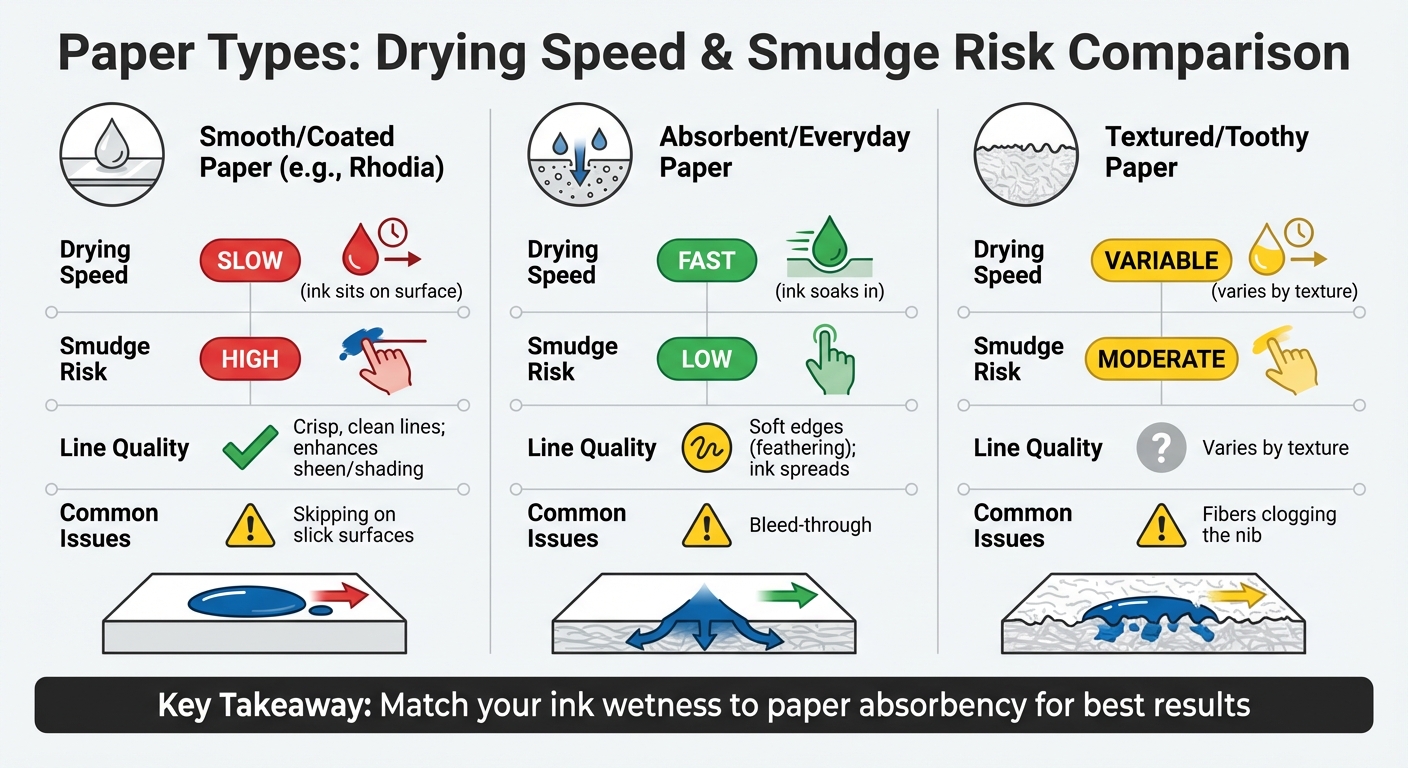
Paper Types Comparison for Fountain Pen Ink Drying and Smudging
Paper often plays a leading role in smudging issues. Even the most carefully crafted fountain pen ink can struggle if the paper isn't well-suited to it. Understanding how different paper types interact with ink can help you sidestep those annoying smudges.
How Paper Texture Affects Smudging
The texture of the paper has a direct impact on how ink behaves. Smooth papers, like those from Rhodia or Clairefontaine, create sharp, clean lines and minimize bleed-through. However, because these papers don't absorb ink as quickly - leaving it to sit on the surface - drying times can be longer.
On the other hand, textured or "toothy" paper presents its own set of challenges. The rougher surface can snag fibers in the fountain pen nib, leading to skipping or uneven ink flow. Meanwhile, extremely smooth or coated papers can feel almost slippery, which might cause the pen to skip if the writing angle or pressure isn't consistent. Striking a balance between texture and smoothness is essential to match your pen and writing habits.
Absorbent vs. Non-Absorbent Paper
The absorbency of paper is another key factor in smudging. Absorbent papers draw ink into their fibers quickly, which helps reduce smudging but can lead to feathering - where the ink spreads beyond its intended line - and ink spreading. High-porosity papers are known for their faster drying times.
Non-absorbent, coated papers, on the other hand, have a denser surface that keeps ink on top. This results in crisper lines and highlights ink effects like sheen and shading. However, these papers prolong drying times, increasing the potential for smudging .
Here’s a quick comparison of different paper types:
| Paper Type | Drying Speed | Smudge Risk | Line Quality | Common Issues |
|---|---|---|---|---|
| Smooth/Coated (e.g., Rhodia) | Slow (ink sits on surface) | High | Crisp, clean lines; enhances sheen/shading | Skipping on slick surfaces |
| Absorbent/Everyday | Fast (ink soaks in) | Low | Soft edges (feathering); ink spreads | Bleed-through |
| Textured/Toothy | Variable | Moderate | Varies by texture | Fibers clogging the nib |
Matching Ink and Paper
Pairing the right ink with the right paper is all about understanding texture and absorbency. Experimentation is often the best way to find what works. For example, if you're using a "wet" pen or ink with a high flow, slightly more absorbent paper can help manage drying times and reduce smudging. Conversely, pens with a drier ink flow pair well with smoother papers like Rhodia, though you may need to slow your writing to allow the ink to dry properly.
A simple way to test compatibility is with a timed dry test. Write a few consistent lines or scribbles on different paper types, then drag a clean finger across the text after a set interval (e.g., 30 seconds). This will give you a clear sense of how well your ink and paper combination performs.
For example, Fountain Pen Revolution (https://fprevolutionusa.com) provides inks designed to work with various paper types. When testing their inks, check the back of the page for show-through (visible writing) and bleed-through (ink soaking through the page). If you notice feathering, switching to a smoother, fountain-pen-friendly paper may improve your results.
sbb-itb-1dd4fe9
Environmental Factors
Environmental conditions play a big role in whether ink smudges after writing. Even when ink seems dry, humidity and temperature can keep it vulnerable to smudging. Knowing how these factors interact with your materials can help you avoid issues, especially in extreme climates.
The Role of Humidity
Paper naturally absorbs water from the air, a process called hygroscopy. When humidity rises above 60%, the paper absorbs excess moisture, which can interfere with how ink dries and leads to smudging. You might notice your paper feels damp or that your writing takes longer to dry during humid summer days.
For optimal results, aim for a relative humidity of 40% to 60% when writing with a fountain pen. If humidity drops below 30%, other problems can arise, like static electricity, ink clogs, and faded text because the paper becomes too dry. On the flip side, high humidity above 60% can cause smudges, streaks, and even warped paper. A small hygrometer, which costs about $10–$20, can help you monitor the moisture levels in your workspace.
Temperature and Ink Drying
Temperature has a direct impact on how ink behaves. Warm temperatures make ink thinner by lowering its viscosity, which increases the chances of smearing or dripping. On the other hand, cold temperatures thicken the ink, potentially leading to uneven lines and restricted flow. As C.A. Smith, M.Sc., explained:
Ink drying is a complex business depending upon a variety of conditions and situations. If you alter one of the variables then you are into a new situation.
The ideal temperature for storing paper and ensuring consistent ink performance is between 68°F and 76°F. When it’s too hot, ink evaporates faster, which can cause it to spread before it dries. In colder conditions, evaporation slows down, extending drying times and increasing the risk of smudging. These temperature changes add another layer to the challenges of ink drying.
Adjusting to Different Conditions
You can take several steps to reduce smudging caused by environmental factors. For starters, keep your paper in its original sealed packaging and store it away from windows, doors, or HVAC vents. If you’ve opened a ream, reseal it to maintain the paper’s moisture balance.
In humid environments, using a dehumidifier or air conditioner can help reduce excess moisture. For dry climates, a humidifier can prevent issues like ink clogs and static buildup. Lori Slovik, Technology Manager at Domtar, advises maintaining:
a humidity level between 35–55 percent in all paper handling and storage areas to avoid issues caused by fluctuating moisture levels.
She also recommends letting paper acclimate for at least 24 hours before use. This prevents "paper shock", which happens when sudden changes in temperature or humidity lead to wrinkling and poor ink absorption.
If you often face challenging conditions, consider using paper with ColorLok technology, which is designed to improve ink absorption and drying. Store paper flat on solid surfaces instead of wire racks, and keep it on lower shelves where temperatures are cooler and more stable. By combining these storage tips with proper writing techniques, you can significantly cut down on smudging.
Pen and Writing Technique
After selecting the right ink and paper, the next step to avoid smudging is focusing on your pen and writing technique. The type of fountain pen you use - and how you use it - plays a big role in how ink behaves on the page. Even with the best materials, factors like nib size, ink flow, and writing habits can determine whether your writing stays clean or ends up smeared.
Nib Size and Ink Flow
The size of your pen’s nib directly impacts how much ink flows onto the paper. Broader nibs deliver more ink, which takes longer to dry and increases the chances of smudging. As Inkcision Works puts it:
A 'wet' nib... simply means the pen delivers a heavy ink flow. Some people like this... But for others, especially students or professionals using standard notebooks, it means smudges, feathering, and a messy writing experience.
If smudging is a concern, switching to an extra-fine or fine nib can make a big difference. These nibs release less ink, allowing it to dry faster. Research shows that surface tension primarily governs how ink is deposited, with viscosity playing a secondary role. A finer nib combined with reduced ink flow can help keep your writing neat and smudge-free.
Writing Angle and Pressure
How you hold and use your pen also matters. A lighter grip and reduced hand pressure can limit the amount of ink being deposited, which speeds up drying time. Additionally, the angle at which you hold the pen plays a role. Experts recommend maintaining an angle of about 45 degrees for optimal ink distribution without causing pooling. This combination of light pressure and a proper angle can significantly reduce the risk of smudging.
Choosing the Right Fountain Pen
The pen itself is just as important as the ink and paper. Brands like Fountain Pen Revolution offer budget-friendly options starting at $35, with a range of nib sizes to suit different writing needs. For those looking for something more refined, their gold nib collection provides controlled ink flow for a smoother experience. Japanese nibs, known for their finer lines, are another excellent choice for minimizing ink volume. Pairing a fine or extra-fine nib with a light writing touch creates the perfect conditions for quick-drying, smudge-free writing. When combined with high-quality ink and paper, selecting the right pen and using proper technique ensures a clean and enjoyable writing experience.
Conclusion
Preventing Ink Smudging: Summary
As we've explored, ink smudging can result from a mix of factors, including the type of ink, the texture of the paper, and even environmental conditions. Key contributors to smudging include overly smooth or non-absorbent paper, highly saturated or glossy inks, broad or wet nibs that release excess ink, and high humidity. Even skin oils from your hand can interfere with how ink dries, causing smudges in specific areas. Research highlights that surface tension plays the most significant role in how much ink is deposited, followed by viscosity. Thankfully, many of these issues can be addressed by tweaking your combination of ink, paper, and pen.
The key is finding the right balance. For example, using wet inks with drier pens or absorbent paper can help manage drying times, while dry inks work better with wet pens or smoother paper. Switching to a fine or extra-fine nib can also reduce the amount of ink laid down, and a guard sheet can protect against smudges caused by hand oils. Environmental adjustments, like using a desk fan or humidifier, can also help.
With these small changes, you can enjoy a cleaner and more reliable writing experience.
Improving Your Writing Experience
Achieving smudge-free writing doesn't have to break the bank. A simple timed dry test can help you figure out where the problem lies: write a line, then drag your finger across it at different intervals to see how long the ink takes to dry. If smudging continues, consider switching to thinner, quicker-drying inks or opting for a finer nib.
For those looking to elevate their writing tools, Fountain Pen Revolution offers an affordable entry point. With pens starting at just $35 and a variety of nib sizes ranging from extra-fine to broad, they make it easy to find a setup that matches your style. Their gold nib collection, designed for controlled ink flow, pairs well with premium inks to reduce smudging. When you combine the right pen with thoughtfully chosen paper and mindful writing techniques, smudging becomes a thing of the past. By aligning your tools and technique, you can enjoy consistently clean, smudge-free writing every time.
FAQs
How can I pick the right ink to avoid smudging?
To keep smudging at bay, selecting the right ink and paper is key. Opt for inks with a thinner consistency - they tend to dry faster, which is especially helpful when working with highly absorbent paper or in humid conditions. Also, resist the urge to touch the ink immediately after writing to allow it time to dry properly.
Your choice of paper plays an equally important role. Heavier, fountain pen-friendly papers (typically 120 gsm or higher) allow inks to dry more evenly and reduce the risk of smudging. Experimenting with various ink and paper combinations can help you discover what works best for your writing habits. If you handle documents soon after writing, quick-drying or water-resistant inks can provide extra peace of mind.
What type of paper helps ink dry faster?
For quicker ink drying, opt for highly absorbent paper with a weight of at least 120 gsm. This type of paper absorbs ink more evenly, helping to reduce common problems like smudging and feathering. If you're looking for an extra boost, textured paper can also work well, as it disperses ink more effectively. On the other hand, smooth or coated paper tends to dry ink more slowly because of its less absorbent surface.
When it comes to fountain pens, papers designed to handle their ink flow strike a balance between absorption and smoothness, which can lead to faster drying times. If avoiding smudges and enhancing your writing or drawing experience is a priority, heavier, absorbent paper is a solid choice.
How do temperature and humidity affect ink drying and smudging?
Environmental elements like temperature and humidity significantly impact how ink dries and performs. For instance, high humidity can cause dried ink to reactivate, which may lead to smudging or feathering as the moisture interacts with the ink. Meanwhile, colder temperatures can thicken the ink, slowing its flow. In extreme cases, freezing temperatures might even cause hard starts or damage to your pen.
To keep these problems at bay, store your pens and ink in a stable environment, ideally within a temperature range of 64°F to 72°F. If you live in a particularly humid or cold area, you might want to explore inks designed for such conditions, like quick-drying or freeze-resistant formulations. Taking a little extra care with storage can make all the difference in keeping your writing sharp and smudge-free, regardless of the weather.