

When it comes to traveling with fountain pens, ink cartridges and bottled ink each have their strengths. Cartridges are compact, sealed, and easy to use, making pocket-sized fountain pens ideal for short trips or daily commutes. Bottled ink, on the other hand, offers more color variety and better cost efficiency for frequent writers or extended travel, though it requires extra care to avoid spills.
Key Takeaways:
- Cartridges are lightweight, leak-resistant, and TSA-friendly but cost more per milliliter and have limited color options.
- Bottled ink is cheaper per milliliter and allows access to specialty colors but is bulkier, fragile, and less convenient for travel.
Quick Comparison:
| Criterion | Ink Cartridges | Ink Bottles | Best for Travel |
|---|---|---|---|
| Portability | Compact, lightweight, easy to carry | Bulkier, heavier, and glass bottles can break | Cartridges |
| Leak Risk | Low, sealed design | Higher, requires careful packing | Cartridges |
| Refill Convenience | Instant and mess-free | Slower, requires tools like converters or syringes | Cartridges |
| Cost per Milliliter | Higher (~$1.00/mL) | Lower (~$0.15–$0.40/mL) | Bottles |
| Color Variety | Limited, often standard shades | Wide range, including specialty inks | Bottles |
| TSA Compliance | Pre-sealed, no restrictions | Must follow liquid rules, risk of breakage | Cartridges |
For short trips, cartridges are the safer, easier choice. For longer trips or if you prefer unique ink colors, bottled ink bundles can be worth the extra precautions. A hybrid approach - refilling cartridges with bottled ink - offers a balance of convenience and variety.
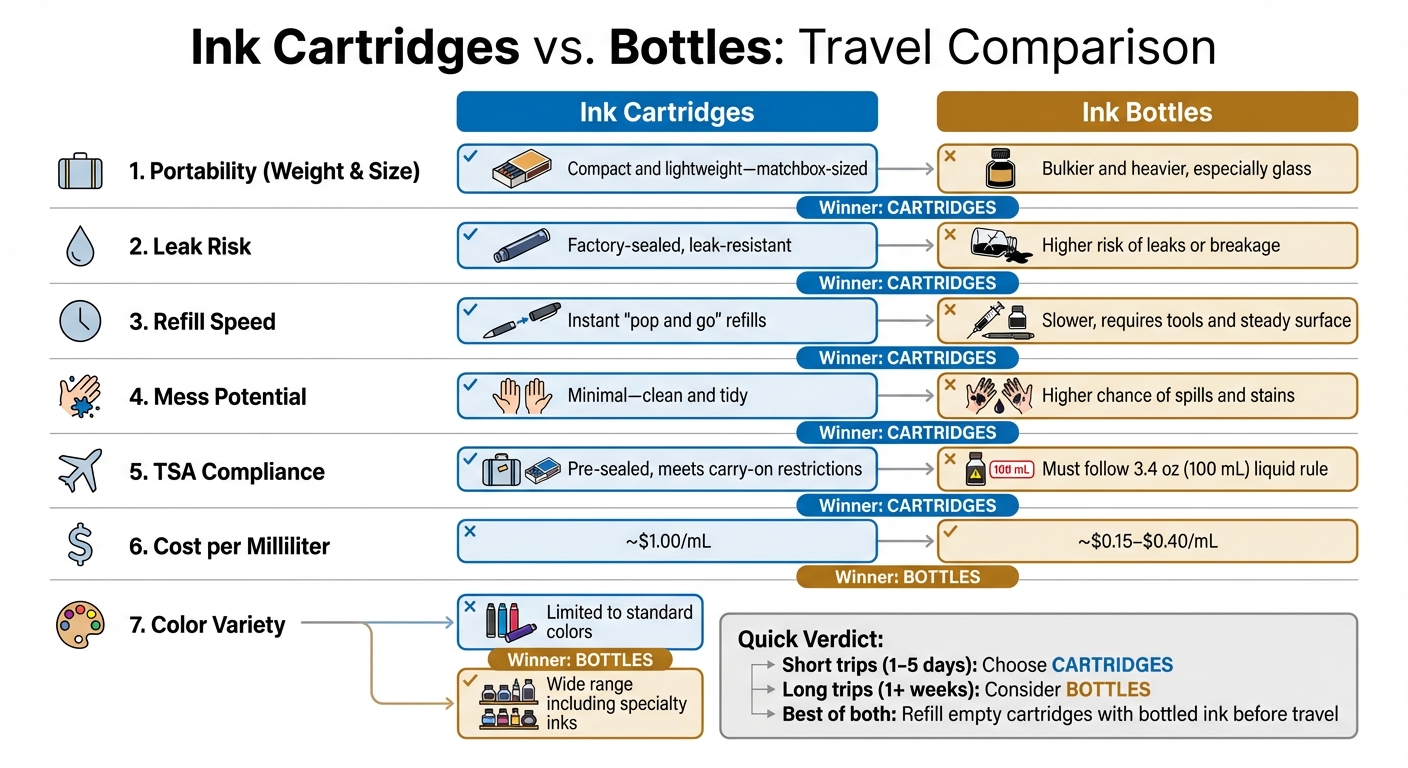
Ink Cartridges vs Bottles Travel Comparison Chart
Ink Cartridges for Travel: Pros and Cons
Benefits of Ink Cartridges
Ink cartridges solve many common travel issues. They’re compact and lightweight, making them easy to slip into a carry-on or briefcase without taking up much room. Unlike fragile glass bottles, cartridges are made of sealed plastic, reducing the chances of breakage and leaks.
Refilling your pen is quick and hassle-free with cartridges. As Alexandra Richardson from Goldspot Pens puts it:
"The added bonus of using cartridges is the ease with which you can instantly re-ink your pen when you are out and about. They are literally a no-mess solution when you run your pen dry."
Some pens even have space for spare cartridges, offering a convenient backup. Standard international cartridges are widely available, making replacements easy to find. And for air travel, cartridges are TSA-friendly since the ink already inside your pen doesn’t count toward the 3-1-1 liquid rule.
In terms of capacity, a short international cartridge holds about 0.7 mL of ink, which can cover around 14 pages with a broad nib, 18 pages with a medium nib, or 45 pages with a fine nib. Long cartridges, holding 1.45 mL, provide even more writing mileage.
While these benefits make cartridges appealing, they do come with some drawbacks.
Drawbacks of Ink Cartridges
The biggest downside is the cost. Cartridges are priced around $1.00 per mL, compared to bottled ink, which can be as low as $0.23 per mL. A six-pack of cartridges typically costs $2.50 to $5.00, and for frequent writers, these expenses can add up quickly.
Color options can also be a sticking point. While standard international cartridges offer some variety, proprietary systems from brands like Pilot, Sailor, and Lamy often limit you to basic shades like blue, black, or blue-black. Specialty inks with shimmer or sheen are rarely available in cartridge form.
Environmental concerns are another factor. Most cartridges are single-use plastic, contributing to waste. Additionally, once punctured and installed in your pen, a cartridge can be prone to leaks during flights. Air trapped inside may expand at altitude, pushing ink out through the nib. To minimize this risk, pack your fountain pens for travel by storing them nib-up while flying.
sbb-itb-1dd4fe9
Ink Bottles for Travel: Pros and Cons
Benefits of Ink Bottles
Using bottled ink opens up a world of options, including specialty shimmer, sheen, and shading inks - features that are hard to find in cartridges. If you prefer a bit of flair beyond standard blue or black, bottled ink is the way to go.
Another big plus is cost. Bottled ink can be as low as $0.15 per mL, compared to cartridges, which average about $1.00 per mL. For example, a 130 mL bottle of Noodler's ink costs roughly $20, while a 30 mL bottle of Lamy ink is about $7. Over time, especially on longer trips or for frequent writers, these savings can really add up.
Bottled ink also offers compatibility with any fountain pen that uses a converter or built-in filling system, freeing you from being tied to proprietary cartridges from brands like Pilot, Sailor, or Lamy. Pens like the Lamy 2000, with its 2.67 mL capacity, or eyedropper pens that hold up to 4 mL, can store much more ink than the 0.7 mL in a standard short cartridge.
On top of that, bottled ink is a more eco-friendly option. By reducing the use of single-use plastic cartridges, you can help cut down on waste.
Drawbacks of Ink Bottles
That said, traveling with bottled ink has its challenges. Glass bottles, for instance, are fragile. If your luggage gets tossed around, there’s always a chance of a messy disaster. Alexandra Richardson from Goldspot Pens sums it up well:
"While it is possible to pack a bottle of ink into a checked bag, the risk of dying all my clothes a shade of Ferris Wheel Press Russet Typecase is enough to influence me to keep the fragile glass bottles home."
TSA regulations also complicate things. The 3-1-1 rule limits carry-on liquids to 3.4 ounces (100 mL) or less. While most standard 50 mL bottles meet this requirement, they’ll still need to fit in your quart-sized liquids bag, competing for space with your toiletries.
Glass bottles are not only fragile but also heavier and bulkier than a few spare cartridges. They take up valuable room in your bag and add extra weight. Plus, refilling your pen on the go can be tricky - it’s easy to end up with ink-stained fingers, clothes, or even hotel furniture.
Another issue is air pressure during flights. If the bottle’s seal isn’t airtight, ink can leak due to air expansion. To avoid this, you can wrap the cap with Parafilm for a tighter seal, double-bag the bottle, and pad it with paper towels. A more practical solution? Transfer a small amount of ink into 5 mL plastic sample vials. These are lightweight, durable, and far less likely to break than glass.
Side-by-Side Comparison: Cartridges vs. Bottles
Comparison Table
When packing for your next trip, it’s helpful to weigh the pros and cons of ink cartridges and ink bottles based on key travel considerations.
| Criterion | Ink Cartridges | Ink Bottles | Better for Travel |
|---|---|---|---|
| Portability (Weight & Size) | Compact and lightweight - about the size of a matchbox, making them easy to slip into a pocket or briefcase. | Bulkier and heavier, especially if made of glass, which can take up more space in your luggage. | Cartridges |
| Leak Risk | Factory-sealed and designed to resist leaks until inserted into a pen. | Higher risk of leaks or breakage, which could damage clothing or other items. | Cartridges |
| Refill Speed | Instant "pop and go" refills with no extra tools required. | Slower process requiring a steady surface and tools like a converter or syringe. | Cartridges |
| Mess Potential | Minimal - keeps your hands, clothes, and workspace clean. | Higher chance of spills or stains on fingers, clothing, or surfaces. | Cartridges |
| TSA Compliance | Pre-sealed and compact, meeting carry-on liquid restrictions with ease. | Must adhere to TSA's 3.4 oz (100 mL) liquid rule, potentially triggering additional screening. | Cartridges |
| Cost per Milliliter | Higher - approximately $1.00 per mL. | Lower - around $0.40 per mL, making it a budget-friendly option for frequent writers. | Bottles |
| Color Variety | Limited to standard colors like black and blue. | Wide range of colors, including unique shades and special effects. | Bottles |
For short trips, the convenience and spill-free design of cartridges often outweigh their higher cost. Their simplicity and reliability make them a practical choice for travelers. As The Gentleman Stationer explains:
When you're on the road, it's quite easy to grab a matchbox-sized pack of Kaweco cartridges and stick it in your briefcase, as opposed to sealing an ink bottle in a plastic bag and worrying about leaks, breakage, and TSA inspections.
This comparison highlights the strengths of each option, helping you decide which fits your travel needs best.
✈️ Flying With Fountain Pens? Here's How to Avoid Inky Disasters! 🖋️
Which Option Fits Your Travel Style
Your travel habits play a big role in deciding the best ink solution for your needs. Whether you're heading out for a short business trip, tackling your daily commute, or embarking on an extended vacation, the right choice can make all the difference.
Short business trips are ideal for cartridges. If you're away for just a few days, packing one or two pens with standard international cartridges is simple and efficient. These cartridges are compact enough to fit in a briefcase or jacket pocket and allow for quick, mess-free refills during meetings or on the go. No need to lug around bottles or worry about spills .
Daily commutes also lean toward cartridges. Their sealed design ensures no ink leaks while you're on the move. Toss a spare pack into your bag, and you're set. If your pen runs dry, swapping in a fresh cartridge takes seconds. As The Hamilton Pen Company highlights:
The safety of a sealed ink cartridge is a big draw for those looking for a daily use fountain pen they can throw in their bag.
But when it comes to longer trips, the choice becomes a bit more complex.
Extended vacations might call for a different strategy. While standard international cartridges are easy to find in office supply and stationery stores around the world , bottled ink offers a lot more mileage. For example, a 30 mL bottle equals nearly 38 standard cartridges. If you're planning a month-long trip with heavy writing, bottled ink could be the way to go. To avoid leaks during flights, consider a vacuum-filler pen with a secure sealing mechanism. Before you travel, double-check whether your pen uses proprietary or standard international refills - standard ones are much easier to find abroad .
For those who want the best of both worlds, a hybrid approach can be a smart solution. Using a syringe to refill empty cartridges before your trip lets you enjoy specialty ink colors without the hassle of carrying bulky bottles.
Ultimately, your choice depends on how often you write and how long you'll be away. Cartridges, bottles, or a mix of both - there’s an option to suit every traveler's needs.
Travel Recommendation
When traveling, ink cartridges are a convenient choice. Their compact, sealed design significantly reduces the risk of spills. Plus, they’re small enough to slip into a briefcase or even a jacket pocket. Swapping out a cartridge takes just seconds, making them perfect for short trips or daily commutes. But if your travels stretch beyond a few days, you might want to explore other options.
For longer trips where writing will be more frequent, bottled ink can be a practical solution. A single 30 mL bottle holds about the same amount of ink as 36 standard cartridges. However, transporting bottled ink requires extra caution. To keep it safe, wrap the bottle in parafilm, add a layer of paper towel for cushioning, and seal it inside a plastic bag. Just remember, TSA regulations limit carry-on liquids to 3.4 oz (100 mL) per container.
For added peace of mind on extended trips, pack a few spare Standard International cartridges. These are widely available and easy to find at stationery stores across the globe.
If you’re looking for affordable options, check out Fountain Pen Revolution for both cartridges and bottled ink. Whether you opt for cartridges for quick trips, bottled ink for extended stays, or a mix of both, your choice ultimately depends on how long you’ll be away and how much writing you plan to do.
FAQs
How many cartridges should I pack for a week-long trip?
For a week-long trip, bringing along 3 to 5 ink cartridges should do the trick. These cartridges come pre-filled, are compact, and super simple to replace - perfect for travel. Unlike bottled ink, cartridges significantly reduce the chance of leaks, which is a big plus when you're on the go. Plus, they serve as handy backups for any unexpected writing needs. Since they’re inexpensive and barely take up any room in your bag, packing a few extras is a smart way to ensure you’re covered for the entire trip.
What’s the safest way to fly with a fountain pen to prevent leaks?
When flying with a fountain pen, there’s always the concern of ink leaks due to cabin pressure changes. To avoid this, here are a few tips:
- Use a sturdy pen case: This protects your pen from damage and contains any potential leaks.
- Empty the pen beforehand: If possible, travel with an empty pen to eliminate the risk of ink spills.
- Opt for a pen with a shut-off valve: Some fountain pens are designed to prevent leaks by sealing off the ink flow.
- Store the pen properly: Keep it nib-up during the flight to minimize pressure on the ink reservoir.
Following these precautions can help you travel worry-free with your fountain pen while keeping your belongings safe from ink accidents.
Can I refill cartridges with bottled ink before traveling?
Refilling cartridges with bottled ink before a trip can be a smart choice. It’s a greener alternative, saves money, and gives you access to a broader range of ink colors and styles - some of which aren’t offered in pre-filled cartridges. Just make sure the cartridge is securely sealed to prevent any leaks while you're on the move.