

If you're a left-handed writer, choosing the right fountain pen nib can make writing smoother and less frustrating. Left-handers face challenges like smudging, resistance from "pushing" the nib, and grip styles that affect ink flow. This guide breaks down the best fountain pen nib sizes, practical tips, and maintenance advice to help you enjoy writing with fountain pens.
Key Takeaways:
- Grip Styles Matter: Underwriters avoid smudging; overwriters and sidewriters need nibs that work with their angles.
- Nib Types: Fine (F) and extra-fine (EF) nibs dry faster and smudge less. Medium nibs balance smoothness and control. Stub and oblique nibs add style but need practice.
- Special Nibs for Lefties: Lamy LH nibs reduce scratchiness; Pilot Waverly nibs adjust to various angles.
- Prevent Smudging: Pair fine nibs with fast-drying inks and absorbent paper (80–100 gsm).
- Maintenance Tips: Clean nibs regularly with water or mild solutions to avoid clogs.
With the right nib and care, left-handed writers can enjoy the smooth, intentional flow of fountain pens without the usual struggles.
The Fountain Pen Guide for Lefties: Do I need a lefty nib?
sbb-itb-1dd4fe9
Challenges Left-Handed Writers Face
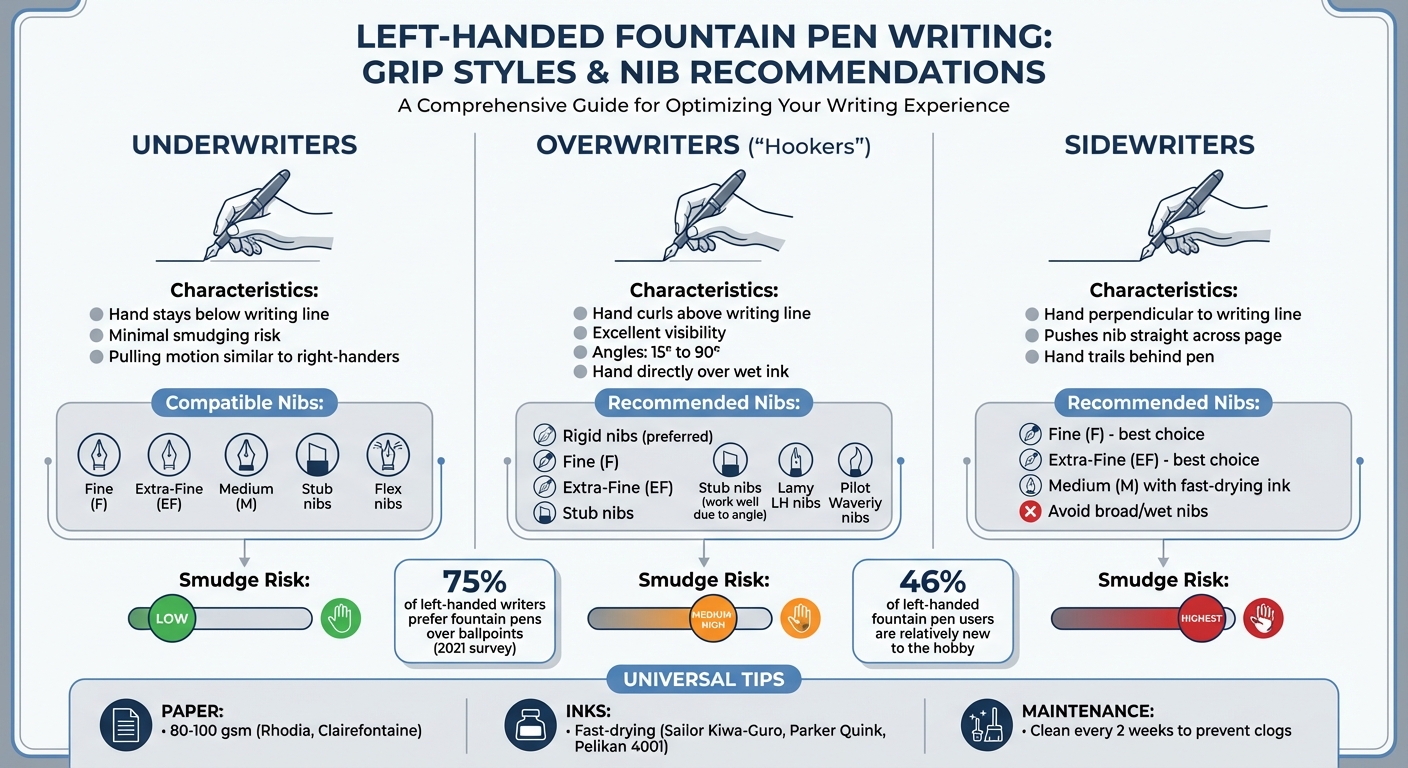
Left-Handed Writer Grip Styles and Recommended Fountain Pen Nibs
Left-handed writers encounter specific challenges when using fountain pens, largely due to the left-to-right nature of English writing. Understanding these hurdles is essential for selecting a nib that complements their writing style by following a fountain pen buying checklist. Let’s break down these challenges.
Push vs. Pull Writing Techniques
For right-handed writers, the nib glides smoothly across the page in a pulling motion. Left-handers, however, push the nib, which increases resistance. This can cause flexible nibs to splay or catch, leading to ink splattering across the paper.
"In a bygone era when fountain pens were often equipped with flexible or soft nibs, there were some challenges for lefties who push, rather than pull, a pen across the page. If those tines separate in the wrong direction, ink goes sputtering across the paper." - nibs.com
Modern fountain pens with rigid nibs mitigate this issue. Their stiff tines resist separating under pressure, providing a smoother, more controlled writing experience.
Grip Styles: Overwriter vs. Sidewriter
Left-handed writers often adapt their grip to overcome fountain pen challenges. These grip styles significantly influence how the nib interacts with the paper:
- Underwriters: Hold their hand below the writing line, mimicking a right-hander's pulling motion. This keeps their hand away from fresh ink, reducing smudging. Underwriters generally find most nib types compatible with their style.
- Overwriters: (also called "hookers") curl their hand above the writing line. While this grip offers excellent visibility, it places the hand directly over wet ink. Angles can range from 15° to 90°, and rigid nibs are often preferred to avoid catching.
- Sidewriters: Position their hand perpendicular to the writing line, moving it alongside the text. This grip pushes the nib straight across the page, increasing the risk of smudging as the hand trails behind the pen.
A 2021 survey revealed that 75% of left-handed writers preferred fountain pens over ballpoints, and 46% of these fountain pen users were relatively new to the hobby. Since grip style directly affects how the nib contacts the paper, selecting a nib that aligns with your natural writing posture is essential.
Ink Drying Time and Smudging
Smudging is a frequent issue for left-handed writers, as their hand often moves over freshly written ink. Among the grip styles, sidewriters face the highest smudge risk, followed by overwriters. Underwriters, on the other hand, experience minimal smudging.
To minimize this problem, fine (F) and extra-fine (EF) nibs are excellent options. They deposit less ink, which dries faster. Pair these nibs with quick-drying inks and absorbent paper (80–100 gsm) for the best results.
Best Nib Types for Left-Handed Writers
Selecting the right nib type can make a world of difference for left-handed writers, addressing issues like smudging and control. The goal is to find a nib that balances smoothness, ink flow, and drying time while complementing your unique grip style and writing pressure.
Fine and Extra-Fine Nibs
Fine (F) and extra-fine (EF) nibs are a go-to choice for many left-handed writers. These nibs release less ink, which means faster drying times and reduced smudging risks. As Wood Fountain Pens explains:
"Less ink on the paper means it dries faster and is less likely to smear".
These nibs are particularly well-suited for those with smaller, precise handwriting or for use on lower-quality, absorbent paper. If you're an overwriter or sidewriter - grip styles prone to smudging - fine nibs offer enhanced control. Japanese brands are worth considering, as their fine nibs often produce thinner lines compared to their Western counterparts.
However, there is a trade-off. Fine nibs tend to provide more tactile feedback, which some might perceive as a "scratchy" feel. Cult Pens elaborates:
"Finer nibs do come with a slight downside, though - the finer the nib, the more 'scratchy' it will tend to feel. A smaller tip touching the paper will never feel as smooth as a big wet nib tip".
To get the most out of fine nibs, pair them with fast-drying black inks and use a light touch. If you’re looking for a smoother alternative without sacrificing too much control, medium nibs might be the next step.
Medium Nibs for Balanced Writing
Medium nibs strike a balance between smooth writing and manageable drying times, making them a versatile option. Scriveiner London highlights their practicality:
"Medium and fine nibs offer the most versatility, providing smooth ink flow without excessive line width that might smudge before drying".
With a larger tip size, medium nibs reduce friction, making them comfortable for longer writing sessions. They are also the standard nib size for most fountain pens, fitting the needs of a broad range of writers. Cult Pens advises:
"If you really have no idea, going with a Medium nib is probably the best choice, as it's right there in the middle".
For left-handed writers who prefer a lighter grip or prioritize smoothness over absolute smudge prevention, medium nibs are an excellent option. Keep in mind that Japanese medium nibs typically write thinner than Western mediums, which can subtly affect both smoothness and drying time.
Stub and Oblique Nibs for Creative Writing
If you’re looking to add a touch of flair to your handwriting, stub and oblique nibs are worth exploring. Stub nibs have a flat edge that creates calligraphic line variation, with thick downstrokes and thin cross-strokes. They can elevate your handwriting without requiring a complete change in your writing style. As Brian Goulet of The Goulet Pen Company puts it:
"can make your handwriting look more impressive without having to really do anything different with your writing".
Using a stub nib may involve some technique adjustment, such as rotating the paper up to 45° to maintain full contact with the nib. Interestingly, overwriters often find stub nibs easier to use since they mimic the natural angle of right-handed writers. Goulet explains:
"Stub nibs actually emulate a righty, just coming from the opposite angle!".
Oblique nibs, on the other hand, feature slanted tips that align better with certain writing angles, offering a smoother "sweet spot" compared to standard stubs. A 1.0mm or 1.1mm stub is a great starting point for everyday creative writing. Since these nibs lay down more ink, pairing them with fast-drying inks is essential. Scriveiner London adds:
"Specialty nibs, such as stub or architect styles, require more technique adaptation for left-handed users but can produce beautiful results with practice".
Nibs Designed for Left-Handed Writers
When it comes to fountain pens, left-handed writers often face unique challenges. Thankfully, some nibs are specifically crafted to make writing smoother and more comfortable for lefties. While many standard nibs can work just fine, these specialized options take things up a notch by addressing common struggles like scratchiness and inconsistent ink flow.
Lamy LH (Left-Handed) Nibs

The Lamy LH nib, priced at $13.00, is designed with a steeper grinding angle. This tweak reduces scratchiness and gives the nib the feel of a smooth medium nib, even when used with a pushing motion. It’s no wonder this nib has earned a perfect 5.0/5 rating from reviewers.
Kyle Vedder, a satisfied customer, shared:
"The pen writes so much better as a left hander with this nib! Just a reminder that the world is catered to righties!"
Another user, Peter Gilbert, noted:
"I learned that LAMY had a left-handed nib that could possibly help... the new nib has made all the difference in the world."
This nib is an excellent choice for left-handed writers who often push the pen across the page.
Pilot Waverly Nibs

The Pilot Waverly nib stands out with its upturned tip, which adapts effortlessly to various writing angles. This feature is especially helpful for overwriters, ensuring consistent ink flow regardless of how the pen is held. Left Hook Pens highlights its versatility:
"With the gentle upturn, it doesn't matter how you hold the pen or at what angle. It's always just right, and I've found that my handwriting is neater while using my Pilot Waverly nib."
Typically available in 14k gold on models like the Pilot 912 or 742, the Waverly nib combines a luxurious feel with the adaptability that left-handed writers often need.
Custom Nibs from Fountain Pen Revolution
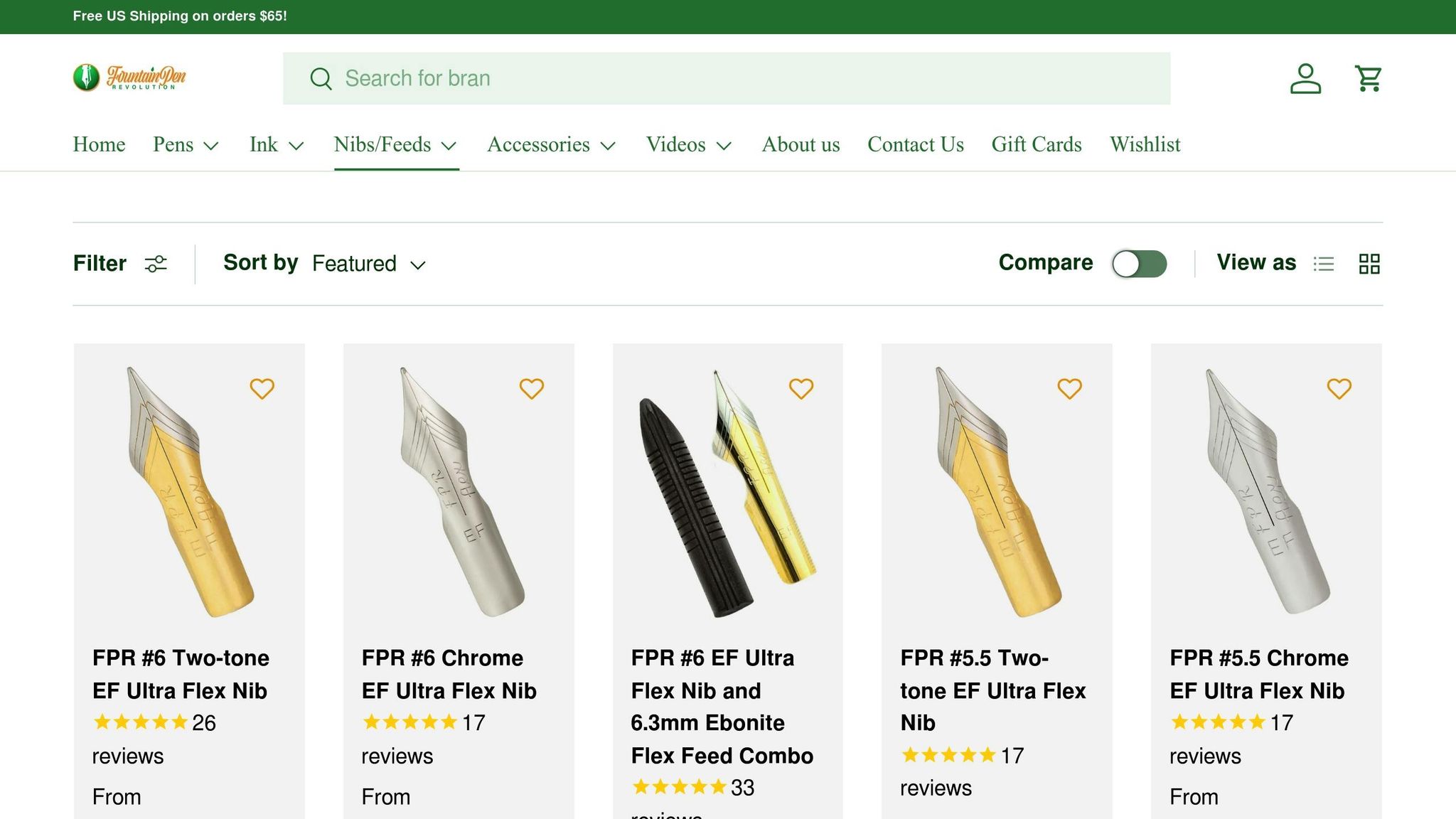
For those looking for a truly personalized writing experience, Fountain Pen Revolution offers customizable 14k gold nibs. These nibs can be tailored to specific writing styles, with options like left-foot oblique cuts and adjusted tipping angles. Such modifications enhance tactile feedback and optimize ink flow.
This bespoke approach eliminates many of the compromises that come with standard nibs. Plus, with proper care, these customized nibs can deliver long-lasting performance and a writing experience like no other.
Maintaining Nibs for Left-Handed Writers
Keeping your nib in good condition is especially important for left-handed writers. The natural pushing motion used by lefties can lead to quicker ink buildup and potential misalignment. Regular maintenance helps ensure smooth writing and consistent ink flow.
Choosing Compatible Inks and Paper
Fast-drying inks are a game-changer for left-handed writers. Options like Sailor Kiwa-Guro, Parker Quink, or Pelikan 4001 dry quickly, reducing the chances of smudging. Equally important is selecting the right paper. Look for sheets with a weight between 80 and 100 gsm to balance smoothness and absorbency. Brands like Rhodia and Clairefontaine are excellent choices - Rhodia tends to dry ink slightly faster. Avoid glossy papers, as they repel ink and are more likely to cause smudging.
Cleaning and Storage Tips
To keep your pen in top shape, clean it every two weeks - or at least once a month - to prevent dried ink from clogging the feed.
- Cleaning Method: Use a bulb syringe (about $4.25) to flush lukewarm water through the nib section. This method is more effective than relying on the converter alone. For stubborn clogs, mix one part household ammonia with two parts water, but avoid this solution if your pen has aluminum components or is vintage. After cleaning, air-dry all parts completely or use a lint-free cloth to remove moisture that could dilute fresh ink.
"Just as your car needs its oil changed, your fountain pen needs internal cleaning. A once a month cleaning will often save you a trip to the nib specialist." - nibs.com
- Storage Tips: Always store pens capped, either horizontally or with the nib pointing upward, to prevent leaks and drying. Aim for a storage environment with humidity levels between 45% and 55%. After cleaning, inspect the nib for alignment and remove any remaining debris.
Adjusting Nibs for Better Performance
Even small tweaks can turn a scratchy nib into a smooth writer. A 10× loupe (about $29.50) is a handy tool for checking nib alignment. If one tine sits higher than the other, gently adjust it with your fingernail until both are level.
For pens that skip, clear the nib slit with a thin brass sheet (0.002 inches thick, ~$4.25) to improve ink flow. Avoid using brown paper bags or pennies to smooth nibs, as they can leave fibers in the slit or wear down the nib unevenly.
In cases of severe ink buildup, an ultrasonic bath might be necessary, though manual cleaning is usually sufficient for restoring performance.
Conclusion
Picking the right nib for left-handed writing doesn’t have to be complicated. It all starts with understanding your grip style - whether you're an underwriter, overwriter, or sidewriter - and selecting a nib that works with your natural writing motion. If you tend to push the pen across the page, fine and medium rigid nibs are ideal. They dispense less ink and dry faster, helping to prevent smudging as your hand moves over the text.
"Modern fountain pens have solved that problem by providing rigid nibs that write smoother for all kinds of writers, lefties included." - nibs.com
For the best results, pair your nib with fast-drying inks and paper supplies. Underwriters have more flexibility and can even experiment with flex and stub nibs since their hand stays below the ink line. Overwriters and sidewriters, on the other hand, may find specialty options like left obliques or Lamy LH nibs better suited to their unique writing angles.
Don’t overlook maintenance - it's essential for keeping your fountain pen in top shape. Flushing your pen every two to three weeks helps prevent ink flow issues, which can be especially frustrating for left-handed writers working at unconventional angles. A well-maintained nib requires minimal pressure, reducing hand fatigue and ensuring a smooth, enjoyable writing experience.
Fountain pens offer left-handed writers benefits that ballpoint pens simply can’t match - less pressure, a smoother ink flow, and a more intentional, satisfying connection to writing. With the right nib and proper care, left-handed writers can fully embrace the joys of fountain pen use.
FAQs
How do I figure out my left-handed grip style?
To figure out your left-handed grip style, take a moment to notice how your hand naturally moves when you write. There are three common styles:
- Underwriting: Your hand stays below the writing line, and the pen is held at a lower angle.
- Overwriting: Your hand curves above the line, with your wrist bent and the pen at a steeper angle.
- Side writing: Your hand and pen align more horizontally, parallel to the writing surface.
Understanding your grip style can make it easier to pick pens and nibs that provide the best comfort and control.
Should I choose a rigid or flexible nib as a lefty?
For those who are left-handed, a rigid nib tends to be the go-to option. It provides a smoother glide across the page and helps prevent problems like ink splattering, which often happens with flexible nibs when they’re pushed rather than pulled. Flexible nibs can also separate under pressure, making them a less practical choice for left-handed writing techniques.
What’s the easiest way to stop smudging fast?
To cut down on smudging, try using quick-drying inks and finer nibs. Adjusting your hand position and applying lighter pressure while writing can also help reduce ink transfer. These small changes can make writing more comfortable and mess-free for left-handed writers.