

Ink bleed-through happens when ink soaks through paper, ruining the reverse side. It's frustrating, especially for fountain pen users. The main causes are:
- Paper quality: Thin or untreated paper absorbs ink more.
- Ink formulation: Wet inks deposit more liquid, increasing the risk.
- Pen nib size: Broad nibs release more ink than fine ones.
To fix or prevent bleed-through:
- Use paper with 80 GSM or higher and "fountain pen friendly" labels.
- Switch to drier inks like Montblanc or Pelikan.
- Opt for extra-fine or fine nibs to limit ink flow.
- Place a guard sheet under your page to protect the next one.
Testing different combinations of paper, ink, and nibs helps pinpoint the issue. Start with thicker, treated paper and adjust from there. For affordable solutions, try brands like Rhodia or Clairefontaine for paper and Fountain Pen Revolution for nib and ink options.
How Paper Causes Ink Bleed-Through
Paper often plays a key role in ink bleed-through, and understanding its characteristics can help you avoid this frustrating issue.
Why Certain Paper Leads to Bleed-Through
To prevent ink from soaking through paper, it’s important to know what makes some types more prone to bleed-through. One key factor is GSM (grams per square meter), which measures paper density. Higher GSM means the paper is thicker and better at resisting ink penetration.
| Paper Type | GSM Range | Bleed-Through Risk |
|---|---|---|
| Thin | 20–40 | Very High |
| Standard | 40–80 | Moderate |
| Thick / Cardstock | 80–110 | Low |
For fountain pen users, a GSM of 80 or higher is often recommended. For instance, Clairefontaine and Rhodia notebooks use 90 GSM paper, offering a great balance of thickness and smoothness.
However, GSM isn’t the only factor. Sizing, a chemical treatment applied during paper production, is equally critical. This treatment helps ink stay on the surface longer instead of being absorbed into the fibers. Paper like newsprint or standard copy paper typically lacks this treatment, leading to quicker absorption and more bleed-through.
"The right paper doesn't merely hold ink - it hosts it." - Ferris Wheel Press
Another culprit is the paper’s fiber structure. Porous fibers can pull ink into the paper through capillary action. When the paper absorbs too much ink, you not only get bleed-through but also feathering, where the ink spreads out unevenly.
Quick Paper Fixes Without New Supplies
If you’re working with thin or absorbent paper and can’t switch to better options, a few tricks can help minimize bleed-through:
- Place a guard sheet (a plain piece of paper) behind the page you’re writing on. While it won’t stop bleed-through on the current page, it will protect the next page in your notebook.
- Use an extra-fine nib to reduce ink flow. Less ink per stroke means the paper has less liquid to absorb.
- Opt for a drier ink formulation and apply lighter pressure while writing. These adjustments reduce the amount of ink that sinks into the fibers.
These temporary fixes can make a big difference while you work toward finding better paper.
How to Choose Paper That Resists Bleed-Through
To eliminate bleed-through entirely, selecting the right paper is essential. Before committing to a new notebook or pad, try a scribble test: write a few lines, draw loops, and fill in a solid scribble block. Flip the page - if the ink hasn’t seeped through, the paper is likely a good choice.
When shopping, look for terms like "sized" or "fountain pen friendly" on the packaging. Smooth, coated surfaces are ideal because they keep lines crisp and slow down ink absorption. It’s also helpful to keep a sheet of trusted paper on hand as a reference. If your pen performs well on the trusted paper but bleeds on a new option, you’ll know the issue lies with the paper, not your pen.
sbb-itb-1dd4fe9
How Ink and Pen Choice Affects Bleed-Through
When it comes to bleed-through, paper often gets the blame, but your ink and pen setup can be just as important. Even good-quality paper can falter if paired with the wrong ink or nib.
How Ink Formulation Contributes to Bleed-Through
Fountain pen inks range from wet to dry. Wetter inks deposit more liquid, making bleed-through more likely. When paper fibers become oversaturated, the ink can seep through to the other side.
"Bleed-through occurs when ink soaks through the paper fibers to the other side. Thinner paper (lower GSM) has less fiber to absorb ink. Wet inks and broad nibs lay down more ink, increasing the risk." - Tara Bekdache, Author, Dingbats*
Some inks, especially those with high dye content, can exacerbate this problem. For instance, Tara Bekdache's February 2026 ink test for Dingbats* revealed that Noodler's Baystate Blue frequently caused bleed-through on 70 GSM Moleskine paper but showed no bleed-through on 100 GSM Dingbats* Wildlife paper. While wet inks aren't inherently bad, they do demand better paper or nib control when used.
| Brand | Typical Wetness | Bleed-Through Risk |
|---|---|---|
| Noodler's | Very Wet | High |
| Pilot Iroshizuku | Wet | Moderate to High |
| Diamine | Medium | Moderate |
| Montblanc | Dry to Medium | Low |
| Pelikan | Dry | Low |
The pen's nib size and flow settings are just as important as the ink itself in determining how it interacts with paper.
How Nib Size and Pen Flow Affect Bleed-Through
The size of your nib and how your pen distributes ink can drastically affect bleed-through. A Japanese extra-fine nib (~0.3mm) lays down a minimal amount of ink, while a Western broad nib (0.8–1.0mm) deposits significantly more. On lower-quality paper, a broad nib paired with wet ink can quickly overwhelm the fibers.
Some pens naturally deliver more ink, even with finer nibs. When combined with absorbent paper, this can lead to unavoidable bleed-through. Wet inks on coated paper often need 15–30 seconds to dry, while drier inks can set in under 10 seconds. This longer drying time increases the chance of ink migrating through the page.
Adjusting Ink and Pen Settings to Reduce Bleed-Through
To minimize bleed-through, you can tweak your pen and ink choices. Switching to a fine or extra-fine nib reduces the amount of ink applied, which is particularly helpful on thinner paper.
Opting for drier ink formulations, such as those from Montblanc or Pelikan, can also help manage bleed-through on more absorbent paper. Regular pen maintenance is equally important. Cleaning your pen ensures a consistent ink flow and prevents sudden ink surges that could saturate the paper and worsen bleed-through.
Testing and Diagnosing Bleed-Through
To figure out what's causing bleed-through, a step-by-step testing approach works best. By isolating variables like paper, ink, and nib, you can pinpoint the issue.
How to Test for Bleed-Through at Home
A simple swap test can help. Start by writing on high-quality, high-GSM paper. If the bleed-through disappears, the paper is the culprit. If it continues, the ink or nib might be to blame.
Here’s how to narrow it down:
- Swap the paper: Try writing the same sample on three different types of paper - standard 80 gsm copier paper, a generic notebook, and premium 90–100 gsm coated paper. This will show how paper thickness and coating affect bleed-through.
- Swap the ink: Use a dry ink, like Montblanc or FPR Classic Black, on the same paper. If the bleeding stops, the original ink was likely too wet or saturated.
- Swap the nib: Test with a fine or extra-fine nib, which lays down less ink. When selecting a pen, consult a fountain pen buying checklist to ensure the nib and feed system match your paper preferences. This can reduce oversaturation and help determine if the nib size is contributing to the problem.
Experiment with different writing styles and ink volumes, as these can also influence bleed-through. For added clarity, place a guard sheet under your test page to check how well the paper resists ink transfer.
"100gsm is the threshold where fountain pens, markers, and brush pens stop bleeding through." - Tara Bekdache, Dingbats*
Bleed-Through vs. Feathering vs. Show-Through
Although these issues might seem similar, they each have distinct causes and solutions.
Flip your page after writing. If you see actual ink spots or stains on the reverse side, you’re dealing with bleed-through - this happens when ink penetrates the paper fibers. If the back of the page is clean but you can see faint letters, that’s show-through (or ghosting), which occurs due to thin or translucent paper rather than absorbency problems.
Feathering, on the other hand, shows up on the front of the page as blurry, spidery edges around your writing. This happens when ink spreads outward on the paper surface, often because the paper lacks proper surface treatment.
"Feathering refers to 'spreading' from where the ink was laid down... Bleeding refers to ink or marker seeping through the paper." - Strathmore Artist Papers
| Feature | Feathering | Bleed-Through | Show-Through (Ghosting) |
|---|---|---|---|
| Where it appears | Front of page, fuzzy letter edges | Back of page, actual ink spots | Back of page, faint letter shadows |
| Ink behavior | Spreads horizontally on the surface | Seeps vertically through the paper | Results from paper translucency |
| Main cause | Porous or unsized paper | Thin paper, wet ink, or broad nib | Low paper weight or reduced opacity |
| Usability impact | Can affect legibility | Reverse side may be unusable | Generally does not affect usability |
Fixes and Prevention Strategies for Bleed-Through
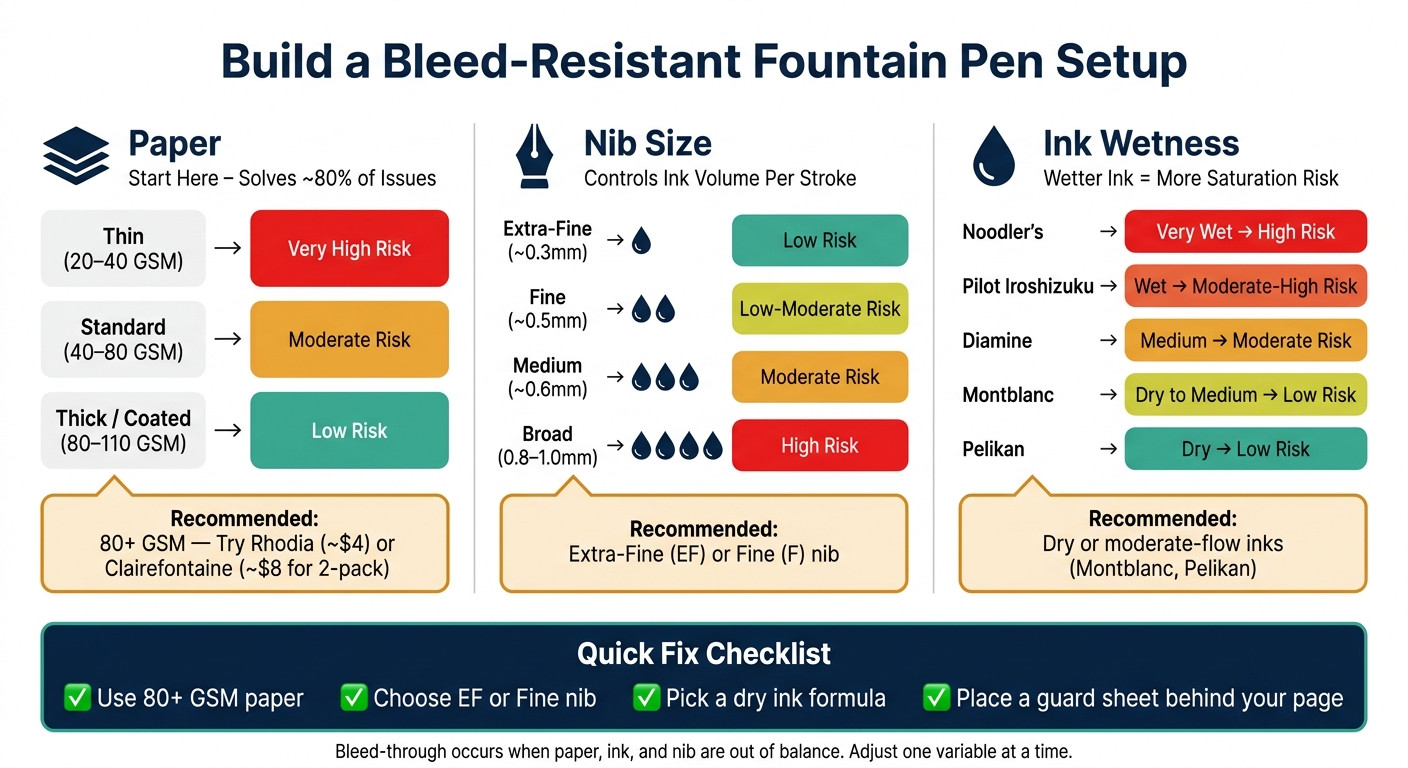
Ink Bleed-Through: Paper, Ink & Nib Comparison Guide
Now that you can spot bleed-through and tell it apart from feathering or show-through, let's explore how to fix it - and stop it from happening again.
Immediate Fixes for Bleed-Through
The quickest solution doesn’t require you to buy anything new. Place a guard sheet or blotter behind your current page. This simple trick prevents ink from seeping onto the next sheet.
Another important fix involves adjusting your technique. Fountain pens rely on capillary action, so pressing harder only pushes more ink into the paper.
"Fountain pens prefer a gentle touch." - Ferris Wheel Press
You can also try writing faster, which reduces the ink's contact time with the paper, or flipping your nib upside down. Writing nib-up restricts ink flow, but keep in mind that these fixes are temporary and not ideal for long sessions. However, they’re great for emergencies while you work on a longer-term solution.
Setting Up a Bleed-Resistant Writing Kit
If bleed-through keeps happening, it’s time to rethink your setup. Aligning your paper, nib, and ink choices can tackle the root causes.
"If paper solves 80% of the issue, you can fine-tune nib width, ink choice, and refill format later." - Art Noise Team
Start with paper rated 80 GSM or higher - this is the sweet spot where fountain pen ink is less likely to bleed. For example, a Rhodia Classic Grid Notebook costs around $4.00, and a two-pack of Clairefontaine Age-Bag Notebooks is about $8.00.
Pair this with an extra-fine (EF) or fine (F) nib, which releases less ink onto the page. Next, choose a dry or moderate-flow ink instead of a wet, saturated formula. The table below outlines the essentials:
| Component | Bleed-Resistant Choice | Why It Works |
|---|---|---|
| Paper | Rhodia, Clairefontaine (80+ GSM) | Thicker, treated paper keeps ink on the surface |
| Nib | Extra-Fine (EF) or Fine (F) | Reduces ink volume for better control |
| Ink | Dry or moderate flow | Prevents spreading and soaking |
| Accessory | Guard sheet or blotter | Shields the next page from ink transfer |
Using Fountain Pen Revolution Products to Reduce Bleed-Through
Once your basic kit is in place, you can explore affordable ways to fine-tune it. Fountain Pen Revolution offers budget-friendly options to customize your setup. Starter sets begin at $35, allowing you to experiment with different nib sizes on the same pen body without committing to a costly upgrade.
Their interchangeable nibs are especially handy. If your current medium or broad nib is causing bleed-through, switching to an EF or fine nib from their collection is an inexpensive way to test whether nib size is the issue - no need to replace your entire pen. Combine this with their ink selection, and you can systematically adjust the "paper, nib, ink" formula until bleed-through is no longer a problem. These options make it easier to refine your writing setup while keeping costs manageable.
Conclusion
To sum up, we've explored how to tackle ink bleed-through by balancing three key elements: paper, ink, and pen. Bleed-through happens when these components aren't working in harmony. Simple adjustments - like opting for paper with a weight of 80 GSM or higher, using an extra-fine or fine nib, or selecting a drier ink - can make a noticeable difference without requiring a big investment.
"The extent to which a fountain pen bleeds through paper mostly depends on the quality of the paper, the pen's nib, and the ink being used."
If you're looking for an affordable way to start experimenting, Fountain Pen Revolution offers beginner-friendly sets starting at $35, along with interchangeable nibs that let you tweak your setup without replacing your entire pen. Focus on one variable at a time - begin with the paper, test your results, and then fine-tune your nib or ink. This step-by-step approach can save you both money and frustration in the long run.
FAQs
How can I tell if it’s bleed-through or just ghosting?
Bleed-through occurs when ink penetrates the paper, creating dark, visible marks on the opposite side. In contrast, ghosting is a lighter, shadow-like imprint that doesn't fully soak through. To tell them apart, look for ink that has clearly seeped through versus a subtle, translucent shadow effect.
What’s the fastest way to find what’s causing my bleed-through?
To figure out what's causing bleed-through, try testing your pen and ink on high-quality, fountain pen-friendly paper, such as Rhodia or Clairefontaine. If you notice bleed-through only on your regular paper and not on the test paper, the problem is likely with the paper's quality. Additionally, take a look at your ink and nib size - wetter inks and broader nibs are more prone to causing bleed-through. This simple test can help determine whether the issue lies with the paper, the ink, the nib, or a mix of these factors.
How do I make a pen write drier without buying a new one?
To get your pen to write drier, consider a few simple adjustments. Start by switching to an ink with lower surface tension, as these tend to flow less freely. Opting for a finer nib can also help, as it naturally lays down less ink. Additionally, try applying lighter pressure when writing - this reduces the amount of ink transferred to the paper.
Regular cleaning is another effective step. Over time, residue can build up in your pen, affecting ink flow. And if you're using highly saturated inks, consider alternatives, as these tend to write wetter. These tweaks can make a noticeable difference without requiring you to invest in a new pen.