

Improving letterform consistency is all about making your handwriting look uniform, polished, and professional. This means ensuring letters are the same size, evenly spaced, and written with smooth, steady strokes. Here's how you can achieve it:
- Grip and Posture: Hold your pen with a relaxed tripod grip and sit upright with proper arm positioning.
- Practice Basic Strokes: Start with simple drills like lines, circles, and loops to build muscle memory.
- Control Pressure and Speed: Use a light touch and write at a steady pace to avoid uneven strokes.
- Choose the Right Tools: Use a fountain pen with a suitable nib size, paired with smooth, high-quality paper and ink.
- Daily Practice: Dedicate 10–20 minutes a day to focused exercises, gradually increasing your endurance.
Consistency comes with practice and attention to detail. By combining the right techniques, tools, and habits, you can transform your handwriting into a more refined and uniform style.
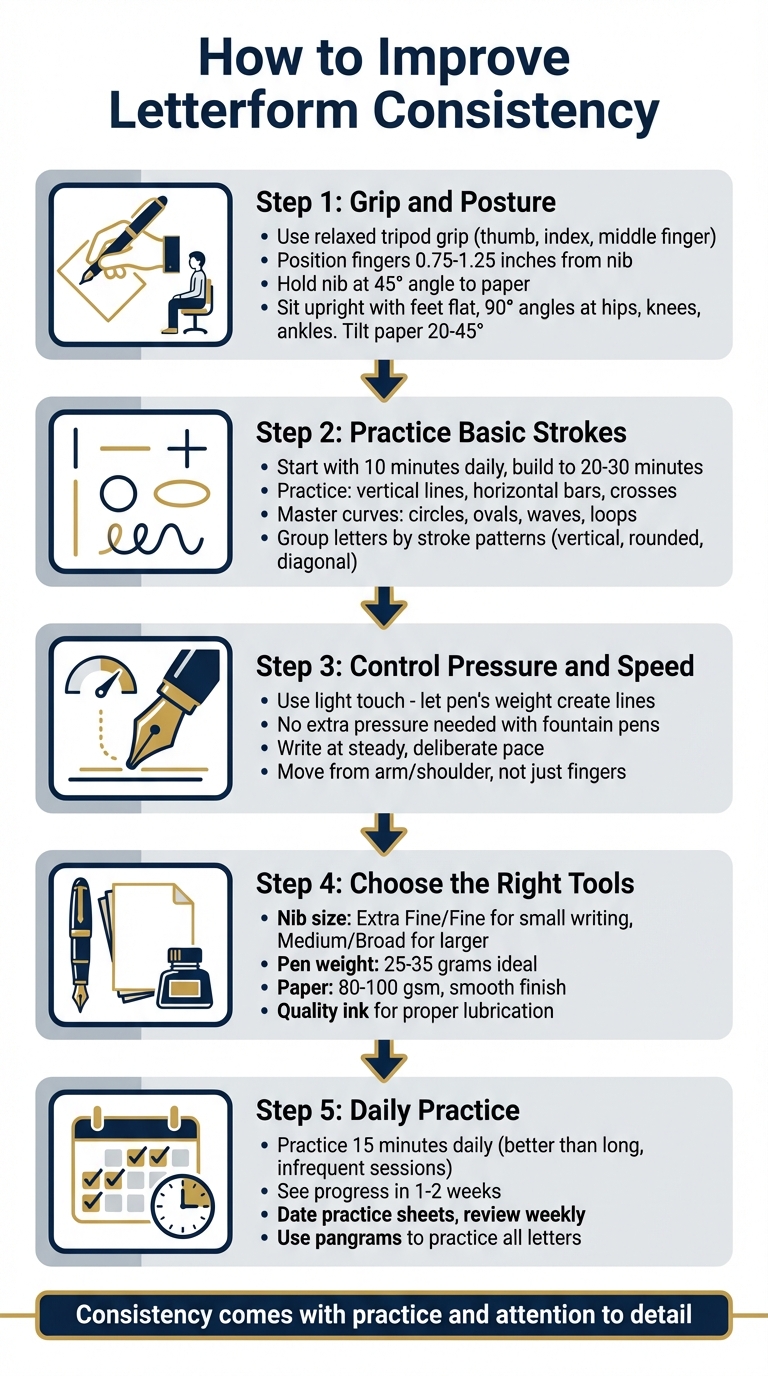
5 Essential Steps to Improve Handwriting Letterform Consistency
Improve your handwriting by having consistent slant
Improving Your Grip and Posture
The way you hold your fountain pen and your overall posture can drastically affect how effortlessly the pen moves across the page. A proper grip and posture not only make your writing smoother but also help you maintain consistent letterforms. On the other hand, a poor grip or slouched posture can lead to hand fatigue and uneven strokes.
How to Hold a Fountain Pen
The best way to hold a fountain pen is by using a tripod grip. This means holding the pen between your thumb and index finger while allowing the barrel to rest gently on your middle finger. Position your fingers about 0.75 to 1.25 inches away from the nib. Keep your grip relaxed - gripping too tightly can cause unnecessary strain and lead to shaky strokes.
For smooth ink flow, aim to hold the nib at a 45-degree angle to the paper. Unlike ballpoint pens, fountain pens don't require pressure; their weight alone is usually enough to get the ink flowing. A light touch is key to achieving clean, fluid lines.
Posture and Arm Movement
Good posture is essential for comfortable and effective writing. Sit upright with your feet flat on the floor and your hips, knees, and ankles forming 90° angles. Rest your forearm parallel to the table, and tilt your paper slightly - somewhere between 20° and 45° - to match the natural movement of your writing arm.
"Decreasing the use of your hand and instead using your arm to write will eventually lead to better control and less fatigue." - John, Author of Fountain Pen Love
When writing, focus on moving the pen with your arm and shoulder rather than relying solely on your fingers. This technique engages larger muscles, which are less likely to tire, and results in smoother, more even strokes. To keep your paper steady, use your non-writing hand as an anchor. Practicing these habits daily can help you develop a more fluid and consistent writing style.
Practicing Basic Strokes
Once you've nailed the right grip and posture, the next step is to develop muscle memory through repetitive stroke exercises. These drills are the building blocks for creating consistent and clean letterforms. Simple pre-writing strokes - like lines, crosses, circles, squares, and triangles - lay the groundwork for tackling more intricate letter shapes.
"Simple drills of lines and loops on a regular basis can make a big difference in how your writing looks." – John, Author of Fountain Pen Love
Start small - just 10 minutes a day - and gradually work up to 20–30 minutes as your endurance improves. The secret to progress is consistency. Short, focused practice sessions are far more impactful than sporadic, lengthy ones. With this in mind, let’s dive into some fundamental exercises.
Drills to Practice Daily
Begin your session with parallel vertical lines. Draw evenly spaced, straight lines from top to bottom to train your arm for controlled, steady movements. Follow this up with horizontal bars and crosses to practice smooth transitions between strokes.
Next, focus on curved strokes like circles, ovals, waves, and loops. These are essential for mastering the rounded shapes found in letters like "a", "o", and "p". If you're working on slanted scripts, include diagonal strokes at a consistent angle - typically between 5–15° - to ensure your letters maintain a uniform slant.
Instead of practicing letters alphabetically, try grouping them by similar stroke patterns. For instance:
- Start with vertical and horizontal letters (e.g., L, E, H, T).
- Move on to rounded letters (e.g., C, O, G, S).
- Finish with diagonal letters (e.g., A, V, W, X).
This method focuses on specific muscle movements, making your practice more effective.
Keeping Your Strokes Uniform
Once you've worked through the drills, shift your attention to uniformity. Consistency in shape, pressure, and alignment is what takes your writing to the next level. Aim to replicate each stroke precisely - same circle size, line length, and angles.
If you're using a fountain pen, remember that it requires only light pressure. These pens are designed to glide effortlessly across the page, so keep your grip relaxed and let the nib do the work.
Practicing on guide sheets - like lined or dot-grid paper - can help you maintain straight baselines and consistent letter heights. For added precision, use a ruler and pencil to draw lines through your completed strokes. If the lines are parallel and don’t intersect, your angles are consistent. This simple trick can quickly highlight areas for improvement and help you refine your technique.
Managing Pressure, Speed, and Rhythm
Now that your basic strokes are consistent, it's time to fine-tune the details of pressure, speed, and rhythm. These elements work in harmony to produce clean and uniform letterforms. Luckily, fountain pens are designed to make this process feel intuitive.
Using the Right Amount of Pressure
Fountain pens operate through a combination of gravity, capillary action, and air pressure - so no extra force is required. The key is to let the pen glide naturally. As EndlessPens explains, "A fountain pen works by using gentle pressure for the ink to flow naturally. There is no need to press down hard".
To find the right balance, try this simple approach: hold the pen at a 45-degree angle and let it rest on the paper. Apply just enough pressure to allow the pen's weight to create a steady line. Pressing too hard can misalign the nib's tines, causing scratchiness and uneven ink flow.
Pay attention to nib size. Finer nibs require an even gentler touch. Brian Goulet, founder of The Goulet Pen Company, advises, "Finer nibs need a lighter touch. If you want a smoother writing feel, you may want to go broader, especially if you write with a heavier hand". If you tend to press down while writing, consider switching to a broader nib for a smoother experience. For extra-fine nibs, relax your grip and let the pen do the work for you.
Once you've mastered pressure control, it's time to focus on pacing your writing for consistent results.
Writing at a Consistent Pace
Writing too quickly can lead to messy letterforms, while writing too slowly might result in shaky lines. The goal is to establish a steady rhythm.
Engage your whole arm, not just your fingers. Rest your forearm on the desk and pivot from your elbow for smoother movements. This technique not only improves control over your speed but also reduces hand fatigue. As Wood Fountain Pens explains, "Using your arm muscles with a pen instead of your fingers will give you more control over the pressure and velocity of your pen".
During practice, deliberately slow down. Quality takes precedence over quantity. Dee Quine, author of Bullet Journal, highlights the importance of mindfulness: "If you slow down, you become more mindful of putting pen to paper, hence paying closer attention to achieving consistency in letter forms". Once muscle memory kicks in, you can gradually increase your speed without compromising uniformity. For now, focus on smooth, flowing movements and let your rhythm evolve naturally.
sbb-itb-1dd4fe9
Choosing the Right Tools
Your technique is crucial, but the tools you use are just as important for achieving consistent letterforms. A good fountain pen, paired with the right ink and paper, creates the perfect combination for smooth strokes and even lines. When your tools align with your technique, consistency becomes much easier to achieve.
Finding an Affordable Fountain Pen
The nib size of a fountain pen significantly impacts your writing experience - about 90%, to be exact. If your handwriting is small and detailed, go for an Extra Fine or Fine nib. For larger, more flowing styles, a Medium or Broad nib will give you the coverage you need.
Look for pens designed with ergonomic grips, such as triangular sections, which encourage a relaxed tripod hold. This reduces hand fatigue and improves control. Fountain Pen Revolution, for example, offers beginner-friendly sets starting at $35.00, featuring well-balanced pens with reliable ink flow - perfect for building consistency.
When choosing a pen, test for balance. A pen weighing between 25–35 grams provides enough heft to guide your hand without causing strain. Hold it at a 45-degree angle to find the "sweet spot" where the nib makes full contact with the paper for the smoothest writing. As JetPens puts it, "The 'sweet spot' is the angle and position where the nib makes contact with the paper and allows for smooth, effortless writing".
Using Quality Ink and Paper
The right ink and paper can make all the difference in maintaining uniform strokes. Ink acts as a lubricant for the nib, while quality paper ensures the pen glides smoothly without interruptions. Cheap or rough paper can cause the nib to catch, leading to skips that disrupt your letterforms.
Opt for smooth, fountain pen-friendly paper. Paper with a satin finish and a weight of 80-100 gsm (grams per square meter) is ideal, as it prevents feathering and bleed-through. For practice, HP 32lb Premium Laserjet paper is an excellent choice, while premium options like Rhodia Le R provide an unparalleled smooth writing experience. As Shawn Buckles notes, "For the smoothest writing experience, you want the smoothest paper you can afford".
The ink you use should match your pen's flow characteristics. If your pen writes too dry or feels scratchy, try a "wetter" ink like Diamine to improve lubrication. On the other hand, if the ink pools or the pen floods, a "drier" ink such as Parker Quink can help control the flow. For added stability, place a second sheet of paper underneath your writing page. This creates a slightly cushioned surface that enhances pen responsiveness and helps maintain consistent strokes.
With the right tools in hand, you’re set to refine your skills through regular, focused practice.
Creating a Practice Schedule
A consistent practice routine is key to mastering uniform letterforms. Daily practice helps build muscle memory, making your strokes more natural over time. Instead of long, occasional sessions, aim for short, focused practices - they're far more effective for developing automaticity.
Start small and gradually increase your stamina, working up to 20–30 minutes per session.
To get the most out of your practice, structure your sessions. Begin with basic strokes like upstrokes and downstrokes to warm up your hand and refine pressure control. Once warmed up, focus on similar letterforms - such as "o", "a", and "d" - before progressing to full words and sentences.
Practicing Every Day
Practicing for just 15 minutes daily is far more effective than infrequent, lengthy sessions. Short, consistent efforts help build muscle memory and improve focus. Stick with it, and you could see noticeable progress within 1 to 2 weeks.
If staying motivated feels tough, start with just 5 minutes to ease into the habit. Consistency is key, so aim to establish a routine that keeps you focused.
To keep things interesting, mix drills with practical writing tasks. After warming up with strokes and loops, try incorporating everyday activities like journaling, writing out quotes, or even lettering your grocery list. Using guide sheets or slanted lines during practice can help maintain a steady x-height and consistent slant.
Once you’ve established a regular routine, tracking your progress becomes the next step.
Monitoring Your Progress
Tracking your progress is a great way to reinforce your improvements. Date each practice sheet and review them weekly to identify areas that need extra attention. As Dee Quine wisely recommends:
"Slow down, aim for consistency in your letter forms, and practice".
Pay close attention to patterns in your work. Are certain letters consistently larger or smaller than others? Does your slant shift partway through a line? Identifying these trends allows you to adjust your focus where it’s needed most.
For well-rounded practice, try pangrams like "The quick brown fox jumps over the lazy dog" or "Pack my box with five dozen liquor jugs." These sentences ensure you're practicing all the letters of the alphabet equally.
If certain letters give you trouble, write them larger to examine the details more closely. Enlarged letters make it easier to spot mistakes, and once you’ve mastered the form, you can return to standard sizes. This method helps you pinpoint inconsistencies and provides a clear path for improvement.
Conclusion
Improving the consistency of your letterforms takes dedication, regular practice, and attention to technique. Start by mastering the basics: maintain a proper grip and adjust the paper angle as needed. These foundational steps, outlined earlier, are crucial for creating stable and uniform writing.
Instead of relying solely on your fingers, incorporate movement from your forearm and shoulder. This approach not only builds endurance but also enhances accuracy, helping you achieve consistent letter shapes, spacing, and a steady 5°–15° slant. Slowing down your writing pace can also make a big difference, allowing you to focus on precision with every stroke.
Once your technique is solid, the right tools can make a noticeable impact. Fountain pens, for example, require minimal pressure, which helps you avoid the dreaded "death grip" that can throw off your consistency. Pairing your pen with high-quality ink and paper designed for fountain pens further supports a smooth writing experience. If you're new to fountain pens, consider starting with budget-friendly options from Fountain Pen Revolution to help you refine your skills.
Consistency also comes from building muscle memory, and that requires daily practice. As calligrapher Jake Rainis wisely notes:
"Knowing how to approach your work with an aim for consistency is the first step to achieving consistency".
With patience and determination, you'll see progress over time. The secret lies in showing up every day, focusing on the details, and perfecting your technique one stroke at a time.
FAQs
What are some effective daily tips for improving handwriting consistency?
Improving your handwriting takes patience and regular practice, but it can be a rewarding process. Start by selecting a fountain pen that's comfortable to use - look for beginner-friendly options in the $15–$20 range with a fine or extra-fine nib to suit your writing style. Hold the pen lightly at an angle of 40–55°, which helps minimize hand fatigue and allows for smoother, more controlled strokes.
Set aside 5–10 minutes each day to practice. Write a single line of the alphabet or a favorite sentence, concentrating on keeping your letters consistent in height, spacing, and slant. Using high-quality, fountain-pen-friendly paper can make a big difference, as it ensures smoother ink flow and better results. After each session, take a moment to review your work. Identify any uneven letters and practice them again until they look more consistent. To track your progress, try writing a paragraph once a week - you’ll be able to see how your handwriting improves over time. With steady effort, your writing will become more polished and uniform.
How can a fountain pen help improve the consistency of your handwriting?
A fountain pen can help improve handwriting consistency by encouraging better technique and control. Its unique design requires less pressure and offers smoother ink flow, which not only reduces hand fatigue but also helps maintain uniformity in letter size, spacing, and slant. Additionally, using a fountain pen promotes a steadier grip and ensures the nib is angled correctly, giving you more precision with every stroke.
To achieve the best results, it’s important to choose a nib size that matches your handwriting style and pair it with high-quality, fountain-pen-friendly paper. This combination helps create clean, consistent lines without issues like smudging or skipping. If you’re just starting out, consider an affordable, well-balanced fountain pen - options priced around $15–$20, like those from Fountain Pen Revolution, are a great starting point. With regular practice and the right tools, a fountain pen can naturally guide your handwriting toward greater consistency.
Why does good posture matter for consistent handwriting?
Good posture plays a big role in maintaining consistent handwriting. When you sit upright with your feet flat on the floor and your desk or table at a comfortable height, it provides the stability needed for steady hand movements. This setup not only helps you control your pen more easily but also reduces strain, making it easier to write for longer periods without feeling fatigued.
Having the right posture also encourages a relaxed grip and positions your hand at the ideal writing angle - typically between 40–55°. These factors are crucial for creating smooth, even letters. Paying attention to how you sit and hold your pen can make a noticeable difference in the quality and uniformity of your handwriting.