

Custom and bespoke fountain pens offer two levels of personalization, but they differ in design, craftsmanship, and cost. Custom pens are built using pre-made components with options for materials, nib sizes, and engravings. They’re affordable, starting at $50, and ready in as little as two weeks. Bespoke pens are entirely handcrafted from raw materials, allowing for complete design control, from grip ergonomics to rare materials like vintage celluloid. Prices start at $175 and can exceed $700, with production times ranging from three months to a year.
Quick Comparison:
| Feature | Custom Pens | Bespoke Pens |
|---|---|---|
| Design Starting Point | Pre-made components | Fully handcrafted |
| Price Range | $50–$300 | $175–$700+ |
| Production Time | 2 weeks or less | 3 months to 1 year+ |
| Material Options | Standard resins, metals | Rare materials, custom resins |
| Personalization Depth | Limited to pre-set options | Fully customizable |
Custom pens are ideal for practicality and quick personalization, while bespoke pens cater to collectors and enthusiasts seeking one-of-a-kind craftsmanship.
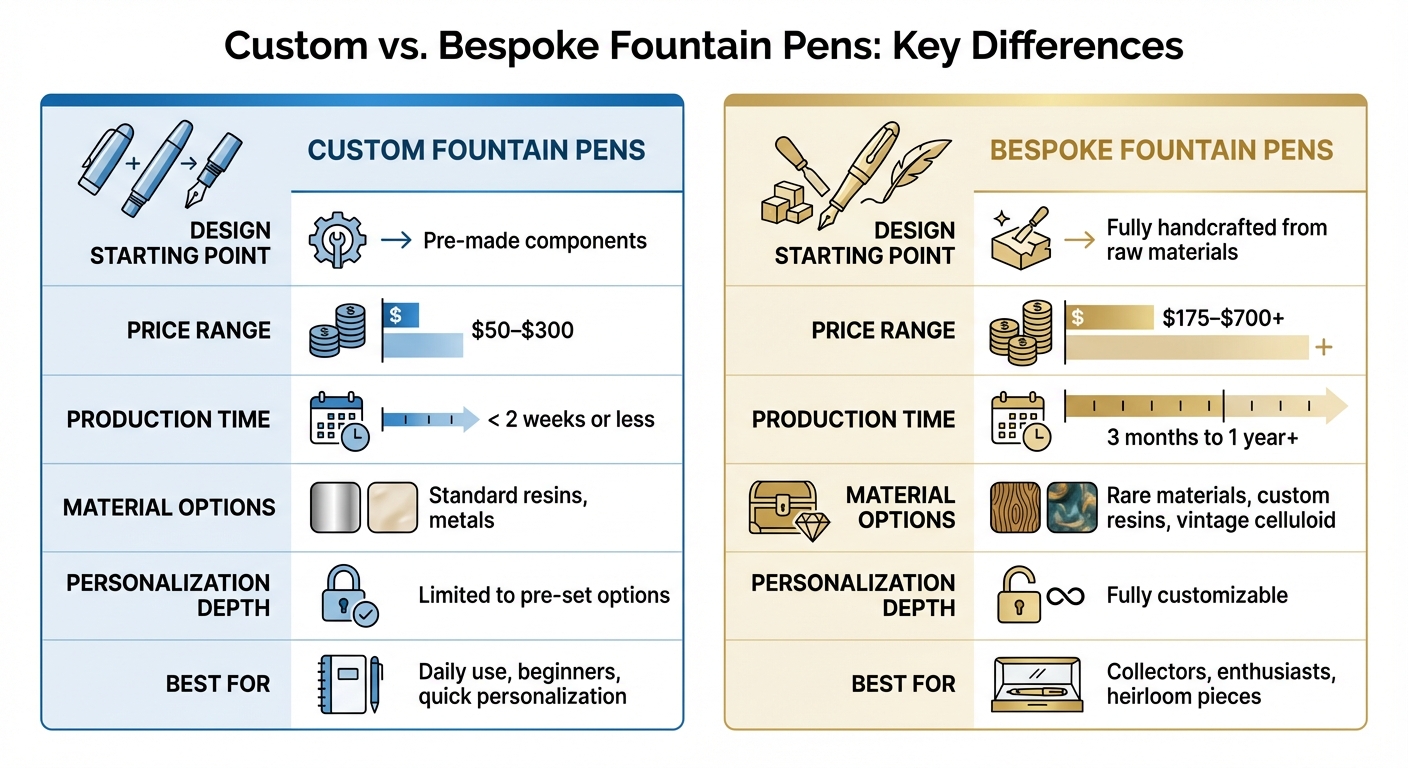
Custom vs Bespoke Fountain Pens Comparison Chart
Materials, Kits, Custom, Bespoke Pens
What Are Custom Fountain Pens?
Custom fountain pens combine standardized internal components - like nibs, feeds, and ink converters - with exteriors and nibs that can be tailored to personal preferences. This approach ensures reliable performance while allowing for creative, individualized designs.
The word "custom" in this context has a specific origin. Brian Goulet, Founder of The Goulet Pen Company, explains:
"They're called Custom because they're pens with nicer materials and more nib grind options than were available from other standard pens at the time."
Thanks to standardized parts from manufacturers such as JoWo, Bock, or Schmidt, custom pen makers don’t need to engineer complex feeds from scratch. For example, the standard international ink converter - a key feature in these pens - measures 7.82 mm at its widest point. This level of uniformity allows designers to focus on crafting unique exteriors while ensuring dependable ink flow and writing performance. Let’s explore the range of customizations these pens offer.
Features of Custom Fountain Pens
Custom fountain pens provide numerous ways to personalize your writing experience. Makers offer a variety of materials, including resin, wood, metal, and ebonite, which can be finished in styles like matte, translucent, or ombre.
Nib customization is another major draw. Options range from Extra-Fine to Broad, with materials like stainless steel or 14k/18k gold. For more specialized writing styles, nibs can be ground into shapes like Stub, Italic, Oblique, or Architect's Point. If you're interested in nib grinds that offer line-width variation, starting with at least a Medium nib is recommended to ensure enough tipping material for customization.
The decorative possibilities are nearly endless. You can add laser engravings of names, initials, dates, or logos to the pen’s cap or barrel. Some makers even offer hand-painted designs or intricate embellishments. Beyond aesthetics, functional customizations like choosing between cartridge, converter, piston, or vacuum filling systems are available, as well as clip styles or roll-stops to keep your pen from rolling off your desk.
Benefits of Custom Fountain Pens
Custom fountain pens offer more than just good looks - they’re practical, too. For instance, they can be surprisingly affordable. Entry-level options like the Pilot Custom 74 start at around $200.00, while handmade wood and brass pens are available in the $49.00–$59.00 range.
The use of standardized components also means faster production times - some pens can ship in as little as four business days after artwork approval. Maintenance is straightforward, making these pens an excellent choice for beginners. A great example is the Pilot Custom 74, a gold-nib pen that’s often recommended for first-time users. It offers a smooth writing experience without the steep price tag of fully bespoke pens. Plus, the wide availability of replacement parts ensures easy upkeep.
What Are Bespoke Fountain Pens?
Bespoke fountain pens take personalization to a whole new level. Unlike custom pens, which often adapt pre-made components, bespoke pens are crafted entirely from scratch. This approach allows for unmatched individuality in design. Phil Dart, the Founder of Beaufort Ink, explains it best: "The whole point about making a kitless pen is that you get to make it look exactly how you want it".
The term "kitless" is key here. Instead of assembling pre-made parts, artisans shape the pen’s body, grip, and cap from raw materials like ebonite, resin, celluloid, or metal. This method gives you complete control over every detail, from the pen’s overall length to the grip diameter that feels just right in your hand.
The process usually begins with a one-on-one consultation, where you collaborate with the artisan to bring your vision to life. This could involve discussing motifs, ergonomic preferences, and aesthetic details. As Katy Klassman from Galen Leather says, "For someone who truly loves pens, there may be nothing more meaningful than getting to have your writing instrument customized to your every whim and will".
Features of Bespoke Fountain Pens
Every bespoke pen starts with the careful selection of materials. Artisans often use rare and luxurious materials, such as Italian celluloids, hand-cast resins, exotic woods, and precious metals. Some even blend ancient craftsmanship with modern techniques, like combining urushi lacquering with 3D-printed metal components.
The level of technical customization is extraordinary. Makers design every detail, from specific dimensions and custom-cut threads (often triple-lead for smoother cap action) to specialized nib housings. You can also choose unique ink-filling systems, such as eye-droppers or piston fillers, and add functional features like roll-stops to prevent the pen from rolling off a desk.
Artistic craftsmanship is another hallmark of bespoke pens. This might include intricate hand-engraving, barrel painting, or traditional Japanese techniques like maki-e, which uses gold and silver powder lacquerwork. Montegrappa, an Italian luxury pen maker, describes their bespoke service as creating pens "entirely in your vision". The result is often considered a "private art piece" - an heirloom that can outlast both the maker and the owner.
However, this level of craftsmanship comes with a time investment. Each pen requires dozens of hours of meticulous work, from the initial consultation to the final touches, and waitlists can stretch beyond a year.
These painstaking efforts result in a pen that not only meets but surpasses the collector’s desire for something truly one-of-a-kind.
Benefits of Bespoke Fountain Pens
Owning a bespoke pen means owning something truly exclusive. No other pen in the world will share its exact design, dimensions, or artistic details. You’re not confined by pre-existing models or standard options; instead, you have complete creative freedom. Everything - from the grip diameter and weight balance to the color of a hand-mixed resin or a motif painted on the barrel - is up to you. Kilk Fine Writing Instruments describes it perfectly: "The pen carrier's persona and the persona of the pen should be one and the same".
Bespoke pens also hold a unique place in the luxury market. The global luxury pen industry is projected to hit $3,800 million by 2031, with fountain pens expected to grow at a compound annual growth rate of 2.51% from 2023 to 2030. While these pens come with premium price tags - often determined by the materials and labor involved - they retain their value as collectible works of art.
Design and Manufacturing: Custom vs. Bespoke
When it comes to fountain pens, the terms "custom" and "bespoke" often get thrown around, but they mean very different things. Custom pens are crafted using preset models and parts, while bespoke pens are built entirely from raw materials, starting from scratch. Essentially, custom pens are like choosing from a menu, while bespoke pens are a blank canvas.
Custom pens rely on existing designs and components. Buyers pick options like materials, nib sizes, and finishes through a configurator or design platform. Once the choices are made, manufacturers assemble these pre-made parts in their workshops. This streamlined process means you could receive your custom pen in as little as 10 days.
Bespoke pens, on the other hand, take a completely different approach. These pens begin with the internal components - like the nib assembly and ink converter - before any external design work is done. As Phil Dart from Beaufort Ink explains:
"The design of your fountain pen needs to start with the inside, not the outside".
From there, the maker determines the precise dimensions for the section, barrel, and cap. Every piece is meticulously machined from raw materials, such as rods of ebonite, resin, or wood, using a lathe. This "kitless" process means nothing is pre-made - everything is crafted by hand.
While custom pen manufacturers use industrial processes with precision margins as tight as 0.01mm, bespoke makers rely on manual calculations to achieve perfect fits. For example, companies like Pilot cast their own gold alloys and maintain strict nib tolerances. Bespoke artisans, however, use specialized tools like ER-32 collet chucks and triple-lead taps to manually cut threads, ensuring both functionality and durability.
Another distinction is material choice. Bespoke makers can work with a wider variety of raw materials, including rare Italian celluloids, exotic woods, or hand-cast resins. These materials must be carefully chosen for their ability to handle fine threading and structural demands.
Comparison Table: Design and Manufacturing
Here’s a side-by-side look at the key differences between custom and bespoke fountain pens:
| Feature | Custom Fountain Pens | Bespoke Fountain Pens |
|---|---|---|
| Design Starting Point | Selection from existing models and parts | Internal components (nib and converter first) |
| Material Selection | Pre-defined resins, ebonite, or precious metals | Raw stock such as wood, resin, or exotic materials |
| Nib Integration | Proprietary or standard gold/steel nibs from the manufacturer | Standardized assemblies (Jowo, Bock, Schmidt) fitted to custom-machined sections |
| Production Technique | Industrial manufacturing with workshop assembly | Manual machining on lathes, turned from scratch |
| Thread Creation | Standardized factory threading | Manual tapping and die-cutting with specialized tools |
| Precision Level | 0.01mm margin of error (industrial) | Hand-calculated dimensions for structural integrity |
This comparison highlights the distinct craftsmanship and processes that set bespoke pens apart from their custom counterparts. Each approach offers its own unique appeal, catering to different preferences and priorities.
sbb-itb-1dd4fe9
Personalization Options: Custom vs. Bespoke
When it comes to custom fountain pens, you're selecting from a menu of predefined choices. These could include body materials like wood, acrylic, or resin, nib sizes ranging from extra-fine to broad, various ink filling systems, and the option to engrave initials. Essentially, you're personalizing within the boundaries of what's already available. For example, some manufacturers, like Pilot, provide up to 15 different nib grinds in their Custom line, offering more variety than standard retail pens. However, bespoke pens take personalization to an entirely different level.
Bespoke pens go beyond predefined options - they’re created entirely from scratch, offering complete creative freedom. Phil Dart from Beaufort Ink puts it perfectly:
"The whole point about making a kitless [bespoke] pen is that you get to make it look exactly how you want it to".
With bespoke pens, the possibilities are virtually limitless. Artisans can shape the grip section to fit your hand like a glove, incorporate rare materials such as vintage celluloid or exotic woods, and even analyze your writing style via video to craft a nib that matches your unique pressure and angle.
While custom pens stay within certain parameters, bespoke services extend to hand-painted designs, gemstone accents, and custom-engraved signatures. For instance, Montblanc’s bespoke program starts at approximately $1,660 and offers 16 specialized nib sizes beyond their standard options. Each nib reflects what author Nick Foulkes describes as "an entirely different writing philosophy". The table below highlights the key differences between these two approaches to personalization.
| Feature | Custom Fountain Pens | Bespoke Fountain Pens |
|---|---|---|
| Design Approach | Selection from pre-set options | Designed from scratch based on your input |
| Nib Options | Standard sizes or up to 15 factory grinds | Tailored to your writing style; 16+ specialized sizes |
| Body Personalization | Pre-machined shapes with curated materials | Custom ergonomics designed specifically for your hand |
| Decorative Options | Basic engraving and standard finishes | Hand-painted artwork, gemstone settings, custom signatures |
Custom pens give you control within a structured framework, but bespoke pens break free from those boundaries, allowing you to create something genuinely one-of-a-kind.
Cost and Production Time: Custom vs. Bespoke
The price difference between custom and bespoke pens is significant. Custom pens typically range from $50 to $300, while bespoke pens start at $175 and can soar beyond $700, thanks to the labor-intensive process and use of rare materials. The construction methods play a major role in these cost differences. Custom pens rely on pre-made components, which streamline assembly. Bespoke pens, on the other hand, are crafted from raw stock materials, requiring more intricate work. This distinction also impacts production timelines.
When it comes to production time, the gap between the two categories is just as stark. Custom pens are often ready for immediate purchase or ship within two weeks. Bespoke pens, however, involve a much longer wait. For example, Loft Pens has a waiting list of about three months, and artisans like Bokumondoh can have wait times stretching up to a year for their meticulously hand-lacquered pens.
The extended timeline and higher costs of bespoke pens are tied to the labor-intensive processes they require. These include manual turning on lathes, precision drilling, hand-cutting threads using specialized tools, and painstaking hand-finishing. In contrast, custom pens focus on assembling and personalizing pre-existing parts, which significantly reduces production time.
Material choices also play a big role in both cost and production time. Opting for standard materials like basic resins or metals keeps expenses in check. However, selecting rare materials - such as solid gold or vintage celluloid - can add weeks to production and push prices well above $500. Even the nib selection affects the final cost; for instance, upgrading from a steel nib to a gold one can dramatically increase the price.
Cost & Production Time Comparison
| Factor | Custom Fountain Pens | Bespoke Fountain Pens |
|---|---|---|
| Price Range | $50–$300 | $175–$700+ |
| Production Time | Immediate to 2 weeks | 3 months to 1 year+ |
| Labor Requirements | Assembly, engraving, nib tuning | Manual turning, drilling, threading, hand-finishing |
| Material Sourcing | Standard resins, metals, woods | Raw rods of ebonite, custom resins, exotic materials |
| Availability | Often in-stock or short lead times | Long waiting lists due to commissions |
When to Choose Custom vs. Bespoke
Deciding between custom and bespoke pens comes down to your budget, timing, and how much personalization you’re looking for. If you’re after an affordable, reliable writing tool, custom pens are a great choice. They’re usually ready to go immediately or within two weeks, cost between $50 and $300, and offer enough customization - like engraving or nib options - to make the pen feel unique.
On the other hand, bespoke pens are the way to go if you’re looking for something truly one-of-a-kind. Whether it’s unique ergonomics or rare materials like hand-cast resin or ebonite, bespoke options deliver unmatched individuality. As Katy Klassman from Galen Leather puts it:
For someone who truly loves pens, there may be nothing more meaningful than getting to have your writing instrument customized to your every whim and will.
If exclusivity and complete personalization are your top priorities, bespoke pens are the ultimate choice.
When Custom Fountain Pens Make Sense
Custom pens shine when you need a dependable writing instrument without the cost or complexity of a fully handmade design. They’re perfect for exploring nib sizes and materials like steel or gold without committing to a high-end option. Custom pens are also ideal for corporate gifting or bulk orders. For example, ordering in large quantities - 5,000 or more - can bring the cost down to as little as $0.50 to $1.00 per pen.
The convenience and affordability of custom pens make them especially practical. Unlike bespoke pens, which require intricate craftsmanship and longer wait times, custom pens are readily available and straightforward to use. They’re perfect for daily writing needs or as gifts for events, with most options shipping immediately or within two weeks. Additionally, they often use standard international fittings for cartridges and converters, making maintenance and replacements hassle-free.
When Bespoke Fountain Pens Make Sense
Bespoke pens are tailor-made for collectors, enthusiasts, and anyone who sees a fountain pen as more than just a tool - it’s an experience. If you want an heirloom-quality piece designed specifically for your hand, bespoke is the way to go. Phil Dart from Beaufort Ink highlights this perfectly:
The whole point about making a kitless pen is that you get to make it look exactly how you want it to.
These pens are also ideal for those with specific ergonomic needs. For example, if you write for long periods and require a pen designed to reduce hand fatigue, a bespoke maker can craft a design that perfectly suits your grip. Plus, bespoke pens often incorporate rare materials like urushi lacquer, vintage celluloid, or precious metals, giving them a level of uniqueness that mass-produced custom pens can’t match. While they come with a higher price tag and longer wait times, the result is a pen that’s truly yours in every sense.
Conclusion
The decision between custom and bespoke pens ultimately boils down to what matters most to you: convenience or exclusivity. Custom pens provide dependable performance with options like personalized nibs and engravings, making them perfect for everyday use. On the other hand, bespoke pens are truly one-of-a-kind creations, meticulously crafted to your exact specifications, often using rare materials and requiring significant wait times - sometimes over a year.
If you’re looking for a quality writing instrument without the long lead times or significant expense, custom pens are a fantastic choice. They allow you to experiment with different nib sizes or materials while keeping the process simple and accessible. They’re great for daily writing, thoughtful corporate gifts, or enjoying a personalized design without diving into the complexities of fully handmade craftsmanship. However, if you’re after a pen that’s more than just a tool - something that reflects your personality, preferences, and even tells a story - a bespoke pen is an investment in functional art, crafted to last generations.
For those new to fountain pens or seeking an affordable way to explore personalized options, Fountain Pen Revolution offers handmade pens priced between $18 and $149. Their collection includes a variety of nibs, inks, pen stands, and cases, making it easy to find something that suits both your writing style and budget. Whether you’re starting your fountain pen journey or searching for specialty items like flex nibs, their selection balances quality and affordability. Visit Fountain Pen Revolution to explore their offerings.
FAQs
What’s the difference between custom and bespoke fountain pens?
Custom fountain pens are crafted by combining ready-made parts like nibs, feeds, and converters with materials such as wood, resin, or metal. While you can customize features like nib size, color, or add engravings, the essential components remain standardized and mass-produced.
Bespoke fountain pens, however, are a different story. These are meticulously handcrafted from the ground up. The pen maker designs and creates nearly every part, from the body to the filling system, often working with rare materials to produce a design that's entirely unique and tailored to the buyer's specific tastes.
This distinction is also reflected in the price. Custom pens are generally more budget-friendly, starting at a few hundred dollars. Bespoke pens, with their artistry and exclusivity, typically cost anywhere from several hundred to thousands of dollars.
What are the differences in production times and costs between custom and bespoke fountain pens?
Custom fountain pens are made using pre-manufactured parts like kits or blanks. Since these components are already produced, the assembly process is relatively fast, taking anywhere from a few days to a few weeks. Plus, they’re more budget-friendly, typically costing less than $200 USD. This makes them a popular choice for fountain pen enthusiasts looking for something personalized without breaking the bank.
Bespoke fountain pens, however, are an entirely different story. These pens are crafted from the ground up, with the maker designing every detail - everything from the body to custom-shaped nibs and even unique filling systems. This level of craftsmanship takes much longer, often several weeks to a few months, and comes with a higher price tag, sometimes ranging from several hundred to thousands of dollars. Each bespoke pen is a one-off masterpiece, showcasing the artisan's expertise and tailored to the buyer’s exact preferences.
What kind of personalization can I get with a bespoke fountain pen?
A custom fountain pen lets you personalize nearly every aspect to match your style and needs. From choosing the body material and shape to selecting the nib type and ink-filling system, the options are nearly endless. You can even pick your favorite colors and add personal touches like engraving. The result? A pen crafted just for you, delivering a writing experience that's entirely your own.