

Testing fountain pen ink flow ensures smooth writing and helps identify and fix common issues like skipping, dry starts, or excessive feathering. Here’s how to do it:
- Quick Test: Use a dip pen or calligraphy nib to quickly test ink behavior on fountain-pen-friendly paper.
- Full Fill Test: Fill the pen completely to evaluate long-term ink performance and flow consistency.
- Pattern Test: Draw repetitive loops or lines to check for skipping, hard starts, or feed starvation.
Key Tools
- Pens: Affordable options like Lamy Safari ($29.60) or Jinhao 599 (under $10 for 8-pack) are ideal for testing.
- Paper: Use Rhodia or Tomoe River for accurate ink flow results.
- Cleaning Supplies: Rinse pens with water or mild ammonia solutions to remove residue and prevent clogs.
Fixing Issues
- Dry Starts: Clean the pen or realign nib tines.
- Skipping: Check for feed starvation or switch to a different ink.
- Excessive Flow: Adjust nib tines or use less "wet" inks.
Routine cleaning and testing can resolve most problems. If issues persist, experimenting with different inks or minor nib adjustments could help.
Tools and Materials You'll Need
Fountain Pen and Ink
Start with a fountain pen that's easy to clean and maintain. The Lamy Safari or Lamy Vista (around $29.60) are great options, offering quick nib and converter swaps for convenience. The TWSBI Go features a spring-loaded pump system, making cleaning simple, while the Sailor HighAce Neo includes a translucent feed so you can visually check for leftover ink before testing.
If you're planning to test multiple inks, budget-friendly choices like the Jinhao 599 are ideal. These pens are available in packs of eight for under $10, making them perfect for experimenting. For quick ink tests without the hassle of thorough cleaning, glass dip pens or a Speedball Calligraphy Set (about $12 for five nibs and a holder) allow you to switch inks in seconds with just a rinse.
Paper and Cleaning Supplies
The texture of your paper plays a big role in how ink behaves. Rhodia dot pads are a reliable option for testing ink flow. In a study of 18 paper types with 11 inks, Rhodia showed no instances of ink resist, meaning the ink adhered evenly. For shading tests, Tomoe River paper is a top choice, while MD Cotton is excellent for larger lettering experiments.
Basic cleaning supplies are essential. You'll need tap water, paper towels, and fine-tipped pipettes for transferring ink from narrow sample vials into pens. If you're serious about avoiding ink cross-contamination, an ultrasonic cleaner can ensure that all traces of previous inks are removed.
Optional Tools for Advanced Testing
To examine common nib issues like nib gap or tine alignment more closely, a jeweler's loupe or a 60mm macro lens can come in handy. For exploring the color components of an ink, chromatography paper strips or even coffee filters dipped in water work well. If you want to organize swatches or track ink performance over time, specialized tools like Col-o-ring or Col-o-dex cards are excellent for keeping everything in order. Once you’ve gathered your tools, you’re ready to prepare your pen for testing.
sbb-itb-1dd4fe9
Preparing Your Pen for Testing
Disassembling and Cleaning the Pen
Factory oil residue can interfere with ink flow, so it's a good idea to clean your pen before testing. If you're switching between inks, a thorough cleaning is even more important to prevent cross-contamination and clogging.
To start, take the pen apart by removing the nib unit, converter, or cartridge. Rinse the nib section under warm running water until the water runs clear. For tougher residue, soak the nib unit in warm water with a drop of dishwashing liquid, then rinse thoroughly. Be sure to avoid hot water, as it can damage certain parts of the pen.
"The JetPens team recommends cleaning fountain pens every four to eight weeks as a preventative measure against inconsistent ink flow, staining, and clogging." - JetPens
Certain inks, like pigment-based, iron gall, or shimmer inks, may leave behind more residue and require extra effort to clean. After cleaning, ensure the pen is dried properly to maintain optimal ink performance.
Drying and Refilling the Pen
Completely drying your pen before refilling is essential. Any leftover water can dilute the ink and affect its flow and performance. After cleaning, shake out any excess water and let the pen air dry for several hours.
When refilling, gently roll the ink bottle between your hands to mix any settled particles, especially for shimmer or pigment inks. Avoid shaking the bottle, as this can create air bubbles. Also, never return unused ink from a syringe or pen back into the bottle, as it could introduce contaminants like paper fibers or dust, which might lead to clogging or mold. Once refilled, your pen will be ready for the ink flow assessment steps outlined in the next section.
How To Ink Up and Test a New Fountain Pen
How to Test Ink Flow: 3 Methods
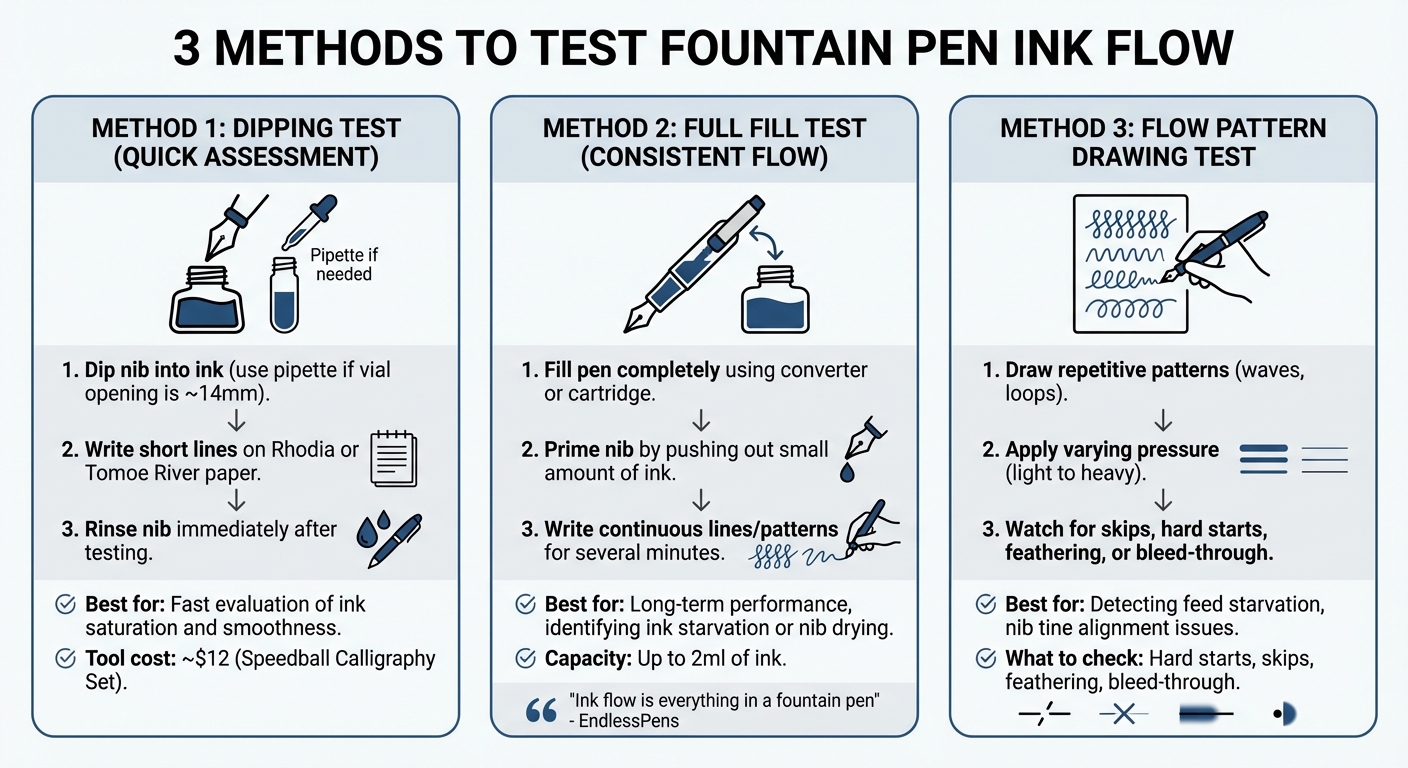
3 Methods to Test Fountain Pen Ink Flow
Dipping Test for Quick Assessment
If you're looking for a fast way to check ink flow, try a dip pen or calligraphy tool. These pens don't have internal reservoirs, so cleaning them is a breeze.
Dip just the nib (and the feed, if swirled) into the ink. If the vial opening is too narrow (about 14 mm in diameter), a pipette can help. Write a few short lines on fountain-pen-friendly paper, such as Rhodia or Tomoe River, to evaluate the ink's saturation and smoothness. This method gives you a quick idea of how the ink behaves on paper.
After testing, rinse the nib in clean water right away to prevent the ink from drying in the grooves. For an affordable option, consider a Speedball Calligraphy Set, which costs around $12 and includes five nibs and a holder.
Full Fill Test for Consistent Flow
To experience how the ink performs during extended use, completely fill your pen using its converter or cartridge system. This approach lets you see how the pen's internal feed and reservoir work together over time, helping identify problems like ink starvation or nib drying during longer writing sessions.
Once filled, prime the nib by pushing out a small amount of ink. This ensures the feed is fully saturated and ready for smooth writing. Write continuous lines or patterns for several minutes - most converters hold up to 2 ml of ink, providing plenty for thorough testing. For consistent results, use the same pen hardware when comparing inks.
"Ink flow is everything in a fountain pen. It is essential for writing to happen smoothly and without any issues like hard starts or skipping." - EndlessPens
Flow Pattern Drawing Test
Drawing repetitive patterns, like waves or loops, can help detect issues like hard starts and skips. This method is especially useful for identifying feed starvation - a problem where the pen's air-exchange system can't keep up with ink demand, leading to sudden skips until an air bubble enters the reservoir.
While drawing, apply varying pressure, from light to heavy. This helps you see if the nib tines are too tight (restricting flow) or too far apart (causing excessive flow). Keep an eye out for feathering (ink spreading into paper fibers) or bleed-through, which signal a wet ink or nib combination. If a new pen shows poor flow during these tests, flush it with a mild ammonia solution (1 tablespoon of clear ammonia mixed with 2/3 cup of water) to remove any oily residue left from manufacturing.
"You'll be writing along and suddenly there's a skip; an instant later, the pen writes again. The natural assumption, that more ink is needed, is wrong. Fixing feed starvation involves... modifying the feed." - Richard Binder, RichardsPens.com
Use these methods to identify any flow issues before moving on to adjustments in the next steps.
Reading Your Results and Fixing Problems
Common Ink Flow Problems and Their Causes
When testing your fountain pen, you might encounter one of four common issues: dry starts, skipping, intermittent flow, or excessive flow and feathering.
- Dry starts or no flow: This happens when the nib tines are pressed too tightly together, preventing ink from flowing, or when dried ink residue clogs the feed. New pens can also experience this due to leftover manufacturing oils that need to be flushed out.
- Skipping: This points to feed starvation, where the air-ink exchange is disrupted. It can also happen if the nib tines are spread too far apart, often caused by pressing too hard while writing, which interrupts the capillary action that draws ink to the paper.
- Intermittent flow: This is usually caused by a sprung nib, where the nib is lifted too far from the feed, breaking the capillary connection.
- Excessive flow or feathering: This may result from using a particularly "wet" ink or having a nib slit that's too open.
Once you’ve identified the issue, you can take specific steps to get your pen back to writing smoothly.
How to Fix Flow Issues
Fixing flow problems starts with regular maintenance and targeted adjustments. Begin by flushing your pen with cool water every two to four weeks. For stubborn clogs, soak the nib and feed in a solution made from 1 tablespoon of clear household ammonia mixed with 2/3 cup of water, then rinse thoroughly. If you’re dealing with a new converter, flush it before the first use to remove any leftover manufacturing oils.
For nib adjustments, a 10× magnifier can help you check the alignment of the tines. If the flow is too restricted, gently press the bottom of each tine upward. If the flow is too heavy, press the top of the tines downward. Even a tiny adjustment can make a noticeable difference.
Sometimes, switching inks can resolve flow problems without needing mechanical tweaks. Certain inks, especially those with high viscosity or particles, can clog the feed. Trying a different ink might solve the issue entirely. Brands like Fountain Pen Revolution offer affordable ink options that work well with a variety of pens.
Conclusion
Testing ink flow doesn’t have to be complicated. The three methods discussed - the dipping test, full fill test, and flow pattern drawing test - offer a straightforward way to evaluate how well your pen is performing. If your pen produces a smooth, continuous line, you’re in good shape. But if you notice skips, dry starts, or bleed-through, it’s a sign that adjustments might be needed.
Most ink flow problems stem from simple issues, like leftover manufacturing residue in new pens, ink that doesn’t match well with your pen, or improperly installed cartridges or converters. Regular care, such as flushing your pen periodically and making sure cartridges or converters are securely fitted, can help you avoid these common problems.
And if the problem persists? Switching to a different ink might do the trick without requiring mechanical fixes. Affordable ink options, like those from Fountain Pen Revolution, start at just $5, making it easy to experiment and find the perfect match for your writing style.
FAQs
How do I know if my pen is too dry or too wet?
A dry pen tends to leave faint or pale lines, can struggle with hard starts, and often delivers an inconsistent flow. It might also feel scratchy or as if it’s dragging across the page. On the other hand, a wet pen releases too much ink, which can lead to blurring, ink spreading, or even soaking through the paper. To address these issues, try cleaning the nib, adjusting the spacing between the tines, or experimenting with a different ink to find the flow that suits your writing style.
Should I test ink with a dip pen or a full fill first?
When testing ink flow, it’s usually best to begin with a full fill. This approach mimics normal writing conditions, allowing you to assess factors like flow, drying time, and consistency more accurately. Keep in mind that dip pens often produce wetter lines, which might not represent how the ink will perform in regular use. Start with a full fill to spot issues like skipping or hard starts. If you need further testing, dip pens can be a secondary option.
What’s the safest way to fix skipping without damaging the nib?
To tackle ink flow problems, begin by thoroughly cleaning the pen. Use lukewarm water or a mild cleaning solution to clear out any dried ink or debris. This simple step often solves most issues. While cleaning, handle the nib with care to avoid damage.
If cleaning doesn’t fix the problem, grab a magnifier to inspect the nib for misaligned tines. If you notice misalignment, you can carefully adjust them using the right tools. However, avoid applying too much force - this can cause permanent damage. When in doubt, it’s best to consult a professional for help.