

Fountain pens are designed to write effortlessly without applying pressure. This makes proper technique key to achieving smooth, comfortable writing. Here's what you need to know:
- Grip: Use a light tripod grip - hold the pen between your thumb and index finger, resting it on your middle finger.
- Angle: Hold the pen at a 40° to 55° angle for optimal ink flow and to avoid scratching or skipping. Understanding fountain pen nib sizes can also help you find the right balance for your writing angle.
- Pressure: Let the pen’s weight guide the ink; pressing too hard can damage the nib and disrupt flow.
- Posture: Sit upright with relaxed shoulders, and tilt your paper slightly (20°–45°) to match your natural arm movement.
- Movement: Use your arm and forearm for controlled strokes instead of relying solely on finger movements.
The combination of proper grip, posture, and minimal pressure ensures a smooth, enjoyable writing experience. Adjusting your technique for different nib types or pen styles can further enhance your results.
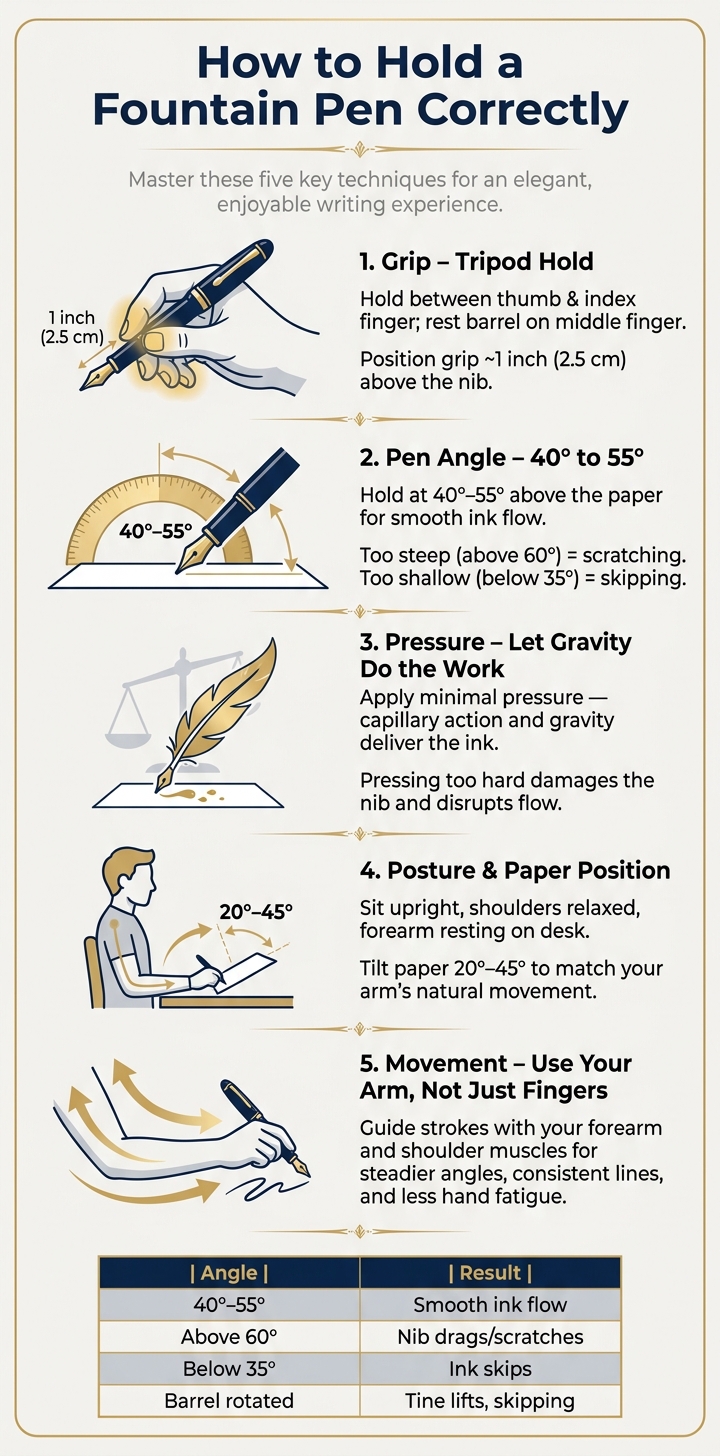
How to Hold a Fountain Pen: 5-Step Technique Guide
How To Hold a Fountain Pen
For a deeper look at technique, see our guide to handwriting with fountain pens.
sbb-itb-1dd4fe9
What Makes Fountain Pen Writing Smooth
Smooth writing with a fountain pen depends on the interplay of nib design, ink, paper, and writing technique. Here’s a closer look at how these elements come together to create a unique writing experience, setting fountain pens for beginners apart from ballpoint and gel pens.
How Fountain Pens Differ from Ballpoint and Gel Pens
The key difference lies in how ink is delivered to the page. Ballpoint pens rely on thick, oil-based ink that is dispensed by pressing down to activate a rolling ball. In contrast, fountain pens use water-based liquid ink that flows effortlessly through the nib via capillary action and gravity - meaning no pressure is required.
"While a ballpoint pen often requires the writer to press into the paper, a fountain pen allows the ink to flow ahead of the nib." - Scriveiner
This unique ink delivery system allows you to guide the pen lightly across the page. Applying too much pressure can force the nib apart, leading to blotting or scratching, which disrupts the smoothness.
These design differences highlight the delicate balance between nib, ink, and paper that fountain pens rely on for a seamless writing experience.
How Nib, Ink, and Paper Affect Smoothness
The nib is crafted to glide effortlessly on a thin layer of ink, which acts as a lubricant. This reduces friction between the metal nib and the paper. Each nib has a "sweet spot" - a specific area on the tip that’s been carefully smoothed and curved to maximize glide.
"The sweet spot is the area of the nib's tip, sometimes called the writing pad, that is smoothed and curved just right so that it will glide across the paper on a thin layer of lubricating ink." - Richard Binder, RichardsPens.com
Most nibs are optimized to hit this sweet spot when held at a writing angle of 40° to 55° above the paper. Deviating from this angle can make the writing feel rough or cause skipping. Broader nibs, like Medium or Broad, provide more surface contact, which often results in smoother writing. On the other hand, finer nibs, such as Extra Fine or Fine, offer more tactile feedback, which some writers prefer for precision work.
Ink and paper also play a crucial role. A wetter ink flow creates more lubrication, enhancing the smoothness. Conversely, dry or low-flow inks can leave the nib feeling resistant, even if it’s perfectly tuned. Paper texture is equally important - smooth, less absorbent paper keeps the ink on the surface longer, preserving the lubricating layer. In contrast, rough or fibrous paper can create drag and may even snag the nib tines, regardless of the pen’s quality.
The careful engineering of nibs, along with the choice of ink and paper, shows why proper grip and posture are essential to maintaining that sweet spot for a truly smooth writing experience.
Setting Up Your Writing Space
Creating an organized writing space is key to achieving smooth, controlled fountain pen performance. The way you sit and arrange your materials can significantly impact how fluidly you write. A proper setup not only minimizes fatigue but also helps you maintain the correct nib angle while writing. This is especially important when choosing the perfect fountain pen for your hand size and style.
How to Sit for Better Writing Control
Start by sitting upright with your back straight, shoulders relaxed, and feet firmly on the floor. Slouching or poor posture can lead to shoulder tension, which often travels down your arm, making it harder to control your pen steadily.
"Good posture reduces fatigue and helps you maintain the correct fountain pen grip without strain." - Hannah Smith, The Pen Company
The height of your desk plays a big role too. If the surface is too high, you'll end up hunching your shoulders. If it's too low, you may lean forward uncomfortably. Ideally, your forearm should rest lightly on the desk, providing a stable foundation for your writing hand.
How to Position Your Arm and Paper
One aspect that often goes unnoticed is the angle of your paper. Instead of placing it perfectly straight, tilt the paper between 20° and 45° to match your arm's natural movement. To find the ideal angle, rest your arm on the desk and move your hand back and forth. Adjust the paper until the lines align with this motion.
When writing, rely on your lower arm muscles rather than just your fingers. This approach helps maintain a consistent nib angle as you move across the page and reduces strain on your hand.
"Practice engaging your lower arm muscles when you write. Since this muscle group is bigger, it won't get tired as quickly as your hand muscles do." - EndlessPens
For added stability, lightly anchor your ring finger, pinky, and part of your palm on the paper. This keeps your hand steady without restricting movement, allowing you to glide effortlessly across the page without smudging wet ink. By combining good posture, proper desk setup, and thoughtful paper positioning, you'll be well-prepared to achieve a flawless fountain pen grip.
How to Grip a Fountain Pen Correctly
Once you've got your posture and paper angle sorted, it's time to focus on how you hold the pen. Your grip plays a huge role in controlling ink flow, maintaining consistent lines, and ensuring your hand doesn’t tire too quickly.
The Tripod Grip Explained
The tripod grip is the go-to method for holding a fountain pen. Here’s how it works: hold the pen between your thumb and index finger, allowing the barrel to rest naturally on the side of your middle finger, close to the lower knuckle.
"Hold the pen gently between your thumb and index finger, with the barrel resting on the side of your middle finger. Don't press tightly - let the pen sit naturally." - Hannah Smith, The Pen Company
Your ring finger and pinky should rest lightly on the paper, providing stability without locking your hand in place. Position your grip about 1 inch (2.5 cm) above the nib to maintain the correct angle. If it feels awkward, adjust the pen slightly toward the "V" between your thumb and index finger until it feels natural.
Once your grip is set, the next step is to find the right balance of pressure to keep your writing smooth and comfortable.
How Much Pressure to Apply When Gripping
Fountain pens are a bit different from ballpoints. You don’t need to press down hard - the ink flows naturally through capillary action, so gravity does most of the work.
"Apply gentle pressure: it is not necessary to press hard to make the ink flow, in fact, excessive pressure could damage the nib and alter the ink flow." - Montegrappa
The trick is to apply just enough pressure to guide the pen. Pressing too hard can not only tire out your hand but also damage the nib and disrupt the ink flow. Proper fountain pen maintenance can also help prevent these flow issues. If you notice your hand tensing up, loosen your grip. Ideally, the pen should feel as though it could almost slip from your fingers - that’s the sweet spot for a relaxed and effective hold.
Adjusting Your Grip for Hand Size and Pen Style
Not all pens work the same for everyone, and that’s okay. If your pen feels too short or unbalanced, try placing the cap on the end of the barrel to shift the weight forward.
"Depending on the size of the hand and pen, there might be some issues with balance: placing the cap on the end can help balance the weight of the pen in some cases." - Montegrappa
For larger hands, pens with longer barrels and wider grip sections can feel more comfortable, while smaller hands may do better with slim, unposted pens. If a heavier pen is causing strain, take breaks rather than tightening your grip to compensate. The goal is a grip that feels effortless - where the pen stays steady without requiring much thought or effort.
Once your grip feels natural and balanced, you're ready to explore the best pen angle for precise, controlled writing.
Getting the Pen Angle Right
Once you've mastered your grip, the next step is nailing the angle at which you hold your pen. Unlike a ballpoint pen that works even when held almost upright, a fountain pen needs a specific tilt for the ink to flow smoothly.
Finding the Best Writing Angle
Fountain pens typically perform best when held at an angle of 40° to 55° relative to the paper. If your pen feels scratchy or the ink skips, it’s time to adjust. A quick fix? Move your fingers closer to the nib to increase the angle, or slide them back to decrease it.
"Manufacturers typically tune nibs so you'll be on the sweet spot when you hold the pen at an elevation of between 40° and 55° above the paper with the nib straight on to the paper." - RichardsPens.com
But getting the angle right is just part of the equation. Aligning the fountain pen nib correctly on the page is equally important for a smooth writing experience.
How to Align the Nib on the Page
The nib should rest squarely on the paper, with the breather hole and any branding facing directly upward. This alignment ensures proper ink flow and prevents scratching.
"The side of the nib with the breather hole and branding should always face the ceiling. If the nib is off-angle, the ink won't flow correctly, and the pen may feel scratchy on the page." - Hannah Smith, The Pen Company
Both tines of the nib need to touch the paper evenly. If the pen barrel rotates even slightly, one tine will lift off the page, leading to scratchiness or ink skipping. To keep the nib steady, use your forearm and shoulder to guide the pen rather than relying solely on your fingers. Writing with just your fingers often causes the pen to shift, disrupting the nib's alignment.
Here’s a quick reference chart to help you understand how angle and position affect your writing:
| Angle or Position | What Happens |
|---|---|
| 40° to 55° | Smooth ink flow; nib glides on its sweet spot |
| Too steep (above 60°) | Nib drags or scratches the paper |
| Too shallow (below 35°) | Ink skips or the feed touches the page |
| Barrel rotated | One tine lifts; causes skipping and scratchiness |
Applying the Right Pressure and Movement
Once you've nailed your grip and angle, it's time to fine-tune your writing with the right balance of pressure and movement. These two factors are essential for achieving smooth, consistent strokes. Let’s explore why using minimal pressure and proper motion can make all the difference.
Why Light Pressure Works Best
Fountain pens rely on gravity and capillary action to deliver ink. The moment the nib touches the paper, the ink begins to flow. Robert Henderson, a Fountain Pen Educator at InkHow, puts it perfectly:
"Fountain pens are designed to write with their own weight - no pressure required."
Applying too much pressure can actually backfire. It can restrict ink flow, make the nib feel scratchy, and even damage the nib by splitting its tines. Instead, let the pen do the work. A gentle touch is all you need to guide the ink smoothly onto the page.
Using Wrist and Arm Movement to Guide the Pen
Pressure and movement go hand in hand with your grip and angle, completing the foundation of proper fountain pen technique. Many beginners make the mistake of writing with just their fingers. This can disrupt the nib’s "sweet spot", leading to skipping or uneven lines. As Wood Fountain Pens explains:
"Using your arm muscles with a pen instead of your fingers will give you more control over the pressure and velocity of your pen."
The trick is to use your forearm and shoulder for motion while maintaining a relaxed tripod grip. Rest your forearm lightly on the desk and let your lower arm guide the pen. This approach keeps the nib angle steady, reduces hand fatigue, and delivers smoother strokes.
| Movement Type | Muscle Group Used | Key Benefit |
|---|---|---|
| Finger Movements | Small hand muscles | Ideal for fine details and short strokes |
| Arm Movements | Forearm and shoulder | Ensures steady angles and reduces fatigue |
Shifting to an arm-led movement might feel unfamiliar at first, but the results are worth it. You’ll notice steadier lines, less strain, and an overall more enjoyable writing experience in no time.
Adjusting Your Technique for Different Pen Types
Once you've mastered proper grip and angle, the next step is tailoring your technique to suit different nib types. Each nib type has its quirks, and fine-tuning your approach ensures smoother, more consistent writing.
Writing with Stub, Italic, and Flex Nibs
Standard nibs are forgiving and versatile, but stub and italic nibs demand a bit more precision. These nibs, with their broader and flatter tips, require you to hold the pen at a flatter angle to make the most of their natural line variation. Stub nibs are excellent for everyday writing, while italic nibs shine when creating italic-style lettering. By adapting your technique, you can unlock the strengths of each nib type, keeping your writing smooth and expressive.
Flex nibs, on the other hand, require the most significant adjustment. These nibs are designed to create line variation through intentional pressure on the downstrokes. The key is to apply pressure against the barrel of the pen rather than pressing directly onto the paper.
"Pressure should be applied against the barrel of the pen, and not between the nib and the paper." - Mauricio Aguilar, Vintage Fountain Pens
A crucial point with flex nibs is to avoid applying pressure during upstrokes, as this can damage the nib. As Mauricio Aguilar emphasizes, "Applying pressure on the 'up stroke' can damage your nib." Additionally, keeping the nib aligned with your writing direction is essential. Any rotation can cause uneven pressure on the tines, leading to scratchiness or inconsistent ink flow. Flex nibs reward a slower, more deliberate writing style, allowing you to achieve beautiful, expressive results.
Once you’ve adjusted your technique for each nib type, experimenting with different pen designs can further refine your writing experience.
Trying Different Pen Designs from Fountain Pen Revolution
Fountain Pen Revolution offers a variety of pens, ranging from beginner-friendly models to handcrafted premium options. Their bundles start at $29, while starter sets begin at $35, making it easy to explore different options without breaking the bank. Testing various pen weights, grip sections, and nib styles is a natural way to find what feels most comfortable in your hand.
For those interested in flex nibs, Fountain Pen Revolution's designs are a great starting point. Their pens can produce a 0.5 mm line with light pressure and expand to a 2 mm line when fully flexed. This range gives you plenty of room to experiment and refine your technique, helping you discover the perfect balance for your writing style.
Conclusion: Putting It All Together
Mastering the art of smooth fountain pen writing boils down to a few essential elements working in harmony. Once these fundamentals click, writing becomes a seamless and enjoyable experience. For many, the biggest hurdle is breaking free from the habits ingrained by years of using ballpoint pens. As Hannah Smith of The Pen Company explains:
"Fountain pens aren't hard to use, but they reward proper technique. When you learn to hold a fountain pen, write with it, and care for it, writing becomes an immersive experience."
Start by improving your handwriting with basic strokes to discover your pen's ideal angle - the position where the ink flows effortlessly without any skipping or scratching. If your nib feels rough, a nib smoothing kit can help restore that glassy feel. Dedicate just a few minutes each day to this practice. These short, consistent sessions are far more effective for building muscle memory than sporadic, lengthy ones.
Don’t be afraid to experiment. Fountain Pen Revolution offers affordable options, with bundles starting at $29 and starter sets from $35, making it easy to explore different barrel weights, grip designs, and nib styles until you find the one that feels just right.
FAQs
How do I find my nib’s sweet spot?
Finding the perfect angle for your fountain pen requires a bit of patience and fine-tuning. Begin by holding the pen at about a 45-degree angle to the paper, then make slight adjustments to your grip. Most nibs perform well within a range of 40 to 55 degrees. You’ll know you’ve hit the sweet spot when the pen glides effortlessly across the page, producing consistent lines without any scratchiness or skips.
Why does my fountain pen feel scratchy?
A scratchy fountain pen can usually be traced back to misaligned tines, where one side of the nib sits higher than the other, causing it to drag against the paper. Other culprits might include dried ink, debris lodged in the nib slit, using rough paper, or applying too much pressure while writing. To avoid these issues, try holding your pen at a 45-degree angle with the nib slit facing upward. For maintenance, tools like brass shims from Fountain Pen Revolution can be helpful for fine-tuning your pen.
What paper and ink make writing smoother?
For the smoothest writing experience, opt for fountain pen-friendly paper such as Rhodia, Clairefontaine, or Tomoe River. These papers have non-porous coatings that help prevent feathering and ensure crisp lines. Combine this with wet inks, which flow more easily and minimize friction between the nib and the paper. Steer clear of highly absorbent or textured paper, as it can create resistance and lead to a scratchy feel while writing.