

Nib size directly impacts how much ink flows onto the paper and the thickness of the line it creates. Here's the key takeaway:
- Fine nibs produce thin, precise lines with less ink, ideal for detailed writing and quick drying.
- Medium nibs offer a balanced flow, showcasing ink properties like shading and sheen.
- Broad nibs deliver bold, wet lines that highlight ink effects but take longer to dry.
The choice of nib size affects drying time, ink visibility, and overall writing feel. For small handwriting or standard paper, finer nibs work best. If you want smoother strokes or to showcase premium inks, broader nibs are a better fit. Experimenting with different nib sizes and papers helps you find what works for your style. You can also use a nib size calculator to get a personalized recommendation.
How Nib Size Controls Ink Delivery
What Is Nib Size?
Nib size refers to the line width a nib creates on paper, measured in millimeters. This measurement isn't about the physical size of the nib itself (like #5 or #6, which describe the overall nib unit), but rather the width of the line produced. The tipping material at the nib's tip determines this line width. A broader tip covers more surface area, allowing more ink to flow onto the page, resulting in a wetter, more saturated line. On the other hand, a finer tip restricts ink flow, producing a thinner, drier line. Essentially, the width of the tip directly affects how much ink reaches the paper.
Grasping this concept is a vital part of any fountain pen buying checklist and key to understanding how nib design influences ink flow.
How Nib Design Controls Ink Flow
The nib doesn’t operate in isolation. Ink travels from the pen’s reservoir through the feed - a component made of plastic or ebonite with thin channels - and into the nib’s slit using capillary action. The slit, being narrower than the feed’s channels, creates suction that draws ink toward the tipping material. When you write, the pressure spreads the nib’s tines slightly, widening the slit and increasing ink flow.
Broader nibs are matched with larger feeds to handle higher ink volumes. This extra ink also acts as a lubricant between the nib and the paper, making broader nibs feel smoother as they glide across the page. In contrast, finer nibs are designed to limit ink flow, delivering less ink to the paper. This results in quicker drying times and a more tactile sensation - often described as "feedback" or a slight resistance - when writing. Each nib size and design offers a distinct writing experience, shaped by how ink is delivered.
sbb-itb-1dd4fe9
In-Depth Comparison of Different Fountain Pen Nibs
Comparing Fine, Medium, and Broad Nibs
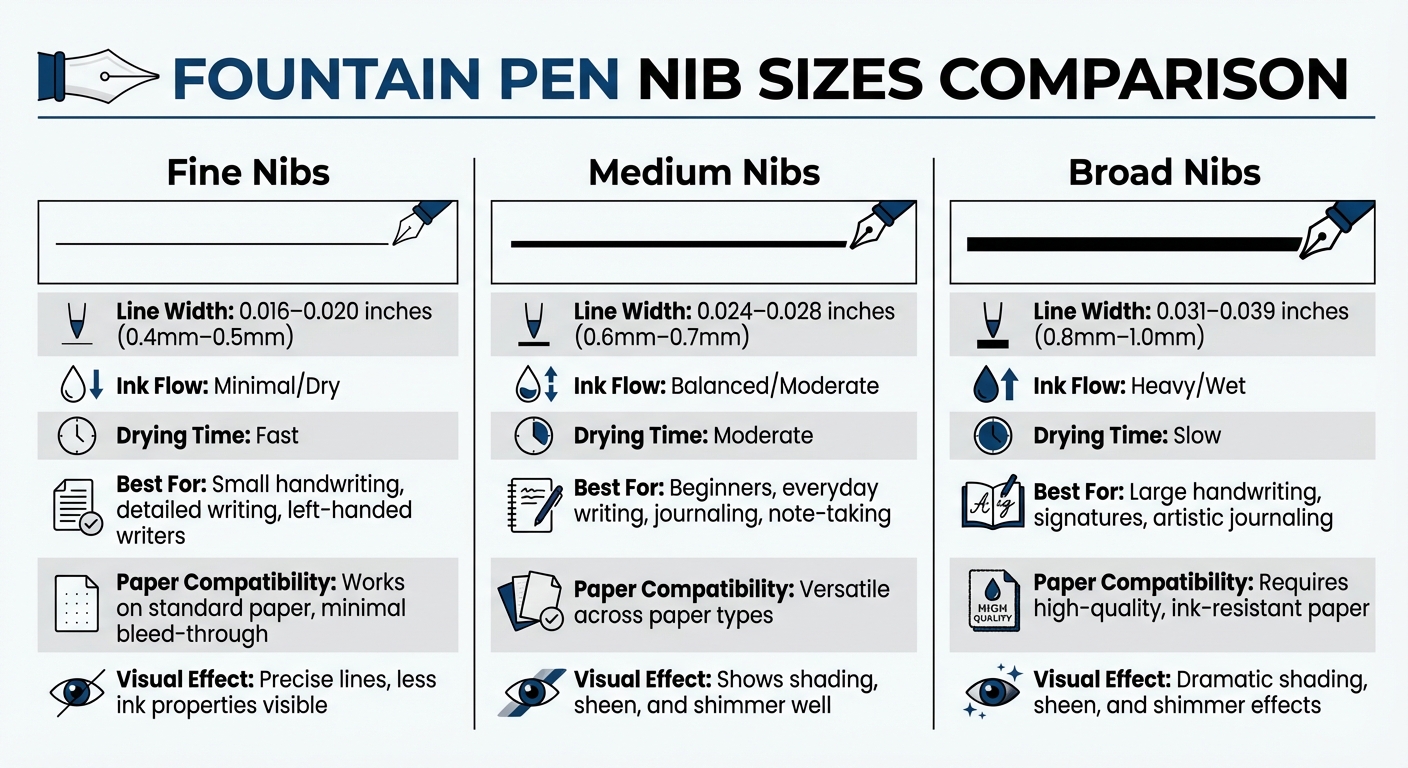
Fountain Pen Nib Size Comparison: Fine vs Medium vs Broad
Let's break down how fine, medium, and broad nibs perform in practical use, building on the way nib design influences ink flow.
Fine Nibs: Thin Lines and Quick Drying
Fine nibs create lines about 0.016–0.020 inches (0.4mm–0.5mm) wide, offering a precise and dry writing experience. Since they deposit less ink, the drying time is short - perfect for left-handed writers who want to avoid smudging. Brian Goulet, Founder of Goulet Pens, puts it simply:
"The smaller the nib size, the thinner the line it puts down. Finer nibs put less ink on the paper, so it'll smear less and dry faster".
Their minimal ink flow also reduces bleed-through on standard paper. If your handwriting tends to be small and detailed, fine nibs are a good fit, as they help prevent letters from blending together due to excess ink.
For a more balanced approach, medium nibs might be the way to go.
Medium Nibs: Versatility and Balance
Medium nibs are a middle-ground option, creating lines around 0.024–0.028 inches (0.6mm–0.7mm) wide. They deliver more ink than fine nibs but less than broad ones, offering a smooth, well-controlled writing experience. Medium nibs are often recommended for beginners because they provide balanced ink flow, showcasing ink properties like shading, sheen, and shimmer without overwhelming the page.
Their adaptability makes them suitable for various paper types and handwriting styles, making them an excellent choice for everyday tasks like journaling, note-taking, or letter writing.
If you're looking for bold, expressive lines, however, broad nibs might be your match.
Broad Nibs: Bold Lines and Artistic Flair
Broad nibs produce wider lines, measuring approximately 0.031–0.039 inches (0.8mm–1.0mm), and lay down significantly more ink. This results in a saturated, wet line that takes longer to dry. Broad nibs glide effortlessly across the page, as Ferris Wheel Press notes:
"A broader nib glides more smoothly, but it uses more ink and takes longer to dry".
The generous ink flow is perfect for highlighting special ink effects like shimmer, sheen, and dramatic shading - features that often go unnoticed with finer nibs. However, broad nibs work best with high-quality, ink-resistant paper to avoid bleed-through. They shine in applications like signatures, large handwriting, or artistic journaling, where the goal is to emphasize the visual impact of premium inks.
Testing Ink Performance with Different Nib Sizes
Setting Up Your Ink Test
To test how ink behaves with different nib sizes, gather the essentials. Start with three fountain pen nib sizes: Extra-Fine (EF), Medium (M), and Broad (B). If you're feeling thorough, you can include Fine (F) and Stub nibs as well. Affordable pens like the Platinum Preppy ($7.00) or the Pilot Metropolitan ($34.00) are great options to get started. For paper, choose both high-quality fountain pen paper (like Rhodia) and more absorbent, everyday paper to see how ink performs on various surfaces. Select inks with a range of properties - look for those that showcase shading, sheen, or shimmer to get a full picture of their behavior under different conditions.
Once you're set up, it's time to observe how the ink interacts with each nib and paper combination.
What to Observe During Testing
As you work through your tests, focus on key factors like ink flow, drying time, and color saturation. Does the ink glide smoothly, or does it occasionally skip? Does it dry quickly enough to avoid smudging, or does it take a while? Broader nibs often produce richer, more vibrant colors, so pay attention to how the ink looks as you write.
Keep an eye out for feathering, where ink spreads along the paper fibers, and bleed-through, where ink soaks through to the other side - these issues are more likely on absorbent paper. Write at various speeds, from fast loops to slow, deliberate strokes, to see how the nib handles ink demand under different conditions.
For quick ink changes without fully cleaning a pen, try using a Sailor Hocoro dip pen. As a Fountain Pen Network member, Penguincollector, once shared:
"If you get one with a nib that has a feed, you can get quite a few lines of writing before you have to dip again."
With your observations in hand, move on to documenting your results systematically.
Recording and Comparing Your Results
For consistent results, write the same sentence for each nib-ink combination, labeling it with details like nib size, ink name, paper type, and the date (e.g., "2/21/2026 - EF Nib, Rhodia Paper"). This method helps you build a personal reference library for future projects. Look for patterns - does your handwriting feel cramped with broader nibs? Or do fine nibs feel scratchy on certain papers?
To make comparisons easier, create a chart that tracks key factors like drying time, feathering, and line width. This way, you can quickly identify which nib and ink combinations work best for your needs.
How Nib Material Affects Ink Flow
Now that we've covered nib sizes and design, let's dive into how the material of a nib influences ink flow and overall writing experience.
While nib size dictates how much ink reaches the paper, the material impacts the way ink flows and interacts with the surface. Gold, stainless steel, and titanium each bring unique characteristics to the table, affecting everything from line quality to durability.
Gold nibs are highly regarded for their natural flexibility. The softer tines of gold nibs spread more easily under pressure, which increases ink flow and allows for line variation. This creates a "cushioned" feel that adapts to your writing style over time, making gold nibs an excellent choice for expressive tasks like journaling or writing personal letters. Additionally, gold's resistance to corrosion makes it safe to use with acidic inks, such as traditional iron gall formulas. You'll typically find gold nibs on higher-end pens priced at $200.00 and above, with purities ranging from 14k to 21k.
Stainless steel nibs, on the other hand, offer firm and consistent ink delivery. As Brian Goulet, founder of Goulet Pens, explains:
"The main advantage to gold nibs over stainless steel is that gold is softer. If two nibs are of the same design, the gold nib will write with a bit of bounce to it, acting a little bit like the shock absorber on your car that just helps for a smoother ride".
Steel nibs are ideal for everyday writing where uniformity is key, such as note-taking, and they are a more affordable option for beginners.
Titanium nibs strike a balance between flexibility and durability. They offer a touch of expressiveness similar to gold nibs but with higher corrosion resistance, making them a great choice for those seeking something different from the usual steel or gold options.
One important detail: regardless of whether the nib body is gold, steel, or titanium, the actual tip that touches the paper is almost always made from a hard alloy, often referred to as "iridium." This material ensures durability and smoothness over years of use. The writing experience you feel is a combination of the tipping material and the flexibility of the nib itself.
Conclusion
Fine nibs release less ink and dry quickly, making them perfect for detailed notes or use on absorbent paper. Medium nibs strike a balance between smooth writing and precision, while broad nibs create bold, expressive lines that highlight ink shading and sheen.
The key is to choose a nib that fits your writing style and needs. If you write small or often use standard printer paper, an extra-fine or fine nib minimizes feathering and bleed-through. On the other hand, if you love showcasing the nuances of your inks or prefer a smoother writing experience, a medium or broad nib might be the better fit. As Brian Goulet, founder of Goulet Pens, explains:
"There's always a tradeoff with nibs, and no one nib is right for everyone. It'll be a highly personal choice, and it's sometimes hard to know what you're going to like until you experience it for yourself".
To find your ideal nib, start experimenting with affordable options like the Platinum Preppy ($7.00) or Pilot Metropolitan ($34.00) in various nib sizes. Test your favorite inks with these nibs to observe differences in drying time, line sharpness, and overall comfort. You might discover that a Japanese fine nib complements your small handwriting better than a Western medium, or that a stub nib adds flair to your everyday writing.
FAQs
Why does my fine nib feel scratchy on some paper?
A fine nib might feel scratchy for a few reasons: misaligned nib tines, dried ink buildup, or even the texture and absorbency of the paper you're using. These factors can increase resistance and interrupt the ink flow, making writing less smooth. To reduce this scratchy sensation, try switching to smoother, high-quality paper and check that the nib is clean and aligned correctly.
Do Japanese and Western nib sizes write the same width?
When it comes to fountain pens, Japanese and Western nib sizes differ significantly in line width, even if they share the same label (like "Fine"). Japanese nibs are generally finer, meaning a Japanese Fine will produce a thinner line compared to a Western Fine. This difference matters a lot for those who care about precise line widths, especially if you're switching between pens from Japanese and Western brands.
How can I reduce smudging with a broad nib?
To cut down on smudging when using a broad nib, opt for high-quality, fountain pen-friendly paper. This type of paper is designed to absorb ink more slowly, helping to prevent smears. Another tip? Slow down your writing speed - this gives the ink extra time to dry. These small adjustments can make a big difference, keeping your writing clean and smudge-free.