

Converting a fountain pen into an eyedropper pen is a simple way to increase ink capacity, reduce refill frequency, and enjoy a cleaner, low-maintenance design. By filling the pen's barrel directly with ink, you can store up to 10 times more ink compared to standard cartridges. Here's what you need to know:
- Benefits: Holds more ink (2–5 ml), saves money by using bottled ink, and works well with transparent pens for a visual appeal.
- Tools Needed: Silicone grease, an ink syringe or pipette, optional O-rings, and bottled fountain pen ink.
- Steps: Clean the pen, apply silicone grease to seal threads, fill the barrel with ink, reassemble, and test for leaks.
- Pen Compatibility: Use plastic or resin pens without metal parts or breather holes (e.g., Platinum Preppy, Kaweco Sport).
This process takes about 10–15 minutes and requires regular upkeep to prevent leaks or ink "burping." Follow these steps to enjoy longer writing sessions and a better writing experience.
Pen Tinkering - Eyedropper a Fountain Pen
What is an Eyedropper Fountain Pen Conversion?
An eyedropper conversion turns your fountain pen's barrel into an ink reservoir, replacing the need for a small plastic cartridge. Instead of relying on a cartridge, the entire body of the pen holds the ink, offering a much larger capacity.
This process hinges on creating a leak-proof seal. To do this, apply 100% silicone grease to the threads where the grip section connects to the barrel. For extra security, you can add an O-ring to ensure a watertight seal. Once sealed, fill the barrel with ink using a syringe or pipette, then reassemble the pen.
By using the pen's body as the reservoir, you eliminate the space limitations caused by plastic cartridges or mechanical filling systems. This approach allows for significantly more ink storage.
Before starting, confirm that your pen is compatible. Check for breather holes at the end of the barrel - if they exist, seal them with two-part epoxy. Avoid converting pens with metal barrels or internal metal parts, as many inks can corrode metal over time.
Why Convert to an Eyedropper System?
The main draw of this conversion is the increased ink capacity. While standard cartridges hold about 0.5 ml of ink, an eyedropper conversion can hold anywhere from 2 ml to 5 ml, depending on the size of the barrel. That’s 4 to 10 times the ink of a standard cartridge.
This larger capacity means fewer refills, making it ideal for long writing sessions. It’s also more cost-effective since you’ll be using bottled ink rather than proprietary cartridges. For compact pens like the Kaweco Sport, which have limited room for converters, an eyedropper conversion can expand the capacity from about 0.5 ml to over 2 ml.
If you’re using a transparent or demonstrator pen, the conversion adds a visual bonus. Watching the ink swirl inside the barrel is a satisfying feature that many fountain pen enthusiasts enjoy.
Another advantage is simplicity. Eyedropper pens have fewer moving parts compared to piston or vacuum fillers, which makes them easier to clean and maintain. With no mechanisms to break or clog, the design is straightforward - just a sealed barrel filled with ink.
Pros and Cons of Eyedropper Conversion
Before diving into an eyedropper conversion, it’s important to weigh the benefits against the potential drawbacks. While the advantages can be appealing, some disadvantages might make you reconsider depending on how you use your pen.
One of the standout benefits is the huge ink capacity - up to 6ml compared to the 0.8ml offered by a standard cartridge. That’s enough ink to last for weeks without needing a refill. Rachel Goulet from The Goulet Pen Company highlights this advantage:
"Not only do you save cash, but you also dramatically increase your ink capacity."
However, the downsides mainly involve maintenance and the risk of leaks. If the threads aren’t sealed properly, you could end up with ink stains on your hands or belongings. Cleaning is also more complicated because of the larger ink reservoir. Another issue is ink expulsion, often referred to as "burping." When the pen is less than half full, heat from your hand can cause the air inside the barrel to expand, pushing ink out through the nib. These challenges emphasize the need for careful conversion steps, which will be covered later.
Benefits and Drawbacks Comparison
| Benefit/Drawback | Description |
|---|---|
| Massive Ink Capacity | Holds significantly more ink than standard cartridges, allowing for extended writing sessions. |
| Cost Savings | Reduces the need for buying cartridges, saving money over time. |
| Visual Appeal | Especially striking in transparent or demonstrator pens, letting you showcase ink colors. |
| Risk of Leakage | Improper sealing can result in leaks, particularly during travel or pressure changes. |
| Cleaning Effort | Requires more thorough cleaning due to the larger reservoir and the need to re-grease threads periodically. |
A long-term durability test by Unsharpen, conducted from Spring 2018 to December 2019, examined 13 Platinum Preppy pens converted to eyedroppers. After about 20 months of regular use, 10 pens (77%) remained functional, while 3 pens (23%) failed due to cracking or leaking. This suggests that while most conversions are reliable, there’s still a noticeable failure rate to keep in mind.
Which Fountain Pens Work for Eyedropper Conversion
Choosing the right fountain pen is a key step in successful eyedropper conversion. Not all pens are built for this transformation, and the material of the barrel plays a crucial role. Pens made from non-reactive materials like plastic, acrylic, or glass are ideal because they resist ink-related damage. On the other hand, pens with metal bodies or parts are unsuitable. As Goldspot Pens explains:
"If there is any metal that would come in contact with the ink, then you can't eyedropper convert it. Most likely, the metal will corrode due to constant ink exposure."
Another important factor is the barrel's construction. It must be airtight and free of breather holes or ink windows. For instance, pens like the Lamy Safari have small openings for safety or manufacturing reasons, which disqualify them unless those vents are permanently sealed with two-part epoxy. A simple test for leaks involves filling the barrel with water and leaving it on a paper towel for 24 hours to check for any seepage.
Additionally, the pen's plastic threads should fit securely when paired with silicone grease and an appropriately sized O-ring. This ensures a tight seal, preventing leaks and maintaining durability during use.
Recommended Fountain Pens for Conversion
Several popular models meet these criteria and are well-suited for eyedropper conversion. The Platinum Preppy (priced around $7.00) is a standout option, thanks to its transparent plastic body and absence of metal parts. The Kaweco Sport series - including the Classic, Ice, and Skyline models - also makes a great choice. These compact pens are often limited to mini-converters, making them ideal for conversion. Other frequently converted pens include the Pilot Petit1, Noodler's Ahab, and various models from Fountain Pen Revolution, many of which feature durable resin barrels designed to handle larger ink capacities.
Key Features to Look For
When selecting a pen for conversion, focus on the following features:
- A solid, one-piece barrel made from plastic, acrylic, or resin
- Plastic threads that seal securely with silicone grease and an O-ring
- No metal components in contact with ink
- Transparent or demonstrator-style bodies to showcase your ink colors
Brands like Fountain Pen Revolution offer affordable options with resin barrels that combine durability with aesthetic appeal, making them an excellent choice for eyedropper enthusiasts.
sbb-itb-1dd4fe9
Tools and Supplies Needed
If you're planning to convert your fountain pen into an eyedropper system, you'll need a few basic supplies to get started. The most important item on your list is 100% pure silicone grease. This grease is used to seal the pen's threads and prevent leaks. As one expert explains:
"You can use any 100% clear silicone grease (NOT silicone caulk), available at local hardware stores".
Be sure to check the label carefully - some products marketed as silicone grease are only 90% pure and include additives that could damage your pen's plastic components.
To transfer ink from the bottle to your pen's barrel, you'll need a 10ml ink syringe with a blunt tip or a clear plastic pipette. These tools make the process clean and precise, and they’re much safer than using sharp needles. For cleanup and preparation, keep paper towels and cotton swabs handy. These are useful for wiping away excess grease and ensuring that your pen is properly sealed before use.
For added protection, consider using a chemical-resistant rubber O-ring. For instance, a 7.5 mm ID and 9.2 mm OD O-ring works well with pens like the Platinum Preppy. While some people rely solely on silicone grease, an O-ring creates an extra layer of security, giving you peace of mind against potential leaks.
If you’re wondering where to find these items, Fountain Pen Revolution offers silicone grease in 3 ml tubes for US $3.25. They describe it as:
"the ideal lubricant/sealant for pistons, eyedropper pen threads, screw-in converters, or any other pen parts that need periodic lubrication".
You can also find complete eyedropper conversion kits from specialty retailers. These kits typically include silicone grease and O-rings, saving you the hassle of sourcing individual components, and they’re usually priced around US $5.95.
Required Tools and Materials
| Tool/Material | Purpose | Typical Cost |
|---|---|---|
| 100% Silicone Grease | Seals threads to prevent leaks | US $3.25–$3.95 |
| Ink Syringe or Pipette | Transfers ink from bottle to barrel | US $2.00–$5.00 |
| Rubber O-Rings | Provides secondary leak barrier | US $1.00–$2.00 per pack |
| Paper Towels | Cleanup and leak testing | US $2.00–$4.00 |
| Cotton Swabs | Detailed cleaning and grease application | US $1.00–$3.00 |
| Bottled Fountain Pen Ink | Fills the converted pen | US $8.00–$20.00 |
Once you've gathered these tools and supplies, you're ready to move on to the step-by-step instructions for converting your pen.
How to Convert Your Fountain Pen to an Eyedropper
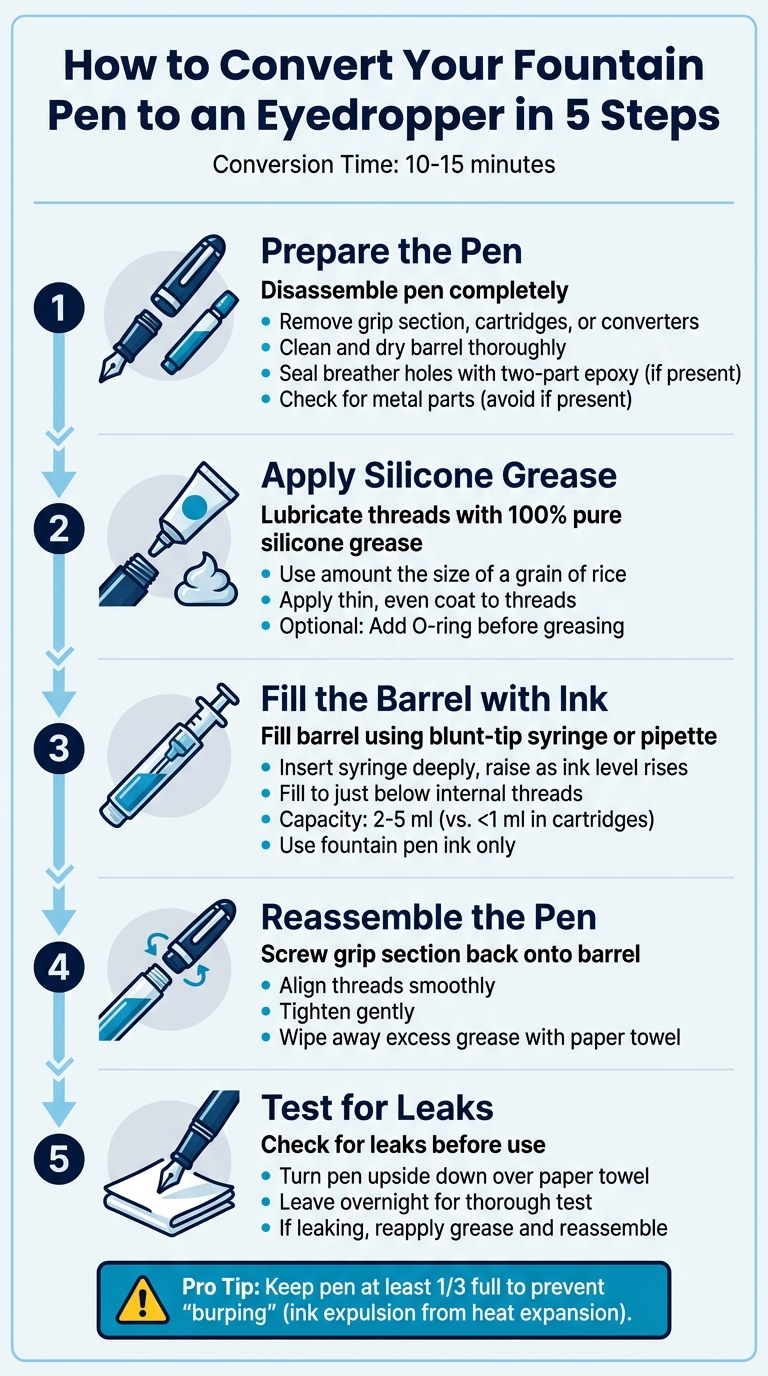
5-Step Fountain Pen to Eyedropper Conversion Process
Set up a clean, organized workspace with paper towels close by to catch any spills. This process should take about 10 to 15 minutes, so take your time to ensure everything is sealed properly.
Step 1: Prepare the Pen
Start by completely disassembling your fountain pen. Remove the grip section, along with any cartridges or converters. Make sure the barrel is thoroughly cleaned and dried - this helps prevent ink contamination and sealing problems.
If your pen has breather holes, seal them using a two-part epoxy and allow it to fully cure. Also, inspect the pen for any metal threads or internal metal parts. As Goldspot Pens warns:
"If there is any metal that would come in contact with the ink, then you can't eyedropper convert it. Most likely, the metal will corrode due to constant ink exposure."
– Goldspot Pens
Once the barrel is clean and sealed, move on to lubricating the threads.
Step 2: Apply Silicone Grease
To prevent leaks, apply a thin, even coat of 100% pure silicone grease to the threads. If you're using an O-ring, slide it over the threads and press it down to the base before applying the grease. Use a small amount - about the size of a grain of rice. Overdoing it can cause excess grease to squeeze out during reassembly, creating a mess.
Step 3: Fill the Barrel with Ink
Use a blunt-tip syringe or pipette to fill the barrel with ink. Insert the syringe as deeply as possible and slowly fill the barrel, raising the syringe as the ink level rises to avoid trapping air bubbles. Stop filling when the ink reaches just below the internal threads. A typical eyedropper conversion can hold up to 5 ml of ink, compared to less than 1 ml in a standard cartridge .
Stick to fountain pen ink only - avoid India ink, calligraphy ink, or drawing ink, as these contain binders that can clog the feed. Once filled, carefully reassemble the pen.
Step 4: Reassemble the Pen
Screw the grip section back onto the barrel gently, ensuring the threads align smoothly. If you feel resistance, double-check the alignment. As you tighten, you may notice a small amount of grease oozing out - this indicates a proper seal. Use a paper towel to wipe away any excess grease or ink from the pen’s exterior.
Step 5: Test for Leaks
Turn the pen upside down over a paper towel to check for leaks. If you spot any ink, reapply the silicone grease and reassemble the pen. For a more thorough test, leave the pen on a paper towel overnight. If no ink appears the next morning, your seal is secure.
Before using your newly converted pen, keep this advice in mind:
"The warmth from your hand may cause the air inside the barrel to expand, forcing ink into the feed. Keep your pen at least one-third full of ink to prevent this from occurring."
– JetPens
This issue, often referred to as "burping", happens when heat causes the air inside the barrel to expand, pushing ink into the feed and creating unwanted blobs on your paper.
Conclusion
Transforming your fountain pen into an eyedropper system turns it into a high-capacity writing tool, capable of holding 2–5 ml of ink - up to 10 times more than standard cartridges. Plus, it’s a budget-friendly option since you’ll be using bottled ink instead of pricey refills.
The process is simple and doesn’t require much: just some 100% pure silicone grease, an optional O-ring, and a blunt-tip syringe. By following these five steps - preparing the barrel, applying silicone grease, filling with ink, reassembling, and testing for leaks - you can modify most plastic-bodied pens in about 10–15 minutes.
To keep your pen working smoothly, regular upkeep is key. Make sure to keep the ink level at least one-third full, reapply silicone grease as needed, and check the O-ring for wear. Connie from JetPens sums it up perfectly:
"Eyedropper fountain pens are easy to clean and maintain. With simple assembly and no finicky filling systems, they are a great option for beginners looking to graduate from cartridges".
FAQs
Will converting my pen to an eyedropper void the warranty?
Converting a fountain pen into an eyedropper involves a few steps: disassembling the pen, adding an O-ring for sealing, and sometimes applying silicone grease to prevent leaks. However, keep in mind that this alteration changes the pen's original design, which could void its warranty. Many manufacturers won't cover issues like leaks or damage caused by such modifications. It's a good idea to review your pen's warranty policy or reach out to the manufacturer before proceeding.
What should I do if my eyedropper pen starts burping ink?
Ink burping in eyedropper pens happens when air inside the barrel expands, pushing ink out unexpectedly. To address this:
- Check the seal: Ensure the pen is tightly sealed and free from gaps or leaks around the threads.
- Use silicone grease: Applying a thin layer of silicone grease to the threads can help create a better seal.
- Avoid heat exposure: Keep the pen away from heat, as temperature changes can cause air expansion.
- Don’t overfill: Leave some space in the barrel when filling the pen. Overfilling can make the problem worse.
These steps can help minimize ink burping and keep your writing experience smooth.
Can I safely fly or travel with an eyedropper-converted pen?
Flying with an eyedropper-converted pen is usually fine, but cabin pressure changes during flights can make leaks more likely. To avoid this, you can either empty the pen before your trip or make sure it’s sealed tightly and stored with the nib facing up. Pens designed with shut-off valves or specialized sealing mechanisms can also help prevent leaks. It’s always smart to take steps to protect your belongings from any unexpected ink spills.