

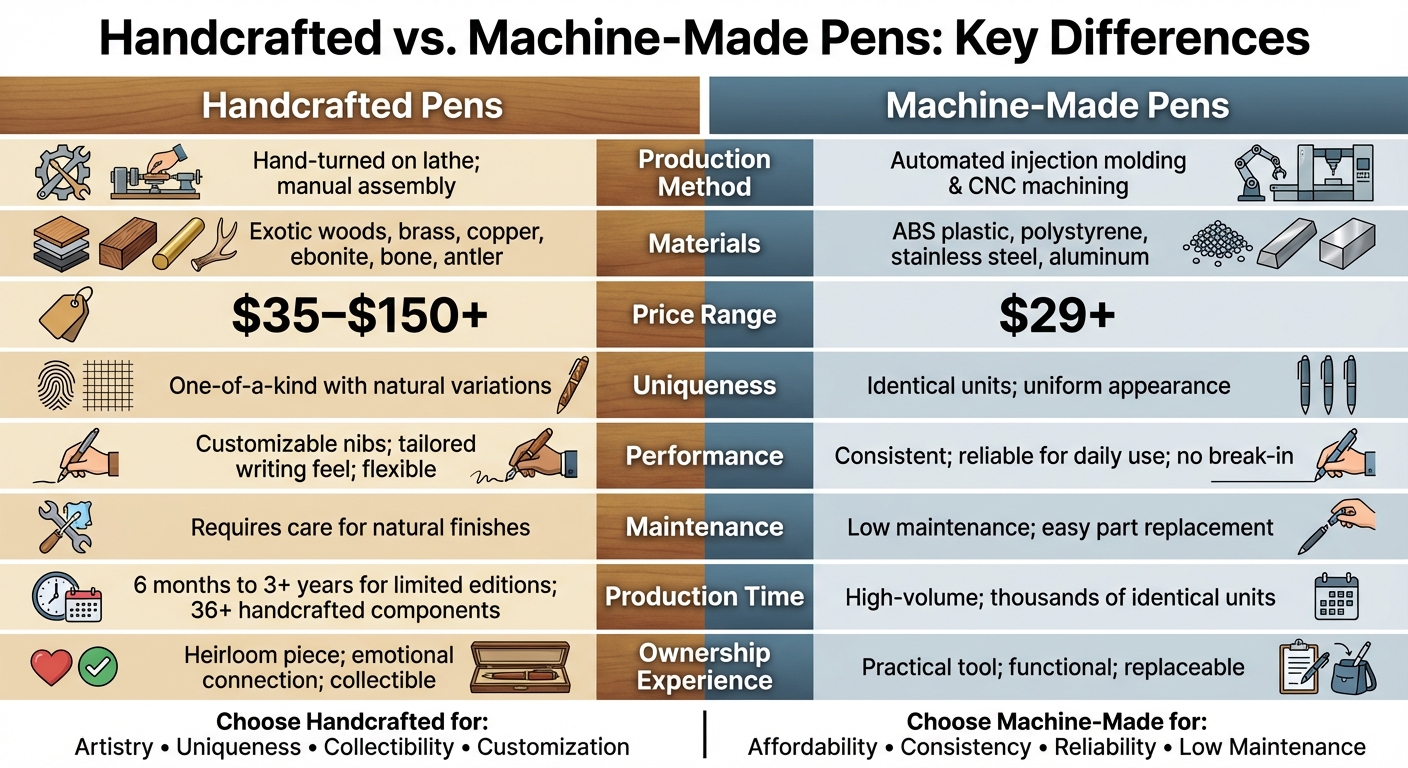
Handcrafted and machine-made pens differ in production methods, materials, pricing, and user experience. Handcrafted pens are made by artisans using manual techniques, offering one-of-a-kind designs and high-quality materials like exotic woods or ebonite. These pens often feature custom options and are seen as collectible, with prices ranging from $35 to over $150. Machine-made pens, produced through automated processes, prioritize consistency, affordability, and practicality. They use durable materials like plastics and metals and start at $29. Choosing between the two depends on whether you value artistry and uniqueness or reliability and affordability.
| Feature | Handcrafted Pens | Machine-Made Pens |
|---|---|---|
| Production Method | Hand-turned; manual assembly | Automated; high-volume manufacturing |
| Materials | Exotic woods, brass, ebonite | Plastics, metals, acrylics |
| Price Range | $35–$150+ | $29+ |
| Performance | Customizable; tailored writing feel | Consistent; reliable for daily use |
| Maintenance | Requires care for natural finishes | Low maintenance; easy part replacement |
Your choice depends on your priorities: go handcrafted for artistry or machine-made for practicality.
Handcrafted vs Machine-Made Pens: Complete Comparison Guide
Turned? Injection Molded? 3D Printed? Which is Best for Making Fountain Pens?
What Are Handcrafted Pens?
Handcrafted pens are created by skilled artisans using time-honored techniques like lathe-turning, hand-polishing, and precise assembly. This process ensures that each pen is truly one-of-a-kind, showcasing the unique characteristics of the materials and the artisan's craftsmanship.
Unlike mass-produced pens, these are made with an emphasis on quality rather than speed. Artisans carefully choose materials based on their grain patterns, durability, and visual appeal. The pen bodies are shaped individually with hand tools, while key components like feeds are often made from ebonite - a porous material that enhances ink flow - rather than the hard plastic commonly used in machine-made pens. Nibs are also hand-tuned to guarantee smooth, consistent writing performance. This meticulous approach results in pens that are not only functional but also deeply personal and visually striking.
Materials and Design
Handcrafted pens stand out for their use of high-quality and rare materials that you won't typically find in mass-produced options. Artisans work with natural woods like maple, walnut, and rosewood, each offering distinct grain patterns that add warmth and character. For those seeking something more exotic, materials like snakewood, ethically sourced mammoth ivory, celluloid, and even marble are sometimes used.
Many high-end pens incorporate luxurious elements such as sterling silver or 18k gold (available in yellow, rose, or white) for their barrels and components. Some manufacturers even innovate with proprietary materials. For example, Montegrappa has developed "Montegrappite" resin, a material that ensures their pens have a distinct look compared to standard acrylics. Beyond aesthetics, these materials enhance functionality - like ebonite feeds, which deliver better ink flow than injection-molded plastic.
"Handmade products have a charm and uniqueness that mass-produced items simply can't replicate. They possess a personal touch and attention to detail that makes them truly special." - Wood Fountain Pen Team
How They're Made
The process of crafting a handcrafted pen is intensive and detail-oriented. Each pen body is shaped individually on a wood lathe, allowing for unique designs such as tapered, bowed, or hexagonal profiles. Artisans ensure precise alignment between the pen body and internal components, creating a seamless and polished finish.
After shaping, the pen undergoes multiple rounds of sanding, followed by a lacquer or resin finish that not only highlights the wood grain but also provides water resistance. Montegrappa, Italy's oldest pen company, showcased their craftsmanship in December 2023 with their "Extra Custom" program. Using a burin, they hand-engraved intricate patterns like "leaves and scrolls" or replicated artwork on precious metal barrels. Crafting a single pen from a luxury maker like Montegrappa involves at least 36 individually handcrafted components.
Artisans often add artistic details through techniques like burin engraving, hand carving, lost-wax casting, or Maki-e lacquer work. For limited-edition pens, the entire production process - from concept to completion - can take anywhere from 6 months to over 3 years.
What It's Like to Own One
Owning a handcrafted pen is a tactile and deeply personal experience. The natural variations in materials, hand-applied finishes, and custom engravings ensure that your pen is truly unique. Many people see these pens as "movable art" or heirloom-quality pieces meant to be cherished and passed down through generations.
Customization is a key feature of handcrafted pens. Programs like Montegrappa's "Extra Custom" allow buyers to commission pens with hand-painted or engraved designs, ranging from specific motifs to personal artwork. Prices for these custom creations can range from $1,100 to $29,000, while entry-level handcrafted pens made from wood and brass start at a more accessible $49 to $59.
From a functional perspective, handcrafted pens deliver exceptional performance. Ebonite feeds and hand-tuned nibs ensure ink flow and writing performance are tailored to individual preferences. Montegrappa even conducts both manual and robotic writing tests to guarantee smooth, consistent strokes. This level of care transforms a pen from a simple tool into a meaningful object that reflects your personality and values.
What Are Machine-Made Pens?
Machine-made pens are crafted through automated processes designed for efficiency, precision, and high-volume output. These processes ensure that every pen in a production run is nearly identical, with minimal variation between units. From molding the barrel to assembling the final product, machines handle every step, resulting in consistent quality.
This method of manufacturing allows companies to produce thousands of pens with exacting standards and uniform designs. Back in 2001, the Writing Instrument Manufacturers Association heavily relied on these automated systems. The result? Pens that are reliable, affordable, and perfect for everyday use - making them an excellent choice for beginners seeking dependable performance.
"The larger companies now use an automated process to produce fountain pens, while some smaller companies and individuals still produce them by hand." - Kathy Saporito
Materials and Design
Machine-made pens are typically constructed from materials chosen for their durability and cost-effectiveness. Common plastics like ABS, polystyrene, and polypropylene are widely used, along with metals such as brass, stainless steel, and aluminum. For higher-end models, materials like acrylic resins (e.g., Lucite or Perspex) and cellulose acetate are used to achieve a more polished look.
To ensure longevity, manufacturers often enhance these materials. For instance, UV stabilizers are added during the molding process to protect plastics from sunlight damage, while reinforcing agents improve strength. Metal parts undergo treatments like anodizing, electroplating with gold or palladium, or lacquer coating to enhance their appearance and resistance to wear. When it comes to nibs, stainless steel is the go-to material for its durability and corrosion resistance, though premium pens may feature nibs made of gold or titanium. The tips of these nibs are reinforced with alloys containing iridium, osmium, or tungsten to ensure smooth writing that lasts for years.
The design of machine-made pens prioritizes functionality and universal appeal. Features like screw-on threads, grooved sections, and standardized ink refill systems are incorporated directly into the manufacturing process. This standardization not only simplifies production but also makes it easy to replace components like nib units, converters, and caps if needed. These thoughtful design elements make machine-made pens practical and user-friendly.
How They're Made
The production of machine-made pens involves several automated techniques. Injection molding is the most common method for creating plastic components. In this process, plastic granules are melted and injected into molds under high pressure to form the pen body and cap. For metal parts - often made from materials like aluminum or zinc alloys (ZAMAC) - CNC machining and die casting are used to achieve precise shapes and dimensions.
Large manufacturers use specialized machines to stamp and crimp metal parts, assemble the pens, and even handle polishing and cleaning automatically. For instance, the Parker 75 pen undergoes an impressive 792 quality inspections to maintain its high standards. Achieving this level of precision and consistency would be nearly impossible with manual production methods.
"If the goal is to achieve a high level of uniformity between the different units, machines are the way to go." - Ivica Baraba, Sales & Marketing Management, P.E.S.
While the initial investment in machine production is steep - developing a tool for a small metal item like a keyring can cost around $325, and a bottle opener might require $540 - the cost per pen drops significantly once production begins. This makes machine manufacturing a cost-effective option for large-scale production.
What It's Like to Own One
Owning a machine-made pen is all about practicality and reliability. These pens are designed to be dependable, "workhorse" tools for daily use, offering consistent performance with minimal upkeep. Thanks to their standardized parts and tight manufacturing tolerances, they are less prone to defects and easier to repair or replace if needed.
For beginners, machine-made pens are especially appealing. They often feature straightforward filling systems like cartridges and converters, which are easy to clean or replace. The modern materials used - such as UV-stabilized plastics and stainless steel nibs - ensure durability and resistance to wear. While they may lack the artistic flair of handcrafted pens, machine-made pens are a reliable choice that delivers the same performance every time you use them.
sbb-itb-1dd4fe9
Handcrafted vs. Machine-Made: Direct Comparison
Craftsmanship and Materials
The creation process is where handcrafted and machine-made pens diverge most. Handcrafted pens go through a meticulous five-step process: selecting premium materials, shaping them on a lathe, sanding with multiple grits, finishing with wax or lacquer, and assembling by hand. This attention to detail results in pens that are entirely unique, often featuring natural grain patterns or artistic elements like carved designs and metal inlays.
Machine-made pens, on the other hand, prioritize efficiency and uniformity. They’re crafted using automated molding and machining, with materials like standardized plastics and common metals chosen for durability and cost-effectiveness. Interestingly, many artisans making handcrafted pens opt for reclaimed or upcycled materials, while machine-made pens focus on materials that streamline production. This contrast influences not just the look and feel of the pens but also the overall experience of owning and using them.
These differences in craftsmanship set the foundation for variations in writing performance and user experience.
Performance and Ergonomics
The way these pens perform ties directly to how they’re built. Handcrafted pens offer a personalized writing experience, thanks to their flexible nibs that adapt to your writing style. The warmth of natural materials like wood, combined with unique textures, makes them feel distinctly different in every hand. Their ergonomic designs blend aesthetics and functionality, adding to their charm.
Machine-made pens, by contrast, focus on consistency. They deliver reliable performance with no surprises - perfect for everyday tasks where predictability is key. There’s no adjustment period or break-in time; they simply work as expected, every time.
Price and Durability
The price tags reflect the effort and materials involved. Handcrafted pens typically range from $35 to over $150, a testament to the labor-intensive process and premium materials. Machine-made pens start at a more accessible $29+, making them a practical choice for beginners or those seeking a dependable everyday tool.
Durability varies slightly between the two. Handcrafted pens, built with high-quality materials and techniques, are designed to last but may need occasional care for natural finishes. Machine-made pens, like Parker ballpoints, are engineered for easy maintenance and part replacement. For example, a Parker ballpoint can write up to 3,500 meters (around 3,827 yards) before needing a refill. Both types can last a lifetime, but handcrafted pens often carry sentimental value, becoming heirlooms passed down through generations.
| Feature | Handcrafted Pens | Machine-Made Pens |
|---|---|---|
| Production Method | Hand-turned on a lathe; hand-finished | Automated injection molding and CNC machining |
| Materials | Exotic woods, brass, copper, bone, antler | Standardized plastics (ABS, polystyrene) and common metals |
| Uniqueness | One-of-a-kind with natural variations | Identical units; uniform appearance |
| Price Range | $35–$150+ | $29+ |
| Maintenance | May require care for natural finishes | Low-maintenance; easy part replacement |
| Ownership Experience | Heirloom piece; emotional connection | Practical tool; functional and replaceable |
How to Choose Between Handcrafted and Machine-Made Pens
What Matters Most to You
Think about what matters most when selecting a pen. If you’re drawn to individuality and artistry, handcrafted pens stand out with their natural variations, customizable features like engravings or nib adjustments, and the chance to support artisans who often use eco-friendly materials. On the other hand, if consistency and affordability are higher on your list, machine-made pens deliver reliable performance at prices that make them great for everyday use. Your writing style also plays a role - handcrafted fountain pens often feature flexible nibs that create unique line variations and reduce hand fatigue, while machine-made pens are perfect for straightforward, no-fuss writing tasks. Don’t forget to factor in how the pen feels in your hand and how much maintenance you’re willing to handle.
Ultimately, your priorities shape not just your pen choice but also how well it aligns with your level of expertise.
Your Experience Level
For beginners, machine-made pens are a smart choice. They’re dependable, require no break-in period, and start at just $29 - ideal for learning the basics of fountain pens without a big upfront investment.
If you’re more experienced, handcrafted pens offer a step up with their superior craftsmanship and unique writing experience. Once you’ve figured out your preferences and understand nib types, you’ll appreciate the artistry and precision that go into these pens.
Fountain Pen Revolution Options
No matter your preferences, Fountain Pen Revolution has options tailored to your needs. Whether you’re after artisanal flair or practical consistency, they’ve got you covered.
- Starter Sets (from $35): Perfect for beginners, these sets include everything you need to get started. They balance affordability with reliability, making them a great entry point.
-
Premium Pens (from $44): This collection includes handcrafted gems like the Triveni Ebonite, made by artisans in South India. Each pen boasts unique textures, making it, as one customer put it, “a work of art.” Elyssa, a verified buyer, shared:
"I genuinely cannot recommend this pen strongly enough if you want a dependable, sturdy pen with line variability to last years and years and years."
- Gold Nib Collection: Designed for seasoned enthusiasts, these pens feature 14k gold nibs that deliver smooth ink flow and the flexibility you’d expect from handcrafted-quality construction.
Whether you’re budget-conscious or chasing artisan-level craftsmanship, these collections prove that high-quality fountain pens can meet a variety of needs without breaking the bank.
Conclusion
Deciding between handcrafted and machine-made pens ultimately comes down to what matters most to you in a writing instrument. Handcrafted pens offer a sense of artistry, with unique grain patterns from materials like exotic woods and the unmistakable touch of an artisan. On the other hand, machine-made pens provide precision, consistency, and affordability, making them a practical choice for many.
In 2022, the global writing instruments market was valued at approximately $17.08 billion, with the luxury pen segment accounting for $2,457 million. A growing number of consumers are leaning toward personalization, seeking products that reflect their individuality and support small-scale artisans. These trends highlight the importance of aligning your choice with both your personal preferences and budget.
Your decision will likely hinge on your priorities and the experience you're looking for. Machine-made pens are ideal for those seeking cost-effective, reliable tools, while handcrafted pens offer exceptional craftsmanship and collectible appeal. As Ivica Baraba from PES explains:
"If the goal is to achieve a high level of uniformity between the different units, machines are the way to go".
Fountain Pen Revolution exemplifies a balanced approach, offering options that cater to both ends of the spectrum. From $18 machine-made pens for everyday use to $149 handcrafted Urushi art pieces, their collection ensures that quality and affordability coexist. Their commitment - "Crafted by passionate pen lovers. Priced for the everyday writer" - means you can find something that resonates with your needs, whether you prefer artisan-crafted ebonite or precision-engineered resin.
Ultimately, the best pen is the one that feels right in your hand, aligns with your priorities, and inspires you to write more often. This harmony is the key to discovering your perfect writing companion.
FAQs
Which pen type is better for beginners?
Lightweight fountain pens with medium nibs are a great starting point for beginners. Their design makes them easier to control, requiring minimal pressure to write smoothly. This helps new users focus on building proper writing techniques without feeling overwhelmed. On the other hand, handcrafted or high-end pens, while appealing with their intricate designs and customizable features, are often better suited for seasoned writers or collectors due to their complexity and upkeep. For anyone just stepping into the world of fountain pens, sticking with a simple, lightweight option with a medium nib is the smartest way to begin.
How do I care for a handcrafted pen’s finish?
To keep your handcrafted pen looking great and working smoothly, regular care is key. Start by rinsing the nib and feed with lukewarm water - steer clear of hot water or harsh cleaners, especially if your pen has wooden or delicate parts. When you're not using it, store the pen in a soft-lined case to avoid scratches. Keep it dry and away from extreme temperatures to prevent damage. With proper cleaning and careful storage, your pen will stay beautiful and functional for years.
Do handcrafted pens write better than machine-made pens?
Handcrafted pens deliver a writing experience that stands apart from their machine-made counterparts. With thoughtful weight distribution, ergonomic designs, and high-quality materials, they provide a level of comfort and tactile satisfaction that feels more personal. The attention to detail in artisan craftsmanship also ensures smooth ink flow and reliable performance.
While machine-made pens are often more budget-friendly and dependable, the artistry and distinctive touch of handmade pens make them a favorite for those who value individuality and craftsmanship. Ultimately, the choice comes down to personal preferences and priorities.