

Mastering the right angle for using a fountain pen can transform your writing experience. The ideal range is 40° to 55°, with 45° often being the sweet spot. Why does this matter? The correct angle ensures smooth ink flow, prevents nib damage, and reduces hand strain. Here’s a quick breakdown:
- 45°: Best for smooth ink flow and everyday writing. Works well with most nib types.
- 50°: Slightly steeper for consistent flow and relaxed grip during long sessions.
- 40°: Lower angle for comfort and steady ink flow, ideal for beginners.
- 55°: Upper limit for bold strokes, great for artistic lettering or sketches.
- 35°: A low angle that focuses on comfort but may cause inconsistent ink flow.
- 60°: Steeper angle that mimics ballpoint grip but risks nib drag.
- Custom Angles: Adjust based on your grip and hand movement for optimal results.
Key takeaway: Start with a 45° angle and adjust slightly to match your writing style. A light touch and proper paper alignment can make a big difference. Avoid steep angles (like 60°) to prevent common nib issues. Experiment within the 40–55° range to find your perfect balance.
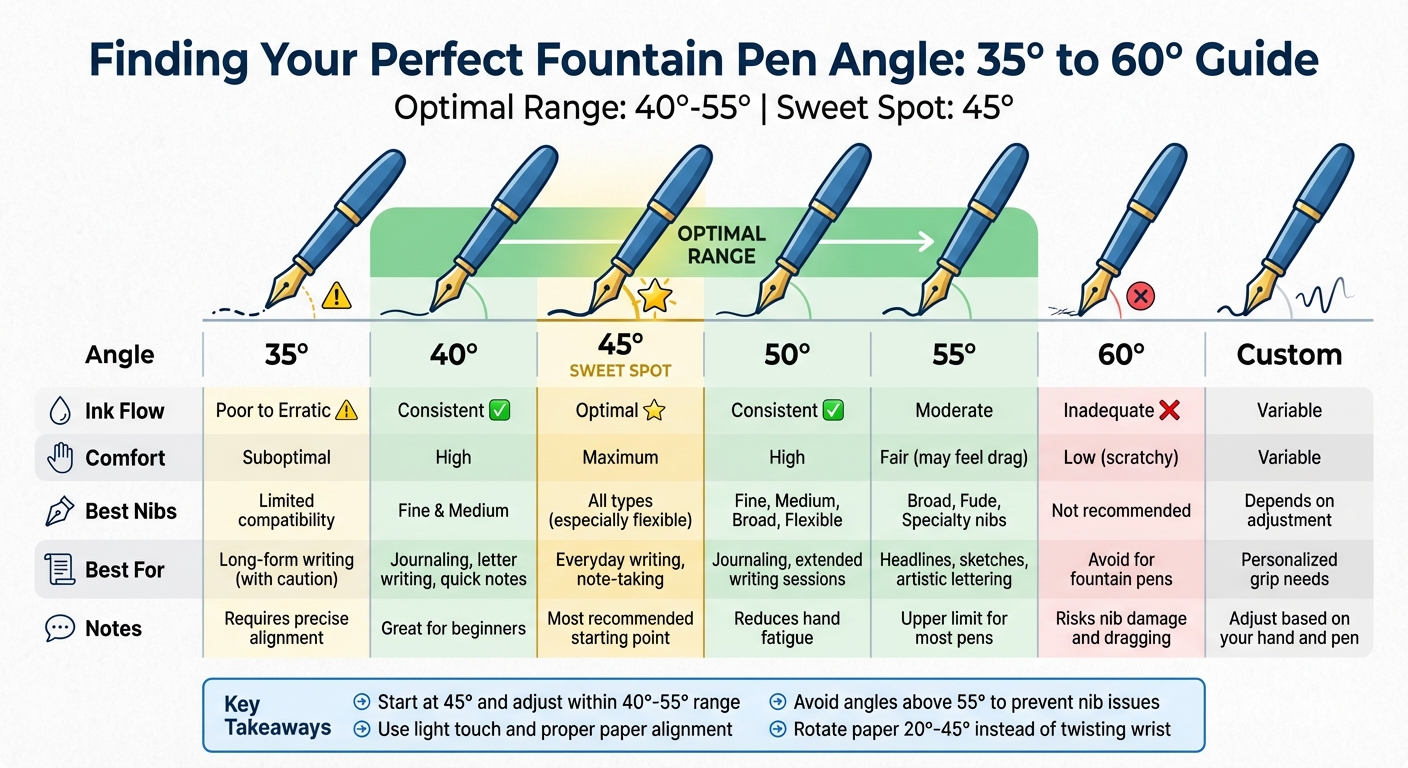
Fountain Pen Writing Angles Comparison Chart: 35° to 60° Range
How To Use & Properly Write with a Fountain Pen!
sbb-itb-1dd4fe9
1. 45-Degree Angle
The 45-degree angle is often referred to as the "sweet spot" for writing with a fountain pen. At this angle, the nib's slit aligns perfectly with the paper, enabling gravity and capillary action to work together for consistent ink flow. As Wooden Earth notes:
The optimal pen-holding angle is 45 degrees. If you tilt your paper up, the ink will flow more smoothly.
Smooth Ink Flow
At this angle, the iridium-tipped nib moves effortlessly across the page. The ink flows steadily from the reservoir through the feed without requiring extra pressure, reducing issues like skipping or railroading.
Comfortable Writing
Holding the pen at 45° allows it to rest naturally between your thumb and index finger. This reduces strain on your wrist and fingers while letting the pen's weight guide the ink flow, making long writing sessions more comfortable.
Works with Various Nibs
This angle works well for most standard fine and medium nibs, making it a great choice for anyone transitioning from ballpoint pens. Flexible nibs also perform beautifully at this position, as they can create thin lines with light pressure and thicker strokes with a bit more force. Oblique nibs are also designed to maintain proper contact at this angle, even if your hand naturally rotates slightly during writing.
Best for Everyday Use
The 45-degree angle is perfect for everyday tasks like note-taking, journaling, or letter writing. To maintain this angle, align the nib's breather hole upward and adjust your paper to support a natural grip. In the next section, we’ll look at how a steeper angle can further refine your technique.
2. 50-Degree Angle
Positioning your fountain pen at a 50-degree angle, which sits at the higher end of the ideal 45–55° range, can significantly improve the nib's performance by ensuring smoother ink flow. Montegrappa highlights the importance of this angle, stating, "The correct angle is very important, as it allows the wings to move away from the feeder, allowing the ink to flow: each fountain pen has its own right angle".
Ink Flow Consistency
When held at 50 degrees, the nib's tines separate just enough from the feeder to optimize capillary action. This positioning minimizes issues like skipping or scratchiness, which are common when the pen is held too flat or too upright. Many users in the fountain pen community appreciate this "higher than average" angle. If your pen skips at lower angles, tilting it closer to 50 degrees often resolves the issue. Plus, smoother ink flow reduces the effort needed to write, which can make long writing sessions less tiring.
Writing Comfort
A 50-degree angle encourages a relaxed grip and engages the arm and shoulder muscles rather than straining the fingers. This makes it ideal for extended writing. Patrick Maness of A.T. Cross explains:
Keep the pen at an angle between 40 and 55 degrees relative to the paper. This positioning allows the nib to make full contact with the page, supporting steady ink flow.
By maintaining this angle, you can write for longer periods without discomfort or fatigue.
Nib Compatibility
Most nib types - fine, medium, broad, and flexible nibs - perform well at this angle, provided you use a light touch and keep the nib's face upward. This slight adjustment can make everyday writing smoother and more enjoyable.
Ideal Use Cases
The 50-degree angle is particularly suited for activities like journaling and note-taking, where consistent ink flow is key. To maintain this angle comfortably, try adjusting your paper's position to between 20° and 45° instead of twisting your wrist. This small change can make a big difference in your overall writing experience.
3. 40-Degree Angle
A 40-degree angle represents the lower end of the 40–55° range, often considered the ideal threshold for fountain pen writing. Glenn Marcus from Glenn's Pens describes it this way:
The pen should rest in the hand and be at a 40 to 55-degree angle to the paper. You will find as you write with a fountain pen, there will be a sweet spot.
Ink Flow Consistency
At this angle, the nib's tines stay fully aligned, ensuring the iridium tip makes proper contact with the paper. This alignment promotes smooth and consistent ink flow. Anna from The Pen Company emphasizes:
Hold the pen at about a 40–55° angle to the paper. Too steep, and the nib may drag - too low, and the ink flow may suffer.
If the nib doesn't glide smoothly, shifting slightly toward 45 or 50 degrees can improve performance.
Writing Comfort
A 40-degree angle allows the pen to rest naturally in the web of your hand, nestled between the thumb and index finger. This positioning lets your fingers guide the nib rather than bearing the pen's full weight. The relaxed grip encourages broader arm movement, reducing strain during extended writing. This angle supports a tripod grip that engages your arm, shoulder, and elbow, helping to minimize fatigue.
Nib Compatibility
This angle works particularly well with fine and medium nib sizes, making it a great starting point for beginners who want a balance between ink flow and control. For faster writers, combining a 40-degree angle with a wet nib ensures the ink keeps up with the pace. While broad and specialty nibs, like stub or italic, can also perform at this angle, they tend to shine more with larger handwriting styles. The versatility of this angle provides a solid foundation for experimenting with grip adjustments in the future.
Ideal Use Cases
The 40-degree angle is perfect for long-form writing, such as journaling, letter writing, or taking quick notes when paired with a wet nib. It's a favorite among professionals like lawyers and judges who appreciate its light grip and smooth glide across the page.
4. 55-Degree Angle
A 55-degree angle, considered the upper limit for most fountain pens, brings specific advantages to writing. Brian Goulet, Founder of The Goulet Pen Company, highlights:
Most nibs are ground in such a way that a 45-55 degree angle works best, though you may find that you write with a lower or higher angle than that.
Ink Flow Consistency
At this angle, the nib's tines slightly separate from the feeder, creating ideal conditions for capillary action. The slit stays centered, and the breather hole faces upward, ensuring smooth ink flow. Patrick Maness from A.T. Cross advises:
Keep the pen at an angle between 40 and 55 degrees relative to the paper. This positioning allows the nib to make full contact with the page, supporting steady ink flow.
If you naturally prefer a steeper writing angle, consider custom nibs vs. standard nibs to find a grind better suited for extreme vertical use. This balance in ink flow not only improves consistency but also enhances the overall writing experience.
Writing Comfort
Using a 55-degree angle allows fountain pens to function through gravity and capillary action alone, reducing the need for pressure and helping to minimize hand strain. The Pen Company points out:
The proper fountain pen grip is looser, lighter, and more ergonomic. Over time, you'll notice less cramping and better writing flow.
If the nib feels like it’s dragging, try lowering the angle slightly to 50 or 45 degrees for a smoother glide. Pairing this technique with fountain-pen-friendly paper, like Rhodia, can also prevent issues like feathering or bleeding during extended writing sessions.
Nib Compatibility
Specialty nibs, like broad and fude nibs, perform particularly well at a 55-degree angle due to the increased ink flow. Fude nibs, designed for high-angle writing, excel at this position. Logan from Idyll Sketching explains:
The 55 degree pen is more extreme; you can still get the thin lines with a little skill, and the thicker lines are thicker.
For example, the Sailor Fude de Mannen is a popular pen designed with a 55-degree nib angle. At this angle, fude nibs create bold, expressive lines by maximizing contact between the bent nib and the paper. Even standard rounded nibs work well at 55 degrees, though they tend to produce heavier ink flow compared to lower angles. This versatility opens up a range of creative possibilities.
Ideal Use Cases
The 55-degree angle is perfect for creating headlines, sketches, and artistic lettering, rather than everyday note-taking. The increased ink flow produces bold, dynamic strokes, making it ideal for calligraphy and creative projects. However, this same characteristic can result in "blobby" lines, which may not suit standard body text. To maintain consistency and reduce fatigue during creative work, rely on arm movements rather than finger movements to keep the angle steady.
5. 35-Degree Angle
A 35-degree angle is slightly below the typical 40–55 degree range recommended by manufacturers such as Montegrappa and A.T. Cross. This makes it a low writing angle. Unlike steeper positions, this angle offers a more laid-back hand posture.
Ink Flow Consistency
At 35 degrees, consistent ink flow depends heavily on the alignment of the nib. The angle impacts how the nib's "wings" lift from the feeder, allowing ink to flow through capillary action.
Montegrappa highlights this concept:
The correct angle is very important, as it allows the wings to move away from the feeder, allowing the ink to flow.
When writing at this angle, a gentle touch and precise alignment are key to maintaining capillary action without causing the tines to spread too much. Misalignment at this lower angle can lead to issues like skipping or uneven strokes. To find the "sweet spot" where the nib moves smoothly, practice single strokes to fine-tune the nib's contact point.
Writing Comfort
The 35-degree angle isn’t just about ink flow - it also improves writing comfort by reducing hand fatigue during long writing sessions. With this lower position, the pen barrel rests deeper in the web of the hand between the thumb and index finger, giving a stable base without needing the fingers to bear the pen's weight. Glenn Marcus from Glenn's Pens explains:
The pen rests in the hand, laying in the space between the finger and the thumb... If you grasp your pen with your fingers at the bottom, the pen will write, but you may experience writing fatigue sooner!
To maintain comfort and consistency at this angle, rely on your arm and shoulder for movement rather than just your fingers. This approach reduces strain and helps keep the angle steady. Avoid rotating the pen, as even slight twists can misalign the nib tines with the paper, disrupting ink flow.
Nib Compatibility
Like higher angles, writing at 35 degrees requires a nib that maintains full contact with the paper. However, this angle tends to favor broader nibs due to their larger "sweet spot." Standard nibs are usually designed for a 45-degree angle, so writing at 35 degrees might call for specific fountain pen nib characteristics. Brian Goulet, Founder of The Goulet Pen Company, advises:
If you write in an extreme angle you might have to be more selective about the pens you use, or you could consider getting a custom grind to accommodate such an angle.
Broader nibs often perform better at low angles because their design allows smoother ink delivery. Rounded tips, such as those on iridium-tipped nibs, glide more easily at shallow angles compared to flat-cut stub nibs. To avoid ink flow problems, make sure the top of the nib - with the breather hole and branding - is always facing upward.
Ideal Use Cases
The 35-degree angle is perfect for long-form writing like journaling, note-taking, or letter writing, where comfort is more important than speed. The relaxed hand position minimizes muscle strain, making it a great choice for writers who spend hours with their pens. However, at this lower angle, paper selection becomes critical - absorbent paper can cause feathering if the slower, wetter strokes linger on the surface.
This angle is less suited for quick writing or sketching. For those activities, a steeper angle offers better control and faster ink flow. But for extended, relaxed writing sessions, the 35-degree angle shines, complementing the techniques discussed in earlier sections.
6. 60-Degree Angle
Most people write with their pens angled between 40–55 degrees, but at 60°, the pen is held almost vertically - an unusual position for fountain pens. Anna from The Pen Company advises:
Hold the pen at about a 40–55° angle to the paper. Too steep, and the nib may drag - too low, and the ink flow may suffer.
Ink Flow Consistency
When writing at a 60-degree angle, ink flow often becomes unreliable. This happens because the nib's tines don't maintain consistent contact with the paper, disrupting the capillary action that keeps ink flowing. This can lead to skipping or even complete stoppage. Unlike ballpoint pens, which work fine even when held straight up, fountain pens depend on steady nib-to-paper contact. Pen Happy explains:
Keep the pen at a 45 degree angle (roughly)... ballpoint pens don't need this btw. You can literally hold ballpoint pens straight up and they work fine, but this will not get a great ink flow from a fountain pen.
If you favor this steeper angle, use a very light touch. If ink flow becomes inconsistent, gradually lower the pen to around 45 degrees to find the nib's optimal position again.
Nib Compatibility
Most factory-ground nibs aren’t designed for writing at such a steep angle. This can make the nib drag rather than glide, creating a scratchy and uncomfortable writing experience. If you naturally hold your pen more vertically, consider getting a custom-ground nib tailored for this grip. Broader nibs may also help by increasing surface contact and improving ink flow, but they won’t completely resolve the challenges of writing at this angle.
Ideal Use Cases
The 60-degree angle might appeal to those transitioning from ballpoint or rollerball pens, as these tools are typically used with a more upright grip. Writers with this natural grip may benefit from specialty nibs or slight adjustments to their technique. However, for the majority of fountain pen users, the lower angles discussed earlier provide better performance and comfort. Up next, learn how customizing your pen angle based on your grip can further enhance your writing experience.
7. Custom Angle Based on Your Grip
Adjusting your pen's tilt to align with your natural grip can greatly improve writing comfort and fluidity. Every nib has a sweet spot where it makes optimal contact with the paper. By finding this angle, you can prevent issues like skipping or scratchiness.
Writing Comfort
The way you hold your pen plays a big role in how comfortable and smooth your writing experience is. The tripod grip - where the pen rests between your thumb and index finger while being supported by your middle finger - is a reliable and comfortable option. To keep your writing smooth and smudge-free, hold the pen slightly above the nib rather than directly at it. As Pen Happy explains:
The ideal grip is one that is comfortable and allows you to apply pressure evenly.
For those with larger hands, it might feel more natural to position the pen further back in the "web" between the thumb and index finger. Supporting your forearm on the desk and writing from the shoulder can also reduce fatigue and help you maintain a steady angle. A grip tailored to your needs not only ensures comfort but also affects how the nib interacts with the paper.
Nib Compatibility
The angle you use can change how a nib performs. Flexible nibs, for example, are highly sensitive to both pressure and angle, which makes them ideal for achieving varied line widths - but they demand more control. Broad nibs, which release more ink, require careful angling to avoid messy writing. On the other hand, fine and medium nibs tend to be more forgiving and easier to manage.
Ideal Use Cases
If you're straining to maintain a specific pen angle, try rotating your paper by 20°–45°. This small adjustment can help align the nib with your arm's natural movement across the page. Start at a 45° angle and gradually adjust the pen's tilt while writing until the ink flows effortlessly and the nib feels smooth, not scratchy. Using smoother papers like Rhodia or Tomoe River can make this process easier, as they allow for more forgiving nib contact. On the other hand, rougher papers demand greater precision to prevent the nib from catching on fibers.
Angle Comparison Table
Here's a quick breakdown of how different writing angles affect ink flow, comfort, and compatibility with various nibs and writing scenarios:
| Writing Angle | Ink Flow | Comfort Level | Compatible Nib Types | Best Writing Situations |
|---|---|---|---|---|
| 35 Degrees | Poor to erratic | Suboptimal | Limited | Can lead to inconsistent ink flow |
| 40 Degrees | Consistent | High | Varies | Ideal for a relaxed grip; lower end of the optimal range |
| 45 Degrees | Optimal | Maximum | All nib types (especially flexible nibs) | The "sweet spot" for balanced flow and smooth writing |
| 50 Degrees | Consistent | High | Varies | Works well for those who prefer a slightly more upright posture |
| 55 Degrees | Moderate | Fair (may feel some drag) | Varies | Upper limit of the effective range; can feel "toothy" on certain paper types |
| 60 Degrees | Inadequate | Low (scratchy) | Not recommended | Too steep; mimics a ballpoint grip and risks nib damage |
| Custom Angle | Variable | Variable | Varies | Adjusted for individual hand size and the pen's specific "sweet spot" |
Fountain Pen Revolution pens perform best within the 40–55° range, making them a great choice for both new and experienced users. Their starter sets, priced from $35, include fine and medium nib options that align perfectly with this effective angle range.
If you notice scratchiness or skipping, use this table to tweak your writing angle. Even a small adjustment can greatly enhance ink flow and overall writing experience.
Conclusion
Discovering the right writing angle can completely change how you experience your fountain pen. For most writers, the sweet spot lies within the 40° to 55° range, with 45 degrees being a great place to start. This angle often provides a smooth glide and consistent ink flow. However, it’s important to remember that every hand - and every pen - is different.
Once you’ve explored this range, don’t hesitate to make small adjustments to find what works best for you. Try altering your grip, rotating your paper by 20° to 45°, or experimenting with different angles until the nib feels just right. As Helen B. Harris from Artltdmag wisely points out:
Fountain pens can be intimidating to use at first, but you will find your sweet spot as long as you keep practicing what you have learned.
If you’re just starting, Fountain Pen Revolution offers beginner-friendly sets starting at $35. These pens are designed to perform well within the recommended 40–55° angle range, making them perfect for honing your technique and building confidence.
A few tips to keep in mind: use a light touch, engage your forearm rather than relying solely on your fingers, and ensure the nib stays face-up. Even a slight 5° adjustment can help eliminate issues like scratchiness or skipping. With consistent practice and experimentation, your fountain pen technique will become second nature, turning writing into a pleasure rather than a chore. Every stroke can become a reflection of your personal style.
FAQs
How do I find my pen’s “sweet spot” angle?
To get the best performance from your fountain pen, hold it at an angle between 40° and 55° above the paper. Make sure the nib stays flat against the surface - this is key to finding the nib's "sweet spot", where it glides smoothly and delivers consistent ink flow. If needed, adjust your grip and hand position to keep the angle steady and enjoy a more comfortable, effortless writing experience.
Why does my pen skip even at 45°?
If your pen skips at a 45° angle, it might be due to insufficient ink flow caused by the angle. Other factors, like a misaligned or dirty nib, can also interfere with smooth ink delivery. To fix this, make sure the nib is clean and correctly aligned for better writing performance.
Should I rotate my paper or change my grip to fix scratchiness?
If your fountain pen feels scratchy, try adjusting your grip and the angle at which you write instead of simply rotating the paper. Hold the pen gently at a 40–55° angle to help the ink flow more smoothly and minimize scratchiness. Play around with various grips and hand positions until you discover a comfortable and steady angle that allows for easier, more fluid writing.