

Choosing fountain pen ink is about balancing cost and how well it performs. Here's what matters most:
- Value: Bottled inks are often more affordable per milliliter than cartridges. For example, Lamy inks cost $0.24/ml, while premium options like Pilot Iroshizuku are $0.51/ml. Bigger bottles, like Diamine (80 ml), offer better savings.
- Performance: Key factors include flow, drying time, and water resistance. Dye-based inks are smooth and easy to clean but lack water resistance. Pigment-based inks are waterproof but need more maintenance. Specialty inks, like shimmer or hybrid types, add flair but require extra care.
- Maintenance: Standard inks are easy to clean, while pigment and shimmer inks need frequent cleaning to avoid clogs. Avoid using India or calligraphy inks in fountain pens.
The right ink depends on your needs - whether it's for daily writing, archival use, or artistic projects. Start with dye-based inks for hassle-free use, or explore pigment and specialty options for durability or visual effects.
Quick Comparison:
| Ink Type | Cost Per ml | Water Resistance | Maintenance | Best Use |
|---|---|---|---|---|
| Dye-Based | $0.24–$0.51 | Low | Low | Everyday writing |
| Pigment-Based | $0.60–$0.80 | High | High | Archival documents |
| Specialty (Shimmer) | $0.63–$0.83 | Variable | High | Decorative/artistic use |
Your pen, paper, and ink work together to shape your writing experience. Experiment with combinations to find what works best for you.
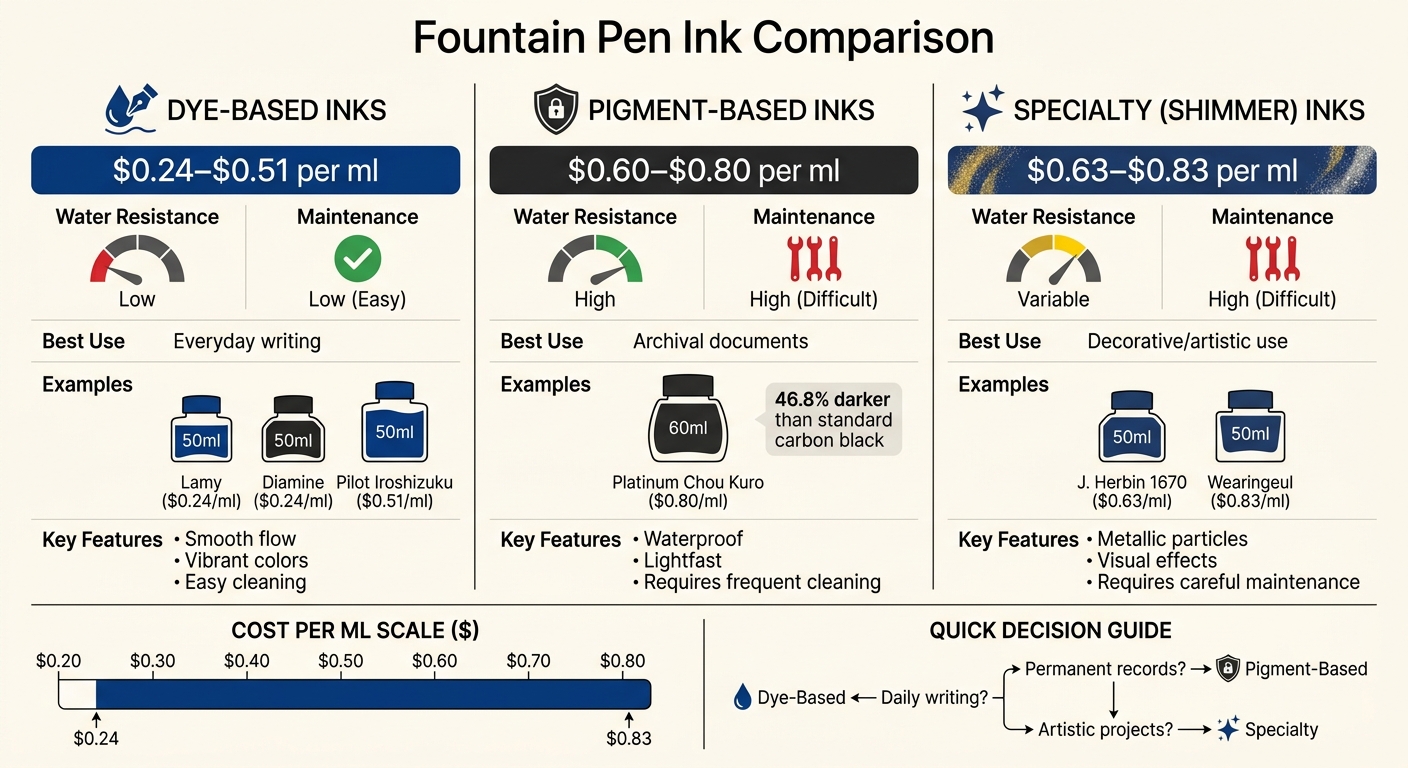
Fountain Pen Ink Types Comparison: Cost, Performance, and Best Uses
Top 10 Fountain Pen Inks of 2️⃣0️⃣2️⃣4️⃣ 🎉
sbb-itb-1dd4fe9
How to Evaluate Fountain Pen Ink
Choosing the right fountain pen ink means weighing factors like cost, performance, and maintenance needs. Here's a breakdown of what to consider.
Cost Per Milliliter and Bottle Sizes
One way to assess value is by calculating the cost per milliliter. Bottled inks tend to be more economical than cartridges, as you're not paying for disposable plastic with each refill. For instance, Lamy standard inks cost about $12.00 for a 50 ml bottle (roughly $0.24/ml), while Pilot Iroshizuku inks are priced at $25.60 for the same volume (around $0.51/ml). On the higher end, Platinum Chou Kuro costs approximately $48.00 for a 60 ml bottle (about $0.80/ml).
Larger bottles, like those from Diamine or Noodler's (often 80 ml or 90 ml), offer better cost efficiency per milliliter. While the upfront cost might seem higher compared to cartridge packs, bottled ink can refill your pen multiple times and gives you access to a wider range of colors. However, before investing, check if your pen supports a converter for bottled ink or if it only works with proprietary cartridges.
Beyond price, an ink's performance is what truly determines its overall value.
Flow, Drying Time, and Color Quality
Performance is all about how the ink behaves - its flow, drying time, and color vibrancy. According to Goldspot Pens:
Excellent fountain pen inks should flow nicely, can be cleaned out easily, and have a reliable consistency across the paper you use.
Dye-based inks are known for their bright colors and smooth flow but typically lack water resistance. On the other hand, pigment-based inks are more permanent and waterproof but require more frequent cleaning. For those who need fast-drying inks to avoid smudges, options like Graf von Faber-Castell are ideal. A standout example is Platinum Chou Kuro, which is reported to be 46.8% darker than the brand's previous Carbon Black, making it one of the deepest waterproof blacks available.
Cleaning Requirements and Pen Compatibility
Maintenance is another key factor when choosing ink. Different formulations require different levels of care. As Waterman advises:
cleaning your fountain pen between each ink refill or, in general, every couple of days when in normal use.
Standard dye-based inks from brands like Waterman, Parker Quink, or Pelikan 4001 need minimal upkeep - just flush with cool water. In contrast, pigment-based inks contain tiny particles that can build up in the pen's feed, requiring more frequent and thorough cleaning.
For vintage pens, it's safer to stick with traditional, pH-neutral inks to avoid damaging delicate materials. Blue inks are often the best choice for older pens since they contain fewer dyes, whereas red inks are more prone to clogging. Lubricated inks, such as Noodler's Eel series, can help smooth out scratchy nibs but usually take longer to dry. Avoid using India ink, calligraphy ink, or drawing ink in fountain pens, as these contain shellac or acrylic binders that can permanently clog the pen's feed system.
Regular maintenance not only ensures better ink performance but also extends the life of your pen.
Ink Types Compared by Category
Fountain pen inks cater to various needs, whether for everyday writing, archival purposes, or artistic pursuits. The choice of ink depends on factors like performance, upkeep, and intended use. Here's a breakdown of the main categories.
Dye-Based Inks for Daily Writing
Dye-based inks are a go-to for many fountain pen users. These inks use dissolved dyes, ensuring smooth flow and easy cleanup with water. They're perfect for everyday tasks like journaling, writing letters, or taking notes. Plus, they come in a wide array of vibrant colors, making them versatile and low-maintenance.
However, they do have a downside: limited water resistance. As Faber-Castell USA explains, dye-based inks create:
a color lay‐down that will bind itself and sink into your paper.
| Ink Brand | Bottle Size | Cost Per ml | Flow Rating | Drying Time | Water Resistance | Cleaning Ease |
|---|---|---|---|---|---|---|
| Lamy | 50 ml | $0.24 | Excellent | Medium | Limited | Very Easy |
| Diamine | 80 ml | $0.24 | Excellent | Medium | Limited | Very Easy |
| Pilot Iroshizuku | 50 ml | $0.51 | Excellent | Medium | Limited | Very Easy |
Pigment and Hybrid Inks for Permanent Documents
For documents requiring longevity, pigment and hybrid inks offer durability that dye-based inks can't match. Pigment inks contain tiny particles that adhere to the paper's surface, providing excellent permanence and resistance to light.
One standout is Platinum Chou Kuro, priced at $48.00 for 60 ml (about $0.80/ml). Known to be 46.8% darker than Platinum Carbon Black, it’s also completely waterproof once dry. However, pigment inks require regular cleaning, as they can clog nibs over time. Hybrid inks, which combine dye and pigment properties, strike a balance by offering better water resistance with less maintenance. These are ideal for business or legal documentation.
| Ink Type | Water Resistance | Lightfastness | Maintenance Level | Cost Per ml (Avg) | Best For |
|---|---|---|---|---|---|
| Pigment | Excellent | High | High | $0.60–$0.80 | Archival documents, artwork |
| Hybrid/Document | Very Good | Good | Low–Moderate | $0.40–$0.60 | Business and legal use |
| Standard Dye | Limited | Low | Low | $0.24–$0.51 | Daily writing |
Shimmer and Specialty Inks for Visual Appeal
Shimmer inks are all about aesthetics. They include metallic particles that sparkle under light, creating striking effects. These inks are popular for their eye-catching appearance but require extra care. As Scriveiner points out:
these inks require careful pen maintenance to prevent particle accumulation.
For example, J. Herbin 1670 Anniversary ink costs $31.50 for 50 ml (around $0.63/ml), while Wearingeul specialty inks are priced at $25.00 for 30 ml (approximately $0.83/ml). Shimmer inks can be tricky to use, as the particles may settle and clog finer nibs. To avoid this, use broader nib sizes and gently shake the bottle before filling. Multi-chromatic specialty inks, like Sailor Manyo Haha, add another layer of artistry by drying into multiple hues, such as pink and blue.
| Ink Brand | Bottle Size | Cost Per ml | Shimmer Intensity | Flow Consistency | Maintenance Level |
|---|---|---|---|---|---|
| J. Herbin 1670 | 50 ml | $0.63 | High | Variable | High |
| Wearingeul | 30 ml | $0.83 | Very High | Variable | Very High |
| Standard Dye (Reference) | 50–80 ml | $0.24–$0.51 | None | Excellent | Low |
These ink categories highlight how formulations can influence both practicality and artistic expression, offering something for every type of fountain pen enthusiast.
Fountain Pen Revolution Inks: Affordable Performance
Benefits of Fountain Pen Revolution Inks
Fountain Pen Revolution has carved out a niche by offering inks that balance affordability with reliable performance. Their Classic line starts at just $1.05, making it roughly half the cost of many premium options. This pricing is perfect for beginners looking to explore fountain pens without overspending, while still providing a quality that experienced users can enjoy.
For those who love specialty inks, Fountain Pen Revolution offers shimmer and sheening options like Gilded Ivy Shimmer and Cosmic Pink Sheening, priced at only $2.15. These are budget-friendly alternatives to pricier specialty inks on the market. Plus, bulk buyers can take advantage of free shipping - available for U.S. orders over $65.00 and international orders over $149.00. Whether you're looking for everyday functionality or creative flair, their inks offer a cost-effective solution for all kinds of writing needs.
Features and Recommended Uses
The ink selection from Fountain Pen Revolution is impressively versatile. They offer professional, everyday staples like Classic Black and Blue-Black, as well as vibrant specialty options such as Mardi Gras (a purple sheening ink) and Galaxy Blue (a shimmer ink). This range caters to both practical use and creative endeavors like journaling or calligraphy.
Designed for smooth and consistent flow across various nib sizes, these inks deliver dependable performance. For those using flex nibs, occasional railroading can be resolved with their Railroad X additive, available for $6.55. Cleaning is a breeze too - Pen Flush ($5.45) makes switching between shimmer and standard inks hassle-free. Want to experiment with custom colors? The Ink Mixing Kit, priced at $47.25, opens up endless creative possibilities for crafting personalized shades.
Conclusion
Choosing the right fountain pen ink depends on what you need it for. If you're looking for something reliable for everyday writing, dye-based inks are a great pick because they flow smoothly and require minimal upkeep. On the other hand, pigment or hybrid inks are better suited for tasks like legal documents or archival work, where permanence is key.
The performance of an ink comes down to how it interacts with both your pen and your paper. Some inks are designed to complement specific pen systems - wetter inks can offset pens that write dry, while drier inks work better with pens that naturally release more ink. Trying out different inks on various types of paper can reveal how versatile they are.
As one enthusiast insightfully put it:
"The ink needs to be relatively inexpensive for it to be accessible to those who use fountain pens often. Many fountain pen users look at the cost per milliliter, and most want to get the most bang for their buck when purchasing a full bottle of inky goodness." - EndlessPens
FAQs
How do I calculate ink cost per milliliter?
To figure out the ink cost per milliliter, simply divide the bottle's total price by its volume in milliliters. For instance, if a bottle is priced at $14 and holds 50 ml, the cost per milliliter would be $14 ÷ 50 = $0.28. Generally, bottled ink prices fall between $0.14 and $0.24 per ml, though this varies by brand.
Which inks are safest for vintage fountain pens?
The best inks to use with vintage fountain pens are Waterman Blue, Pelikan 4001 Blue, Parker Quink, Sheaffer Skrip, and Aurora. These inks are specially formulated to be gentle on older pens, reducing the risk of clogging or causing damage to their delicate mechanisms.
What nib sizes work best with shimmer inks?
Shimmer inks work best when paired with broader nib sizes and smooth paper. This combination amplifies their sparkle and helps maintain consistent ink flow. To avoid clogging from the glitter particles, it's important to clean your pen regularly.