

Fountain pen history isn’t just about Lewis Waterman. Many inventors contributed to its evolution, yet their stories often go untold. From a 953 CE Egyptian pen commissioned by the Fatimid Caliph to Petrache Poenaru’s 1827 portable pen patent, the journey spans centuries. These early designs tackled ink flow, portability, and usability, paving the way for modern pens. Understanding this history helps enthusiasts better clean and maintain their own collections.
Key Highlights:
- 953 CE: Fatimid Caliph’s pen solved ink leakage, featuring a reservoir and controlled ink flow.
- 1827: Petrache Poenaru patented a lightweight, self-feeding pen using a swan quill.
- 1809: Frederick Fölsch introduced an air-pressure ink feed system.
- 1832: John Jacob Parker developed a piston mechanism for easier refilling.
- 1883: Frank Holland’s designs influenced Waterman’s later commercial success.
Waterman’s 1884 design succeeded due to practical improvements and effective marketing. However, these earlier inventors laid the groundwork for the pens we use today, even if their contributions are often overlooked.
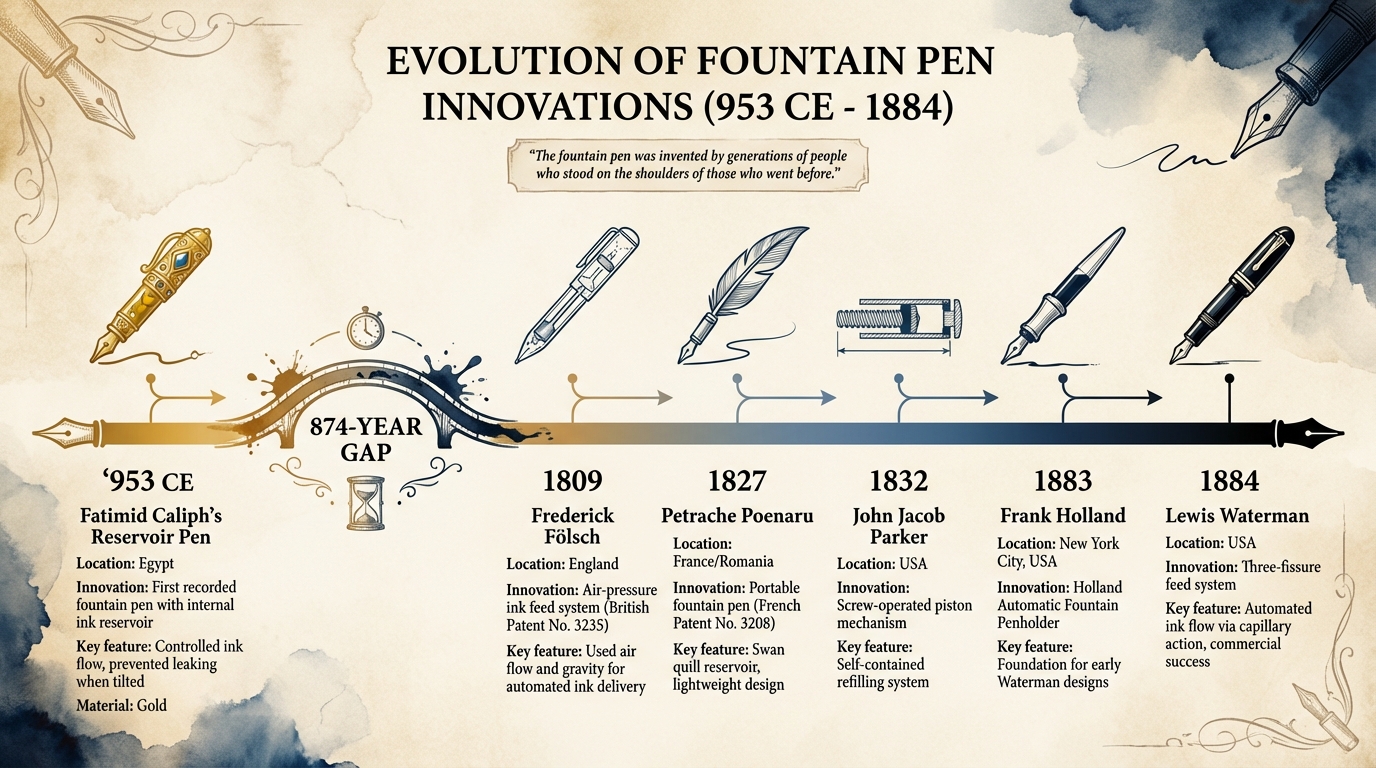
Timeline of Fountain Pen Innovations from 953 CE to 1884
The History of fountain pens, Predawn era of dip pens, reeds, and quills
sbb-itb-1dd4fe9
The Fatimid Caliph's Fountain Pen (953 CE)
The first recorded fountain pen dates back nearly a millennium before modern patents, originating in the Fatimid Caliphate in 953 CE. Abu Tamim Ma'ad al-Mu'izz li-Din Allah, the Fatimid Caliph, commissioned this groundbreaking invention to solve the challenges faced by 10th-century scribes, such as frequent ink dipping and messy stains.
"We wish to construct a pen which can be used for writing without having recourse to an ink-holder and whose ink will be contained inside it... The writer can put it in his sleeve or anywhere he wishes and it will not stain nor will any drop of ink leak out of it." – Abu Tamim Ma'ad al-Mu'izz li-Din Allah, Fatimid Caliph
Crafted from gold, the pen featured an internal ink reservoir and a clever mechanism to prevent leaking. It could be tilted or even turned upside down without spilling a drop. Ink flowed only when the pen touched paper - what the Caliph poetically referred to as the "intention to write" - and stopped as soon as it was lifted. Initial over-inking issues led to mechanical tweaks that improved the flow.
This invention predates Petrache Poenaru's 1827 fountain pen patent by an astounding 874 years. Despite its historical significance, it is often overlooked in Western narratives. The only record of its existence comes from historian Qadi al-Nu'man’s writings in Kitāb al-Majālis wa 'l-musayarāt (Book of Sessions and Excursions). Unfortunately, no physical examples of the pen have survived. While translations of Qadi al-Nu'man’s work have brought attention to the design, some historians question its authenticity, citing the lack of archaeological evidence and detailed schematics.
Although the exact workings of this pen remain a mystery, its ability to control ink flow upon contact with paper suggests early knowledge of reservoir pressure or capillary action. As the Caliph himself remarked, "We are unaware of anyone previously ever constructing [a pen such as this]". This remarkable invention laid the foundation for future developments, including Poenaru's portable fountain pen centuries later.
Petrache Poenaru: Creator of the Portable Fountain Pen
In 1827, Romanian inventor Petrache Poenaru obtained French Patent No. 3208 for his "never-ending portable pen" (plume portable sans fin, qui s'alimente elle-meme avec de l'ancre). The patent, valid for five years, introduced a design that was more lightweight and portable than earlier pens made of metal or glass. Poenaru’s pen used a swan quill as its ink reservoir, which was a novel choice at the time.
The pen's operation was straightforward but required manual effort. Users would squeeze the flexible quill barrel to push ink through a small ferrule opening. To prevent leaks, Poenaru included an internal cap needle. Refilling the pen involved unscrewing a metal blind cap and using an eyedropper to add ink.
Poenaru himself highlighted the benefits of his design, stating:
"The advantages of this pen over those that exist for the same purpose, consist in the tube A, which is a quill instead of being metal or glass. By this means the instrument is much lighter, less fragile, and to make the ink arrive at the tip of the pen, it is not necessary to shake, which is an issue of great inconvenience."
Despite its ingenuity, Poenaru's pen faced significant challenges. It lacked an automatic ink-feed system, had a fragile quill barrel compared to metal alternatives, and used a slip-on cap that wasn’t secure. These limitations prevented the design from reaching commercial production.
After his return to Romania, Poenaru shifted focus to education and politics. He became known for translating the first Romanian textbooks on geometry and algebra. In 2010, Poșta Română honored his invention with a 5 lei stamp, recognizing a pioneer whose work was ahead of its time but overshadowed by technical constraints and his later career pursuits.
Early Self-Filling Mechanisms: Fölsch and Parker
Frederick Fölsch: Early Automated Filling Systems
In May 1809, Frederick Fölsch secured the first English fountain pen patent. His design, detailed in Writing Pens under British Patent No. 3235, introduced a feed system that used air flow and gravity to deliver ink from an internal reservoir to the nib. This eliminated the need for constant dipping. However, while innovative, the feed system often struggled to provide a consistently smooth writing experience.
As described on frederickfolsch.com:
"Frederick Fölsch... had a clear understanding of how air flow and gravity play together to ensure a steady flow of ink. This was a major drawback in older versions of fountain pens."
Fölsch's work laid important groundwork for automated filling systems, even though the technology needed further refinement to improve reliability and user convenience.
John Jacob Parker: Improving Pen Usability
In 1832, John Jacob Parker advanced fountain pen design with a screw-operated piston mechanism. This innovation made refilling ink more straightforward and self-contained, paving the way for future improvements in pen usability. Remarkably, Parker's piston system was decades ahead of its time, as similar commercial designs, like Pelikan's piston-filling mechanism, didn’t emerge until 1929.
Historian David Nishimura commented:
"'History is written by the victors' applies to commercial as well as military conflicts. Decades later, once it had overshadowed all its earliest rivals, the Waterman company boldly began to claim to have invented the first practical fountain pen – a claim which is now as widely accepted as it is false."
Despite the ingenuity of Fölsch and Parker, their designs lacked later innovations such as hard rubber barrels, iridium-tipped gold nibs, and inks designed to prevent sediment build-up.
Frank Holland: The Overlooked Collaborator
Frank Holland played a pivotal role in the early days of fountain pen innovation, though his contributions have largely been overshadowed. This Connecticut-based inventor launched a pen company in New York City in the spring of 1883. His design, the "Holland Automatic Fountain Penholder", was advertised in American Bookseller on April 2, 1883 - months before Lewis Edson Waterman became associated with the company. Holland’s invention likely laid the groundwork for what would later become the early Waterman pens.
Initially hired as a salesman, Waterman assumed control of the company after Holland’s brief six-week tenure ended due to a dispute with his financial backers. Waterman reworked Holland’s existing pen stock, incorporating his own simplified "three fissure feed" design. The first "Ideal" pen, sold to R.E. Bingham on July 11, 1883, was probably a modified version of Holland’s original model, enhanced with Waterman’s feed innovation.
Pen historian David Nishimura offered this perspective:
"Though Holland's backers might have felt that Waterman stole Holland's success... Waterman was guilty of nothing more than picking up the pieces of what Holland threw away."
Despite Holland’s foundational contributions, the narrative quickly shifted to portray Waterman as the sole innovator. This misconception was further solidified by the widely debunked "ink blot" story. Recognizing Holland’s role would require confronting his professional missteps, a topic deemed too sensitive for discussion at the time. His story serves as a reminder of how easily nuanced contributions can be overshadowed by simplified historical accounts, leaving much to reconsider.
Why These Inventors Remain Forgotten
The gap between early invention and widespread commercialization explains much of why certain inventors faded into obscurity. For example, while Poenaru and Fölsch introduced innovative designs, their pens required manual adjustments. In contrast, Waterman's 1884 three-fissure feed system automated ink flow using capillary action, making his design practical for everyday use. This leap in functionality set Waterman's pen apart from earlier attempts and redefined what a "functional" writing instrument could be, a standard still sought in the best fountain pens for beginners today.
Marketing also played a massive role in shaping the narrative. Waterman's company used aggressive tactics, offering five-year guarantees and targeting professionals like lawyers and insurance agents. These efforts helped position Waterman's pens as the gold standard. Adding to this was the "ink blot incident", a story that became a compelling origin myth. Notably, this tale didn’t appear in print until May 1912 - more than a decade after Waterman’s death - yet it overshadowed more complex and accurate accounts of earlier innovations.
Beyond technical and marketing factors, historical record-keeping also contributed to the erasure of early inventors. For example, there are no surviving examples or detailed schematics of the Egyptian reservoir pen from 953 CE. Pen historian Richard Binder highlighted this issue:
"Al-Nu'man gave no details of the pen's construction, and no examples are known to have survived".
Meanwhile, promotional materials from later periods, such as magazine ads, have endured, ensuring the legacy of more recent inventors. Temporary records, like those documenting early designs, were often lost over time.
Another factor is Western-centric bias, which sidelined non-Western pioneers. Innovations like the Egyptian reservoir pen were often dismissed due to the focus on Western patent systems. Pen historian David Nishimura aptly noted:
"History is written by the victors".
This bias extended to how "practicality" was defined, favoring mass-produced Western designs over earlier prototypes from regions like Egypt and Romania.
Conclusion: Recognizing the Early Innovators
The story of the fountain pen stretches across centuries and continents, marked by countless innovations. It all began with the Fatimid Caliph's reservoir pen in 953 CE, a design created to avoid ink stains on hands and clothing. Later, in 1809, Frederick Fölsch's patent introduced a regulating plate to control ink flow - an advancement that paved the way for the pens we use today. These early inventors tackled challenges that modern fountain pens continue to refine, from ink reservoirs to automated filling systems.
"The fountain pen was invented by generations of people who stood on the shoulders of those who went before".
This rich history adds depth to every writing experience. When you pick up a fountain pen, you're connecting with over a thousand years of ingenuity. Innovations like Lewis Waterman's three-fissure feed ensured smooth ink flow, while portable designs eliminated the need for constant dipping - transforming the act of writing into something both practical and elegant.
Fountain Pen Revolution celebrates these trailblazers by offering high-quality, affordable pens for everyone. Whether you're considering your first fountain pen or a collector seeking finely crafted instruments, their pens honor the legacy of early inventors.
Each time you write, you become part of a centuries-old tradition of problem-solving and creativity, built by inventors whose contributions deserve to stand alongside today's iconic brands.
FAQs
How did the 953 CE Fatimid pen likely control ink flow?
The Fatimid pen from 953 CE likely featured a reservoir system to control ink flow. This design allowed ink to be stored within the pen, with gravity and capillary action guiding it to the nib. This setup ensured smooth writing while minimizing the risk of spills or leaks.
Why wasn’t Poenaru’s 1827 pen commercially successful?
Poenaru’s 1827 pen struggled to gain traction in the market, largely because earlier fountain pens had already made their mark. For instance, Nicolas Bion introduced designs in the early 1700s, and even older references to fountain pens exist, dating back to the 1650s and as far as 10th-century Egypt. These earlier innovations overshadowed Poenaru’s contribution, reducing its impact despite its forward-thinking design.
What made Waterman’s feed design more practical than earlier pens?
Waterman’s feed design stood out for its practical "three fissure feed" system, which greatly improved ink flow and dependability. This advancement made fountain pens more user-friendly and efficient, solving many of the problems that plagued earlier designs.