

When it comes to holiday calligraphy, your ink choice matters more than you might think. The right ink can elevate your cards, envelopes, and decorative projects, while the wrong one can lead to smudges, clogs, or dull results. Here's a quick guide to help you pick the perfect ink for your festive projects:
- Dye-based inks: Smooth flow, quick drying, great for cards and general writing. However, they aren't waterproof and may fade over time.
- Pigment-based inks: Water-resistant, ideal for envelopes that may face weather exposure. Regular pen cleaning is needed to avoid clogs.
- Shimmer inks: Add sparkle and shine, perfect for decorative accents. Best used with broader nibs and require frequent shaking.
- Sheen inks: Create striking metallic edges, great for headers or upscale stationery. Work best on smooth paper but take longer to dry.
Pro Tip: Always test your ink on a scrap of your chosen paper to check for feathering, bleed-through, and drying time. Pair shimmer or sheen inks with smooth, coated paper for the best results.
Whether you're signing cards, addressing envelopes, or adding decorative flourishes, the right ink can make all the difference. Start with a few holiday-themed colors - like red, green, gold, or blue - and experiment with shimmer or sheen effects for added flair. For beginners, ink samples and a glass dip pen are budget-friendly ways to try different options before committing to full bottles.
Ready to make your holiday calligraphy shine? Let’s dive into the details.
Understanding Fountain Pen Inks for Holiday Projects
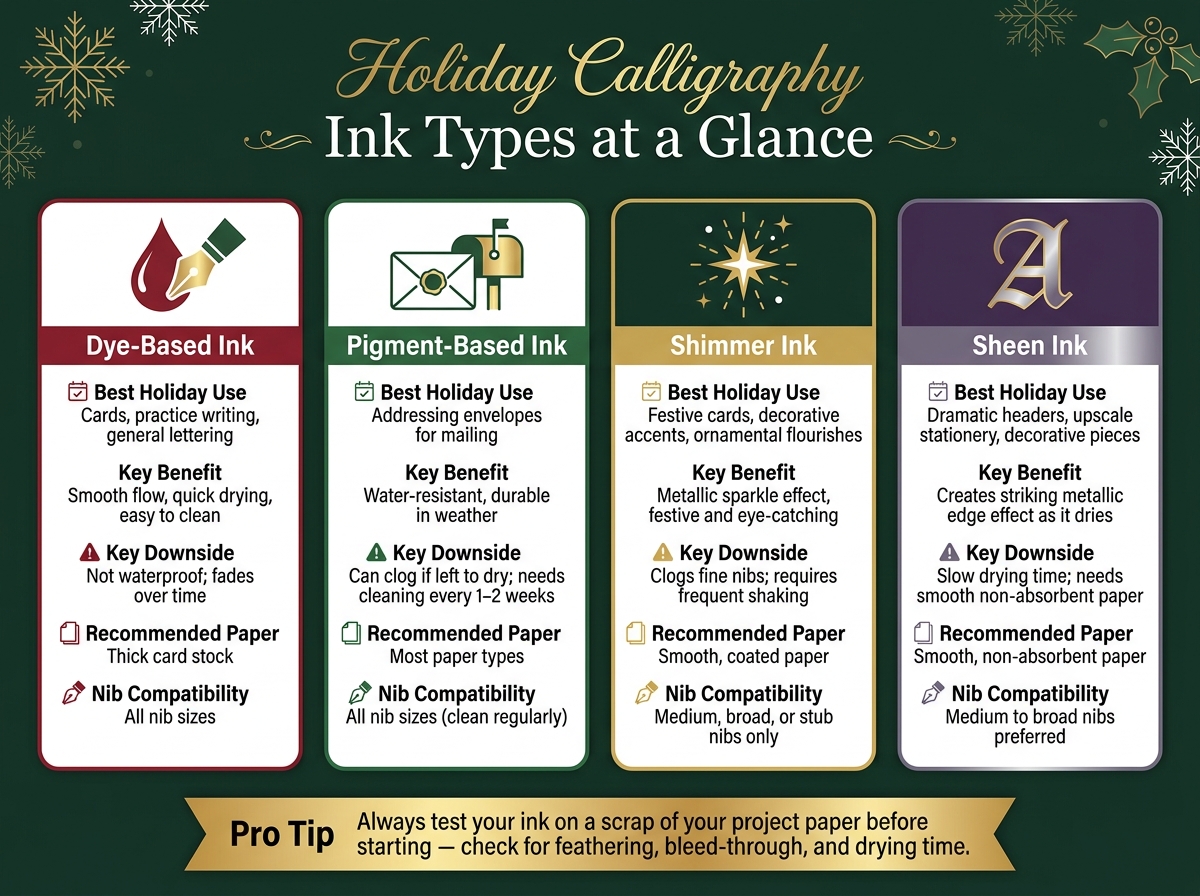
Holiday Calligraphy Ink Types: A Complete Comparison Guide
Fountain pen inks vary widely, and picking the right one is crucial for holiday calligraphy. Whether you're addressing envelopes or creating festive cards, the ink you choose can make or break your project. Let’s dive into the different types of inks and how they perform in holiday crafting.
Types of Fountain Pen Inks
Dye-based inks are known for their smooth flow and ease of cleaning. Available in classic holiday colors like red, green, and blue, they’re perfect for indoor projects. However, they’re neither waterproof nor fade-resistant, so keep them away from anything exposed to the elements.
Pigment-based inks offer water resistance thanks to their suspended particles, making them a great choice for addressing envelopes that will be mailed. The trade-off? These inks demand regular pen cleaning every one to two weeks to avoid buildup.
Shimmer inks bring a festive sparkle with their metallic particles. They can transform your writing into a show-stopping display, but they require shaking before use and work best with medium or broad nibs to prevent clogging.
"Shimmer inks sparkle with suspended metallic particles, transforming every letter into a celebratory flourish."
Sheen inks create a striking metallic edge as they dry, adding drama to headers or decorative pieces. They shine brightest on smooth, non-absorbent paper but take longer to dry. According to Ferris Wheel Press, they’re ideal for:
"fans of drama, glamour, and page-turning flair."
By understanding these ink types, you can pair them with the right projects - whether you’re prioritizing durability for mailed items or aiming for a bold, decorative look.
Here’s a quick reference chart to help you decide:
| Ink Type | Best Holiday Use | Key Downside |
|---|---|---|
| Dye-Based | Cards, practice, and general writing | Not waterproof; fades over time |
| Pigment-Based | Addressing envelopes for mailing | Can clog if left to dry in the pen |
| Shimmer | Festive cards and decorative accents | Clogs fine nibs; requires frequent shaking |
| Sheen | Dramatic headers and upscale stationery | Needs smooth paper; slow drying time |
Why Fountain Pen Ink Differs From Dip Pen Ink
It’s just as important to understand why fountain pen ink can’t replace dip pen ink. Fountain pen ink is thin and water-based, designed to flow smoothly through a pen’s intricate feed system. Dip pen inks, like India ink or traditional calligraphy inks, are much thicker and include binders like gum arabic or shellac to help them stick to the nib.
These binders, while essential for dip pens, can wreak havoc on fountain pens. Calligrapher Richard Wideman of Calligrascape explains:
"Calligraphy ink is pigment-based ink that contains a compound called 'gum arabic' and is made for dip pens only. 'Gum arabic' can make your fountain pens and pilot parallels unusable if put into them."
The same warning applies to India inks and acrylic-based inks - they can permanently clog or damage your fountain pen’s feed system. To keep your tools in good shape, stick to inks specifically labeled for fountain pens. This simple choice will protect both your pen and your holiday creations.
How to Pick the Right Ink for Holiday Calligraphy
Understanding different ink types is just the beginning. The real challenge - and fun - comes in pairing the right ink with your project, paper, and specific conditions.
Matching Ink to Paper and Project Type
The type of paper you’re using plays a big role in how your ink behaves. Always test your ink on a small scrap of your chosen paper before diving into the project. Glossy cards, for instance, tend to hold moisture longer, which means smudges are more likely. Coated surfaces also need extra drying time, while uncoated paper might lead to feathering. If you’re working with thick card stock and need ink that dries quickly, dye-based inks are a great choice. They flow smoothly and dry faster than their pigment-based counterparts, making them ideal for fast-paced tasks like signing holiday cards.
Dry Time, Smudging, and Ink Flow
Once you’ve settled on your paper, think about how quickly the ink needs to dry and how much handling the project will endure. For items like envelopes or gift tags that get handled a lot, quick-drying, smudge-resistant inks are your best bet. Calligraphy writer Scott Humphries offers this insight:
"If you select a non-waterproof ink, like those for fountain pens, ensure your final project won't encounter conditions that may cause the ink to run."
This advice is especially important for envelopes sent through the mail during winter. Rain, snow, and rough handling can ruin non-waterproof inks. For these situations, consider using water-resistant options like Octopus Red Koala, which can stand up to the elements and keep your calligraphy looking festive and intact.
Picking Holiday Colors and Effects
Beyond practical considerations, the colors and effects you choose set the mood for your holiday project. Traditional colors such as deep red, forest green, and metallic gold evoke classic holiday cheer. For a standout gold ink, Robert Oster Heart of Gold is a fantastic choice. As Kelli, founder of Mountain of Ink, puts it:
"I especially love Robert Oster Heart of Gold. It's the perfect gold color with gold shimmer."
If you want to explore beyond the usual Christmas palette, try rich blues and purples for a wintry, elegant vibe. Diamine Jack Frost, for instance, offers a stunning medium blue with a pink sheen and frosty blue shimmer. Vanness describes it as having "high shading, high pink sheen, and frosty blue shimmer."
For decorative touches, shimmer inks add a metallic sparkle that catches the light, while sheen inks create a secondary color along the edges as they dry. These effects shine brightest when used with medium or broad nibs on smooth, high-quality paper.
| Ink Property | Best Holiday Use | Paper Consideration |
|---|---|---|
| Dye-based | Fast-paced card signing | Thick card stock; dries quickly |
| Shimmer/Sheen | Decorative holiday flourishes | Requires longer dry time; best on smooth paper |
| Waterproof/Permanent | Envelopes and mailing | Resists smudging and moisture during transit |
| High-Opacity | Bold headers on dark paper | Maintains vibrant color after drying |
How to Test and Use Holiday Inks
Testing Inks on Your Project Paper
Before diving into your holiday card designs, it's a good idea to test your ink on a scrap of the same paper you'll be using. This simple step can save you from unexpected surprises.
When testing, pay attention to three key factors: feathering (how much the ink spreads along the paper fibers), bleed-through (whether the ink soaks through to the back of the paper), and color quality (how rich and vibrant the ink appears). As Ferris Wheel Press explains:
"Using the wrong paper... can hide sheen, reduce shimmer, and flatten colour."
Smooth, coated paper is your best bet for showcasing shimmer and sheen effects, as it allows the ink to stay on the surface longer. On the other hand, absorbent paper draws the ink into its fibers quickly, which can speed up drying but might dull metallic finishes. If you're working with glossy holiday cardstock, gently blot the wet ink with a tissue to avoid smudging before it dries completely.
Keep in mind that sheen effects often reveal themselves only after the ink has dried or when the paper is tilted under light. By taking the time to test, you can ensure your designs look as stunning as you imagined. Once you're satisfied with the ink's performance on your paper, it's time to think about the pen and nib that will bring out the best in your holiday inks.
Pairing Inks with Pens and Nibs
The type of nib you choose can dramatically impact how your holiday inks perform. Medium, broad, or stub nibs are ideal for shimmer, sheen, and shading effects because they lay down more ink, giving these features room to shine. Fine nibs, however, may struggle with shimmer inks, as the metallic particles in these inks are heavier and require a more generous flow.
To keep those metallic particles evenly distributed, shake the ink bottle before filling your pen, roll the pen gently between your palms during use, and store it nib-down if you won't be using it for a while.
Proper cleaning is also essential when working with shimmer inks. The Goulet Pen Company emphasizes:
"Due to the amount of particulate in this ink used to achieve the sparking look, you may experience restricted ink flow in some of your pens."
Be sure to flush your pen thoroughly with water after each use to avoid clogging. If you find that a shimmer ink consistently clogs your fountain pen despite regular cleaning, consider switching to a dip pen for that particular ink. Many calligraphers prefer this approach, as it not only prevents clogs but also enhances the decorative flair of holiday lettering.
sbb-itb-1dd4fe9
Building a Holiday Ink Collection
Core Inks to Have for Holiday Projects
Once you’ve got a handle on ink properties and how they pair with your tools, it’s time to put together a holiday ink collection. A carefully chosen set of 5–7 inks can cover everything from formal labels to decorative gift tags.
Start with a dependable dark ink like FPR Classic Black - perfect for addresses and formal text. Then, add traditional holiday colors: a vibrant red such as FPR Firecracker Red and a rich green like Diamine Sherwood Green will handle most festive needs.
For a bit of sparkle, include a shimmer or metallic ink. Something like Diamine Merry & Bright (silver shimmer) or Colorverse Christmas Star (gold shimmer) adds a festive touch without overwhelming your palette. If you want a versatile, wintry ink, consider Diamine Jack Frost. Its medium blue base with pink sheen and blue shimmer works beautifully for envelopes and card borders.
Here’s a quick reference for a starter set:
| Ink | Base Color | Effect | Best Use |
|---|---|---|---|
| FPR Classic Black | Black | None | Addresses, main text |
| FPR Firecracker Red | Red | None | Accents, greetings |
| Diamine Sherwood Green | Deep Green | None | Decorative lettering |
| Diamine Merry & Bright | Green | Silver shimmer | Ornamental flourishes |
| Diamine Jack Frost | Medium Blue | Pink sheen / blue shimmer | Envelopes, borders |
| Colorverse Christmas Star | Yellow/Gold | Gold shimmer | Stars, highlights |
Affordable Options from Fountain Pen Revolution
Creating your ink collection doesn’t have to break the bank. Fountain Pen Revolution offers ink samples starting at just $1.00 for staples like FPR Classic Black or Blue-Black. Specialty colors, like Firecracker Red, are available for $1.25, while shimmer inks such as FPR Galaxy Blue Shimmer or FPR Gilded Ivy Shimmer start at $1.75. This makes it easy to try out different inks before committing to a full bottle.
If you’re testing multiple colors, glass dip pens are a practical tool. Fountain Pen Revolution sells them for $12.60–$14.00, allowing you to sample various inks in one session without needing to clean out a fountain pen between uses. For beginners, picking up a few ink samples alongside an affordable pen is a budget-friendly way to explore and find the perfect colors for your holiday projects. It’s a simple way to experiment and expand your calligraphy skills during the festive season.
Conclusion: Getting Started with Holiday Calligraphy
Armed with these tips, you're ready to bring your holiday calligraphy ideas to life. Choosing the right ink comes down to a few simple steps: test your ink on the project paper, pair it with the right tools, and pick colors that match the festive mood - whether it's the warmth of reds and golds or the serene elegance of blues and silvers.
As Scott Humphries of The Pen Company says:
"Understanding the differences between types of inks for calligraphy and how they suit various writing tools and projects makes all the difference."
Getting started is simpler than it seems. A small selection of inks - a classic black, a cheerful red or green, and a shimmer ink for accents - can handle most holiday projects. Ink samples are a budget-friendly way to experiment before buying full bottles. You don’t need pricey tools or a massive ink collection to create beautiful, festive pieces. A few dependable supplies and a little practice will go a long way.
Keep it simple, and let every stroke reflect the joy of the season.
FAQs
Which ink is safest for mailed envelopes?
For addressing mailed envelopes, choose smudge-resistant and water-resistant inks to keep your writing intact during handling or exposure to moisture. Opt for waterproof or document-grade inks, which are designed to withstand rain and smearing. If you're using a fountain pen, make sure the ink is specifically labeled as safe for fountain pens to prevent clogging. Pigment-based or document inks are excellent choices for their durability during mail transit.
What nib works best for shimmer or sheen inks?
Broader nibs, such as broad, stub, or flex, work best with shimmer and sheen inks. These nibs release more ink onto the paper, amplifying the visual effects of shimmer and sheen. When it comes to shimmer inks, the wider nibs also help avoid clogging by allowing the suspended particles to flow more easily. In contrast, fine nibs might not deposit enough ink and can become blocked by the shimmer particles, which diminishes the intended effect.
How do I prevent clogging with pigment or shimmer inks?
To keep your fountain pen in top shape, especially when using pigment or shimmer inks, it’s important to flush it with a fountain pen cleaning solution every 1–2 weeks. These inks have tiny particles that can settle and harden over time, potentially causing clogs. Avoid leaving your pen unused for extended periods.
If you’re dealing with a stubborn clog, try disassembling the nib and feed. Soak them in warm water mixed with a drop of dish soap. For an extra boost, use a bulb syringe to flush out the feed and remove any remaining debris.