

If your fountain pen still dry starts, skips, feels awkward, or tires your hand after cleaning, the problem may be the pen’s design - not your setup.
Here’s the short version: handmade pens tend to help most with four things:
- Flow: dry starts, skipping, uneven ink delivery
- Nib feel: too slick, too dry, or scratchy writing feel
- Comfort: poor balance, slippery grip, finger strain
- Materials: ebonite, acrylic, and wood can change grip, warmth, and weight
I’d look at it this way:
- If troubleshooting your fountain pen with a flush, nib alignment check, and ink swap fixes the issue, you likely don’t need a handmade pen.
- If the same problem keeps coming back, a handmade pen can be a more direct fix.
- If you just need a pen for daily notes, travel, or office use, a factory pen still makes more sense.
Some of this comes down to how pens are built. For example, many factory nibs are set on the dry side to cut feathering, which can make roughness stand out more. And section shape matters more than most people think: a slick or narrow grip can lead to extra finger pressure over a 20-minute writing session.
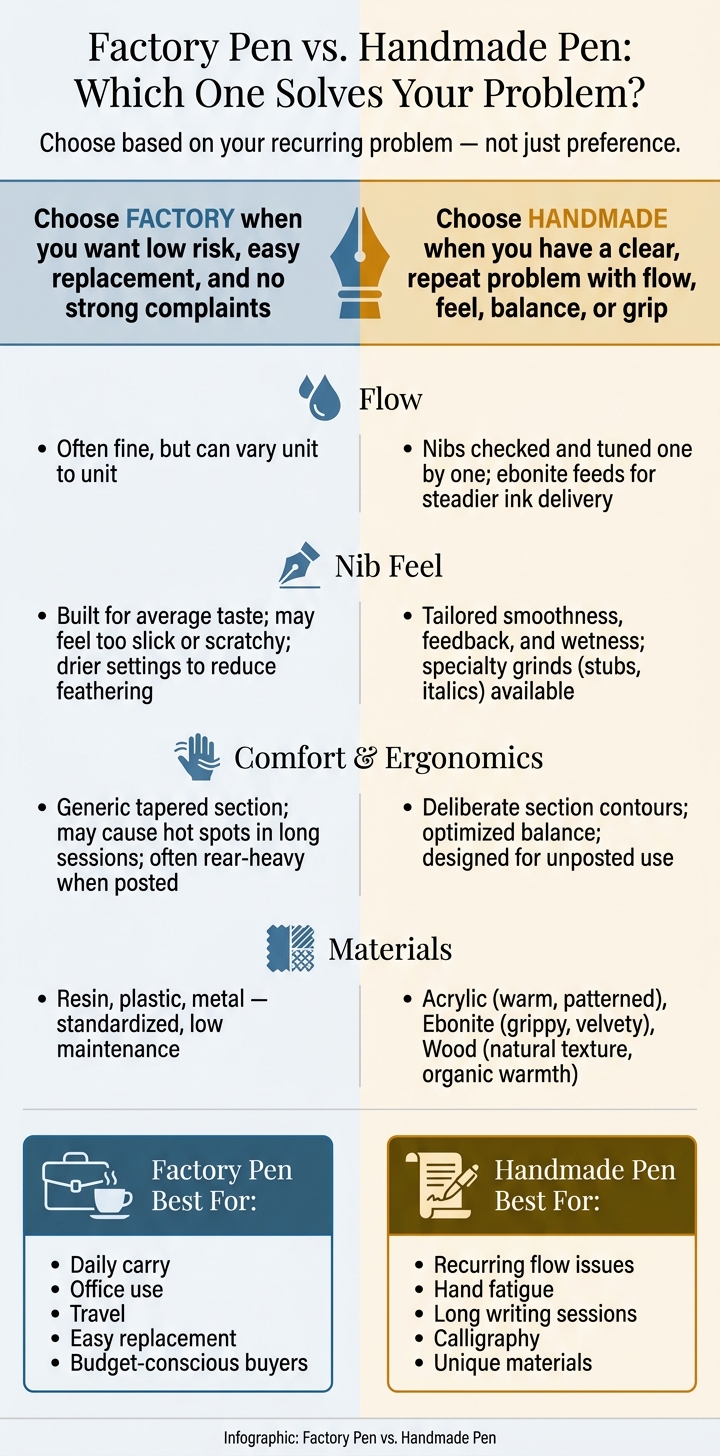
Factory Pen vs. Handmade Pen: Which One Solves Your Problem?
The Hypnotic Process of Handmade Crafting $5000 Fountain Pen
sbb-itb-1dd4fe9
Quick Comparison
| Area | Factory pen | Handmade pen |
|---|---|---|
| Flow | Often fine, but can vary unit to unit | More often checked and tuned one by one |
| Nib feel | Built for average taste | More control over smoothness, feedback, and wetness |
| Comfort | Generic grip and balance | More focus on section shape and hand feel |
| Materials | Resin, plastic, metal | More acrylic, ebonite, and wood options |
| Best for | Low cost, easy replacement, daily carry | Fixing repeat problems with fit and feel |
Bottom line: choose handmade when you have a clear, repeat problem with flow, feel, balance, or grip. Choose factory when you want low risk, easy replacement, and no strong complaints with your current pen. If you are still undecided, consult our fountain pen buying checklist.
Flow Problems: Dry Starts, Skipping, and Inconsistent Ink Delivery
A first-stroke miss doesn't always mean the pen is flawed. Start with the simple stuff: clean the pen and check nib alignment. If that doesn't fix it, then it's time to look at the pen's build.
When Cleaning and Nib Alignment Are Enough
Many new factory pens need a flush before they write the way they should. An unflushed new pen is a common cause of dry starts. Small bits of residue can be left behind in the feed or nib during manufacturing.
Dry starts also often come from dried ink at the nib, a cap that doesn't seal well, or an ink-and-paper pairing that just doesn't play nicely together. If the issue shows up after the pen has been sitting for a while, check the cap seal first and then try a different ink.
If cleaning and alignment don't solve the issue, the cause is probably in the pen's design.
How Handmade Pens Can Improve Flow by Design
Handmade pens are often inspected and tuned one at a time, which means the nib may already be adjusted before it gets to you. That kind of one-by-one tuning can make the difference between a pen that skips and one that writes the same way every time.
Some handmade pens also use ebonite feeds. These feeds can hold and move ink with more consistency.
Factory vs. Handmade for Flow Problems
| Problem | Common cause | First fix | Handmade advantage |
|---|---|---|---|
| Dry start on first stroke | Residue in the feed | Flush with plain water | Nib checked and adjusted before shipping |
| Skipping | Nib needs adjustment | Clean and align the nib | Individual nib alignment check |
| Dry start after sitting | Poor cap seal or dried ink | Check the cap seal; try ink that dries slowly | Better cap fit |
| Uneven ink flow | Dried or thickened ink in the feed | Thorough cleaning | Ebonite feed supports steadier ink flow |
If the same dry start keeps coming back, a handmade pen starts to look like a better answer than yet another cleaning cycle.
Nib Feel and Comfort: Where Handmade Pens Often Have an Edge
If you've already fixed ink flow, the next thing to check is nib feel. A pen can write with no skips and still feel off in your hand. That's not a flow issue. It's a feel issue.
Why Some Factory Nibs Feel Bland or Scratchy
Factory nibs are usually set up for average performance, not much personality. That can lead to two very different problems.
On smooth paper, a nib may feel almost too slick - glassy, slippery, and a bit detached from the page. On cheaper paper, that same nib can feel draggy or scratchy instead.
Fine and extra-fine factory nibs run into this more often because the smaller tipping makes tiny flaws easier to notice. Even slight misalignment or uneven polish at the contact point can change the feel. The nib may catch on upstrokes or seem sharp in one direction, even when ink flow and line width look normal.
There's another factor too: factory flow settings often lean drier to reduce feathering. Less ink between nib and paper means less lubrication, so roughness stands out more.
How Handmade Pens Improve Nib Character and Balance
Handmade nibs give the maker more control over the exact mix of smoothness, feedback, and wetness. That matters more than it sounds. A well-set nib can feel smooth in normal writing directions while still letting you feel the page a little. Think pencil-like feedback, not scratchiness.
Comfort also depends a lot on section shape and balance. Many factory pens use generic tapered sections, and those can lead to slipping or cramped finger placement during long writing sessions. Handmade makers often pay closer attention to how the fingers actually sit on the pen. You may see gentle flares near the nib, slight curves where the fingers rest, or a wider section that keeps you from pinching too hard.
That shape can lower finger pressure over time. And yes, material matters too. Ebonite, a hardened rubber used in many handmade pens, tends to develop a warm, slightly grippy surface. It doesn't get slick from perspiration as easily and can stay comfortable through long sessions. Very smooth plastic or metal sections often do the opposite - they make you squeeze harder, and your hand feels it later.
Factory vs. Handmade for Nib Feel and Ergonomics
The gap shows up pretty clearly side by side:
| Dimension | Factory pen | Handmade pen |
|---|---|---|
| Smoothness | Consistent, but tuned for broad appeal | Tailored - can be glassy, buttery, or lightly feedback-heavy |
| Feedback | Minimal to mild, often unintentional | Intentionally set by the maker or nib tuner |
| Line character | Uniform, round | Can include stubs, italics, and other specialty grinds |
| Section comfort | Generic taper; may cause hot spots in long sessions | More deliberate contours, often longer grip areas away from threads |
| Overall balance | Often rear-heavy when posted | Frequently optimized for unposted use with neutral or forward balance |
If you want to test wetter flow, different fountain pen nib sizes, or more feedback before stepping into a handmade pen, Fountain Pen Revolution offers lower-cost pens and replacement nibs for that kind of trial.
Material Choice and Design Variety Beyond Standard Factory Options
Factory pens usually stick to resin, plastic, or basic metal finishes because those materials are cheap and easy to produce at scale. That keeps costs down, but it also limits the range of feel and balance you can get. And that shows up fast when a pen feels too heavy, too slick, or just tiring after a while. If ink flow and nib feel are already where you want them, material is often the next thing to look at.
What Different Pen Materials Change in Daily Use
Material changes more than appearance. It affects how the pen feels the second you pick it up and how your hand feels after 20 minutes of writing, which is why improving your handwriting posture and grip matters.
Metal pens show the clearest trade-off. Aluminum versions can feel very light, while brass or copper versions of the same shape can feel much heavier. Metal also picks up and gives off temperature fast, so a pen sitting on a cool desk can feel cold at first touch. That may not matter for a quick note, but it can get old during longer writing sessions.
Acrylic is usually lighter and warms up in your hand fast. It’s also where handmade makers tend to have more fun with design. Swirled multi-color patterns, translucent layers, and depth effects from mica or swirl pigments are common in small-batch acrylic blanks and much less common in factory production.
Ebonite feels warm and slightly grippy. That makes it comfortable over longer writing sessions, especially if you don’t like slick sections. Wood has a similar warmth and a natural micro-texture that helps in the hand, though it needs a bit more care around moisture and temperature swings.
An Affordable Way to Try Handmade Materials
If you haven’t used acrylic or ebonite before, it’s hard to guess the feel from photos alone. Fountain Pen Revolution sells low-cost models and separate nibs, which makes it easier to test both body material and nib choice without spending much upfront.
Factory vs. Handmade for Materials and Aesthetics
The differences make more sense when you put them next to each other.
| Material | Feel | Weight | Grip | Variety | Care Needs |
|---|---|---|---|---|---|
| Resin (factory) | Neutral, slightly cool | Light | Average; can be slippery | Limited - standardized colors | Low |
| Metal | Cool to cold at first | Medium to heavy | Can be slippery if polished | Moderate - finishes vary | Low to moderate |
| Acrylic | Neutral to slightly warm | Light to medium | Decent; improves with contouring | Very high - swirls, translucent, patterned | Low |
| Ebonite | Warm, slightly velvety | Light to medium | Excellent; resists slipping | Moderate - classic rippled or solid | Moderate - avoid prolonged sun exposure |
| Wood | Warm, organic | Light to medium | Good natural micro-texture | High - unique grain per pen | Moderate - avoid soaking or heat |
If you want low-maintenance and steady factory quality, resin or metal can do the job. If you care more about grip, warmth in the hand, and a pen that doesn’t look like every other one on the desk, acrylic, ebonite, or wood are well worth a try.
Conclusion: When to Choose Handmade and When Factory Pens Still Win
After flow, feel, and materials, the choice comes down to your needs. Once those pieces are clear, the real question is simple: does your use case justify a handmade pen?
When Handmade Pens Make the Most Sense
Handmade makes sense when the problem is personal and keeps showing up. A handmade pen earns its spot when you have a clear, recurring frustration that basic fixes haven't solved.
That can include writers who notice small differences in nib feedback, feel hand fatigue after daily journaling, calligraphy, or long writing sessions, or want materials like ebonite or small-batch acrylic that just don't show up in standard factory lineups. If you want a lower-cost way in, Fountain Pen Revolution offers affordable pens and nibs for testing handmade materials.
When Factory Pens Are Still the Right Call
Factory pens win when simplicity, replaceability, and low risk matter more. If you don't have a recurring issue with flow, feel, or balance, a factory pen is still the better fit.
If a pen lives in a bag, gets passed around an office, or might get lost, a factory pen is usually the smarter pick because it's easier to replace. Factory pens already handle most everyday writing needs well, and if you've never felt discomfort from a pen's weight, grip, or nib, there's no practical reason to switch.
The final decision rule is straightforward:
- Choose handmade when you have a recurring, specific problem with flow, nib feel, balance, or materials that cleaning and basic adjustments haven't fixed.
- Choose factory when predictable, out-of-the-box performance, easy replacement, and low risk matter more than personalization.
FAQs
How do I know if my pen problem is the nib or the design?
Use a 5x–10x loupe to inspect the pen. It gives you a close look at what’s going on, and that matters because many nib problems are hard to spot with the naked eye.
Nib issues often show up as misaligned tines, uneven gaps, or damage like baby's bottom. You can sometimes feel that last one by lightly dragging the nib across your fingernail.
Design or assembly problems usually come down to the way the nib and feed line up. If there’s a gap between them, or the slit isn’t centered over the feed channel, that usually means the parts are physically out of line rather than the nib being the main problem.
Are handmade pens better for long writing sessions?
They can be, especially when the nib is tuned to match your grip, writing pressure, and angle. That kind of setup can make the pen feel smoother, improve ink flow, and cut down on scratchiness or skipping.
That said, a factory pen that writes well right out of the box can be just as good for long daily writing sessions. And in many cases, dry starts come down to maintenance more than the pen itself. Proper flushing and storage can help prevent them either way.
Which handmade pen material feels best in the hand?
For comfort, soft, textured cushioning like silicone rubber or foam usually feels best. It gives you a non-slip grip and compresses under pressure, which can help ease finger and hand strain during long writing sessions.
If you like a firmer, more controlled feel, hard plastic may be a better fit. Just note that it can pass more stress straight to your skin and joints.