

When choosing how to fill your fountain pen, you have two main options: cartridges and converters. Cartridges are pre-filled, disposable tubes that are quick and mess-free, making them great for convenience and travel. Converters, however, are refillable reservoirs that let you use bottled ink, offering more ink variety and long-term savings.
Here’s a quick breakdown:
- Cartridges: Easy to use, portable, and clean but limited in ink colors and less cost-effective over time.
- Converters: Allow access to a wide range of bottled inks and are reusable, but they require more effort to fill and maintain.
Quick Comparison:
| Feature | Cartridges | Converters |
|---|---|---|
| Ease of Use | High (pre-filled) | Moderate (manual filling) |
| Ink Options | Limited to manufacturer | Wide variety (bottled inks) |
| Cost Over Time | Higher | Lower |
| Portability | Excellent | Requires carrying ink bottle |
| Waste | Single-use (plastic waste) | Reusable |
Most modern pens support both systems, so you don’t have to pick just one. Use cartridges for quick, on-the-go refills and converters for experimenting with bottled inks at home. This flexibility lets you enjoy the best of both worlds.
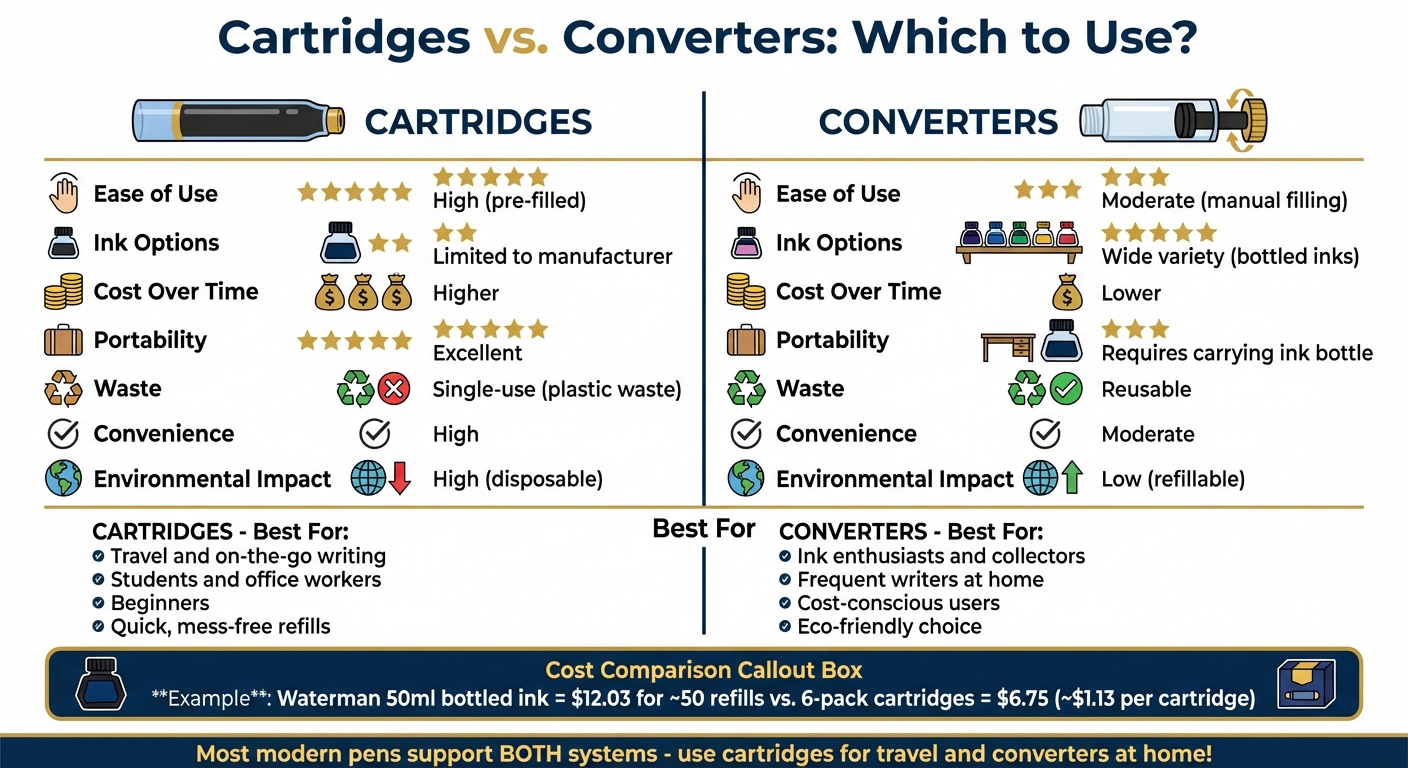
Fountain Pen Cartridges vs Converters Comparison Chart
Cartridge vs Converter: How to Choose Ink for Your Fountain Pen
sbb-itb-1dd4fe9
What Are Fountain Pen Cartridges?
Fountain pen cartridges are pre-filled, disposable ink tubes that make using a fountain pen incredibly straightforward. They’re designed to snap directly into place, offering a clean and hassle-free alternative to traditional ink bottles. To use one, simply push the cartridge into the pen’s grip section until you hear or feel a small "pop." That’s it - your pen is ready to write.
Once inserted, the pen’s feed punctures a small seal on the cartridge. Ink flows through the feed to the nib using capillary action. If the ink doesn’t start flowing right away, you can gently press on the cartridge over some scrap paper to get things going.
How Cartridges Work
Fountain pen cartridges come in two main types: Standard International and Proprietary.
- Standard International cartridges are compatible with multiple brands, including Kaweco, Pelikan, Waterman, and TWSBI.
- Proprietary cartridges, however, are brand-specific. Companies like Pilot, Lamy, Parker, Platinum, Sailor, and Montblanc design cartridges exclusively for their pens.
Even within the Standard International category, there are size variations. Short cartridges (about 1.5 inches) are ideal for compact pens like the Kaweco Sport, while long cartridges (around 2.9 inches) hold more ink but fit only full-sized pens. Some pens even allow you to store a spare cartridge inside the barrel, flipped the other way, so you’re never caught without ink.
Knowing how cartridges function helps you decide when they’re the most practical option.
When to Use Cartridges
Cartridges shine when convenience and portability are key. They’re especially handy for travel - air travel in particular - since they’re far less likely to leak under pressure changes compared to larger ink reservoirs. They’re also a favorite among students and office workers because swapping a cartridge is quick and mess-free, eliminating the need to carry around glass ink bottles.
As Mackenzie from Must Have Stationery explains:
Cartridges are the easiest way to ink your pen with the least fuss and mess.
For beginners, cartridges are a great way to enjoy the writing experience without dealing with the complexities of bottled ink and filling systems. However, they do have some drawbacks. You’re limited to the ink colors your pen manufacturer provides, and cartridges tend to cost more per milliliter compared to bottled ink.
Up next, we’ll take a look at fountain pen converters and how they stack up against cartridges.
What Are Fountain Pen Converters?
A fountain pen converter is a refillable ink reservoir designed to fit inside your pen, much like a cartridge. The main difference? Cartridges are pre-filled and disposable, while a converter allows you to refill your pen using bottled ink. This opens up a world of ink options far beyond the limited colors available in cartridge form.
As Ferris Wheel Press explains:
"Converters are small refillable devices that fit inside your fountain pen, replacing the cartridge. Instead of being pre-filled, you dip the nib into a bottle of ink and draw it up into the converter, almost like a tiny piston." – Ferris Wheel Press
The primary distinction lies in how you refill the pen. Cartridges are simple and quick - just pop one in, and you’re ready to go. Converters, on the other hand, use a mechanical system to pull ink from a bottle through the nib. This method gives you access to a vast range of bottled inks, including specialty formulations with shimmer, sheen, or other unique properties rarely found in cartridges.
How Converters Work
Converters function using different mechanisms to draw ink into their chamber. The most common type is the piston (or twist) converter. By twisting a knob at the end, an internal plunger creates a vacuum that pulls ink into the reservoir. Other types include squeeze converters, which use a flexible sac you compress and release, and push-button converters, which pump ink into the chamber with repeated presses.
Filling a converter takes a bit more care than swapping a cartridge. To avoid air bubbles, make sure the nib and breather hole are fully submerged in the ink bottle. For a complete fill, it’s often helpful to repeat the process two or three times. Afterward, expel a drop or two back into the bottle and gently pull the piston to create negative pressure, which helps prevent dripping.
Compatibility is another factor to consider. Converters come in both Standard International sizes - fitting many brands - and proprietary designs made for specific manufacturers like Lamy, Pilot, Platinum, Parker, and Sailor. Even if the fitting matches, check your pen’s barrel length; pocket-sized pens may require "mini" converters since standard ones might be too long.
When to Use Converters
Converters are perfect for those who enjoy variety and customization. They let you experiment with a wide range of bottled inks that aren’t available in cartridge form. For frequent writers, bottled ink can also be a cost-effective choice. For example, a 50 ml bottle of Waterman ink costs about $12.03 and provides roughly 50 refills. In contrast, a 6-pack of Monteverde cartridges costs around $6.75, or approximately $1.13 per cartridge.
Converters also offer a more sustainable option. Designed for long-term use, they help reduce the plastic waste associated with disposable cartridges. Many fountain pen enthusiasts appreciate the ritual of manually filling their pen, which adds a sense of tradition and satisfaction to the writing experience.
However, converters do come with some trade-offs. They require more maintenance, such as flushing with cold water when changing ink colors, and they’re less convenient for travel since you’ll need to carry an ink bottle. Additionally, converters generally hold slightly less ink than cartridges - on average, about 0.1 ml less. Despite these minor drawbacks, converters are an excellent choice for those who value flexibility and the tactile pleasure of a manual refill. This added versatility is something we’ll explore further in the upcoming pros and cons comparison.
Cartridges vs. Converters: Pros and Cons
Cartridges and converters each bring their own strengths and drawbacks, impacting convenience, cost, and environmental considerations. Let’s dive into how they stack up against each other.
Cartridges: Pros and Cons
Cartridges shine when it comes to ease of use and portability. Pre-filled and sealed, they’re ready to go right out of the box. This makes them a great option for travel, classrooms, or any situation where carrying an ink bottle isn’t practical. Plus, swapping them out is quick and mess-free, which is particularly appealing for beginners trying out fountain pens.
However, cartridges have their downsides. The range of ink colors is usually limited to what the pen manufacturer offers, which can feel restrictive. For instance, users of specific brands may need to seek out proprietary ink cartridges that only fit their specific models. Over time, they can become an expensive choice. Additionally, since cartridges are single-use, they contribute significantly to plastic waste, raising concerns about their environmental footprint.
| Feature | Cartridges |
|---|---|
| Convenience | High |
| Ink Variety | Limited |
| Environmental Impact | High (disposable) |
| Cost Over Time | Higher |
Now, let’s see how converters measure up in these key areas.
Converters: Pros and Cons
Converters provide the freedom to choose from almost any ink available, including specialty formulations that cartridges don’t offer. They’re also more economical in the long run. For example, a 50 ml bottle of Waterman ink costs about $12.03 and can yield around 50 refills - far more than the 10 to 12 cartridges you’d get for the same price. As Thomas, a verified user, put it:
One time use plastic is a deal killer for me. Converters open up a wider array of ink options.
Converters are reusable, making them a better choice for reducing waste.
That said, they do require more effort. Filling a converter from a bottle takes time and care to avoid spills, and you’ll need to clean it thoroughly when switching inks. Plus, converters typically hold less ink - between 0.6 ml and 1 ml - compared to the 1.45 ml capacity of a long international cartridge.
| Feature | Converters |
|---|---|
| Convenience | Moderate |
| Ink Variety | Unlimited |
| Environmental Impact | Low (refillable) |
| Cost Over Time | Lower |
These pros and cons highlight the trade-offs between convenience and customization, helping you decide which option fits your needs best.
Compatibility and Pen Specifications
Before buying cartridges or converters for your fountain pen, it’s crucial to confirm what works with your specific model. Many modern pens are classified as "Cartridge/Converter" (C/C) models, meaning they can handle both options. However, the specifics can vary depending on the pen.
Start by identifying whether your pen uses Standard International or Proprietary fittings. Standard International fittings are widely used across brands like Kaweco, Monteverde, and Visconti. In contrast, Proprietary fittings are unique to certain brands - LAMY, Pilot, Platinum, Sailor, and Parker all have their own designs that aren’t compatible with other manufacturers’ refills. As Cult Pens points out:
Sticking with one that matches the brand of your pen is the safest option, but if your pen uses standard 'international' cartridges, it's very likely to use a standard converter too.
Another factor to consider is the pen's physical size. Compact pens, such as the Kaweco Sport or Sailor Chalana, often lack the room for full-sized converters. These models typically require specialized "mini" or "slim" converters. There are even pens, like the Traveler's Company fountain pen, that only support cartridges and don’t offer a converter option.
Some brands add an extra layer of complexity. For example, Waterman and Faber-Castell accept Standard International cartridges but demand proprietary converters. Always check the packaging for compatibility details, especially with older or rare pens. In some cases, you can refill empty cartridges using a blunt-tip syringe, offering a workaround for hard-to-find refills.
These details highlight why understanding your pen’s specifications is key. Knowing what fits ensures you choose the right ink-filling system for your writing needs.
How to Choose Between Cartridges and Converters
When deciding between cartridges and converters, it comes down to four main factors: convenience, cost, environmental impact, and ink variety. Each of these plays a role depending on how and where you write.
If convenience is your top priority, cartridges are the way to go. They come pre-filled and are incredibly easy to swap out - perfect for people who are always on the move. Converters, on the other hand, require you to fill them manually by dipping the pen nib into an ink bottle, which takes a bit more time and care. However, cost paints a different picture. While cartridges are cheaper initially, bottled ink used with converters is far more economical in the long run. If you write often, a converter quickly pays off.
Environmental impact is another important consideration. Cartridges are single-use and contribute to plastic waste, while converters are reusable, making them a more eco-friendly choice. Then there's ink variety, where converters truly shine. With a converter, you can explore an almost endless array of bottled inks, including shimmering, vintage, and custom colors. Cartridges, however, limit you to the specific options provided by your pen’s manufacturer, and many brands use proprietary designs that narrow your choices even further.
Ultimately, your choice depends on your writing habits. If you’re commuting, traveling, or working in shared spaces, cartridges are practical and hassle-free. But if you enjoy experimenting with inks or tend to write for long stretches at home, converters offer greater flexibility and savings. Many writers find that using both systems works best.
Using Both Systems
The good news? You don’t have to choose just one. Most modern fountain pens are designed as "Cartridge/Converter" (C/C) systems, meaning they can use either option. Many people keep cartridges handy for travel or office use, then switch to a converter at home to enjoy bottled inks. This hybrid approach lets you balance convenience with variety.
Switching between the two is simple. Remove the current ink source and insert the new one. Just make sure to flush the nib and feed with pen flush or water before switching, especially if you’re changing ink colors. This prevents clogs and ensures your colors stay true. For an extra hack, you can even refill empty cartridges with bottled ink using a blunt-tip syringe. This gives you the capacity and secure fit of a cartridge while enjoying the cost savings and color range of bottled ink.
Conclusion
When it comes to choosing between converters and cartridges, there’s no universal answer - it’s about what works best for you. As Bottle and Plume puts it, "There isn’t a single 'best' filling system - just a best match for how you actually write". If you’re a student darting between classes or someone who’s always on the go, cartridges offer a quick, no-fuss solution. On the other hand, if you enjoy experimenting with a variety of inks or are mindful about reducing plastic waste, converters provide a more versatile and eco-friendly option.
The great thing about many modern fountain pens is that they don’t force you to pick just one. A lot of pens are compatible with both systems, giving you the flexibility to switch between cartridges for convenience and bottled inks for variety. This adaptability means your pen can fit seamlessly into your day-to-day life, whether you’re jotting down notes with a FPR Quickdraw at a café or journaling at home.
Curious to try both systems? Fountain Pen Revolution offers affordable pens that work with both cartridges and converters, along with a wide selection of inks and accessories. Whether you’re just starting out or adding to your collection, they’ve got everything you need to make your fountain pen experience truly your own.
FAQs
Can I refill a cartridge with bottled ink?
Yes, you can refill a fountain pen using bottled ink. To make this work, you'll need a converter, a small device that takes the place of a disposable cartridge. Converters typically use a piston or similar mechanism to draw ink directly from the bottle into your pen. This approach not only gives you access to a broader selection of ink colors and styles but also allows you to reuse the cartridge space, making it a more flexible and eco-friendly option.
Which cartridge or converter fits my pen?
When it comes to choosing a cartridge or converter for your pen, it all boils down to the brand and model. Compatibility isn't universal - some pens stick to proprietary systems, while others work with standard international sizes. To make sure you get the right fit, check your pen's specifications or refer to the manufacturer’s guidelines. If your pen uses the standard international size, you're in luck! There are plenty of third-party options available, giving you access to a broader selection of ink colors and often at a lower cost.
How do I clean my pen when switching inks?
To switch inks in your fountain pen, start by flushing it with cool, clean water until the water runs clear. You can do this by running water through the nib and converter or cartridge. If there’s any stubborn ink residue, a pen flush solution can be used to break it down. Just make sure to rinse thoroughly after using any cleaning solution to prevent it from affecting your new ink.