

When picking a limited edition pen, focus on these essentials:
-
Purpose & Budget:
- Decide if it's for daily use, collecting, or investment.
- Daily writers under $65 are practical, while collectible pens start at $700+.
- Budgets range widely: $13–$100 for beginners, $100–$500 for mid-range, and $500+ for high-end collectors.
-
Brand Reputation:
- Opt for brands with a strong history, like Montblanc or Montegrappa.
- Look for in-house production for better quality control and support.
-
Materials & Design:
- High-end pens use premium materials like gold, platinum, or Urushi lacquer.
- Comfort and writing performance are just as important as aesthetics.
-
Collectibility:
- Smaller production runs (e.g., 888 pieces) are more exclusive.
- Themes tied to history or culture often increase appeal and resale value.
-
Performance & Authenticity:
- Test the pen's writing quality before buying.
- Verify serial numbers, packaging, and materials to avoid counterfeits.
Limited edition pens combine artistry, functionality, and exclusivity. By considering your needs, budget, and preferences, you can find a pen that’s both a joy to use and a worthy addition to your collection.
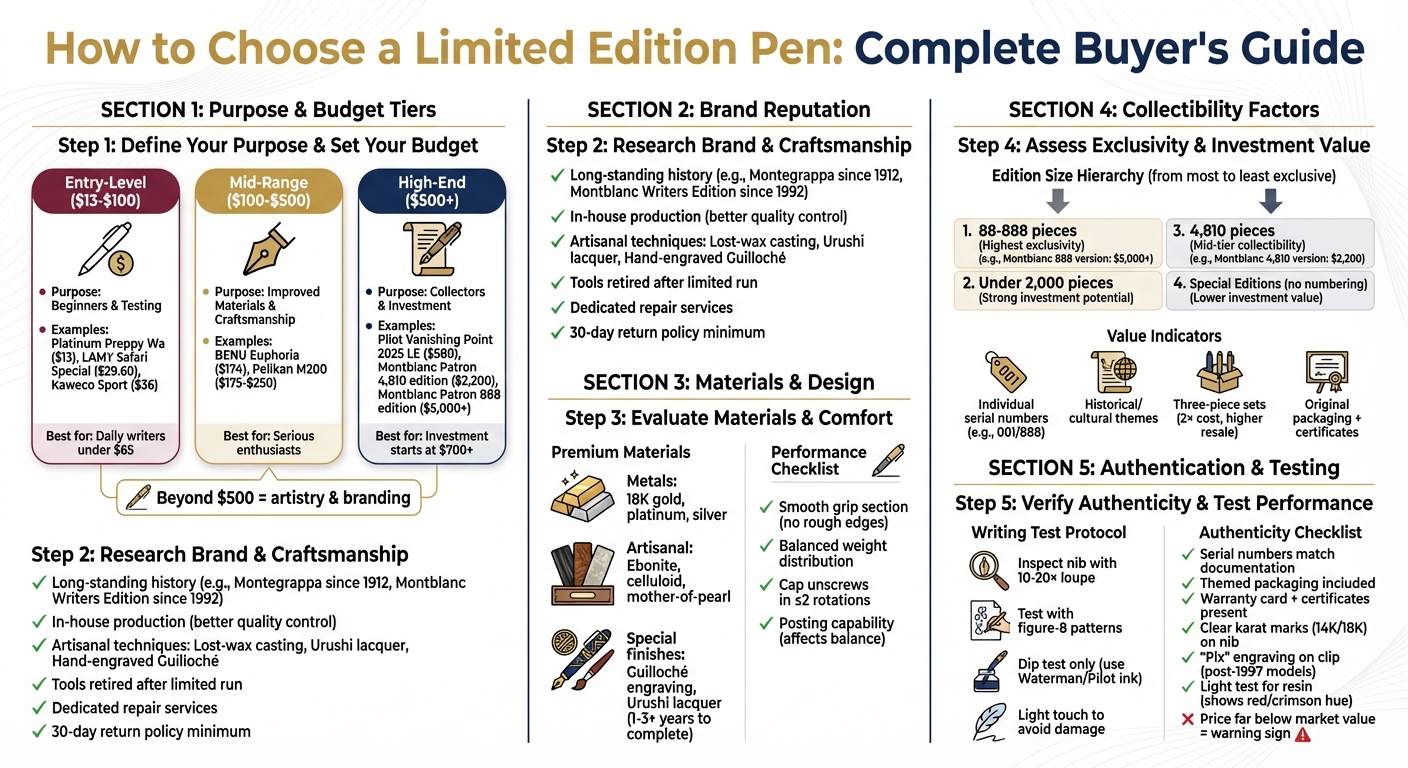
Limited Edition Pen Buying Guide: Budget Tiers and Key Features
Step 1: Determine Your Purpose and Budget
Identify Your Intended Use
Start by clarifying why you need a fountain pen. Your purpose will guide you toward the right features and price range. For everyday use, focus on reliability and comfort. A pen that writes smoothly and feels good in your hand will serve you far better than a rare collector’s item.
"I firmly believe that you don't need to spend more than $65, tops, to get a reliable fountain pen to use as a daily writer".
If collecting is your goal, look for pens with unique materials, special themes, or limited serial numbers. For those viewing pens as investments, seek out limited production runs, ideally under 2,000 pieces.
Once you’ve identified your purpose, the next step is setting a budget to narrow your options.
Set a Budget
Your intended use will naturally shape your budget. Limited edition pens span a wide range, from under $50 to well over $5,000. Entry-level pens ($13–$100) are perfect for beginners testing the waters. Examples include the Platinum Preppy Wa for $13, LAMY Safari special editions at $29.60, and the Kaweco Sport at $36. These options let you explore limited editions without breaking the bank.
For those seeking improved materials and craftsmanship, mid-range pens ($100–$500) are a great step up. Consider models like the BENU Euphoria at $174 or the Pelikan M200, which typically falls between $175 and $250.
High-end pens ($500+) cater to serious collectors and enthusiasts. For instance, the Pilot Vanishing Point 2025 Limited Edition costs $580. At the luxury end, Montblanc’s Patron of the Arts series starts at $2,200 for the 4,810-piece edition and goes beyond $5,000 for the exclusive 888-piece version.
"Once you get past this baseline price point [$500], in my opinion you are definitely paying for more than functional hardware... and get into more subjective forms of 'value' like artistry and branding".
Match your budget to your purpose. For daily use, there’s no need to go beyond $500. However, if you’re investing in pens, expect to start at $700 or more.
Step 2: Research Brand Reputation and History
Review Brand History and Craftsmanship
A brand's history often reflects the quality of its pens. Opt for manufacturers with a long-standing reputation for excellence. Take Montegrappa, for instance - it became Italy's first nib factory in 1912. Or Montblanc, which began its Writers Edition series in 1992, releasing annual tributes ever since. This kind of longevity shows a brand’s commitment to both consistency and the art of pen-making.
Pay close attention to whether a brand uses in-house production. When every component is made under one roof, quality control improves dramatically. Aurora, for example, manufactures everything in-house, from nibs to feeds, ensuring precision and making repairs or replacements more straightforward.
Another hallmark of craftsmanship is the use of artisanal techniques. These methods - like lost-wax casting, Urushi lacquer application, and hand-engraved Guilloché - highlight a brand's dedication to artistry. A standout example is Montegrappa’s "The Dragon" limited edition from 1995. Crafted using intricate lost-wax casting, the series included just 100 pieces made from 18-carat gold. Overseen by Giuseppe Aquila, this release set a new standard for collectors.
To ensure true exclusivity, verify that production tools are retired after a limited run. When combined with strong craftsmanship, this exclusivity is further reinforced by brands offering reliable support for their creations.
Check Customer Support
The level of customer support is just as critical as the pen’s craftsmanship. Limited edition pens often feature rare materials that require specialized care. Before purchasing, make sure the brand provides dedicated repair services. A damaged nib or a pen that doesn’t work can significantly lower its resale value.
Brands like Aurora, which produce nibs in-house, can offer authentic replacements and precise adjustments. This is especially crucial for pens from limited series, where production tools are no longer available. For example, in September 2024, Goldspot Pens photographed all 75 units of the SCRIBO Feel Cenote limited edition. Each pen, made from mottled ebonite, had a unique pattern. Customers could choose their exact serial number and design, reducing returns and ensuring satisfaction with the pen's one-of-a-kind material.
Lastly, confirm that the brand offers at least a 30-day return policy. Strong customer support protects your investment and ensures your limited edition pen stays in excellent working condition for years to come.
The Art of Pen Collecting: a Strategic Guide to Building Your Collection
Step 3: Evaluate Design and Materials
Once you've set a budget and explored a brand's reputation, it's time to dive into the pen's design and how it performs in your hand.
Assess Aesthetics and Materials
The materials used in a pen influence not only its appearance but also its durability and value. High-end pens often feature luxurious metals like 18-carat gold, platinum, or silver. For instance, Montegrappa's 88th-anniversary edition showcased 88 pens crafted from 18-carat gold, adorned with Art Deco-inspired designs. These metals bring both elegance and intrinsic worth.
For something more distinctive, artisanal materials like ebonite, celluloid, or mother-of-pearl offer a unique touch. Celluloid, in particular, requires years of curing to achieve its vibrant, stable finish. Similarly, acrylic resin and ebonite pens often display organic, one-of-a-kind color patterns, adding personality to the writing instrument.
Special finishes also play a significant role. Techniques like Guilloché engraving or traditional Urushi lacquer elevate a pen's visual appeal and craftsmanship. Urushi lacquer, for example, involves painstakingly applying multiple layers, each requiring weeks to cure. This intricate process can mean a single pen takes anywhere from a year to over three years to complete. These details not only enhance beauty but also add to the pen's overall value.
But a pen isn't just about looks. Its comfort and writing performance are just as important.
Check Comfort and Writing Performance
A pen's design should balance aesthetics with functionality, ensuring it writes as beautifully as it looks. Start by examining the grip section. Any rough edges or awkward transitions can make extended writing sessions uncomfortable. The pen's weight is another factor: lightweight resin reduces hand fatigue, while heavier materials like brass or metal provide a sense of balance.
"A pen is a tool we use for writing. While you might be falling in love with the amazing design, if the pen is cumbersome to use, it isn't serving its true purpose." - Inkjournal
Also, think about practical details like whether the pen can "post" (placing the cap on the back while writing). Posting changes the pen's weight distribution, which might affect your comfort. For everyday use, check that the cap unscrews smoothly and doesn't require more than two rotations. These small details can make a big difference in your overall writing experience.
sbb-itb-1dd4fe9
Step 4: Assess Collectibility and Exclusivity
Once you've evaluated the design and writing performance, the next step is to dive into what makes a pen collectible: its limited edition size, theme relevance, and potential long-term value.
Check Edition Size and Theme
The size of an edition strongly influences its exclusivity. Smaller production runs - like 88 or 888 pieces - are often aimed at serious collectors and tend to fetch higher prices and retain better long-term value compared to larger runs. For example, Montblanc's Patron of the Arts series offers two tiers: the "4810 version", limited to 4,810 pens (priced around $2,200), and the highly exclusive "888 version", capped at just 888 pens (starting at $5,000). The 888 version often features more luxurious materials and is considered a "Holy Grail" for dedicated collectors.
Look for pens with individual serial numbers (e.g., 001/888) engraved on the barrel or cap. These markers signify a true limited edition and are highly desirable for investment purposes. In contrast, pens labeled as "Special Editions" or "Donation Series" without individual numbering may lack the same potential for value appreciation.
The theme of a pen also adds to its allure. Pens that honor historical figures like Napoleon Bonaparte or Mahatma Gandhi - or those from well-known series like the Montblanc Writers Edition (introduced in 1992) - often have built-in collector appeal and a track record of maintaining value over time. Some brands even tie the edition size to a meaningful number, such as 1,924 pieces to commemorate a founding year or 4,810 pieces representing Mont Blanc's height.
If your budget permits, consider investing in three-piece sets, which typically include a fountain pen, a ballpoint pen, and a mechanical pencil. These sets are often produced in much smaller quantities than individual pens, making them even more attractive to collectors. While these sets generally cost about twice as much as a single fountain pen, they can offer stronger long-term collectibility and higher resale potential.
Assess Investment Value
Limited editions that sell out quickly often resurface on secondary markets like eBay, where they command premium prices.
To preserve a pen's resale value, condition is everything. Pens that are damaged or missing components lose their appeal to collectors. Keep certificates, original packaging, and store pens in a controlled environment to maintain their provenance and value.
"For collectors with investment in mind, research and documentation are essential tools."
- Yanning Li, Co-founder and CEO, Scriveiner London
Step 5: Test Writing Performance and Verify Authenticity
Before making your purchase, it’s crucial to evaluate how the pen performs and verify that it’s genuine. If you’re considering high-end limited editions - typically priced at $500 or more - you’re investing in more than just functionality; these pens are a blend of artistry and branding.
Test the Writing Experience
Start by examining the nib closely with a 10× to 20× magnifying loupe to ensure proper tine alignment. Then, simulate writing strokes in figure‑8 patterns to check for any scratchiness or gouging. Additionally, inspect the cap’s opening mechanism to ensure it operates smoothly without risking damage to the pen.
If the seller allows inking, opt for a dip test instead of fully filling the pen. Dip just the nib tip into a reliable ink like Waterman or Pilot/Namiki, as these inks are easy to clean and less likely to stain rare materials. Write words with descenders and ascenders or cursive letters to evaluate ink flow and smoothness. Use a light touch - applying too much pressure can damage the nib or scratch delicate finishes. Before testing, confirm the seller’s return policy, as some retailers provide a 30‑day return window even after the pen has been inked.
Once you’re satisfied with the writing performance, move on to verifying the pen’s authenticity.
Confirm Authenticity
Checking authenticity builds on earlier evaluations of brand reputation and craftsmanship. Start by ensuring the serial numbers match the accompanying documentation. Authentic limited editions often come in themed packaging, such as book-shaped cases for Writers Series pens or lacquered wooden boxes for Patron of the Arts editions. These should include an official warranty card and certificates that confirm authenticity and ethical sourcing, especially for pens made with precious materials.
If documentation is missing, inspect the nib under magnification for clear karat marks like 14K or 18K and smooth gold plating. Counterfeit pens often show uneven gold-colored paint. For models produced after 1997, look for the "Pix" engraving on the underside of the clip - this detail is frequently missing on fakes. For resin pens, perform a "light test" by holding the barrel up to a strong light source. Genuine resin appears black but reveals a deep red or crimson hue when backlit. Lastly, be cautious of pens priced far below their typical market value, as this is often a warning sign of counterfeiting.
"Modern tools like the Antique Identifier app can provide instant AI-powered identification, but understanding the fundamentals is essential for any serious collector."
- Antique Identifier Team, Expert Antique Appraisers & AI Specialists
Conclusion
When selecting a limited edition pen, start by determining whether you’re looking for a dependable daily writer or a collectible piece for investment. Establish a practical budget - typically, pens priced around $500 mark the divide between functional tools and those prized for their artistry and branding. From there, dive into researching brands, materials, and designs to guide your decision.
Exclusivity is a key factor to consider. Pens produced in smaller runs, such as an 888-piece edition, often carry greater value and appeal. Also, don’t overlook the importance of testing the pen’s performance and verifying its authenticity before committing to a purchase.
Ultimately, the real joy comes from owning a pen that feels personally meaningful. As The Gentleman Stationer points out, your preferences and criteria may shift as you gain more experience in the world of fine writing instruments. Appreciate the individuality of each piece you choose.
Limited edition pens are more than just writing tools - they are functional pieces of art meant to be admired and enjoyed. By balancing your budget, design preferences, collectibility, and authenticity, you can select a pen that brings lasting fulfillment. The growing emphasis on quality over quantity ensures that every addition to your collection holds real significance. A thoughtfully chosen pen doesn’t just write - it becomes a treasured part of your life.
"A limited-edition pen is not just owned. It is experienced, admired, and cherished."
FAQs
What should I look for when selecting a limited edition pen as an investment?
When choosing a limited edition pen as an investment, there are a few key elements to weigh. Start with the brand - well-established names with a reputation for quality and collectibility tend to retain their value more reliably.
Next, think about the pen's rarity. Pens from limited production runs or featuring exclusive designs often attract more interest from collectors. The design and craftsmanship also play a big role - details like intricate engravings or unique materials can make a pen stand out and potentially boost its future value.
Don't overlook the condition and provenance. Pens in pristine condition, especially those with a documented history, are usually more appealing to buyers. Lastly, keep tabs on market trends. Demand for certain themes or series can have a big influence on a pen's long-term value.
By considering these factors, you can select a pen that’s not only a pleasure to own but also a wise investment.
How can I make sure a limited edition pen is authentic?
When you're investing in a limited edition pen, ensuring it's genuine is crucial. Start by examining unique identifiers like serial numbers. These should align with the details provided on the box or the certificate of authenticity that comes with the pen. Many luxury brands also include distinct engravings or logos, so it's worth familiarizing yourself with these specific features for the brand you're considering.
Take a close look at the packaging quality as well. Authentic pens are typically presented in a well-designed box and often include a service guide and a guarantee certificate. Beyond the packaging, assess the pen itself - pay attention to its weight, threading, and overall craftsmanship. Genuine pens are known for their exceptional build quality, which sets them apart from imitations.
For extra assurance, make your purchase through authorized dealers or trusted retailers. This step significantly reduces the risk of ending up with a counterfeit product.
Why does brand reputation matter when choosing a limited edition pen?
When it comes to selecting a limited edition pen, brand reputation is everything. It’s a reflection of the pen's quality, authenticity, and craftsmanship, which are key factors for anyone seeking a standout writing instrument.
Well-established brands have built their names on attention to detail, the use of premium materials, and a dedication to creating designs that feel truly special. These qualities not only make the pen a joy to use but also boost its long-term appeal for collectors. A pen from a respected brand often holds its value better over time and might even become a sought-after piece in the future.
Another big plus? Opting for a reputable brand reduces the chances of running into counterfeit or poorly made products. This means you can buy with confidence, knowing you’re getting the real deal. Whether you’re a seasoned collector or just looking for something extraordinary, a trusted brand ensures your purchase is both rewarding and worthwhile.