

Using heat on celluloid pens can easily go wrong. These vintage pens, made from cellulose nitrate, are highly sensitive to temperatures as low as 120°F (49°C). Heat is often necessary for repairs, like loosening adhesives, but improper techniques can warp, discolor, or even ignite the material. Here's what to avoid and how to handle these pens safely:
- Avoid direct flames or uncontrolled heat sources. High-powered heat guns or open flames can cause irreversible damage or combustion.
- Keep heat within safe limits. Use tools like variable-temperature heat guns and monitor temperatures carefully.
- Inspect and clean the pen first. Residue, moisture, or degraded material can react poorly to heat.
- Protect delicate areas. Threads, imprints, and sections are especially vulnerable to warping or damage.
- Don’t attempt advanced repairs without proper tools. Complex fixes like reshaping barrels require precision and expertise.
Patience and controlled heat application are key. If you're unsure, consider practicing on low-value pens or consulting a professional.
Everything about Celluloid Fountain Pens (INFO)
Understanding Celluloid and Its Sensitivity to Heat
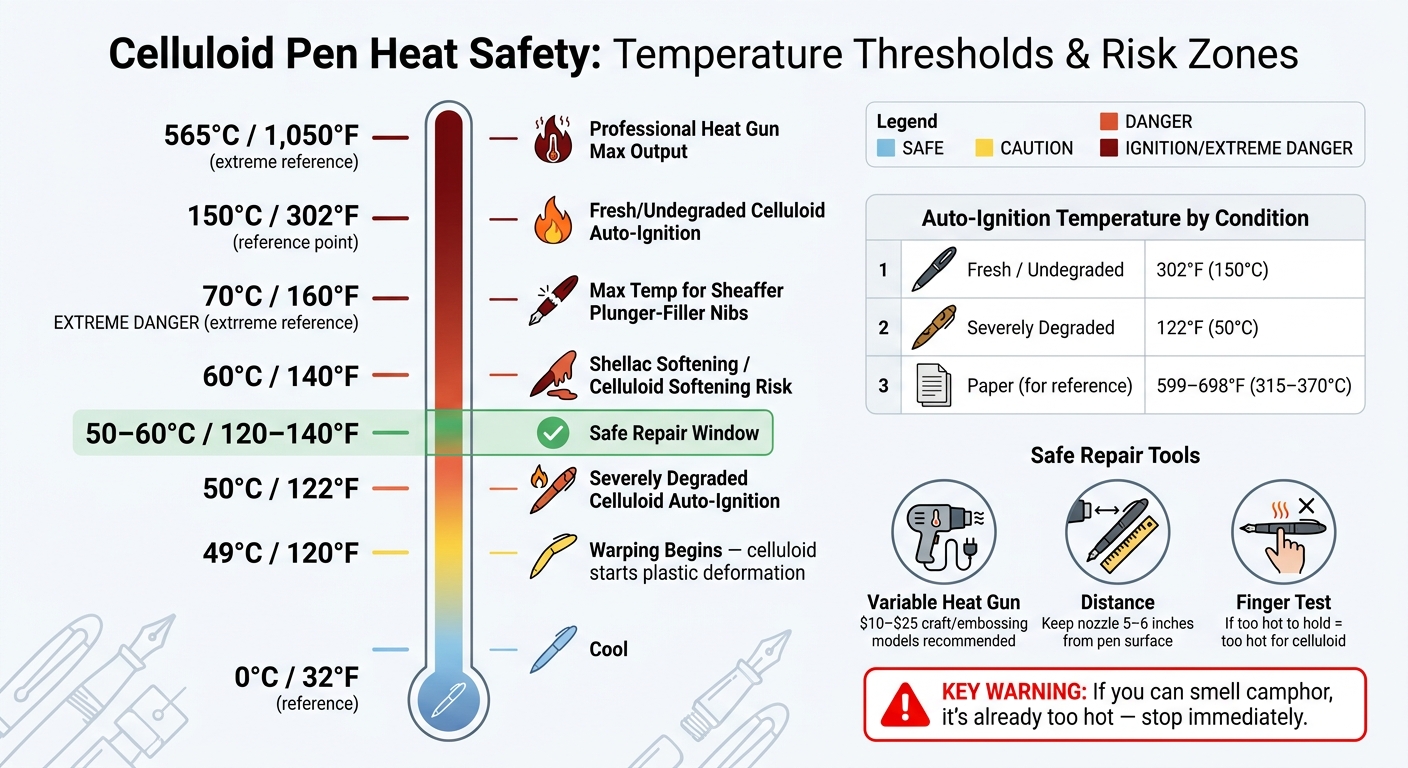
Celluloid Pen Heat Safety: Temperature Thresholds & Risk Zones
What Is Celluloid?
Celluloid is created by combining cellulose nitrate (nitrocellulose) with camphor, which serves as a plasticizer to keep the material flexible and easy to work with. This blend is what gave vintage pens their translucent colors and intricate patterns. However, it also makes celluloid chemically unstable.
Over time, camphor slowly evaporates, even at room temperature. Heat speeds up this process, leaving behind brittle and highly flammable cellulose nitrate. In its degraded state, celluloid can ignite at just 122°F (50°C), compared to 302°F (150°C) for fresh material.
A quick way to identify real celluloid is by rubbing it briskly with your thumb - it releases a distinctive camphor smell, which is medicinal and slightly earthy. In contrast, cellulose acetate (often mislabeled as "fake celluloid") gives off a vinegar-like odor.
Knowing these chemical properties is essential for safely applying heat during pen repairs.
Why Heat Is Used in Pen Repairs
Despite celluloid's sensitivity, heat is often necessary for repairing vintage pens. Many were assembled using shellac and rosin-based adhesives, which harden over time. Without heat, these adhesives are nearly impossible to loosen, and trying to force parts apart without softening them can crack delicate components like the barrel or section.
Heat also temporarily reduces brittleness in aged celluloid, making it safer to unscrew stuck parts. The key is to target the adhesive with heat while avoiding direct exposure to the celluloid itself.
Risks of Applying Heat Incorrectly
The tricky part? The margin for error is razor-thin. Celluloid begins to warp at temperatures lower than those required to soften shellac. For instance, heating beyond 140°F (60°C) risks softening the celluloid itself rather than just the adhesive. Certain repairs, like removing Sheaffer plunger-filler nibs, may require temperatures up to 160°F (70°C), which is dangerously close to this threshold.
Overheating doesn’t just warp the material - it can also cause chemical breakdowns like denitration, chain scission, and oxidation. These processes lead to yellowing and surface damage. Additionally, heating celluloid releases nitrogen oxide gases, which are both toxic and corrosive to metal components. Always ensure proper ventilation when working with heat.
"If you can smell the celluloid, it's too hot. If the celluloid starts to feel soft, it's too hot." - Ray-Vigo, Forum Contributor
The table below highlights how the auto-ignition temperature of celluloid decreases as it degrades, emphasizing the importance of careful handling, especially with older pens:
| Celluloid Condition | Auto-Ignition Temperature |
|---|---|
| Fresh / Undegraded | 302°F (150°C) |
| Severely Degraded | 122°F (50°C) |
| Paper (for comparison) | 599°F–698°F (315°C–370°C) |
Mistake 1: Using Direct Flame or Uncontrolled Heat Sources
Unsafe Heat Methods to Avoid
Steer clear of open flames like lighters, candles, or alcohol lamps, as well as high-powered heat guns set to their maximum output. These methods lack precise temperature control and can easily damage delicate pen details. For context, professional-grade heat guns can reach temperatures as high as 1,050°F (565°C) - on par with a blowtorch! That’s far beyond the safe range of 120–140°F (50–60°C) typically required for pen repairs. This highlights why controlled heat is absolutely essential for working with celluloid pens. As Penultimate Dave puts it:
"There is no reason to use open flame if you have a heat gun." - Penultimate Dave
Using uncontrolled heat doesn’t just risk combustion - it also permanently damages the pen.
Damage Caused by Direct Heat
Direct heat can do more than just warp the material - it can ignite celluloid almost instantly. Made from plasticized cellulose nitrate, celluloid is a material historically associated with low-yield explosives. A single exposure to an open flame can cause it to combust without warning.
Even if combustion doesn’t occur, the damage is often irreversible. Uncontrolled heat can obliterate manufacturer imprints, dull decorative edges, create puckering at barrel seams, and leave scorch marks that can’t be polished away. Warping can start at temperatures as low as 120°F (49°C).
"Don't use an open flame, especially if you are working on a vintage celluloid pen 'Poof'." - Paul-H, Senior Member, FPGeeks
The risks far outweigh the convenience of using direct heat, making safer methods a must.
Safer Heat Application Methods
For controlled heat, a variable-temperature heat gun is your best option. Look for models that allow adjustments in small increments, ideally no more than 25°F (about 14°C). Hobbyists might find craft embossing guns - brands like Martha Stewart or Zap - both affordable and effective, often priced between $10 and $25.
When using a heat gun, keep the nozzle 5 to 6 inches away from the pen’s surface. Rotate the barrel continuously to ensure even heat distribution, and work in short bursts rather than prolonged exposure. A simple guideline: if the pen becomes too hot to hold comfortably with bare fingers, it’s already too hot for the celluloid.
"If the part is so hot your fingers recoil from the heat, it is too hot. Better to have to use lower heat and do it longer than too much and have to look for a new barrel because the old one melted off." - Brian Anderson, Pen Expert
Mistake 2: Overheating Threads, Sections, and Imprint Areas
Areas Most at Risk from Overheating
When working with pens, certain areas are especially prone to damage from heat. Threads, grip sections, and decorative imprints are particularly vulnerable. Threads are critical for maintaining a proper seal, while grip sections often lack structural support. Decorative imprints, being cosmetic, are irreplaceable if damaged. Any harm to these areas can compromise both the pen's functionality and its aesthetic appeal.
What Happens When You Overheat These Areas
Celluloid, a common material in vintage pens, can deform permanently at temperatures as low as 120°F (49°C). Overheating threads can soften them, leading to distortion or even stripping when pressure is applied during disassembly. Grip sections, if heated without internal support like a feed or mandrel, may collapse inward.
Decorative details are even more delicate. As Penultimate Dave, a pen repair expert, explains:
"Heat of a flame can quickly erase imprints and chasing, round sharp edges, and leave permanent scorch marks."
Additionally, excessive heat can cause celluloid to shrink, which might result in a barrel that no longer aligns with its section. To avoid these issues, careful heat application is critical.
How to Reduce Heat Damage in These Areas
A simple yet effective way to protect these sensitive areas is by masking. Wrapping imprint areas or decorative details with a small piece of leather can shield them from direct heat while still allowing the joint to warm up.
Pair masking with constant rotation to ensure no single spot overheats. Use short bursts of heat and aim the airflow at the joint rather than the surface. A heat gun with a narrow nozzle can provide better precision. Finally, stay alert for a faint camphor smell, which indicates the celluloid is nearing its breaking point - if you notice this, stop immediately.
sbb-itb-1dd4fe9
Mistake 3: Applying Heat to Dirty or Degraded Pens
Why You Should Inspect the Pen Before Applying Heat
Before using a heat gun, it’s crucial to inspect your pen carefully. Leftover moisture, ink, solvent traces, or signs of material wear can ruin your repair instantly.
Start by checking for crazing or crystallization - these are visible surface defects that indicate the celluloid is already degrading and highly unstable. Also, find out if the pen was recently cleaned with solvents like naphtha. Pen repair expert Richard Binder emphasizes the importance of understanding your pen’s material:
"Knowing that this pen's barrel is celluloid gives me a valuable guide to the amount of heat I can use to remove the section (less than for Lucite) and also what cleaners or solvents I can use in its restoration (not alcohol)."
Avoid using household cleaners like Windex or Formula 409. These products contain chemicals that can harm vintage plastics, even before heat is applied.
What Can Go Wrong When Heating a Compromised Pen
Heating a pen that hasn’t been properly inspected or cleaned can lead to more than just cosmetic issues. Trapped moisture can cause uneven heating, leading to blistering. If there’s any residue from ammonia or alcohol, heat can soften the celluloid or leave permanent stains.
Metallic celluloids - those with bronze or gold flake finishes - are especially delicate. Heat combined with moisture or ammonia can leave them with a chalky, opaque appearance. If naphtha was used recently and hasn’t fully evaporated, applying heat can even result in a fire hazard. Celluloid is naturally flammable, and degraded material only increases the risk of a phenomenon collectors call "pen flambe".
Proper cleaning and drying are essential to avoid these dangers.
How to Clean and Dry a Pen Before Heat Repairs
When cleaning a pen, always use cool water. Warm or hot water can cloud or discolor the celluloid. For tougher ink stains, use a diluted ammonia solution (1 tablespoon of ammonia in 2/3 cup of water), but rinse thoroughly afterward. Only submerge the stuck joint - keep the nib facing down to protect metal springs.
Never use alcohol; it’s harmful to celluloid.
Once cleaned, make sure the pen is completely dry before applying heat. Recapping a damp pen can trap acidic gases, accelerating material breakdown. If you notice crazing or crystallization on the celluloid, skip heat repairs altogether. Degraded celluloid is far more likely to catch fire or crack under heat.
Mistake 4: Ignoring Temperature Control
Common Temperature Management Errors
One frequent oversight in celluloid pen repair is neglecting to monitor the heat applied during the process. For example, using a heat gun before its airflow stabilizes can lead to uneven heating - always wait 10–30 seconds before use. Another issue arises with heat guns that only have two or three fixed settings. The lowest setting often lacks the power to loosen a stuck section, tempting users to jump to a higher setting, which can be too intense for delicate celluloid. Additionally, keeping the pen stationary under heat can cause localized overheating, leading to irreversible damage. These missteps not only complicate the repair but can also permanently harm the pen's material.
What Poor Temperature Control Does to Celluloid
Mismanaging heat can have severe consequences for celluloid pens. Celluloid starts to warp at just 120°F (49°C). Pelikan has explicitly highlighted this risk:
"50°C is where the celluloid can start plastic deformation (not going to go back to where it was)." - Jeph, quoting Pelikan
Excessive heat doesn’t just cause warping; it can also lead to stress cracks, surface distortions, and the loss of plasticizers - compounds that keep celluloid flexible. Once these plasticizers burn off, the material becomes brittle over time, even if the damage isn’t immediately visible. A telltale sign of overheating is a camphor-like or medicinal smell during heating, signaling that the celluloid is being compromised.
Tools for Accurate Heat Application
To safely repair celluloid pens, the temperature must stay between 120°F and 140°F (50°C–60°C). Achieving this level of precision requires the right tools.
- Variable Heat Guns: Look for models with fine temperature adjustments, ideally with increments no larger than 25°F (about 14°C). These provide the control necessary for delicate repairs.
- Craft or Embossing Heat Guns: These cost between $10 and $27 and are popular among restorers because they operate at lower wattages compared to industrial heat guns.
- Infrared Thermometers: These can monitor surface temperature without direct contact, though some restorers find them less reliable for the small surfaces of pens.
A simple "finger test" can also help ensure the pen's surface is cool enough to handle. If you can’t comfortably hold the pen, it’s too hot - pull the heat source away immediately. And if a joint remains stubborn after careful attempts, resist the urge to increase the heat. Instead, set the pen aside and try again later.
Mistake 5: Attempting Advanced Heat Repairs Without the Right Tools
High-Risk DIY Repair Attempts
While controlled heat can be useful for pen repairs, the right tools are absolutely essential to avoid damaging your pen. Advanced repairs, in particular, require precision and expertise, and attempting them without the proper setup can lead to disaster.
Take, for example, the challenge of straightening a warped barrel. It might seem simple, but without a snug internal mandrel to support the softened celluloid, the material can ripple, buckle, or even collapse. Pen restorer Penultimate Dave warns:
"Getting a bent pen straight is a lot harder than it looks."
Similarly, removing a nib or feed without the correct tools can result in split sections, cracked nibs, or damaged feeds - especially in pens with delicate components like breather tubes.
Damage Caused by Improvised Repairs
Using makeshift tools or applying heat without precision often leads to irreversible damage. For instance, reshaping a pen without proper support can cause ripples or puckering along seams. Overheating during an unskilled repair can shrink sections, locking internal components in place instead of freeing them.
Another serious risk is the flammability of celluloid. Uncontrolled heat can ignite it in seconds, creating what restorers grimly refer to as "pen flambé". This isn’t just a theoretical hazard - it’s a very real danger of attempting advanced repairs without the right equipment or knowledge.
Knowing the Limits of Safe DIY Repairs
If a pen holds high sentimental or monetary value, has a complex filling system like a vacuum or piston filler, or requires tools that cost more than professional repairs, it’s a clear sign that the job is best left to an experienced restorer. Mat, of Mat's Pens, sums it up well:
"Believe me - I've gotten more hesitant to work on pens with experience, not the other way around."
For beginners, it’s wise to practice on inexpensive "junk" pens, such as old Wearevers or other low-value models, where mistakes won’t be costly. Start with simple tasks, like loosening a stuck section, and avoid anything that involves reshaping, repairing structural cracks, or working with complex mechanisms. These advanced repairs are better suited to professionals who have the tools and expertise to handle them.
Conclusion: Keeping Your Celluloid Pens Safe from Heat Damage
Celluloid is a stunning yet delicate material, with a heat tolerance that tops out at just 120°F (49°C). That leaves very little room for error, and many mishaps occur simply because people underestimate how sensitive it is to heat.
The good news? Protecting your celluloid pens doesn’t have to be complicated - or expensive. Pen expert Brian Anderson puts it best:
"If the part is so hot your fingers recoil from the heat, it is too hot. Better to have to use lower heat and do it longer than too much and have to look for a new barrel because the old one melted off."
Daily care goes a long way in preventing damage. Store your pens in a cool, stable environment, away from direct sunlight or heat sources. Also, avoid sealing them in airtight containers, as trapped moisture and acidic gases can speed up degradation.
If repairs are necessary, patience is your best ally. SFKenk wisely advises, "If you're in a hurry, find something else to do". Use low heat, keep the tool moving, and pause if the pen feels too warm to the touch. Rushing the process can lead to irreversible damage.
For those looking to expand their collection, starting with durable and affordable options can be a smart move. Brands like Fountain Pen Revolution (https://fprevolutionusa.com) offer reliable pens that are perfect for beginners and enthusiasts alike. These are great stepping stones before diving into vintage celluloid pieces, which require more attentive care.
FAQs
What heat source is safest for celluloid pen repairs?
A professional heat gun with infinitely adjustable temperature controls is your best bet for safely working with delicate celluloid pens. These controls let you fine-tune the temperature to low levels, reducing the risk of damage.
When using the heat gun, make sure to rotate the pen continuously. This ensures even heating and prevents the formation of hotspots that could harm the material.
A simple guideline to follow: if the pen becomes too hot to hold comfortably, it’s likely overheated and at risk of damage. Always prioritize caution to protect the pen’s integrity.
How can I tell if my pen’s celluloid is too degraded to heat?
When examining the pen, look for any signs of advanced wear, like cracks, crumbling, or chipped areas. These are clear indicators that the celluloid material has become fragile, making it unsuitable for any heat-based repair methods. Applying heat in such cases can cause permanent damage. If you notice these issues, avoid using heat altogether and handle the pen very carefully, as older celluloid is highly sensitive and can deteriorate further under stress.
When should I stop DIY and send a celluloid pen to a pro?
If you're dealing with structural problems, jammed mechanisms, or significant damage, it's time to stop attempting DIY repairs. For instance, if using gentle, indirect heat to free a stuck section doesn't work after three tries, it's best to stop. Continuing could cause more harm. In such cases, it's smarter to consult a professional. Complex issues require expert handling to avoid making the situation worse or leading to expensive repairs down the line.