

Flex nibs transform handwriting by creating striking line variations through pressure. These nibs feature longer, thinner tines that spread apart when pressed, increasing ink flow for bold strokes, then snap back for fine lines when pressure is released. This dynamic range adds depth and personality to writing, making styles like Copperplate and Spencerian possible. Key factors include nib design, material (e.g., 14K gold or steel), and proper technique like controlled pressure and slower writing speeds. Regular cleaning and avoiding overflexing are essential for maintaining performance. Flex nibs offer an expressive way to elevate your writing experience.
How Flex Nibs Work
The Mechanics Behind Flex Nibs
When you press down on a flex nib, its tines spread apart, creating a wider gap. This allows more ink to flow through, resulting in a broader stroke. As soon as you release the pressure, the tines snap back together, reducing the ink flow and producing a fine, hairline stroke. This quick return, often called "spring back", is what sets a true flex nib apart from one that simply bends.
This behavior is technically known as elastic deflection. Essentially, the tines temporarily deform under pressure but return to their original shape once the force is gone. Engineer Amadeus W. explains it well:
"The vertical component of that force moves the tines apart, hence, the written line, the trace of ink on paper widens or narrows in response to this force."
Every nib has a preload, which is the tension that keeps the tines together when at rest. Flex nibs are designed with a lower preload, so even light pressure spreads the tines. In contrast, rigid nibs have a higher preload, meaning they resist spreading and show minimal line variation regardless of pressure.
Ink flow is another crucial factor. As the tines spread, the feed must supply more ink to fill the gap. If the feed can't keep up, you might experience "railroading", where two thin parallel lines appear instead of one bold stroke. Writing slower can help avoid this issue.
These mechanical features are all tied to the nib's specific anatomy, which plays a big role in its flexibility.
Nib Anatomy and Its Role in Flexibility
The flexibility of a nib comes down to its design. Flex nibs have longer, thinner tines compared to standard nibs, which allows for greater movement. Danny Watts explains this relationship:
"As the bending length (L) increases, the impact on the deflection (distance and ability to bend) of the tines significantly increases, cubed actually."
In simpler terms, the longer the tines, the more they can flex - and this effect grows exponentially. The slit between the tines acts like a hinge, and a longer slit enables more flexibility. At the same time, the breather hole at the top of the slit does double duty: it helps maintain consistent ink flow by equalizing air pressure and also reduces stress on the metal to prevent cracking from repeated use.
The shoulders of the nib - the curved sides - also matter. Narrow, sloping shoulders let the tines spread easily, while wider shoulders make the nib stiffer. The cross-sectional shape is another key factor. A semicircular (arched) cross-section allows the tines to separate effectively, creating true line variation. On the other hand, a flat cross-section causes the tines to lift together, limiting flexibility.
| Component | Role in Flexibility |
|---|---|
| Tines | Spread apart to create a broader ink line |
| Slit | Determines how far the tines can flex |
| Breather Hole | Maintains ink flow and prevents metal fatigue |
| Shoulders | Narrow shoulders enhance flexibility; wide ones restrict it |
| Cross-Section | Arched shapes enable tine separation; flat shapes do not |
The material used for the nib also plays a significant role in its performance, as we’ll see next.
How Nib Materials Affect Flex
The material of a flex nib is just as important as its design. Traditionally, 14K gold has been the go-to choice for flex nibs because it strikes a great balance between softness and spring back. Nib expert Richard Binder puts it this way:
"The best results are usually obtained with 14K nibs, as most 18K nib alloys are either too soft or too stiff to respond well."
While 18K gold might sound more luxurious, it often lacks the ideal balance. It can either be too soft, causing it to deform permanently, or too stiff, making it less responsive to light pressure.
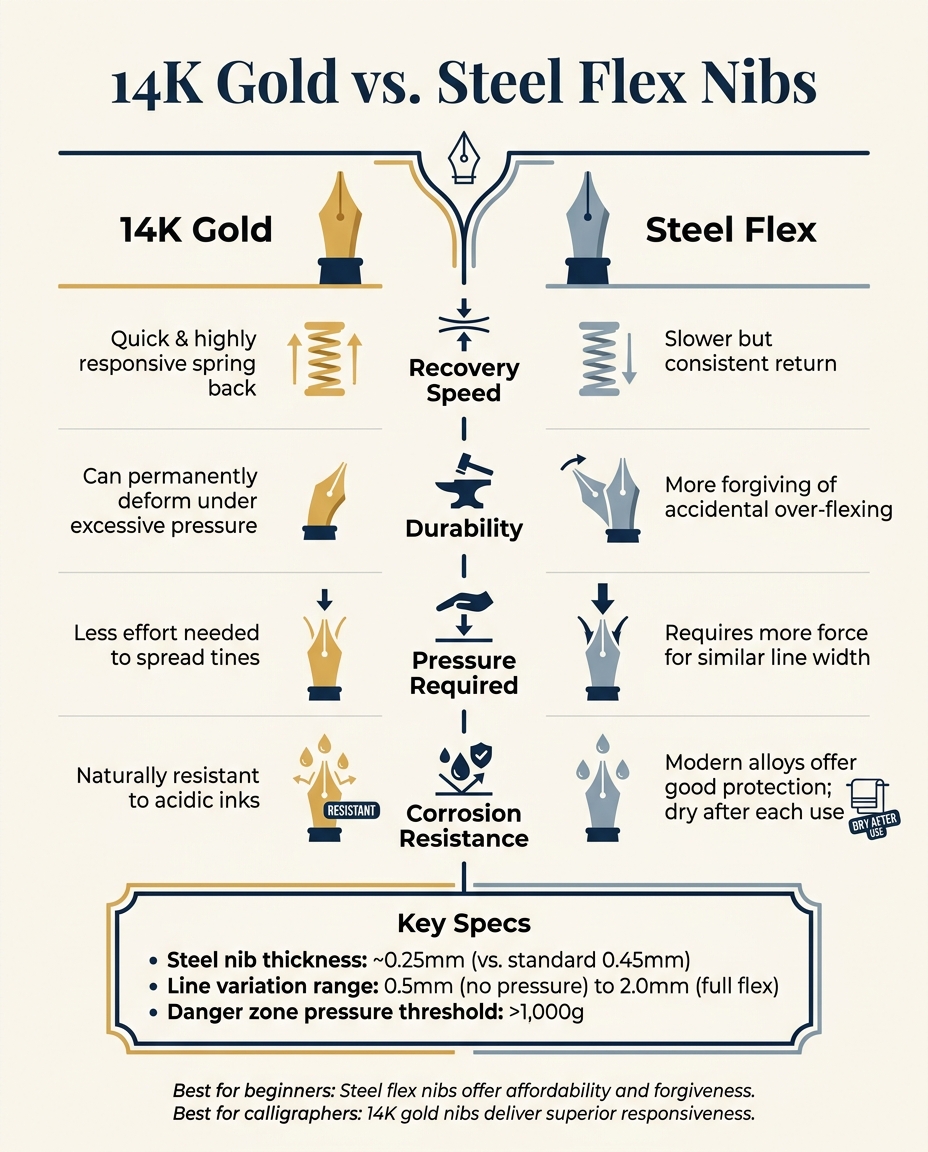
Steel flex nibs, on the other hand, are typically thinned down to about 0.25 mm - almost half the thickness of a standard steel nib at 0.45 mm. This thinner design makes them more flexible. Steel nibs are also more forgiving if you accidentally press too hard, though they generally require more force to spread the tines compared to gold. Their spring back, while decent, may feel slightly less sharp.
| Feature | 14K Gold | Steel |
|---|---|---|
| Recovery Speed | Quick and responsive | Slower but consistent |
| Durability | Can deform under excessive pressure | Better at handling over-flexing |
| Pressure Required | Less effort needed | Requires more force for similar results |
| Corrosion Resistance | Naturally resistant to acidic inks | Modern alloys provide good protection |
The combination of design and material is what makes flex nibs a favorite among calligraphers and pen enthusiasts alike. Each element works together to deliver the smooth, expressive writing experience that flex nibs are known for.
Line Variation VS True Flex Nibs
Using Flex Nibs for Controlled Line Variation
14K Gold vs Steel Flex Nibs: Key Differences at a Glance
How to Control Pressure for Line Variation
Line variation with a flex nib hinges on how much pressure you apply and when. Using light pressure keeps the tines close together, producing thin, hairline strokes. As you gradually increase downward pressure, the tines spread apart, creating a thicker line. Richard Binder, a well-known nib specialist, explains it this way:
"Downward vertical strokes... begin narrow, grow broader as pressure is applied during the stroke, and then tail off, growing thinner as pressure is released toward the end of the stroke."
This technique - starting thin, widening with pressure, and tapering back to a fine line - forms the basis of controlled flex writing. Modern flex nibs, such as those offered by Fountain Pen Revolution, can create lines ranging from 0.5mm with no pressure to as wide as 2mm when fully flexed. Achieving this range consistently takes time and deliberate practice.
A key rule to remember: never apply pressure on upstrokes. When the tines are spread, their sharp tips can catch the paper, potentially causing ink splatters or damage to the nib. Save the pressure for downward strokes only.
Beyond pressure, factors like writing speed and angle also play a big role in achieving clean, consistent line variation.
Writing Angle and Speed
While pressure determines the line thickness, your writing speed and pen angle ensure smooth ink flow. Speed can be a challenge for beginners. Writing too quickly doesn’t give the feed enough time to deliver ink, which can cause "railroading" - those annoying double lines where the ink flow breaks. As Tom Gidden notes:
"If your flex nib isn't keeping up with flow, it might just be because you're writing too fast. Slow down, and it might catch up."
In formal calligraphy styles like Copperplate or Spencerian, each letter can take 2 to 3 seconds to complete. While this slower pace may feel unnatural at first, it’s essential for allowing the feed to supply the extra ink needed for flexed strokes.
Pen angle is equally important. For consistent ink flow and even line variation, the nib must sit at the correct angle so both tines make even contact with the paper. If the pen tilts too much to one side, one tine may bear more pressure than the other, leading to uneven and unpredictable results.
Matching Flex Nib Use to Your Writing Style
Once you’ve mastered pressure, speed, and angle, choosing the right flex nib for your style can make all the difference. Scripts like Copperplate and Spencerian were designed with flex nib mechanics in mind. Their bold downstrokes and delicate upstrokes align perfectly with how a flex nib responds to pressure. With practice, these styles will feel intuitive as you build muscle memory and slow your writing pace.
For everyday handwriting or journaling, a semi-flex nib is often a better choice. It provides subtle line variation without requiring the slow, deliberate movements of full flex calligraphy. Using an ultra-flexible "wet noodle" nib for casual writing can lead to inconsistent strokes and ink flow issues. As Amadeus W. aptly puts it, "A flex‑nib must be designed like one, to be one". In other words, your technique should match the nib’s capabilities.
If your work involves larger letterforms or decorative flourishes, you’ll naturally apply more pressure over longer strokes, giving the feed more time to keep up. On the other hand, smaller, tightly spaced letters demand quicker transitions between pressure and release, which can be harder to control. Starting with larger strokes during practice sessions can help you develop the precision and hand control needed for smaller, detailed scripts.
sbb-itb-1dd4fe9
Caring for Your Flex Nib
How to Avoid Overflexing
Flex nibs are delicate and have a limit to how much pressure they can handle. Pushing beyond this limit can cause permanent damage to the tines. As nib expert Richard Binder puts it:
"The tines of a flex nib curve upward and spread as pressure is applied during writing; the more pressure applied, the broader the nib slit becomes - up to the nib's flexibility limit, beyond which point damage occurs; the tines crease upward near the breather hole, and the nib is said to have been 'sprung.'" - Richard Binder, Nib Specialist
A sprung nib loses its ability to return to its original position, which means it can no longer create those fine, hairline strokes flex nibs are famous for. Imagine three zones when using your flex nib: safe (green), caution (yellow), and danger (red). Applying pressure beyond 1,000g pushes you into the danger zone, causing permanent misalignment where the tines remain apart, even when at rest.
To avoid this, check after each stroke to ensure the tines return to a closed position. If you notice a gap when the nib is at rest, ease up on the pressure immediately. This gap indicates a loss of preload - the gentle tension that keeps the tines together for proper ink flow - and signals overflexing.
Proper tine alignment is also critical. Regular cleaning can prevent issues like ink buildup, which sometimes mimics the effects of overflexing.
Cleaning and Routine Maintenance
Dried ink is a common culprit behind poor flex nib performance. When ink dries between the tines or clogs the feed channels, it can cause skipping during flexed strokes. To prevent this, flush your pen regularly with room-temperature water. For more stubborn ink buildup, remove the nib and feed, then soak them for 20–30 minutes.
Steel nibs require extra care, as they’re more prone to corrosion from acidic inks. To avoid damage, remove and dry steel nibs after every use - corrosion can start in as little as two hours. After cleaning, hold the nib up to a light source to check that the tines are even and touching at the tip. Misaligned tines can cause scratchiness, which is often mistaken for an issue with the paper or ink.
Common Flex Nib Problems and How to Fix Them
When your flex nib isn’t performing as it should, the problem often boils down to cleanliness. To clean new steel nibs, use a small dab of non-gel toothpaste on a soft toothbrush. This helps remove protective wax coatings and finger oils.
"An unclean nib, especially between the tines and on the underside, is the number one cause of poor flow and railroading." - Desiderata Pen Company
Misaligned tines are another frequent issue. They can cause scratchiness or uneven ink flow and often result from the pen rotating slightly during use, which places uneven pressure on one tine. To fix this, ensure the nib stays flat against the paper, with both tines making equal contact. If one tine sits higher than the other, a nib specialist can realign them safely.
Skipping or hard starts usually indicate a gap between the tines at rest, which interrupts the capillary action required for ink flow. If flushing the nib doesn’t resolve the issue, the nib may already be sprung and might need to be replaced.
Conclusion: The Art and Science of Flex Nibs
Flex nibs are a fascinating blend of engineering precision and artistic craftsmanship. The way the tines separate under pressure, expand the ink flow, and return to their original position isn’t just a mechanical feat - it’s what breathes life and rhythm into handwriting. As Fountain Pen Revolution explains:
"Flex nib fountain pens offer the ability to vary your line width depending on the amount of pressure that is used when writing."
This capability transforms simple writing into a dynamic and expressive art form.
Flex nibs allow for an impressive range of line widths, from a fine 0.5mm hairline to a bold 2mm stroke. This versatility adds a personal flair to your penmanship, making flex writing uniquely expressive. But achieving this level of control takes time and practice. Factors like pressure control, writing angle, tine alignment, and regular cleaning all influence how well your nib performs. Fortunately, modern steel-alloy flex nibs are more forgiving than vintage gold nibs, offering a solid starting point for those new to line variation.
For anyone curious about exploring flex writing without a hefty price tag, Fountain Pen Revolution provides an affordable gateway. Their flex and Ultra Flex nibs, crafted and refined by owner Kevin Thiemann, are designed to deliver authentic line variation. With starter sets priced at just $35, experimenting with flex nibs has never been more accessible.
With the right tools and consistent practice, the world of expressive line variation is closer than you think.
FAQs
How do I know if my nib is true flex or just soft?
A true flex nib is crafted to spread its tines when pressure is applied, creating line variation, and then snap back to its original shape. In contrast, soft nibs may feel springy or cushioned but don’t have the same elasticity. If a nib bends or remains splayed after pressure, it’s not a genuine flex nib. Brands like Fountain Pen Revolution design flex nibs that deliver consistent performance and smooth, dynamic writing transitions.
What ink and paper help prevent railroading with flex nibs?
To keep your flex nib writing smooth and prevent railroading, opt for fountain pen inks known for their high flow or wetness. These inks ensure a steady supply during broader strokes. Steer clear of India ink, as it tends to clog the feed and disrupt performance. For the best results, pair your flex nib with smooth, premium-quality paper - this minimizes the risk of snagging on rough fibers, which could interrupt ink flow. Additionally, using an ebonite feed can help maintain consistent ink delivery, making it a great choice for flex writing.
How can I tell if I’ve sprung (overflexed) my nib?
If your nib is sprung, you'll notice that the tines don't return to their original position after lifting the pen from the paper. A well-functioning flex nib should bounce back as soon as pressure is released. Damage is evident if the tines remain splayed, leave a noticeable gap, or if the ink flow is interrupted because of capillarity problems.