

Fountain pens offer a unique writing experience, but how do budget options stack up against premium models? Here's the breakdown:
- Budget Pens (<$50): Reliable, practical, and affordable. Typically made of plastic with steel nibs, they prioritize functionality but lack the refined feel of premium pens. Examples: Pilot Metropolitan, Lamy Safari.
- Premium Pens (>$150): Focus on craftsmanship and materials. Gold nibs, resin or metal bodies, and advanced filling systems provide a softer, more luxurious writing experience. Examples: Montblanc 149, Pelikan M1000.
Key Differences:
- Nib Material: Budget pens use steel (stiffer, durable), while premium pens often feature gold (softer, responsive).
- Ink Flow: Premium pens may use ebonite feeds for smoother ink flow; budget pens rely on plastic feeds.
- Build Quality: Premium pens use high-end materials like resin or metal; budget pens are mostly plastic.
- Comfort: Premium pens are better balanced and designed for long writing sessions.
- Price vs. Performance: Budget pens can match premium pens in everyday writing, but premium models excel in craftsmanship and aesthetics.
Quick Comparison
| Feature | Budget Pens (<$50) | Premium Pens (>$150) |
|---|---|---|
| Nib Material | Steel | Gold |
| Body Material | Plastic | Resin, Metal |
| Feed Material | Plastic | Ebonite or Plastic |
| Comfort | Basic | Ergonomic |
| Price Range | <$50 | $150–$1,000+ |
Bottom Line: Budget pens are perfect for beginners or casual use, while premium pens cater to those who value craftsmanship and long-term comfort. Choose based on your needs and writing habits.
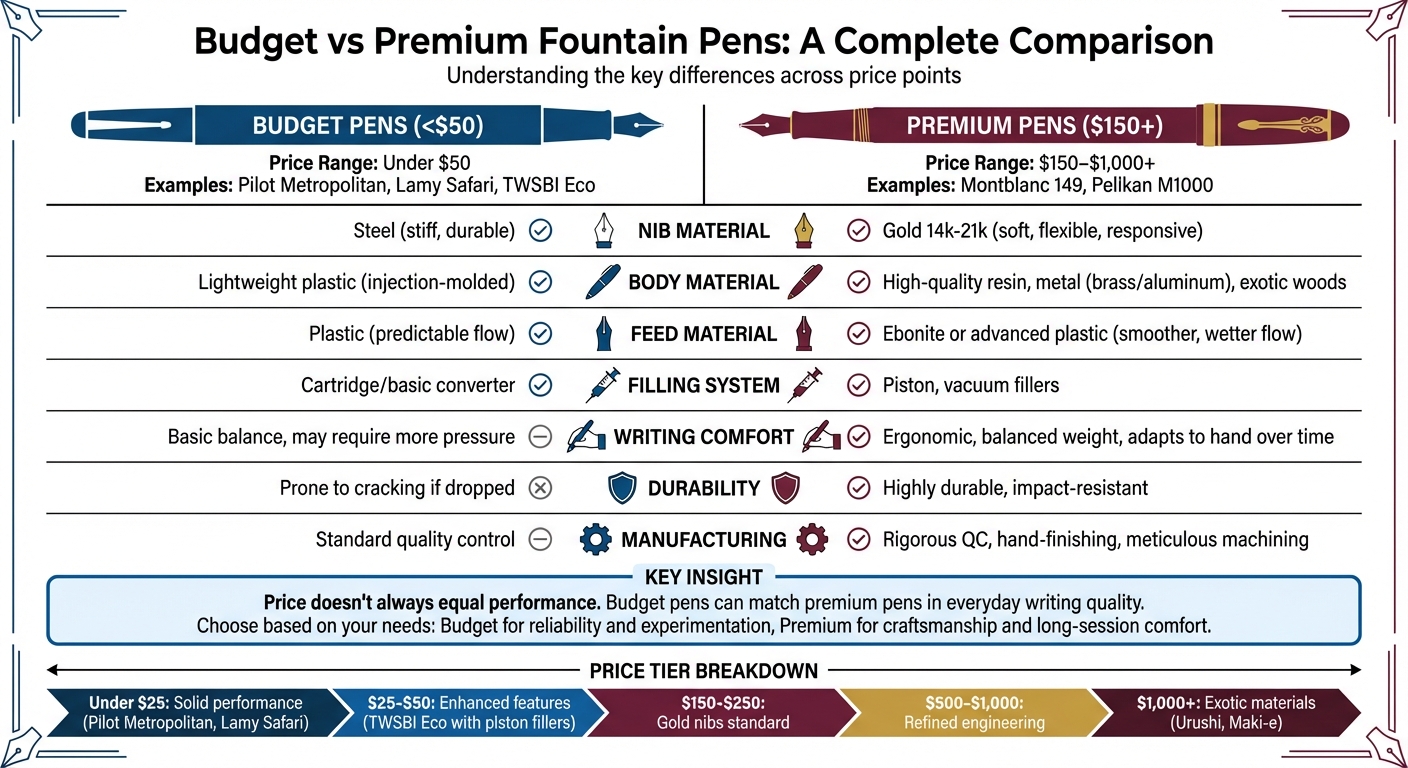
Budget vs Premium Fountain Pens: Complete Feature Comparison
Nib Quality and Writing Performance
Steel Nibs vs. Gold Nibs
The material of a nib significantly impacts how a pen feels when writing. Gold nibs - commonly crafted from 14k, 18k, or 21k gold - deliver a softer, more spring-like sensation, while steel nibs provide a firmer, more controlled experience with noticeable tactile feedback against the paper. As EndlessPens puts it:
Gold nibs can give you a softer and more comfortable ride... It can be likened to a suspension on a car.
However, the smoothness of a nib has less to do with whether it's made of gold or steel and more to do with the quality of the iridium tip. Both types of nibs use the same hard metal tipping - typically iridium - so the level of polish on that tip has a greater impact on smoothness than the nib's core material. R.J. Morgan, a professor at UC Berkeley's Haas School of Business, makes this clear:
The argument that the gold content of a nib per se imparts a smoother writing experience is pure nonsense.
In fact, well-made steel nibs from brands like Faber-Castell and Pilot can rival or even outperform gold nibs in smoothness when manufactured with care. The real edge of gold lies in its flexibility. Gold is more malleable, allowing it to adapt to your writing pressure over time, which creates a unique writing experience. Higher karat gold, such as 18k or 21k, results in softer and more flexible nibs, while 14k strikes a balance between springiness and sturdiness. Additionally, modern stainless steel alloys have addressed earlier concerns about corrosion, narrowing the gap between the two materials. Beyond the material itself, the manufacturing process plays a critical role in determining a nib's performance.
Manufacturing Precision and Design
While the type of metal defines a nib's basic characteristics, the precision of its manufacturing process can make or break its performance. High-end nibs undergo rigorous quality control and meticulous machining of their iridium tips, ensuring smooth ink flow and proper alignment right out of the box. Brands such as Montblanc, Sailor, and Pelikan are known for their strict standards, which help avoid issues like scratchy writing or inconsistent ink delivery.
The design and fountain pen nib sizes also play a key role. Elements like tine length, metal thickness, and the curvature of the nib's top all influence how it writes. Gold nibs in premium pens often feature longer tines or thinner metal for added flexibility, while steel nibs in budget pens are designed to prioritize durability with a more rigid structure. In lower-priced pens, some manufacturers skip the iridium tipping altogether, opting for rolled steel, which tends to wear down faster. That said, many quality budget pens still use iridium-based alloys, similar to those in premium models, though they may receive less hand-finishing.
Interestingly, a well-made steel nib can outperform a poorly tuned gold nib. Inkstable highlights this point:
A badly tuned gold nib can perform worse than a well-made steel nib, especially if there's misalignment or flow issues.
For newcomers, high-quality steel nibs offer an excellent entry point without the hefty price tag. For instance, a Lamy Studio with a steel nib costs about $80, while the gold-nibbed version is closer to $180. This price difference mainly reflects the distinct writing feel rather than a dramatic difference in smoothness.
sbb-itb-1dd4fe9
Ink Flow and Feed Systems
Feed Materials: Plastic vs. Ebonite
The feed, located just beneath the nib, plays a crucial role in controlling how ink travels from the reservoir to the paper. Most budget pens rely on injection-molded plastic feeds, while high-end pens often use ebonite feeds - a vulcanized rubber originally developed as a cost-effective alternative to ebony wood. But the choice of material impacts more than just the price.
Ebonite's semi-porous, textured surface allows ink to spread evenly across it. As Danny Watts, author of Fountain Pen Chronicles, puts it:
Ebonite is favored because it is easily wetted with ink and it won't bead up on an ebonite surface because it is textured.
In contrast, plastic feeds have a smooth, polished surface that can sometimes cause ink to bead, disrupting the flow unless the feed channels are engineered with precision. Modern injection molding techniques have made it possible to create intricate and cost-efficient plastic feed designs. However, ebonite feeds are typically crafted using specialized tools - some as small as 0.015 mm in diameter - through machining or hand-cutting, which makes them more labor-intensive to produce.
One standout feature of ebonite feeds is their ability to be heat-set. By applying heat, they can be softened and molded to fit snugly against the nib, ensuring an airtight seal that enhances capillary action and delivers a wetter, more consistent ink flow. On the other hand, plastic feeds are rigid and cannot be adjusted after manufacturing. They provide a steady, predictable ink flow, making them ideal for everyday use. With these material differences in mind, let’s explore how feed design influences ink flow.
Flow Control Mechanisms in Premium Pens
The feed is responsible for regulating ink flow and allowing air to enter the reservoir. If this balance between ink and air is disrupted, issues like hard starts, skipping, or even ink dribbling can arise. Budget pens, particularly those with poorly fitted plastic feeds, are more likely to experience such problems. As Gentleman's Gazette notes:
Poorly-fitted plastic feeds can have disastrous consequences. Ink can dribble or overflow when writing or even spill out when the pen isn't in use. Airflow defects can also have exactly the opposite problem and prevent ink from coming out even when you want it to.
Premium pens tackle these challenges with advanced engineering. Ebonite feeds, thanks to their microscopic air pockets, help maintain a balanced flow of ink and air, resulting in smoother and more reliable performance. Additionally, some luxury brands, like Visconti, utilize cutting-edge plastic feed designs to achieve "near-perfect air compensation", which prevents leaks caused by changes in air pressure during environmental shifts.
Ultimately, the quality of construction often has a greater impact than the choice of material. A well-designed plastic feed in a mid-range pen can perform just as well as a premium feed, while even an ebonite feed can falter if it isn't properly tuned. Understanding these design principles is key to evaluating the writing performance of both budget and premium pens.
Writing Comfort and Construction
Comfort During Long Writing Sessions
The design and materials of a fountain pen can make or break your experience during extended writing sessions. Budget pens, often made from lightweight plastic, tend to lack the balanced weight distribution necessary to prevent hand fatigue. As Preston from Gentleman's Gazette puts it:
Inadequate heft or poor balancing will confuse the way you grip the pen, leading your hand to become more uncomfortable over time as you apply pressure in incorrect ways.
Another factor is the nib. Budget pens typically feature steel nibs, which are stiffer and require more pressure to write, often leaving your fingers cramped after prolonged use. On the other hand, comparing gold vs steel nibs reveals that premium pens with gold nibs provide a softer, more cushioned feel that naturally adapts to your writing style over time. This flexibility in premium nibs plays a significant role in reducing strain and enhancing comfort.
Materials and Build Quality
The materials used in a fountain pen's construction greatly affect both its durability and how it feels in your hand. Budget pens often rely on injection-molded plastic, which can feel slippery, cold, and is more likely to crack if dropped. Premium pens, by contrast, are crafted from more durable and tactile materials like resin, metals (such as brass or aluminum), or even exotic woods. John from Fountain Pen Love highlights this advantage:
If you're accident prone or toss your pens into a bag or pocket and take them with you everywhere, a metal pen will probably hold up much better than a plastic pen.
Resin, for example, offers a slightly tacky texture that improves grip and feels warmer to the touch compared to plastic. Just as the nib design shapes the writing experience, the choice of body material is equally important for comfort and durability. Premium pens are designed with materials that not only enhance their longevity but also provide a more satisfying tactile experience, making them a practical yet luxurious choice for daily use.
| Feature | Budget Pens (<$25) | Premium Pens (>$200) |
|---|---|---|
| Body Material | Lightweight, thin plastic | High-quality resin, metal, or wood |
| Nib Material | Stainless steel (stiff) | Gold or Titanium (flexible/soft) |
| Durability | Prone to cracking; steel may corrode | Highly durable; resin is impact-resistant |
| Writing Comfort | May require more pressure; can be unbalanced | Balanced weight; personalizes to hand |
These differences in construction and materials highlight the trade-offs between budget-friendly options and premium pens, with the latter offering a more refined and durable experience tailored for comfort during long-term use.
Cheap vs. Expensive Fountain Pens: What Are the Differences?
Value for Money: What to Expect at Each Price Point
Price is a key factor in determining the overall experience and satisfaction of using a fountain pen. While earlier sections explored nib quality and construction, let's dive into what you can expect at different price points.
Budget Pens: Affordable and Reliable
If you're looking for solid performance without breaking the bank, budget pens under $25, like the Pilot Metropolitan and Lamy Safari, are excellent choices. These pens typically feature steel nibs and plastic bodies, paired with simple cartridge or converter filling systems. They come with minimal packaging but deliver dependable writing experiences.
Stepping up to the $25–$50 range introduces features like piston fillers and larger pen sizes. The TWSBI Eco is a standout in this category, offering great value with its enhanced functionality.
Interestingly, many budget pens can match the writing quality of luxury models for everyday use. Brands like Fountain Pen Revolution cater to beginners by offering starter sets for $35 and bundles starting at $29. These affordable options let you experiment with various nib sizes and ink colors without feeling the financial pinch.
Premium Pens: Paying for Craftsmanship and Materials
When you venture into the $150–$250 range, gold nibs become the norm. These nibs offer a softer, more responsive writing experience compared to steel. Moving into the $500–$1,000 range, you'll find flagship models with refined engineering, while pens priced above $1,000 often showcase exotic materials like Urushi lacquer or Maki-e hand-painted finishes.
As Brian Goulet, founder of The Goulet Pen Company, explains:
The increased cost is due largely to the cost of the materials and time it takes to produce.
However, while these higher-end pens reflect superior craftsmanship and materials, they don't necessarily guarantee better writing performance. For instance, upgrading to a gold nib can add about $100, and metal-bodied versions may cost three to four times more than their plastic counterparts.
Price Doesn’t Always Equal Performance
A pen priced at $2,000 won’t necessarily write ten times better than one priced at $200. Your personal writing style often plays a bigger role than the pen's cost. John from Fountain Pen Love shared his experience:
I recently bought a Lamy Studio, tried both nibs, and went with the steel nib as I just didn't feel enough of a difference to justify the extra cost.
For some, the firmer feel of steel nibs is preferable to the springy feedback of gold. Budget pens are also ideal for travel, testing new inks, or learning how to tune nibs without the risk of damaging an expensive pen.
Ultimately, the best value comes down to your needs. If you’re after a reliable, functional tool for everyday writing, pens under $25 often perform just as well as pricier options. On the other hand, if you appreciate the artistry and tactile experience of premium materials, higher price tags may feel worthwhile - even if the improvement in writing performance is minimal.
Conclusion: Choosing the Right Pen for Your Needs
Main Points to Remember
When comparing budget and premium pens, the differences often come down to nib material, feed design, balance, and filling systems. Budget pens typically feature durable steel nibs, which tend to be stiffer, while premium pens often boast gold nibs that offer more flexibility and adapt over time. Plastic feeds are common in budget pens, whereas premium models may use ebonite for smoother ink flow. Balance and weight also play a key role - premium pens are often carefully crafted for comfort during extended writing, while budget pens might feel lighter or less balanced. Filling systems vary as well, with budget pens favoring cartridges or basic converters, while premium options may include piston or vacuum fillers for greater ink capacity and convenience.
However, higher price doesn’t always mean better performance. As fountain pen enthusiast Kai observed:
The cheapest Pilot fountain pen is a far more reliable writer [than some expensive brands].
This highlights that even a well-designed budget pen can meet everyday writing needs as effectively as a high-end model. The choice ultimately depends on your specific writing habits and preferences.
How to Make Your Decision
Your ideal pen will depend on how you plan to use it. If you often write for long periods, a premium pen with a gold nib and balanced design may provide the comfort you need. On the other hand, if you enjoy experimenting with different inks or need something portable, budget-friendly pens - like those from Fountain Pen Revolution, starting at $35 for starter sets or $29 for bundles - offer an affordable way to explore the hobby.
For those seeking a balance between quality and price, pens in the $150–$250 range often deliver upgraded nibs and materials that feel luxurious without breaking the bank. If artistry and craftsmanship appeal to you, pens priced above $500, featuring finishes like urushi or maki-e, can offer aesthetic value, though the writing performance might not differ significantly.
Ultimately, trying out pens is the best way to find your perfect fit. Factors like grip, weight, and nib feel often outweigh the price tag. Think about where and how you’ll use the pen - budget models are ideal for commuting or office use, while premium pens can be reserved for more focused writing sessions at home.
FAQs
How can I tell if a nib needs tuning?
Inspecting the nib of your fountain pen is essential to ensure smooth writing. Look for issues like misaligned tines, uneven tipping, or rough edges - these can cause scratchiness or disrupt ink flow. A 10× loupe is a handy tool for spotting misalignments or irregular surfaces.
If your pen skips, scratches, or writes inconsistently, the nib might need some tuning. Regular cleaning and adjustments can often resolve these problems. Tools like micromesh pads or brass shims are useful for refining the nib's performance. However, if the problem persists, it’s worth consulting a nib specialist for expert care.
Do ebonite feeds really prevent skipping or leaking?
Ebonite feeds are known for promoting smooth and consistent ink flow, which can help minimize issues like skipping and leaking. That said, they aren't a perfect solution. Over time, ebonite tends to oxidize, meaning regular maintenance is essential to keep them performing well. While they can mitigate these problems, they don’t completely resolve them.
When is a gold nib worth the extra money?
A gold nib stands out for its flexibility, smooth writing experience, and premium feel, making it a favorite for those who enjoy expressive writing or calligraphy. Thanks to its softer material, a gold nib provides a springy sensation and can create slight variations in line width.
That said, a well-made steel nib can perform just as well for daily writing tasks. Ultimately, the choice often depends on personal taste, whether it’s the style, the responsive touch, or the lasting durability that matters most to you.