

Ebonite has been a go-to material for fountain pen crafting since the 19th century. Known for its durability, warmth, and performance, it offers unique advantages over metals and plastics. Here's what makes it stand out:
- Easy to Machine: Ebonite can be precisely shaped using basic tools, allowing for detailed designs and custom fits.
- Warm Feel: Its natural texture and warmth make it comfortable for long writing sessions.
- Durable: Resistant to wear, chemicals, and heat, ebonite pens can last for decades with proper care.
- High Polish Finish: Achieves a glossy, premium look that enhances visual appeal.
- Smooth Ink Flow: Its structure supports consistent ink delivery, making it ideal for high-performance feeds.
Ebonite's combination of functionality and aesthetics has cemented its place in ebonite fountain pen design, even as modern materials have emerged.
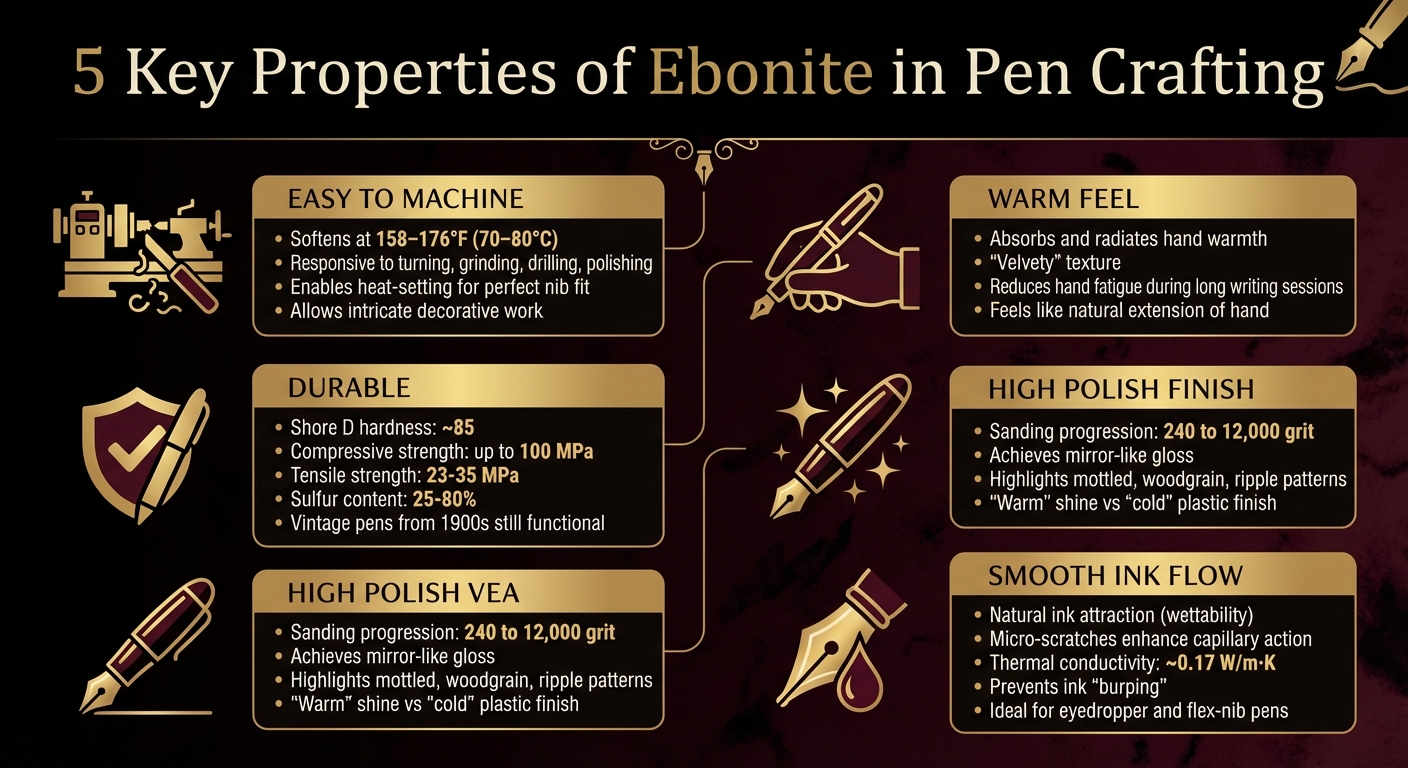
5 Key Properties of Ebonite in Fountain Pen Crafting
1. Easy to Machine and Shape
Material Performance in Crafting
Ebonite is typically crafted from solid rods, bars, or sheets, requiring machining to shape each component. While this might seem restrictive, it actually opens doors for small-scale artisans and independent pen makers. The material is highly responsive to basic engineering techniques like turning, grinding, drilling, and polishing - all achievable with straightforward tools like a lathe. Its thermoplastic quality allows it to soften at 158–176°F (70–80°C), enabling a shape-memory effect. This makes it possible for pen makers to heat-set feeds, ensuring they perfectly match a nib's curvature for optimal ink flow. This level of adjustability is something molded plastic feeds simply can't match, making ebonite an excellent choice for both functionality and artistic expression.
Impact on Pen Design
Ebonite's machinability not only ensures precise functionality but also opens up opportunities for intricate decorative work. For instance, vintage BCHR pens highlight the material's potential for detailed designs, featuring elaborate surface patterns created through techniques like chasing or chiseling.
Modern pen makers continue to celebrate this versatility. In February 2026, Esterbrook introduced its "Estie Ebonite" limited edition, offering 25 handcrafted pens per color (Blackberry and Parrot), each uniquely numbered from 000 to 025. Similarly, Sailor Pen's "Ebonite Sculpture" series showcases the material's potential for precision carving. The Yokaze (Night Breeze) model, priced between $792.00 and $990.00, exemplifies how ebonite allows for intricate, non-molded textures that injection-molded plastics simply cannot replicate.
Pierre Miller from Desiderata Pen Company describes working with ebonite as both challenging and rewarding:
"Working with this material is like being in a lucid nightmare. You have a certain degree of control over the finished product, but in the meantime–everything stinks, your tools never stay sharp, everything is always at the brink of overheating".
Despite the hurdles, ebonite's remarkable workability continues to attract pen artisans who value the ability to create truly one-of-a-kind pieces.
sbb-itb-1dd4fe9
2. Warm Feel in Hand
User Experience Enhancement
Ebonite pens offer a unique warmth that makes them feel like a natural part of your hand. As Pierre Miller from Desiderata Pens puts it:
"Ebonite (or vulcanite as it was called in the early twentieth century) absorbs hand warmth and radiates it back in such a way that when you hold an ebonite pen, it feels like an extension of your hand".
Unlike pens made from metal or plastic, ebonite provides a naturally warm and organic feel, often rivaled only by wood. Salvatore Matrone of Leonardo Officina Italiana adds that ebonite has a "velvety" texture that becomes even more pleasant with regular use. For those who spend long hours writing, this gentle warmth can reduce hand fatigue and make the experience more comfortable.
This warmth isn't just about comfort; it also plays a role in the pen's overall functionality.
Impact on Pen Design
Ebonite's warm surface pairs beautifully with its practical benefits. Its ability to maintain consistent internal pressure is a game-changer for long writing sessions. By preventing hand heat from affecting the air inside the ink reservoir, ebonite minimizes problems like ink "burping". Additionally, its chemical resistance makes it a great material for eyedropper-style pens, where ink comes into direct contact with the barrel.
To keep your ebonite pen looking and feeling its best, avoid exposing it to direct sunlight or submerging it in water. Prolonged UV exposure can oxidize the sulfur content in ebonite (which ranges from 25% to 80%), leading to a dull, brownish discoloration . If this happens, you can restore its shine by sanding with high-grit micromesh (up to 12,000 grit) and polishing .
Making a Luxury Fountain Pen from Scratch (Ebonite & Engraved Brass)
3. Long-Lasting and Tough
Ebonite stands out not just for its smooth, inviting feel but also for its exceptional strength and durability.
Material Performance in Crafting
Ebonite owes its toughness to its unique chemical structure. The vulcanization process, where natural rubber is combined with 25% to 80% sulfur, creates a dense, cross-linked network. This results in impressive mechanical properties, such as a Shore D hardness of around 85, compressive strength reaching up to 100 MPa, and tensile strength ranging between 23 and 35 MPa. These traits make ebonite resistant to surface wear, ensuring that threading and fit remain intact even after years of daily use.
This durability is evident in vintage ebonite pens from the early 1900s, many of which still function flawlessly. In contrast, early plastics from the same era often show significant deterioration.
Impact on Pen Design
Ebonite's resilience extends beyond physical strength. Its chemical resistance and low thermal conductivity (approximately 0.17 W/m·K) make it a perfect material for eyedropper-style pens. Since the ink comes into direct contact with the barrel, ebonite's non-reactive nature prevents issues with acidic inks. Additionally, its insulation properties reduce the risk of air expansion from hand warmth, which helps prevent leaks or "burping" during use . This ensures consistent performance, even during long writing sessions.
Modern pen makers are embracing ebonite's stability in creative ways. For instance, Wancher offers an upgrade to ebonite feeds for about $40, which enhances ink flow consistency and longevity. Luxury brands like Esterbrook, Sailor, and Kaweco have also reintroduced ebonite into their designs, valuing its durability and vintage appeal . These qualities continue to position ebonite as a key material for precision-crafted pens.
User Experience Enhancement
With the right care, an ebonite pen can last a lifetime. To keep it in top condition, store it away from direct sunlight to avoid UV-induced surface oxidation. Also, avoid keeping it alongside celluloid pens, as ebonite's natural sulfur off-gassing can harm celluloid materials over time . When properly maintained, an ebonite pen not only remains reliable but also develops a distinctive patina over time - a feature many collectors and enthusiasts appreciate as it adds to the pen's character.
4. Takes a High Polish
Material Performance in Crafting
Achieving a mirror-like finish on ebonite is no small task - it requires patience and precision. Crafters typically start with coarse sanding at 240 grit and work their way up through finer abrasives, sometimes reaching an ultra-fine 7,000 or even 12,000 grit . Wet sanding is crucial in this process. It not only keeps the material cool but also helps minimize the sulfur odor that ebonite can release. While water is a common choice for wet sanding, some seasoned artisans prefer mineral spirits. These not only prevent lathe rust but also keep fine abrasives from clogging, making the process smoother .
Heat control is another key factor. After machine sanding, turning off the lathe and hand-sanding lengthwise helps eliminate circular micro-scratches that could ruin the final look. The process is completed with polishing compounds like Flitz, Brasso, or Novus 2, applied either by hand or with a buffing wheel. This step is what gives ebonite its signature mirror-like shine . The end result? A polished surface that elevates the pen's visual appeal significantly.
Impact on Pen Design
Once polished, ebonite transforms into a stunning canvas for intricate designs. The smooth, glossy finish not only enhances the pen's appearance but also underscores ebonite's blend of practicality and beauty. As Danny Watts notes, ebonite's polished surface achieves a lacquer-like gloss. This deep shine is particularly effective in highlighting specialty patterns such as mottled, woodgrain, and ripple designs, bringing out their intricate details.
The material is versatile enough to offer a range of finishes, from a high-gloss mirror effect to a more understated matte look. This adaptability also enables traditional techniques like Black Chased Hard Rubber (BCHR), where engraved patterns stand out against the polished surface. Pierre Miller, founder of Desiderata Pen Co., describes the polished ebonite finish as having a "warm" quality that sets it apart from the "cold" shine of modern acrylics or plastics .
User Experience Enhancement
A high polish doesn’t just transform the look of an ebonite pen - it also elevates how it feels. The smooth surface enhances the material’s natural warmth, creating a tactile experience that feels both organic and inviting . Pierre Miller captures this perfectly:
"The gloss you can get is deep and warm, the matte is inviting, and everything in between is possible".
Even when polished to a brilliant shine, ebonite retains its naturally grippy texture, ensuring a secure hold during long writing sessions. However, it’s worth noting that exposure to UV light and moisture can lead to surface oxidation. Fortunately, the finish can be restored through sanding and re-polishing, making proper storage - away from direct sunlight - a simple but effective way to maintain its beauty.
5. Allows Smooth Ink Flow in Feeds
Material Performance in Crafting
Ebonite's vulcanized structure plays a key role in ensuring efficient ink delivery. Its natural rubber base, combined with 25–80% sulfur, creates a surface that naturally attracts ink. When machined, ebonite develops tiny scratches that boost capillary action, helping ink travel seamlessly from the reservoir to the nib. Additionally, its low softening temperature (70–80°C) allows nibmeisters to "heat set" feeds, ensuring a snug fit between the nib and feed. This process eliminates air bubbles and promotes a steady ink flow. Unlike plastic feeds, which are injection-molded, ebonite feeds can be manually adjusted. Craftsmen often use tools like hobby knives or sandpaper to modify ink channels or grooves, tailoring the flow to match a writer's specific needs.
These characteristics not only enhance functionality but also contribute to the artistry of pen design.
Impact on Pen Design
Ebonite's unique properties make it a key material in precision pen crafting. Its texture and durability improve ink delivery, while its superior thermal insulation prevents heat transfer from the user's hand to the ink reservoir. Without this insulation, expanding air inside the reservoir could push ink out, causing "burping". This stability makes ebonite an excellent choice for eyedropper-style pens, where ink is stored directly in the barrel.
Its resistance to chemicals further expands its usability. Ebonite withstands the pigments and acids found in most fountain pen inks, ensuring consistent performance even with more demanding formulations. In modern flex-nib pens, such as those from Noodler's, ebonite’s ability to handle high ink demand during nib flexing makes it indispensable.
User Experience Enhancement
Ebonite's technical advantages translate directly into a more enjoyable writing experience. It minimizes interruptions, delivering smoother, more consistent lines. Danny Watts, author of Fountain Pen Chronicles, highlights this benefit:
"Ebonite is favored because it is easily wetted with ink and it won't bead up on an ebonite surface because it is textured".
The material's natural texture maintains a strong connection with ink molecules, even during fast writing, ensuring uninterrupted flow. Over time, exposure to UV light and moisture oxidizes the sulfur in ebonite, forming a hydrophilic layer that enhances its ability to attract ink. While this feature can make ebonite feeds slightly harder to clean compared to plastic ones, it results in fewer skips, hard starts, and interruptions - giving writers a smoother, more reliable experience.
Conclusion
Ebonite shines in pen craftsmanship thanks to five standout qualities: ease of machining, a warm tactile feel, exceptional durability, a high-polish finish, and smooth ink flow. Each of these features plays a critical role in creating pens that are both functional and a pleasure to use.
Its machinability allows precise shaping using straightforward tools like a lathe, making it a favorite among artisans. The material's warm and organic touch creates a writing experience that many describe as feeling like a natural extension of the hand. Its durability and resistance to chemicals make it perfect for eyedropper pens, where ink comes into direct contact with the barrel. A high-polish capability gives ebonite a rich, glossy finish that exudes elegance. Lastly, its natural wettability and thermal insulation ensure consistent and reliable ink flow, enhancing the writing performance.
These qualities - precision in shaping, a comfortable feel, lasting strength, a polished look, and reliable ink flow - are why ebonite remains a favorite in high-end pen design. This has led to its resurgence among luxury brands like Sailor, Pilot, and Wancher, as well as independent artisans who appreciate its distinctive characteristics.
For both pen makers and enthusiasts, ebonite offers an unmatched combination of performance and tactile comfort that keeps it at the heart of fine writing instruments.
FAQs
How do I prevent ebonite from fading or turning brown?
To keep ebonite looking its best and prevent it from fading or turning brown, limit its exposure to sunlight or UV light. Store your pen in a cool, dark spot, and make regular cleaning part of your routine. Also, avoid soaking it in hot water, as this can affect its appearance over time.
Are ebonite pens safe for eyedropper filling?
Ebonite pens are considered a safe option for eyedropper filling. Ebonite, a vulcanized rubber, is durable and resistant to chemical corrosion. Plus, it doesn't release harmful gases over time, making it a dependable material for holding ink in eyedropper-style pens.
Do ebonite feeds need special cleaning or care?
Ebonite feeds need consistent cleaning to keep ink flowing smoothly. Rinse them with water to clear away ink buildup, but steer clear of warm or hot water, as heat might lead to discoloration or even damage. For dried ink, stick to gentle tools like soft brushes. Taking these steps can also shield ebonite feeds from discoloration caused by sunlight and moisture, helping them stay functional and looking good over time.