

If you care about how your fountain pen performs, the paper you use matters as much as the pen and ink. Poor-quality paper can lead to feathering (fuzzy edges) and bleed-through (ink seeping to the other side), ruining your writing. High-quality paper ensures smooth strokes, sharp lines, and brings out features like shading and sheen in your ink. Here are five papers that work exceptionally well with fountain pens:
- Rhodia Paper: Known for smooth surfaces and excellent ink handling. Available in 80 gsm (quick drying) and 90 gsm (luxurious feel). Prices range from $5.69 to $24.95.
- Clairefontaine Paper: Offers a silky 90 gsm surface that resists feathering and bleed-through. Ideal for vibrant ink colors. Prices start at $5.50.
- Tomoe River Paper: Ultra-thin (52–68 gsm) yet handles wet inks beautifully. Exceptional for shading and sheen but requires longer drying times. Costs around $9.00 for an A5 notebook.
- Leuchtturm1917 Paper: Combines functionality with a subtle texture. The 80 gsm paper is quick-drying, while the 120 gsm version minimizes bleed-through. Prices start at $25.95.
- Maruman Loose Leaf Paper: Affordable and practical with an 80 gsm weight. Dries quickly and resists feathering. A5 size retails for $9.50.
Each option offers unique benefits, from smooth textures to vibrant ink performance. If you're unsure which to pick, try a sampler pack to find the best fit for your writing style.
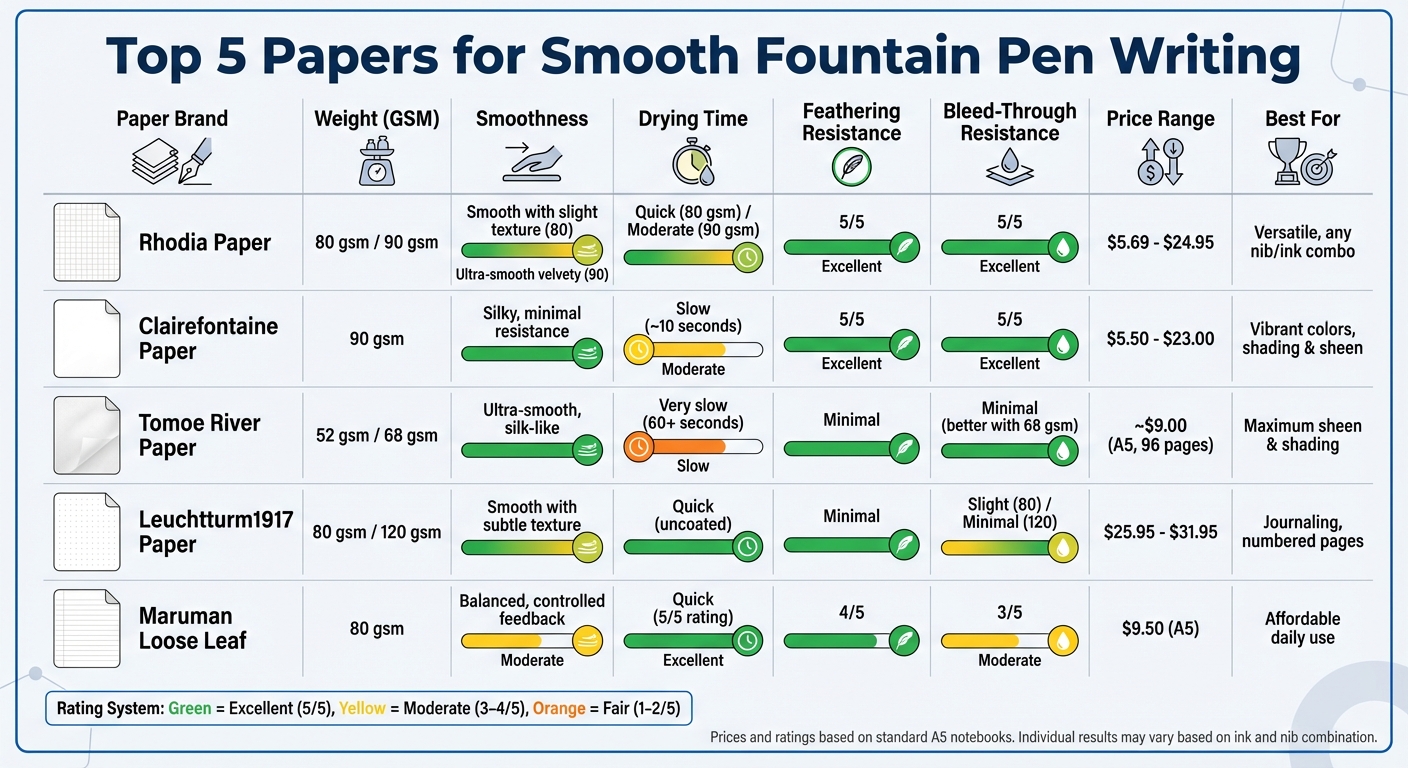
Comparison of Top 5 Fountain Pen Papers: Features, Performance, and Pricing
My Top 5 Fountain Pen Friendly Paper
1. Rhodia Paper
Rhodia paper has long been celebrated as a favorite among stationery enthusiasts. Established in Lyon, France, in 1932 and now produced by Clairefontaine since 1997, it has become a trusted choice for fountain pen users seeking reliable and consistent performance.
Smoothness of Writing Surface
Rhodia paper is known for its smooth, non-porous texture that allows fountain pen nibs to glide effortlessly. It comes in two weights: 80 gsm, which offers a slight texture for better control, and 90 gsm Premium "R", which delivers an ultra-smooth, velvety experience. Brian Goulet, Founder of The Goulet Pen Company, highlights the balance of the 80 gsm option:
"The paper in the Rhodia pads is 80g, and slightly less smooth [than Clairefontaine], ideal for fountain pens or pencils".
The subtle texture of the 80 gsm paper provides a satisfying level of feedback, making it a preferred choice for many writers.
Ink Absorption and Drying Time
Rhodia's coating ensures ink sits on the surface, enhancing features like shading, sheen, and shimmer. The 80 gsm paper dries relatively quickly, making it a practical option for left-handed writers. In contrast, the silkier 90 gsm paper may take a bit longer to dry, but its luxurious feel often makes it worth the wait.
Resistance to Feathering and Bleed-Through
When tested, Rhodia's Dot Pad earned a flawless 5/5 rating for resistance to both feathering and bleed-through. The 80 gsm paper, in particular, scored 0/5 for feathering, meaning no feathering occurred at all. Sam Di Nardo of Dayspring Pens emphasizes Rhodia's versatility:
"Rhodia paper handles ink well no matter the nib/ink combination you use".
This performance makes it a dependable option for any pen and ink pairing.
Overall Durability and Quality
Rhodia paper is acid-free and pH neutral, ensuring it resists yellowing or degradation over time. It is also PEFC-certified, meaning the paper comes from responsibly managed forests. Whether you opt for a budget-friendly $5.69 Dot Pad or invest in a $24.95 Goalbook, you're getting archival-quality paper designed to preserve your writing for years to come. Rhodia sets a high standard for paper quality and durability, making it a top contender for smooth writing experiences.
2. Clairefontaine Paper

Clairefontaine, much like Rhodia, is celebrated for its exceptional writing surface and precise ink handling. This French company has been crafting paper in the Vosges region since 1858. Known for its signature smooth coating, Clairefontaine paper offers a "satin" or "silky" surface that allows fountain pen nibs to glide effortlessly with almost no resistance.
Smoothness of Writing Surface
The smoothness of Clairefontaine paper is a standout feature. As Fountain Pen Love aptly describes:
"To say that this paper is smooth would be a big understatement... Nibs glide across it with little to no resistance."
Clairefontaine notebooks are typically made with premium 90 gsm paper, with the Triomphe line offering an ultra-smooth finish and matching envelopes, costing around $0.10 per sheet. Even extra-fine nibs, which can sometimes feel scratchy on other papers, perform seamlessly on Clairefontaine's surface.
Ink Absorption and Drying Time
While Clairefontaine paper prevents feathering, its coating leads to longer drying times. For instance, a TWSBI ECO Fine nib test showed a drying time of roughly 10 seconds. The Gentleman Stationer explains:
"What makes Clairefontaine paper so ink-friendly is the fact that the paper is coated to minimize feathering and bleed-through, so it takes longer to dry because the paper doesn't absorb as much ink as other brands."
Left-handed writers may want to use fast-drying inks or keep blotting paper handy to avoid smudging. The bright white, non-absorbent surface enhances ink vibrancy, shading, and sheening, making it a favorite among fountain pen enthusiasts.
Resistance to Feathering and Bleed-Through
Clairefontaine paper is designed to handle wet pens and heavily saturated inks with ease. Standard handwriting tests revealed no bleed-through, and even after four passes with an ink-soaked Q-tip, the paper's fibers held up impressively. The Triomphe line received perfect scores (5/5) for both bleed-through and feathering resistance. As The Gentleman Stationer notes:
"Clairefontaine is my personal benchmark for fountain pen friendly paper."
Overall Durability and Quality
Clairefontaine notebooks are priced between $5.50 and $23, depending on size and page count. The 90 gsm paper is not only durable enough for daily use but also minimizes show-through, making it ideal for everything from casual notes to formal correspondence. These qualities make Clairefontaine a go-to choice for anyone seeking a flawless fountain pen experience.
3. Tomoe River Paper
Tomoe River paper offers a "writing on silk" sensation. Originally created in Japan for catalog mailings to cut down on weight and shipping costs, it has since gained a reputation for its distinct coating that stops ink from soaking into the fibers.
Smoothness of Writing Surface
The smoothness of Tomoe River paper is almost legendary. Even with extra-fine or Japanese EF nibs, your pen will glide effortlessly, providing minimal tactile feedback. It’s often compared to the smoothness of Rhodia and Clairefontaine papers. Since 2021, the Sanzen version has introduced a slightly toothier texture, which some users have noticed. As Katy Klassman from Galen Leather explains:
"The Sanzen paper is different, but not at all unrecognizable. In fact, it's just a touch more textured and that seems to be the only discernable difference that I can notice."
Even with this slight change, the paper remains a favorite among fountain pen users, with nearly 99% of notebook and planner makers incorporating it.
Ink Absorption and Drying Time
Tomoe River’s non-absorbent nature means ink stays on the surface, resulting in vibrant colors with impressive sheen and shading. However, this comes at a cost: drying times can stretch beyond 60 seconds. For left-handed writers or those who write quickly, blotting paper might be a necessity to avoid smudging, particularly with high-sheen inks.
Resistance to Feathering and Bleed-Through
Despite its ultra-thin design, Tomoe River paper performs exceptionally well with wet fountain pen inks, showing minimal feathering or bleed-through. It comes in two weights: 52 gsm, which may show minor bleed-through with very wet pens, and 68 gsm, which offers better resistance. Both weights ensure crisp, clean lines, even with broader nibs.
Overall Durability and Quality
While it’s thin and almost like tracing paper, Tomoe River paper is surprisingly durable. It handles not just fountain pens but also pencils, rollerballs, and even light watercolor washes. Ghosting on the reverse side is common due to its thinness, but the paper remains resilient. Its premium quality does come at a cost: an A5 notebook with 96 pages is priced around $9.00 (approximately $0.09 per page), compared to $3.75 (roughly $0.039 per page) for a similar Rhodia notebook. However, it’s best to steer clear of alcohol-based markers or heavy felt-tip pens, as they are likely to bleed through the delicate sheets.
sbb-itb-1dd4fe9
4. Leuchtturm1917 Paper
Leuchtturm1917 strikes a chord with writers who appreciate both functionality and the classic Moleskine look. Its standard 80 gsm paper offers a smooth surface with just enough texture to provide subtle feedback - a detail many writers find appealing. As The Gentleman Stationer aptly notes:
"I always think of the Leuchtturm 1917 notebook as the fountain-pen friendly option for those who like the Moleskine aesthetic but hate Moleskine paper."
Smoothness of Writing Surface
The paper’s uncoated finish gives it a natural feel, avoiding the overly slick texture of heavily coated alternatives. This makes it a solid choice for Japanese Extra Fine (EF) nibs, though ink may spread slightly more compared to coated papers.
Ink Absorption and Drying Time
Thanks to its uncoated surface, the paper absorbs ink quickly, which helps reduce smudging. However, this faster drying time comes at the expense of sheen and shading, which may be less pronounced. Pricing for the standard A5 notebook with 249 numbered pages starts at $25.95, while the 120 gsm Bullet Journal Edition is available for $31.95.
Resistance to Feathering and Bleed-Through
Feathering is minimal, but wetter inks or broader nibs can cause slight bleed-through on the 80 gsm paper. Ghosting, where text is visible on the reverse side, is a commonly noted issue. If you prefer to write on both sides of the page with wetter inks, the 120 gsm edition provides better protection against bleed-through and ghosting.
Overall Durability and Quality
The paper is archival-safe and acid-free, making it suitable for long-term use. Additional features like numbered pages, a table of contents, dual bookmarks, and lay-flat binding enhance its practicality for journaling and note-taking. These thoughtful details make Leuchtturm1917 a reliable choice for those seeking a well-rounded writing experience.
5. Maruman Loose Leaf Paper
Wrapping up the top five, Maruman Loose Leaf Paper combines reliability and practicality, making it a standout choice for fountain pen users. Crafted with an 80 gsm weight, this paper strikes a balance between durability and a surface tailored for smooth writing.
Smoothness of Writing Surface
Maruman Loose Leaf Paper offers a well-balanced surface that allows fountain pen nibs to glide effortlessly while maintaining just enough feedback for controlled strokes. With its 7 mm ruling, it’s particularly accommodating for broader nibs and larger handwriting, ensuring clarity and legibility.
Ink Absorption and Drying Time
This paper excels in ink performance, drying quickly (rated 5/5), which is a huge plus for left-handed writers or anyone concerned about smudging. It absorbs ink effectively and resists feathering (rated 4/5), although heavy ink applications may occasionally lead to minor bleed-through (rated 3/5). These characteristics make it a dependable option for everyday writing.
Resistance to Feathering and Bleed-Through
Ghosting is kept to a minimum, even when using both sides of the paper. This ensures a clean and consistent writing experience, perfect for frequent use.
Overall Durability and Quality
With its 80 gsm weight and archival-safe, acid-free composition, Maruman Loose Leaf Paper is built to last. Designed for daily use, it’s an affordable yet high-performing choice for fountain pen enthusiasts. The A5 size retails for $9.50 and features 26 evenly spaced holes compatible with Japanese binders, along with two larger holes for European 2-ring binders. Whether for students, professionals, or passionate writers, this paper delivers smooth writing, quick drying, and dependable ink handling.
Conclusion
The right paper can transform your fountain pen experience. Drew Brown from The Goulet Pen Company perfectly sums it up:
"Your ink, paper, and pen make the trifecta of your writing experience so if you ever feel like something about the fountain pen experience could be enhanced, don't overlook the profound effect that paper can have".
When these three elements align, your writing comes alive. You'll notice your ink's true character - its shading, sheen, and sharp lines - qualities that ordinary copy paper just can't deliver.
High-quality paper addresses common frustrations like feathering, bleed-through, and nib skipping. The options discussed here are designed with special coatings and fiber compositions to ensure your nib glides effortlessly while keeping ink exactly where it should be.
To discover what works best for you, start with a sampler pack featuring brands like Rhodia, Clairefontaine, and Tomoe River. Paper preferences are deeply personal - some enjoy the silky smoothness of coated pages, while others appreciate a touch of texture for added feedback. Trying different types will help you find your perfect fit.
Whether you're jotting down quick notes, journaling your thoughts, or penning a heartfelt letter, investing in premium paper ensures every word you write feels satisfying, precise, and enjoyable.
FAQs
Why is Tomoe River paper a favorite among fountain pen users?
Tomoe River paper has earned a loyal following among fountain pen users thanks to its ultra-thin, lightweight design and silky-smooth writing surface. Despite being incredibly thin, it holds up impressively well - resisting bleed-through and feathering. This means your ink retains its vibrant hues and sharp, clean lines without smudging.
For those who love the tactile pleasure of writing, this paper elevates the experience, making it a favorite for journaling, detailed note-taking, or creating intricate artwork.
How does paper weight impact writing with a fountain pen?
Paper weight is a key factor in how your fountain pen performs on the page. Measured in grams per square meter (GSM), the thickness of the paper directly impacts its ability to handle ink. Thicker paper - typically 90 GSM or higher - is ideal for fountain pens, as it helps prevent issues like ink bleeding through or feathering. Plus, it provides a smooth surface that keeps your writing sharp and vibrant.
That said, lighter papers in the 52–68 GSM range can still be a good option, though they may show some ghosting or bleed-through, especially when paired with wetter inks. Picking the right paper weight doesn’t just improve how your writing looks - it also enhances the tactile pleasure of using a fountain pen.
What makes Rhodia paper a popular choice over Clairefontaine?
Rhodia paper stands out for its variety of sizes and formats, making it suitable for a range of writing preferences. It's also widely available in stores across the U.S., including art and craft shops, which makes it a convenient option for fountain pen users.