

Luxury fountain pens stand out due to their premium materials, hand-assembled craftsmanship, and unparalleled writing experience. They are more than just writing tools - they are symbols of elegance and precision. Here's what sets them apart:
- Materials: Bodies crafted from precious metals, fine resins, celluloid, exotic woods, or even basaltic lava. Nibs are often made of 14k, 18k, or 21k gold for smooth and durable performance.
- Craftsmanship: Every pen is meticulously assembled, with intricate designs like gemstone inlays, mother-of-pearl accents, and hand-engraved details.
- Nib Quality: Gold nibs provide a soft, responsive writing feel, often enhanced with iridium tips for durability.
- Filling Systems: Options like cartridge/converter, piston, vacuum, or eyedropper systems cater to different preferences for ink capacity and ease of use.
- Price Range: Entry-level options start around $100–$200, while limited editions with rare materials can cost tens of thousands of dollars.
Luxury pens combine functionality with artistry, offering a tactile writing experience that digital tools can't replicate. Whether for daily use, collecting, or gifting, these pens are timeless investments in quality and design.
7 Things To Think About When Buying A Luxury Pen
Premium Materials Used in Luxury Fountain Pens
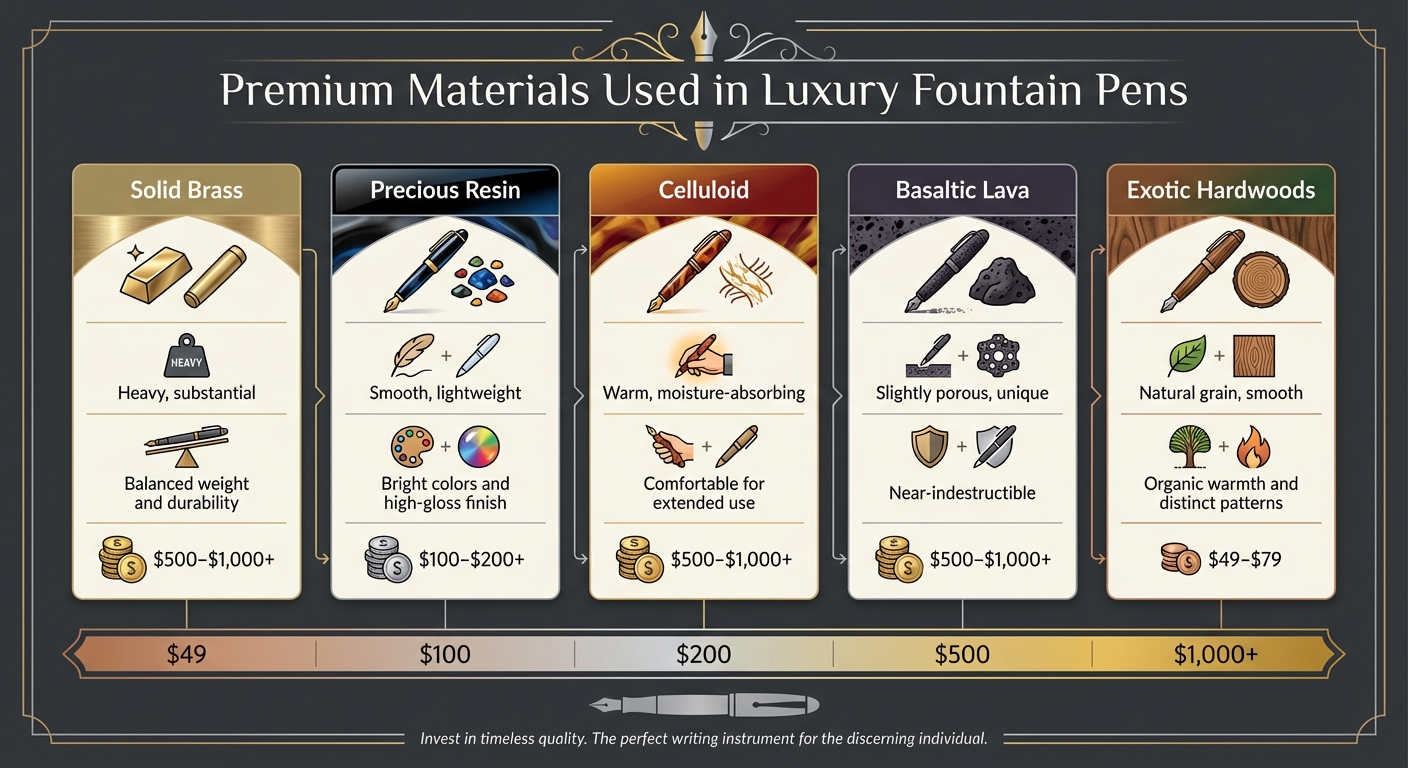
Premium Fountain Pen Materials Comparison: Properties, Benefits, and Price Ranges
The materials in luxury fountain pens go far beyond functionality - they define the pen's elegance, durability, and performance over the years.
Body Materials: Precious Metals and Fine Resins
Luxury pens frequently feature precious metals that enhance their durability and aesthetic appeal. For example, solid brass construction ensures balanced weight and a sturdy feel, making long writing sessions more comfortable. Sterling silver and palladium are often used for intricate overlays and skeletonized designs, giving the pens a jewelry-like allure.
To ensure longevity and a smooth writing experience, many brands rely on solid brass bodies paired with 14k gold nibs, which deliver both strength and consistent weight distribution.
On the other hand, fine resins and acrylics bring vibrant colors and a polished finish to these pens. Montblanc, for instance, uses proprietary resins that are heated to around 536°F (280°C) and subjected to extreme pressure (up to 2,000 bar). This process creates a high-gloss, colorful finish with unique transparency effects, making each pen visually striking.
Celluloid, a material derived from cotton, alcohol, and camphor, is highly sought after for its warm, tactile feel. Its slight moisture absorption also provides a secure grip during use. Similarly, ebonite, a vulcanized rubber, offers a warm touch and a vintage charm, though it requires careful storage to avoid fading when exposed to sunlight.
A standout innovation comes from Visconti's "Homo Sapiens" collection, which incorporates basaltic lava from Mount Etna mixed with resin. This material is almost unbreakable and features a slightly porous texture that sets it apart from traditional finishes. Exotic hardwoods such as Wenge, Ebony, and Zebrawood also add a natural warmth and unique grain patterns, offering a beautiful contrast to sleek metal components.
| Material | Writing Feel | Key Benefit | Price Range |
|---|---|---|---|
| Solid Brass | Heavy, substantial | Balanced weight and durability | $500–$1,000+ |
| Precious Resin | Smooth, lightweight | Bright colors and high-gloss finish | $100–$200+ |
| Celluloid | Warm, moisture-absorbing | Comfortable for extended use | $500–$1,000+ |
| Basaltic Lava | Slightly porous, unique | Near-indestructible | $500–$1,000+ |
| Exotic Hardwoods | Natural grain, smooth | Organic warmth and distinct patterns | $49–$79 |
In addition to these durable materials, luxury fountain pens captivate with their artistic ornamentation.
Gemstones and Decorative Elements
Luxury pens often double as works of art, featuring gemstones, mother-of-pearl, and intricate engravings. Limited-edition models frequently include solid gold overlays and mother-of-pearl accents, which require meticulous artisanal techniques.
Traditional Japanese methods, such as raden (mother-of-pearl inlays) combined with Urushi lacquer, add depth and cultural resonance to these pens. Meanwhile, burin-engraving - a hand-engraving technique applied to silver and gold surfaces - requires the precision and skill of a jeweler.
"Montegrappa luxury fountain pens are handcrafted in Italy, using precious materials and jeweller-calibre craftsmanship to realise true works of art."
These decorative touches are not purely ornamental. Functional elements like clips and rings protect the nib and enhance the pen's display value. Beyond their practicality, these features often tell a story, whether commemorating historical milestones, celebrating literary achievements, or showcasing the artistry of their makers.
Nib Quality: The Heart of the Writing Experience
When it comes to luxury pens, the nib is where the magic happens. Even the finest materials and craftsmanship can't make up for a poorly made nib. In high-end pens, the nib transforms writing from a routine task into a genuine art form, thanks to its superior materials and precise engineering.
Gold Nibs: 14k, 18k, and 21k Options
Gold nibs offer a writing experience that stands apart from steel. Their natural softness provides a suspension-like quality, absorbing pressure and gradually adapting to your unique writing style over time. This adaptability creates a personalized feel that many pen enthusiasts treasure.
Gold also has excellent resistance to corrosion, a key advantage over steel. Fountain pen inks, particularly those with iron gall formulations, contain acidic compounds that can degrade steel nibs over time. Gold, however, remains stable, ensuring consistent ink flow and long-lasting performance.
The karat rating of gold influences how the nib responds to pressure. For instance:
- 14k gold (58.3% pure): Offers firm, resilient feedback, making it ideal for everyday writing and signatures. It’s also well-suited for customizations.
- 18k gold (75% pure): Provides a softer, balanced feel, perfect for journaling or correspondence.
- 21k gold (87.5% pure): Known for its maximum flexibility and responsiveness, making it a favorite for calligraphy and artistic writing.
"The writing character of a gold fountain pen evolves and becomes personalised over time."
– Yanning Li, CEO, Scriveiner London
To enhance durability, manufacturers attach a tiny iridium ball to the nib's tip. Iridium, harder and more wear-resistant than gold, ensures that the nib can withstand constant friction against paper without losing its smooth writing quality.
Nib Craftsmanship and Precision Engineering
The performance of a luxury nib depends not just on its materials but also on the precision craftsmanship behind it. Creating a high-quality nib involves around 35 intricate steps. It starts with stamping the nib’s shape from gold sheets under immense pressure - up to 18 tons. The iridium tip is then ground to exact specifications and polished with diamond paste until it achieves a flawless glide.
One of the most critical steps is cutting the slit in the nib. This slit, thinner than a human hair, forms the capillary channel that regulates ink flow from the reservoir to the paper. Even the slightest variation in this channel can lead to issues like skipping or flooding.
Luxury nibs undergo an additional layer of scrutiny: auditory testing. Skilled technicians, trained for 6 to 8 months, listen to the sound each nib produces as it moves across paper. Only nibs that glide smoothly without scratching or snagging - and produce a continuous, pleasing sound - pass this rigorous inspection.
"The in-house trained nib grinder listens attentively to the sound each nib makes as it glides over the paper. Only nibs that do not scratch or snag, and generate a continuous sound, will pass the special inspection."
– Montblanc
Despite the high standards, over 95% of handcrafted nibs from elite workshops pass the final quality check. This relentless attention to detail ensures that each pen performs perfectly straight out of the box, whether you prefer the silky smoothness of a Medium nib or the tactile feedback of an Extra-Fine.
sbb-itb-1dd4fe9
Craftsmanship and Design in Luxury Pens
Hand-Assembled Construction
Luxury fountain pens are a true testament to artisanal skill, with every detail meticulously refined during the hand-assembly process. Take Montblanc, for instance - each of their pens undergoes over 100 individual steps, ensuring flawless quality and performance at every stage. This dedication to precision is what sets these pens apart.
Some models push craftsmanship to extraordinary levels. The Montblanc Meisterstück Leather Edition is a standout example, featuring a glue-free leather-wrapping technique that achieves perfect tension across the barrel. It's a process that combines innovation with tradition, creating a striking and durable design.
Design Elements and Ergonomics
Luxury pens are as much about comfort as they are about style. From the weight of the barrel to the grip's thickness, every aspect is carefully engineered to reduce hand fatigue, even during extended writing sessions. These pens aren't just beautiful - they're built for everyday use, blending practicality with elegance.
Aesthetics often draw from rich historical and architectural influences. For example, the Montblanc Egyptomania Collection, introduced in October 2020 under the guidance of Creative Director Zaim Kamal, incorporates hand-carved hieroglyphs inspired by the Book of the Dead. The attention to detail is extraordinary, with each design vetted by an Egyptologist. Among its most extravagant offerings is the "Treasure LE1" edition, which features a two-carat diamond on the cap and a turquoise scarab mechanism to open its case - a true masterpiece priced at $2.2 million.
"Using a Montblanc won't make you a better writer, but it is a reliable companion. For a brief moment you notice its beauty in some aspect, then you go back to writing and you feel a certain satisfaction".
Through these carefully considered design choices, luxury pens elevate the writing experience while maintaining their status as works of art. This balance of function and form sets the stage for innovations in filling mechanisms.
Filling Mechanisms in Luxury Fountain Pens
Luxury fountain pens are not just about aesthetics - they're also defined by the ingenuity of their filling mechanisms.
Common Filling Systems Compared
The ink delivery system in a luxury pen is a testament to its engineering. Among the most popular are cartridge/converter systems, which offer convenience and versatility. Disposable plastic cartridges allow for quick refills, while converters let you use bottled ink instead. However, these systems typically hold less ink than their integrated counterparts.
Piston fillers, on the other hand, use the entire barrel as an ink reservoir. A rotating knob controls an internal plunger, drawing ink directly from a bottle. The Lamy 2000 is a classic example of this design, featuring a blind cap to operate the mechanism. Thanks to their larger capacity, piston fillers are perfect for extended writing sessions.
Vacuum fillers take a different approach, using a push-operated plunger to create vacuum pressure, which draws ink into the barrel. The Pilot Custom 823 showcases this system with its transparent body, making it easy to monitor ink levels. A standout feature of vacuum fillers is the shut-off valve, which seals the ink chamber. As Brian Goulet, Founder of The Goulet Pen Company, explains:
"The vacuum-filling mechanism... seals the ink chamber when closed, making it more ideal for flying".
This design helps prevent leaks caused by air pressure changes, making vacuum fillers a top choice for travelers.
Lastly, eyedropper systems offer a simple yet effective high-capacity solution. Ink is added directly into the barrel using a syringe. While some luxury pens are specifically designed for this method to maximize ink volume, proper sealing is crucial to avoid leaks.
| Mechanism | Ink Capacity | Travel Suitability | Cleaning Ease |
|---|---|---|---|
| Cartridge | Low/Medium | High | High |
| Converter | Low/Medium | Low | High |
| Piston | High | Medium | Low |
| Vacuum | High | High | Low |
Each system not only influences ink capacity but also reflects the craftsmanship that defines luxury pens.
Adjustable Features and Customization
Luxury filling systems are more than just functional - they offer customizable features that enhance the writing experience. For instance, piston and plunger-style converters typically fill to about 75% to 80% of their capacity, while squeeze-style converters manage only 50% to 66%. These differences can be critical for uninterrupted writing during long sessions.
While high-capacity systems provide a sustainable alternative to disposable cartridges, they come with more demanding maintenance requirements. Integrated piston and vacuum systems are harder to clean compared to cartridge/converter pens, as they cannot be easily disassembled. Regularly flushing the pen with lukewarm water - at least once a month or when changing ink colors - helps prevent clogging and maintains smooth performance.
Conclusion
Luxury fountain pens combine high-end materials, expert craftsmanship, and elegant design. These pens often feature precisely crafted 14k or 18k gold nibs and unique bodies made from celluloid, ebonite, or rare hardwoods.
As Montegrappa puts it:
"Behind every luxury pen is a story of meticulous work, patience, and a talent for transforming prestige materials into a beautiful machine capable of bringing our innermost thoughts to life."
This dedication to detail is evident in every aspect of these pens. From hand-tuned nibs tested in soundproof rooms to ebonite feeds designed with microscopic air pockets for smoother ink flow, every feature is thoughtfully engineered. Even filling mechanisms are crafted with innovation in mind. These carefully considered details don’t just enhance the writing experience - they turn the pen into a symbol of artistry and skill.
Whether it’s the responsiveness of a gold nib or the unique patterns of select wood grains, luxury pens reflect meticulous engineering that ensures every stroke feels intentional. With entry-level options starting at $100–$200 and custom designs reaching tens of thousands of dollars, there’s a luxury fountain pen for every level of interest and appreciation.
Every element of these pens contributes to a writing experience that’s both functional and artistic. Whether you’re new to fountain pens or a seasoned collector, exploring the craftsmanship and variety available - including selections at Fountain Pen Revolution - offers a chance to discover how premium materials and expert design can transform writing into an art form.
FAQs
Why are gold nibs considered superior to steel nibs in luxury fountain pens?
Gold nibs are highly regarded in luxury fountain pens for their flexibility, smooth writing feel, and long-lasting quality. They deliver a softer, more responsive writing experience, adjusting to the pressure of your hand to produce subtle line variations. This adds a personal flair to your handwriting that many enthusiasts appreciate.
Another standout feature is their resistance to corrosion, which helps preserve both their functionality and appearance over time. With regular use, gold nibs often develop a distinct character, becoming smoother and more refined. This evolution makes them a cherished choice for those who admire fine craftsmanship and enjoy a premium writing experience.
How do filling mechanisms impact the experience of using a luxury fountain pen?
Filling mechanisms are a key element in defining the experience of using a luxury fountain pen. They affect ease of use, ink capacity, and maintenance, making them a crucial factor when selecting the right pen.
For those who prioritize convenience and portability, cartridge systems are a go-to choice. They’re mess-free and allow for quick ink changes, making them ideal for daily use or travel. On the other hand, piston or vacuum-fill mechanisms offer a more traditional feel and significantly larger ink capacities. While they require a bit more effort to operate and clean, they’re perfect for longer writing sessions and appeal to those who admire intricate craftsmanship.
If you’re drawn to a vintage aesthetic, eyedropper systems might be your preference. Common in handcrafted pens, they provide a high ink capacity but need careful handling to avoid leaks. Ultimately, the filling mechanism you choose depends on your priorities - whether it’s convenience, ink capacity, or the charm of tradition, each type adds its own touch of luxury to the fountain pen experience.
What makes a luxury fountain pen a timeless investment?
Luxury fountain pens are more than just writing tools - they're enduring symbols of artistry and precision. Known for their superior craftsmanship, high-end materials, and elegant designs, these pens are built to last, offering both durability and a smooth, enjoyable writing experience.
What sets luxury fountain pens apart is the attention to detail, from the finely crafted nibs to the intricate embellishments. They aren't just functional; they represent a celebration of tradition and creativity, making each use feel like a connection to timeless elegance. Owning one is about more than writing - it's about cherishing a piece of art that can be passed down through generations.