

When it comes to fountain pens, the materials used - urushi lacquer, ebonite, and celluloid - aren’t just about looks. These materials define how a pen feels, performs, and ages. Here’s a quick breakdown:
- Urushi lacquer: A natural resin applied in layers over months. Durable, moisture-resistant, and develops a rich patina over time. Often paired with intricate designs like Maki-e.
- Ebonite: Vulcanized rubber known for its warm feel and excellent thermal insulation. Resistant to chemicals but prone to oxidation and brittleness.
- Celluloid: The first synthetic plastic, offering vibrant colors and patterns. Lightweight and shock-resistant but flammable and subject to "celluloid rot."
Each material has unique qualities, benefits, and drawbacks. Whether you're drawn to urushi’s artistry, ebonite’s vintage charm, or celluloid’s bold aesthetics, your choice will depend on your preferences and care habits.
Quick Comparison
| Feature | Urushi Lacquer | Ebonite | Celluloid |
|---|---|---|---|
| Durability | Resistant to moisture and corrosion; ages gracefully | Chemically resistant but can oxidize | Shock-resistant but flammable |
| Feel | Smooth, warm, and organic | Warm and natural | Smooth and lightweight |
| Aesthetics | Glossy, deep tones; often decorated | Typically black or mottled red | Vibrant, multicolored patterns |
| Maintenance | Low; improves with age | Requires polishing to prevent oxidation | Avoid flames and store ventilated |
| Cost | High-end luxury | Premium artisanal | Premium/luxury |
These materials offer distinct experiences, making each one worth exploring for pen enthusiasts.
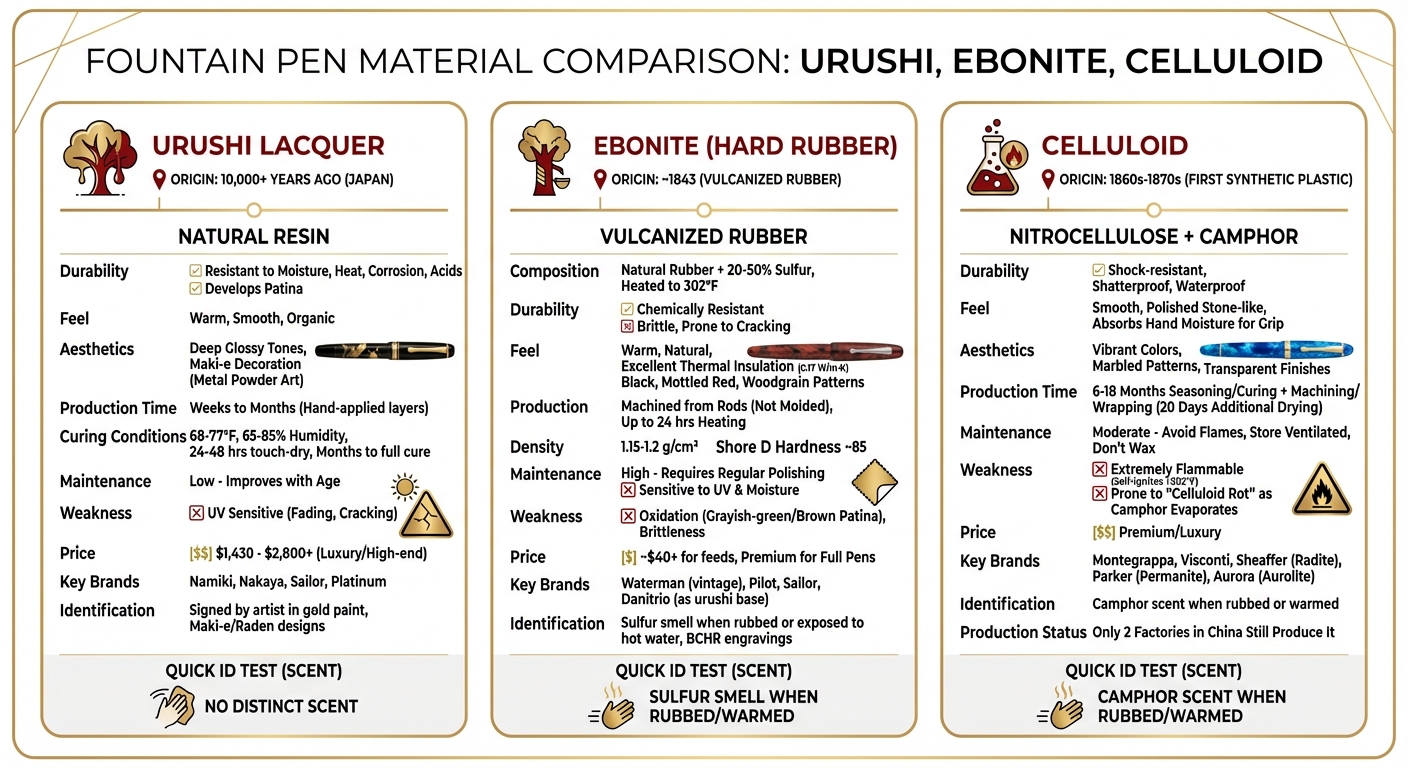
Urushi vs Ebonite vs Celluloid Fountain Pen Materials Comparison
Urushi Lacquer in Fountain Pens
History of Urushi
Urushi lacquer traces its origins back more than 10,000 years to Japan's Jomon period, where it served as an adhesive and protective coating for tools and weapons. The oldest known artifact featuring urushi - a textile fragment from Hokkaido - dates to around 9,000 years ago.
By the Nara and Heian periods (710–1185), urushi had evolved from a practical material into an artistic medium, giving rise to intricate techniques like Maki-e, which involves decorating lacquer with sprinkled metal powders. This artistic significance led Europeans to associate the term "japan" with lacquerware, much like "china" is tied to porcelain.
In the 1920s, Maki-e Master Matsuda Gonroku collaborated with fountain pen makers to bring traditional urushi techniques to international markets. This led to the creation of the "Kokkokai" group within Namiki, laying the groundwork for brands like Namiki, Sailor, Platinum, and Nakaya to craft pens that serve as both tools and art pieces.
Physical Properties of Urushi
Urushi’s appeal lies not just in its history but in its exceptional physical qualities. Once cured, it forms a tough surface resistant to water, heat, corrosion, and acids. Unlike synthetic coatings, urushi offers a warm, smooth feel that seems to come alive in the user’s hand. Over time, it develops a patina, becoming more vibrant and transparent with use. As Living National Treasure Ōnishi Isao describes:
"Layering coat after coat gives a luster with ever greater depth. It's very difficult to get that sheen with any other material."
Urushi doesn’t dry like regular paint. Instead, it cures through oxidative polymerization, a process catalyzed by the enzyme laccase. This requires precise conditions - temperatures of 68–77°F (20–25°C) and humidity levels of 65–85%. While it becomes touch-dry in 24–48 hours, full curing can take months or even a year. However, it is sensitive to UV light, with prolonged exposure potentially causing fading, cracking, or loss of luster.
How Urushi Pens Are Made
Creating an urushi-finished pen is a meticulous process that can take weeks or even months. The journey begins with preparing the pen’s surface, often made of ebonite, by sanding it and applying several layers of raw urushi to fill pores and ensure proper adhesion.
Artisans then build up base and intermediate layers (nakanuri) using multiple coats of lacquer. Each layer is cured in a controlled environment and sanded flat before the next is applied. Pigments, usually limited to 40% of the lacquer’s weight, are added in thin layers.
One popular decorative method is Tamenuri, where transparent urushi is layered over a pigmented base. Artisans carefully sand the edges to reveal the underlying color, creating a striking "lake" effect with rich, layered tones. This step demands precision, as over-sanding can ruin the design, especially on curved surfaces.
The final stages, known as uwazuri and ro-iro, involve applying, wiping, and curing high-quality urushi in repeated cycles. The pen is then hand-polished with fine powders and oil to achieve a mirror-like finish.
Environmental control is critical throughout. According to Sophia Ma of Kyuseido:
"Direct skin contact with the uncured urushi is toxic for most people. This is due to urushiol, which is also found in poison oak and poison ivy, that can cause skin rashes upon contact."
Temperature and humidity fluctuations can cause issues - too low, and the lacquer won’t cure; too high, and colors may darken or muddy. Even a speck of dust on the final coat can ruin the piece, forcing the artisan to start over. Adding to the challenge, raw urushi is scarce. A single lacquer tree yields only about 200 grams of sap over its 10–15-year lifespan, contributing to the high cost of urushi pens. For instance, the Sailor "Rei" Wajima Akebononuri retails for around $1,430, while custom pieces from Kyuseido range between $2,200 and $2,800.
This painstaking process highlights the craftsmanship and dedication behind urushi pens, setting them apart from simpler finishes.
Ebonite in Fountain Pens
History of Ebonite
While urushi is celebrated for its intricate artistry, ebonite earned its place in history through its durability and suitability for mass production. Also known as hard rubber or vulcanite, ebonite became the go-to material for fountain pens in the late 1800s. Invented around 1843, it revolutionized pen manufacturing by providing excellent thermal insulation. This feature prevented the warmth of the writer's hand from affecting the air inside the ink reservoir, reducing the risk of leaks.
Ebonite is made through vulcanization, a process where natural rubber is mixed with 20% to 50% sulfur and then heated to about 302°F (150°C) for several hours. This creates chemical cross-links, turning the rubber into a rigid, acid-resistant material perfect for containing ink.
"The first fountain pens were born substantially as a result of the invention of this material, which with its characteristics of ease of use, chemical inertia... proved to be optimal for the construction of that 'reservoir' of ink." - FountainPen.it
By the 1920s, ebonite began to lose its dominance to celluloid, which offered more vibrant colors and patterns compared to ebonite's typical black, mottled red, or woodgrain finishes. Later, injection-molded plastics like Lucite further pushed ebonite aside by the 1940s. Despite this, ebonite continues to play a key role in modern pen making, especially in premium designs featuring urushi lacquer and for creating high-performance ink feeds.
Physical Properties of Ebonite
Ebonite's resistance to acids and chemicals makes it an excellent material for eyedropper pens, where ink comes into direct contact with the barrel. Its low thermal conductivity, approximately 0.17 W/m·K, helps maintain stable ink temperatures, reducing pressure changes that might cause leaks.
Unlike the cold feel of metal or the slickness of plastic, ebonite offers a warm, organic touch. As noted by UrushiPen.com:
"Ebonite has an added warmth and vitality that acrylic pen bodies don't have. Because it's a natural substance, you might feel like it is alive in your hand." - UrushiPen.com
Ebonite has a density of 1.15 to 1.2 g/cm³ and a Shore D hardness of around 85, making it sturdy yet balanced in weight. It's also easy to machine with simple tools like a lathe, allowing smaller manufacturers to produce custom designs without needing costly molds.
However, ebonite isn't without flaws. It can be brittle and prone to cracking if dropped. Over time, exposure to UV light and moisture can cause sulfur oxidation, leading to a grayish-green or brown patina. A quick way to identify genuine ebonite is to rub it vigorously or expose it to hot water - if it releases a sulfur smell, it's likely authentic.
How Ebonite Pens Are Made
Ebonite’s unique characteristics shape the traditional methods used to craft pens from this material.
The process starts with raw materials like pale crepe or smoked sheet rubber, which are kneaded using heavy rollers to improve pliability. Sulfur and pre-vulcanized ebonite powder are then added to the mix. Unlike modern plastics, ebonite cannot be injection molded. Instead, it is formed into sheets, rods, or tubes via calendering or extrusion.
Once shaped, the material undergoes prolonged heating - sometimes up to 24 hours - to create the chemical cross-links that give it its hard, durable structure. For fountain pens, ebonite rods are machined using techniques like turning on a lathe, grinding, drilling, and polishing.
The classic Black Chased Hard Rubber (BCHR) look is achieved through a vintage engraving technique called chasing. While ebonite is naturally black, it can sometimes feature other hues, such as orange (from cinnabar) or dark red (from hematite).
Because ebonite must be machined rather than molded, pens made from it tend to be pricier than plastic alternatives. For example, Wancher offers ebonite feed upgrades for around $40. High-end Japanese brands like Pilot, Sailor, and Danitrio frequently use ebonite as a base for urushi lacquer. The natural compatibility of these materials enhances the craftsmanship and appeal of premium fountain pens.
Celluloid in Fountain Pens
History of Celluloid
Celluloid, the first synthetic plastic, was developed in the 1860s and 1870s from a mix of nitrocellulose and camphor. By the 1920s, fountain pen manufacturers began using it to replace ebonite. What made celluloid stand out was its ability to offer vibrant colors and intricate designs. While ebonite was limited to darker tones or woodgrain effects, celluloid opened the door to bold hues, transparent finishes, and marbled patterns that mimicked luxurious materials like ivory, tortoiseshell, and mother-of-pearl. Back in 1883, celluloid was even marketed as a cost-effective alternative to ivory, priced at just a third of the cost of the real thing. This blend of affordability and aesthetic appeal made it a hit with consumers in the 1920s.
By the 1940s, however, injection-molded plastics began to dominate, pushing celluloid into niche, high-end markets. Today, it’s reserved for premium, luxury pens due to its rarity and the challenges of production. The manufacturing process is not only labor-intensive but also dangerous, with factory explosions being a known risk. As a result, only two factories in China still produce celluloid. Despite its decline, celluloid remains cherished for its unique properties and rich history.
Physical Properties of Celluloid
Celluloid offers a distinct tactile experience that modern resins can’t replicate. Alan Gill of The Pen Company describes it perfectly:
"Celluloid does have a look and feel which other more modern plastic resins don't... the surface feels smoother, more 'organic'."
One of its standout features is its ability to absorb a small amount of moisture from your hands, improving grip and comfort during extended writing sessions. It’s also hypoallergenic, making it a great option for those with sensitive skin. Despite its dense, stone-like appearance, celluloid is surprisingly lightweight - much easier to handle than metal pens.
Visually, celluloid stands apart because of how it’s made. Colors are mixed into a malleable "dough", which can be layered and rolled multiple times to create intricate, multi-color effects and subtle highlights that injection-molded plastics just can’t match.
However, celluloid isn’t without its flaws. It’s extremely flammable, capable of self-igniting at temperatures above 302°F (150°C). And if a celluloid pen catches fire, you won’t forget the smell. Over time, it’s also prone to "celluloid rot", where camphor molecules evaporate, leaving the material brittle and damaged. A quick way to identify genuine celluloid? Rub it or dip it in warm water - you’ll notice a distinct camphor scent.
How Celluloid Pens Are Made
The craftsmanship behind celluloid pens sets them apart, relying on time-honored, hands-on methods.
The process begins with cellulose, derived from cotton or wood, which is treated with nitric and sulfuric acids to create nitrocellulose. This is then mixed with a 50% camphor-in-alcohol solution to form a gel. The gel undergoes a lengthy "seasoning" period - lasting anywhere from 6 to 18 months - to stabilize before it can be worked with. For instance, Montegrappa insists on a minimum six-month drying phase, during which the material is perforated to improve ventilation.
Unlike modern plastics, which can be injection molded, celluloid requires more traditional techniques:
- Turning: Solid blocks or bars of aged celluloid are hand-machined using a lathe.
- Wrapping: Thin sheets of celluloid (2–3 mm thick) are cut into strips, rolled around a rod to form a tube, and glued into shape. These tubes must then dry for an additional 20 days before further processing.
This painstaking process is a big reason why celluloid pens come with a premium price tag. Italian brands like Montegrappa and Visconti continue to use celluloid, showcasing their dedication to craftsmanship and what many consider the pinnacle of pen-making artistry. Understanding these intricate production methods sets the stage for comparing celluloid with materials like urushi and ebonite in the next section.
sbb-itb-1dd4fe9
Material Comparison: Urushi, Ebonite, and Celluloid
Property Comparison Table
Urushi, ebonite, and celluloid bring distinct qualities to the world of fountain pens, each offering something special. Here's a closer look at what makes each material stand out.
Urushi is known for its incredible durability, with a finish that resists acids and moisture while developing a beautiful patina over time. However, its intricate and time-consuming production process confines it to the luxury market.
Ebonite acts as a remarkable thermal insulator, preventing leaks caused by heat expansion in the ink reservoir. While it resists chemicals, it’s prone to brittleness and can oxidize when exposed to UV light or moisture, forming a dull film. Regular polishing can extend its life significantly, with some ebonite pens lasting over a century.
Celluloid stands out for its shock resistance and the wide variety of colors and patterns it offers. As Alan Gill of The Pen Company puts it:
"Celluloid is widely hailed as the resin material for pens... it has a look and feel which other more modern plastic resins don't".
That said, celluloid has its downsides. It’s highly flammable and susceptible to "celluloid rot" as camphor evaporates over time. Additionally, its lengthy 18-month curing process adds to its premium cost.
Here’s a quick summary of their key attributes:
| Feature | Urushi Lacquer | Ebonite (Hard Rubber) | Celluloid |
|---|---|---|---|
| Durability | Resistant to corrosion and moisture | Chemically resistant but brittle; vulnerable to shocks | Shatterproof, shock-resistant, and waterproof |
| Tactile Feel | Warm, smooth, and organic | Warm; excellent thermal insulation | Smooth, solid, with a polished stone-like feel |
| Aesthetics | Deep, glossy tones; often features Maki-e or Raden | Naturally black with mottled or rippled red patterns | Vibrant colors, patterns, and transparencies |
| Maintenance | Low; improves with age and use | High; sensitive to light and humidity | Moderate; avoid flames and sulfur-emitting items |
| Production Time | Hand-applied layers over weeks or months | Machined from solid bars; not moldable | Machined after an 18-month curing period |
| Price Range | Luxury/high-end pens | Premium artisanal or vintage pens | Premium/luxury pens |
Identifying Rare Pens by Material
Collectors often rely on specific markers to determine a pen's rarity and authenticity. These markers - whether it’s urushi’s artistic details, ebonite’s texture, or celluloid’s scent - help enthusiasts identify valuable pieces.
For urushi, look for pens adorned with Maki-e or Raden designs. High-end urushi pens are often signed by the artist in gold paint, and notable brands include Namiki, Nakaya, and Sailor.
If you’re into ebonite, vintage models with intricate engravings on Black Chased Hard Rubber (BCHR) or red-black rippled patterns are worth seeking out. Waterman is a classic name in this space. A quick rub of the material releases a distinct scent of burning rubber or sulfur, a telltale sign of genuine ebonite.
For celluloid, brands often used proprietary names like Radite (Sheaffer), Permanite (Parker), Pyroxalin (Eversharp), Aurolite (Aurora), or Pearltex (a nacre-infused version by Carter). Rubbing the barrel of a true celluloid pen will release a camphor scent. Modern Italian makers like Montegrappa and Visconti continue crafting celluloid pens, keeping the tradition alive.
My Top 10 Favourite Pen Materials
Conclusion
When choosing between urushi, ebonite, or celluloid, your decision should align with your personal style and how much care you’re willing to invest. Each material offers distinct advantages and demands.
Urushi stands out for its resilience against corrosion and moisture, while also developing a beautiful patina over time. As one expert explains:
"Unlike other materials that may degrade, Urushi pens improve aesthetically with time".
This makes urushi a great choice if you want a pen that ages gracefully with little maintenance.
Ebonite, on the other hand, requires more attention. Its natural thermal insulation helps prevent ink burping, and its chemical resistance makes it ideal for eyedropper-fill designs. However, it’s sensitive to light and humidity, which can lead to oxidation. Danny Watts, author of Chronicles of a Fountain Pen, advises:
"Storing an ebonite pen in a well ventilated, low humidity location will decrease the amount of acid produced".
While ebonite pens offer vintage charm, they are prone to cracking and must be handled with care.
Celluloid demands the highest level of care. Danny Watts cautions:
"Please don't wax celluloid pens; the wax seals the pen, preventing the nitrocellulose gas from escaping and hastening decomposition".
These pens should be stored in ventilated spaces and kept away from flames due to their flammability. In return, celluloid offers vibrant patterns and a solid, shatterproof feel for collectors who value its distinctive look.
FAQs
Which material is best for everyday carry?
For everyday carry, plastic and acrylic stand out as excellent choices because they’re tough, low-maintenance, and can handle impacts well. Plastic is both budget-friendly and simple to care for, while acrylic adds a touch of flair with its vibrant designs and extra durability.
On the other hand, ebonite and celluloid are more delicate. They’re susceptible to discoloration, warping, and require careful upkeep, which makes them less suited for the wear and tear of daily use.
How should I store ebonite or celluloid long-term?
To keep ebonite and celluloid in good condition, store them in a cool, dry, and dark place. Ebonite is prone to discoloration or oxidation when exposed to sunlight or moisture, while celluloid is not only sensitive to heat but also highly flammable. To avoid deterioration or risks, keep these materials away from direct sunlight, high humidity, and any heat sources. Taking these steps will help preserve their quality and reduce potential hazards over time.
How can I tell urushi, ebonite, and celluloid apart?
Urushi lacquer stands out with its deep, glossy finish, creating smooth and durable layers often adorned with intricate artistic designs. Ebonite, on the other hand, mimics the look of dark wood, featuring a matte or slightly textured surface that offers a warm, natural feel and can develop a patina over time. Meanwhile, celluloid is known for its vibrant appearance, showcasing marbled or translucent patterns with a smooth, plastic-like texture and a subtle sheen. Each material brings its own unique visual and tactile charm.