

When it comes to Japanese lacquer art on fountain pens, two techniques stand out: Togidashi Maki-e and Taka Maki-e. Both rely on urushi lacquer and metal powders, but they create distinct effects:
- Togidashi Maki-e: Designs are embedded under multiple lacquer layers and polished until smooth. The result is a flat surface with a design that appears to "float" beneath the lacquer.
- Taka Maki-e: Designs are built up with materials like charcoal powder, creating a raised, textured surface with a three-dimensional look.
Both methods require years of expertise and months of work to complete a single pen. Togidashi offers a sleek, polished look, while Taka provides a tactile, sculptural quality. High-end pens often combine both for a dynamic contrast.
Quick Comparison
| Feature | Togidashi Maki-e | Taka Maki-e |
|---|---|---|
| Texture | Smooth and flat | Raised and textured |
| Visual Effect | Subtle depth, floating look | Bold, 3D relief |
| Feel in Hand | Sleek and uniform | Contoured and tactile |
| Best For | Backgrounds, subtle designs | Focal points, bold details |
Whether you prefer the subtle elegance of Togidashi or the bold texture of Taka, both techniques showcase the artistry and precision of Japanese lacquer work.
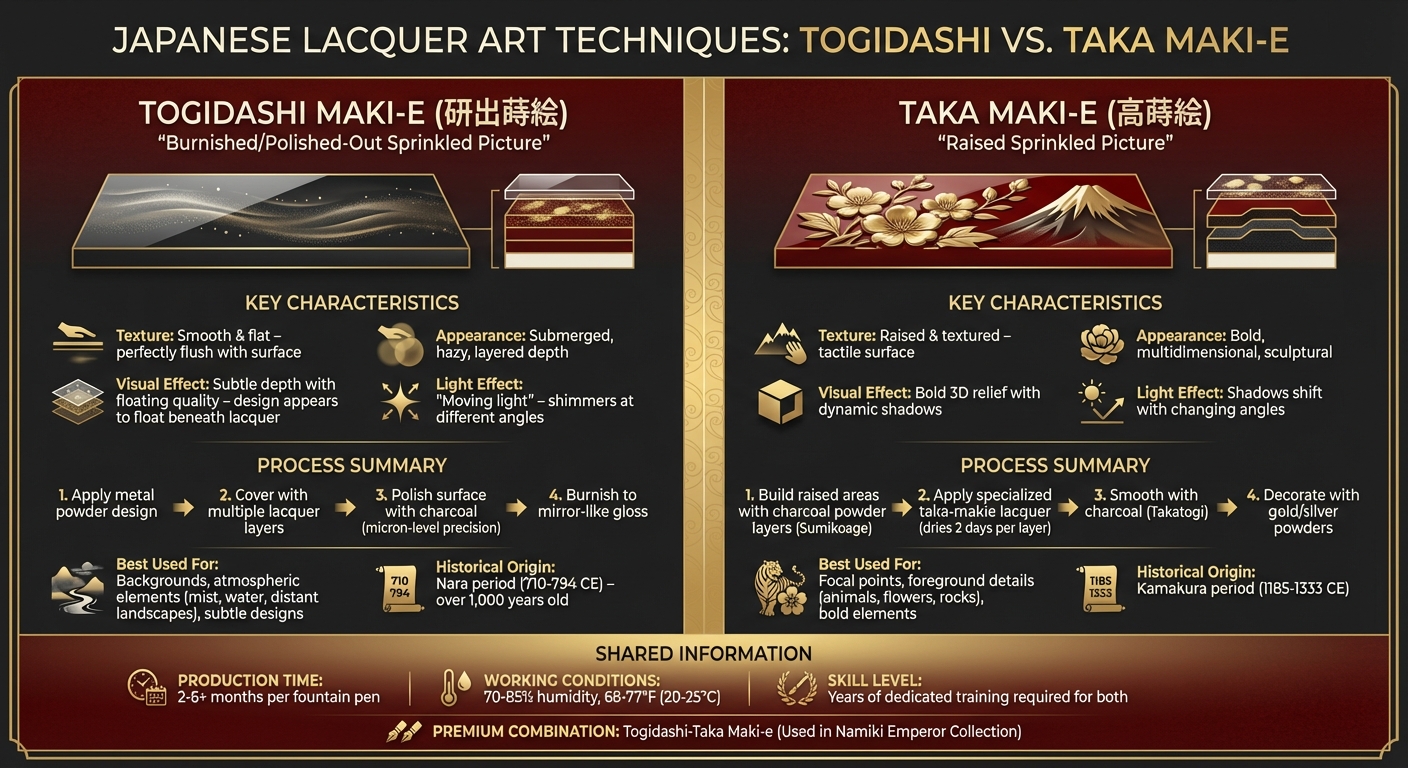
Togidashi vs Taka Maki-e Techniques Comparison Chart
The art of creating a Maki-e fountain pen
What is Togidashi Maki-e?
Togidashi Maki-e (研出蒔絵) translates to "burnished" or "polished-out" sprinkled picture. This intricate technique involves creating a design with precious metal powders, embedding it beneath multiple layers of lacquer, and then polishing the surface until the pattern reappears - perfectly smooth and level with the object’s surface. The result? A flawless, glass-like finish where the design seems to float within the lacquer.
This method dates back over 1,000 years to Japan's Nara period (646–794), with the term "Togidashi" first recorded during the Heian period (794–1185). By the Muromachi and Edo periods, it gained prominence in tea ceremony culture, admired for its subtlety and the way it evoked "beauty that appears and disappears" through understated designs and shadowy depth. These qualities continue to shape its use today, particularly in the decoration of fountain pens.
The Togidashi Maki-e Process
The creation of Togidashi Maki-e is a multi-step process that demands incredible precision and patience. It begins with transferring the design (okime) onto the surface using urushi lacquer, followed by sprinkling (funmaki) gold or silver powder onto the wet lacquer. A fixing layer (fungatame) is then applied to secure the powder in place.
Next comes the layering phase (nurikomi), where multiple coats of lacquer - often black or transparent - completely cover the design. This stage is crucial as it determines the depth of the pattern. Once the layers have cured, the surface is meticulously polished (togidashi) with charcoal or whetstones to gradually reveal the hidden design. Finally, the piece is burnished (migaki) using fine powders, such as deer antler powder, and oil to achieve a mirror-like gloss.
"The surface is subsequently polished with fine pumice and powders until the decoration reappears, now incorporated into the totally flat polished surface." - Seishu Makie
The polishing process is incredibly delicate, requiring artisans to stop at just the right moment - down to the micron level - to ensure the design emerges with perfect clarity. This level of precision can only be achieved through years of dedicated training.
Togidashi Characteristics
What sets Togidashi apart is its perfectly smooth surface. Unlike other maki-e techniques, you won’t feel any texture when running your fingers across the design.
Even though the surface is flat, Togidashi creates an illusion of depth. The metal powders, viewed through the transparent lacquer layers, appear to float, giving the design a three-dimensional quality. The shimmering effect of the metal changes with the angle of light, producing what artisans describe as a "moving light" effect. This dynamic interplay between flatness and visual depth makes Togidashi especially captivating on fountain pens, where the design seems to shift as you write, adding a sense of elegance to everyday use.
Togidashi is often used to create background elements in elaborate designs or combined with other techniques like Taka Maki-e to contrast flat and raised areas. For example, the Namiki Emperor Collection features "Togidashi-Taka Maki-e", a combination technique reserved for high-end pens due to the extraordinary time and skill required.
What is Taka Maki-e?
Unlike the smooth, mirror-like finish of Togidashi, Taka Maki-e (高蒔絵) stands out with its raised designs that add depth and texture. These elevated patterns create a sculptural effect, with shadows shifting as light and perspective change. It’s a technique that doesn’t just catch the eye - it invites touch.
This method is among the most intricate in the world of maki-e, demanding exceptional skill and patience. For instance, the Namiki Emperor Collection employs the "Togidashi-Taka Maki-e" process, combining flat and raised elements to produce its most prestigious fountain pens. Achieving these three-dimensional effects requires layering multiple coatings of lacquer under precise conditions. Craftsmen work in controlled environments, maintaining a temperature of around 77°F (25°C) and humidity levels between 30–40% to avoid issues like static electricity in the lacquer.
The Taka Maki-e Process
The creation of Taka Maki-e begins with transferring a design onto the surface. To build the raised areas, artisans use methods like the Sumikoage technique, which involves sprinkling fine charcoal powder onto wet lacquer. This process is repeated until the desired height is achieved, with each layer set using a thin lacquer coating and left to dry for about half a day.
Once the charcoal base is complete, the Takaage phase begins. Here, a specialized "taka-makie lacquer" is carefully applied layer by layer, drying for two full days between applications. Afterward, the raised surface is smoothed using charcoal in a step called Takatogi, ensuring an even foundation for decoration. Finally, gold or silver powders are applied to bring the design to life.
For high-end creations, the process becomes even more meticulous. Consider the Grand Seiko SBGK002 and SBGK004 models, where master craftsman Isshu Tamura took the technique to new heights. Using a 30× microscope, he repeatedly applied sticky lacquer and built up layers of gold and platinum powders until the grains no longer sank into the surface. The result? What Tamura describes as a "lump of gold" rather than just a surface coating. To polish these delicate raised designs without damaging their sharp contours, Tamura used the fang of a sea bream - an ancient tool prized for its gentle finish.
"The resulting taka maki-e relief generates all manner of shadows depending on the angle from which you look at it, all the while maintaining legibility, and it will go on aging to shine in many diverse ways."
- Isshu Tamura, Master Maki-e Craftsman
This meticulous layering process not only adds height but also sets the stage for the dynamic interplay of light and shadow that defines Taka Maki-e.
Taka Characteristics
What sets Taka Maki-e apart is its tactile quality. Unlike the smooth finish of Togidashi, Taka Maki-e’s raised designs create a dynamic play of shadows that shift with changing light, offering a visual depth that flat techniques can’t replicate.
These raised elements represent the peak of lacquer artistry. The process - meticulously layering materials over several days, maintaining strict environmental conditions, and using specialized tools - makes this technique exclusive to premium fountain pens. Often, Taka Maki-e is combined with Togidashi, creating a stunning contrast between flat and raised areas. Namiki emphasizes that this combination "requires a lot of time, work and advanced skills".
sbb-itb-1dd4fe9
Togidashi vs. Taka Maki-e: Main Differences
The unique visual and tactile qualities of Togidashi and Taka Maki-e come down to their distinct processes and applications in fountain pen design. Here's a closer look at how these techniques differ and complement each other.
Process Comparison
The core distinction between these two methods lies in how they bring designs to life. Togidashi Maki-e involves layering the design under multiple coats of urushi lacquer. Artisans paint the pattern, sprinkle metal powder, and embed it beneath successive lacquer layers. Once cured, the surface is carefully sanded with charcoal to reveal the design, resulting in a perfectly flat finish.
On the other hand, Taka Maki-e focuses on building the design upward. Using materials like charcoal powder, tin, or clay mixed with lacquer, artisans create raised elements through a process called takaage. These raised areas are then smoothed and intricately decorated, maintaining their elevated texture.
Both techniques demand precision during polishing. Togidashi requires micron-level accuracy to avoid over-polishing (togi-yaburi), which could damage the design, or under-polishing, which might leave it unclear. Meanwhile, Taka Maki-e involves careful shaping to preserve its three-dimensional contours, making it one of the most intricate styles of maki-e.
Appearance and Texture Differences
The visual and tactile results of these techniques are strikingly different. Togidashi creates a smooth, submerged design that seems to float beneath the lacquer, offering a soft, hazy, and layered depth. In contrast, Taka Maki-e produces raised, textured designs with a bold, three-dimensional effect.
| Feature | Togidashi Maki-e | Taka Maki-e |
|---|---|---|
| Texture | Smooth and flush | Raised and textured |
| Visual Effect | Depth with a floating quality | High relief with shadows |
| Feel in Hand | Sleek and uniform | Contoured and tactile |
| Design Appearance | Subtle and submerged | Bold and multidimensional |
Historically, Togidashi dates back to the Nara period (710–794 CE), while Taka Maki-e emerged later during the Kamakura period (1185–1333 CE). Both require controlled conditions - 70–85% humidity and 68–77°F (20–25°C) - to ensure the lacquer cures properly.
How Each Technique is Used in Fountain Pens
In fountain pen design, these techniques serve distinct artistic purposes. Togidashi is perfect for creating backgrounds and atmospheric elements like mist, water, or distant landscapes. Its smooth finish adds depth without overshadowing the overall design.
Taka Maki-e, on the other hand, is often used for focal points such as animals, flowers, or rocks. Its raised features catch light from various angles, adding drama and a tactile element to the pen's surface. High-end pens, like those in the Namiki Emperor Collection, often combine both techniques in Shishiai Togidashi-Taka Maki-e. In these designs, distant elements are rendered flat with Togidashi, while foreground details are brought to life in relief with Taka, creating a dynamic and layered composition.
"Compared to other Maki-e techniques, three-dimensional and deep expressions are possible [with Togidashi-Taka Maki-e]... this requires a lot of time, work and advanced skills." - Namiki
Crafting a single maki-e fountain pen can take anywhere from two to six months or more, regardless of the technique used. Whether a pen feels sleek and understated or bold and sculptural depends on the choice of Togidashi, Taka, or a blend of both styles.
Conclusion
Togidashi and Taka Maki-e represent two distinct yet equally captivating approaches to Japanese lacquer art, each offering its own visual and tactile allure. Togidashi is known for its flawlessly smooth surface, where intricate designs seem to float beneath layers of lacquer. In contrast, Taka Maki-e creates raised, three-dimensional elements, adding texture and depth that can be felt as well as seen. Mastering either technique demands extraordinary skill - Togidashi requires polishing with precision down to the micron level, while Taka Maki-e is considered the most technically demanding of the foundational maki-e styles.
Choosing between these techniques often depends on personal taste. For those drawn to a sleek, seamless finish with an illusion of depth, Togidashi offers that ethereal, submerged effect. Meanwhile, Taka Maki-e appeals to those who appreciate a textured, sculptural surface that interacts with light in dynamic ways. Luxury fountain pens, such as those in the Namiki Emperor Collection, frequently combine these methods, blending burnished, smooth backgrounds with raised, detailed foregrounds. This fusion not only enhances the pen's aesthetic but also showcases the remarkable craftsmanship behind each piece.
"Owning a piece of Maki-e is not just acquiring an object, it's embracing a piece of history, culture, and artistic excellence." - Sophia Ma, Kyuseido
FAQs
Which technique is more durable for daily use?
Togidashi Maki-e tends to hold up better for everyday use due to its smooth surface being embedded within several layers of urushi lacquer. This creates a durable and resilient finish. On the other hand, Taka Maki-e, with its raised patterns, depends on layered lacquer for its design, which can be more prone to wear over time.
How can I tell Togidashi from Taka Maki-e by touch?
You can tell the difference between Togidashi Maki-e and Taka Maki-e by how they feel to the touch. Togidashi Maki-e has a smooth, polished surface that feels subtle and refined. In contrast, Taka Maki-e stands out with its raised, textured design. This effect is achieved by layering lacquer and materials like metal powders, creating a more three-dimensional and pronounced texture.
Why do some pens use both techniques?
Some pens incorporate both Togidashi and Taka Maki-e techniques, as the two methods work together to elevate both the look and durability of the design. Togidashi provides a smooth, polished finish with a reflective depth, while Taka Maki-e introduces raised, textured patterns. When combined, these techniques create a balance of visual complexity and tactile appeal. The polished layers of Togidashi also act as a protective seal for the intricate, raised Taka Maki-e elements, highlighting the artistry and craftsmanship involved.