

The best custom pen body is usually the one that fits your hand, stays sealed, and lands in the right weight range for how long you write. If I were buying one today, I’d focus on three numbers first: uncapped length of 4.7–5.5 in. (120–140 mm), grip diameter of about 0.40–0.45 in. (10–11.5 mm), and total weight of 15–25 g for long sessions or 25–35 g for short notes.
Here’s the short version:
- I’d measure a pen I already like and use a nib size calculator to match my writing style
- I’d decide posted or unposted before ordering
- I’d pick material based on grip feel, weight, and upkeep
- I’d ask how the inner cap seals and how long the pen can sit capped
- I’d confirm all specs in writing before paying, especially for a custom order
A few points matter more than the rest:
- A bad cap seal can cause hard starts in days
- Thread placement can change comfort fast
- Heavy metal pens often pass 30 g, which may feel fine for short use but tiring for long writing
- Custom lead times often run about 2 to 8+ weeks
If I wanted a simple way to choose, I’d put fit first, seal second, looks third. That keeps me from paying extra for details I won’t notice once I start writing.
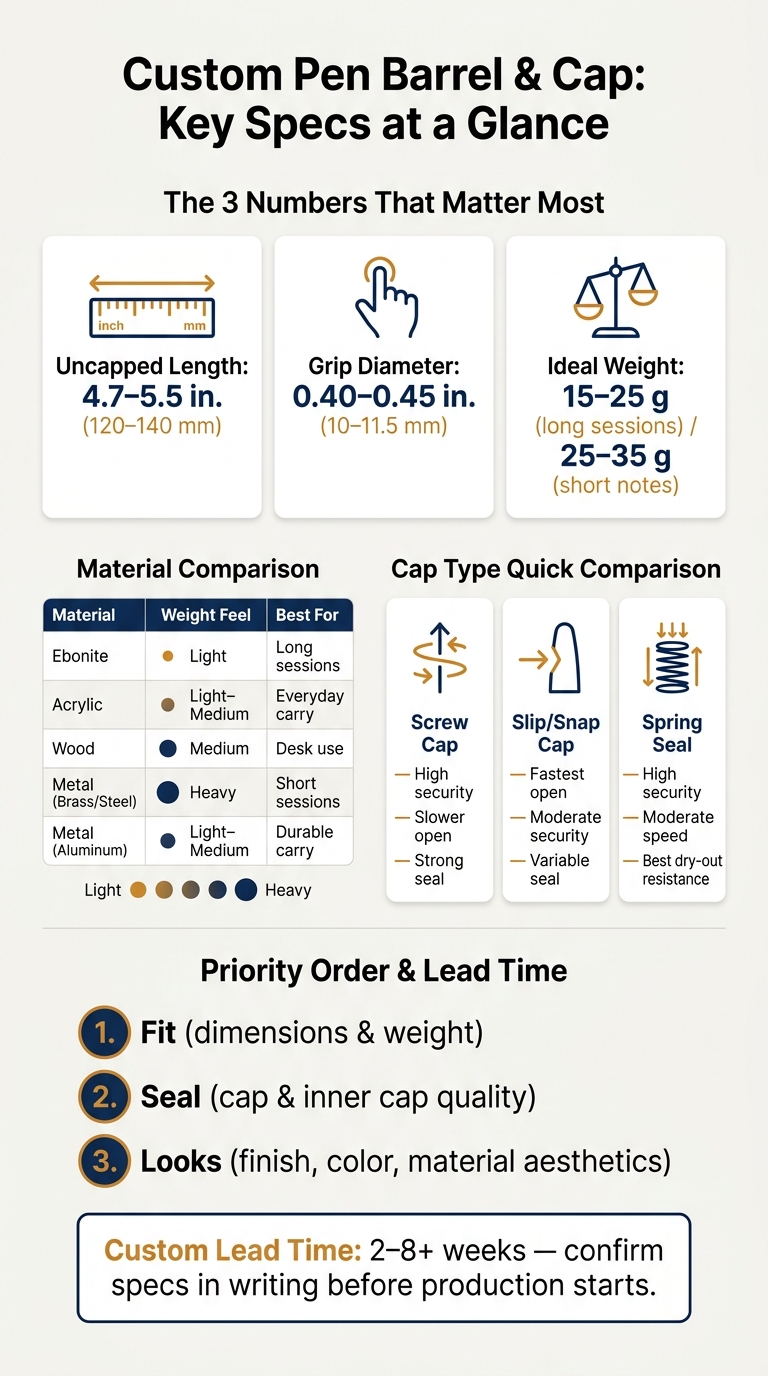
Custom Pen Barrel & Cap: Key Specs at a Glance
Bespoke Pen Making Series | Pt. 3 | The Barrel
sbb-itb-1dd4fe9
Quick Comparison
| What to compare | Best target for many users | Why it matters |
|---|---|---|
| Uncapped length | 4.7–5.5 in. (120–140 mm) | Affects reach and control |
| Grip diameter | 0.40–0.45 in. (10–11.5 mm) | Affects finger pressure and comfort |
| Weight for long writing | 15–25 g | Often feels easier over time |
| Weight for short notes | 25–35 g | Can feel more planted on the page |
| Cap type | Screw, slip, magnetic, or spring seal | Changes carry security, opening speed, and dry-out risk |
| Best daily-buy question | How long can it sit capped without hard starts? | Tells me more than vague seal claims |
| Budget focus | Fit, weight, seal | These shape day-to-day use most |
I’d use this guide to narrow the order down before I contact a maker, so the quote is based on clear measurements instead of guesses.
Step 1: Understand How a Bespoke Barrel and Cap Order Works
A bespoke order usually starts with a clear brief and ends with the maker confirming dimensions, materials, and hardware before production begins. Most makers begin with the big choices first: shape, size, material, and hardware, then lock in the final details. Once you have those basics, the next job is simple: gather the measurements and preferences the maker needs.
What to Gather Before You Order
Before you place an order, measure a pen you already enjoy using. Write down its capped length, uncapped length, posted length, widest barrel diameter, section diameter, and weight.
It also helps to note how you actually use the pen day to day. Do you post the cap or not? Where do you grip the section? Do you hold the pen with a tight grip or a light one? How long are your usual writing sessions? And which filling system do you want - cartridge/converter, piston, or eyedropper?
Those details matter more than people think. They affect wall thickness, the amount of space inside the barrel, and how the cap needs to be built. Last, make a short list of appearance preferences, such as:
- Color family
- Surface finish
- Translucency
- Clip style
That gives the maker enough direction to suggest material options that look the way you want without weakening the pen.
Questions to Ask About Construction and Lead Time
Once your measurements and preferences are written down, ask the maker direct technical questions. Start with wall thickness for your chosen material, especially if you want an eyedropper fill. Then ask where the cap threads sit and whether they’ll land under your grip.
That point can make or break comfort. A barrel may look great on paper, but if the threads hit the wrong spot, the pen can feel off in your hand. Pen-making guidance recommends keeping about 1 mm of solid material between connector threads and cap threads to preserve structural integrity and help prevent cracking.
You should also ask whether the pen includes an inner cap and how well it prevents nib dry-out over several days or weeks. A good inner cap cuts down air exchange and helps the pen start cleanly after sitting unused. After that, confirm whether the cap posts securely without putting stress on the barrel.
Lead times can vary a lot. Simple orders may take about 2 weeks, while custom commissions often take 6–8 weeks or more. That timing affects when you need to finalize measurements and material choices. It’s also smart to ask whether the maker shares design drawings or measurement confirmations before cutting material, and how often they send updates.
How to Use a Pen You Already Own as a Reference
Your favorite everyday pen is one of the best reference tools you have. Measure it, then note what feels right about it - especially how it balances posted or unposted. Tell the maker exactly what you want matched and what you want changed.
For example, you might ask them to keep the same section diameter but make the uncapped length 0.25 inches longer. That’s much more useful than saying you want something “medium-sized.”
If you’re still figuring out your ideal size and weight, try a few lower-cost pens from Fountain Pen Revolution that list their dimensions. That can help you sort out whether you lean toward a lighter, shorter barrel or a longer, heavier one. Those sizing notes give a custom maker what they need to dial in the barrel size, weight, and material in Step 2.
Step 2: Choose Barrel Size, Weight, and Material for Your Writing Style
Barrel Length, Diameter, and Balance
Once you’ve measured your reference pen, use those numbers to pick the dimensions that shape how a pen feels in your hand. The big three are uncapped length, grip diameter, and balance.
For most people, an uncapped length between 4.7 and 5.5 inches (120 to 140 mm) feels right. If you have larger hands or you naturally hold the pen farther back, you’ll likely prefer the longer end of that range. If your hands are smaller or you use a standard tripod grip, 4.7 to 5.1 inches (120 to 130 mm) often feels better because it cuts down on leverage and finger strain.
Grip diameter matters just as much. In many cases, a grip around 9 to 10 mm helps with comfort and lowers strain. For most writers, 0.40 to 0.45 inches (10 to 11.5 mm) is a good target. If you have larger hands or tend to grip tightly, going above 0.45 inches (11.5 mm) can help. A thicker grip spreads pressure across more of your fingers, which can ease that pinched feeling.
Then there’s balance. This is one of those things you notice fast once you start writing. For short notes and quick signatures, many people like slightly heavier pens in the 25 to 35 g range. That extra mass can help the nib move across the page with less downward pressure. For longer writing sessions - journaling, note-taking, or drafting - a more neutral balance and a total weight closer to 15 to 25 g usually feels easier on the hand. A back-heavy pen, especially one with a heavy posted cap, can wear you out faster during long sessions.
Material Options: Ebonite, Acrylic, Wood, and Metal
After size, material has the biggest effect on weight and grip.
Ebonite - also called hard rubber - feels warm in the hand and offers a bit of grip. That can be a big plus if slick sections bother you. The downside is upkeep: it can oxidize and discolor if it spends too much time in the sun.
Acrylic resin is common for a reason. It comes in bold colors, swirls, and translucent finishes, and it resists staining well. The catch is the surface. If it’s polished to a high gloss, it may feel slippery, especially if your hands run warm.
Wood has a warm, natural feel that a lot of people enjoy. It also asks for more care than acrylic. Moisture, temperature swings, and bumps can affect it over time, so it’s not always the easiest pick for rough daily use.
Metal barrels - like brass, stainless steel, or aluminum - are the toughest option. Brass and steel often push a pen above 30 g, and that extra weight can become tiring in longer sessions. Aluminum is much lighter, so it gives you the toughness of metal without as much heft. One thing to keep in mind: metal can feel cold in air-conditioned rooms or during winter.
Material Comparison Table: Comfort and Upkeep
| Material | Weight Feel | Surface Feel | Maintenance | Durability | Best For |
|---|---|---|---|---|---|
| Ebonite | Light | Warm, slightly grippy | Occasional polish; avoid sun and harsh cleaners | Good; can oxidize over time | Long sessions, light grip pressure |
| Acrylic | Light to medium | Smooth, can be slippery when glossy | Easy; wipe clean, stain-resistant | Very good | Everyday carry, visual appeal |
| Wood | Medium | Warm, organic | Periodic conditioning; protect from moisture and heat | Moderate; sensitive to environment | Desk use, natural aesthetic |
| Metal (brass/steel) | Heavy | Solid, can feel cold | Low; very easy to clean | Excellent | Short sessions, tough carry, professional look |
| Metal (aluminum) | Light to medium | Solid, less cold than brass | Low; easy to clean | Excellent | Everyday carry with durability priority |
Step 3: Evaluate Cap Design and Seal Performance
Once you've settled on size and material, the cap becomes a big part of how the pen feels in daily use. It doesn't just change the look of the pen. Its main job is to shield the nib and feed from air so the ink stays wet and the pen is ready when you pick it up again.
If the seal is weak, you'll notice it fast: hard starts after the pen has been sitting for a while. For a custom pen, cap choice usually comes down to three practical things: carry security, opening speed, and dry-out resistance.
Screw Caps, Slip Caps, and Posting Behavior
Screw caps thread onto the barrel, so they’re less likely to come loose in a bag or backpack. That’s the big upside. The downside is speed. Many screw caps need anywhere from a half-turn to two full turns to open. If you jot down notes in class or during meetings, ask the maker for the exact turn count. That small detail can make a big difference over time.
Slip and snap caps open in one motion, which makes them a good fit for fast note-taking. But their security depends on how tightly the cap grips the barrel. If the snap fit is loose, the cap can come off in a bag or get looser with repeated use.
For daily carry, ask for:
- jostling-test results
- the feature that keeps the cap secure in a bag
Posting matters too. A cap that posts well can improve balance and feel. But aggressive posting can wear down softer materials over time. And while posting security matters, the inner cap is what has the biggest effect on whether the pen stays ready to write.
What to Ask About Inner Caps and Airtight Sealing
The inner cap is the part that seals the nib and feed. The outer cap mainly acts as a shell around it. So when you talk with the maker, ask whether the pen has a dedicated inner cap and how that seal works: friction fit, gasket, or a spring-loaded system.
Each option has trade-offs. A gasket can seal well, but it may wear down with temperature changes or contact with hand oils over time. Because of that, it’s smart to ask whether the gasket can be replaced by the user.
When you're judging dry-out resistance, use capped-storage duration as the yardstick. In plain English: how long can the pen sit capped before hard starts begin? Ask for the tested capped-storage duration, not just a general claim that the seal is “good.”
Cap Design Comparison Table: Ease of Use and Drying Resistance
Use the table below to compare opening speed, bag security, and drying resistance.
| Cap Type | Closure Method | Seal Mechanism | Opening Speed | Security in Bag | Posting Comfort | Dry-Out Resistance |
|---|---|---|---|---|---|---|
| Screw cap | Twists onto threads | Inner cap or shaped sealing surface at section | Slower | High | Usually stable if threads and posting are well designed | Strong; depends on inner cap quality |
| Slip cap | Pushes on or clicks into place | Friction fit or inner cap | Fastest | Moderate to high if fit is firm | Can be very good; varies by design | Variable; excellent on well-made designs, weaker on loose ones |
| Spring seal | Screw or push closure depending on design | Spring compresses inner cap against section | Moderate | High | Depends on barrel shape and posting design | Very strong for dry-out resistance |
Step 4: Match Your Design Choices to Your Budget and Place the Order
Set a Budget: Function First, Looks Second
Once you've locked in the size, material, and cap style, let your budget decide which extras stay and which ones get cut.
Start with the basics: fit, balance, and a cap that seals well. That's where your money should go first. Spend more only when you move into finer finishing, higher-end materials, or custom shaping.
It helps to think in tiers. At the entry level, you're paying for the basics done right: a dependable cap seal and the correct dimensions. Mid-range orders usually give you cleaner finishing and better material options. At the higher end, the price often comes from more detailed shaping and a tighter fit.
Put your money into the parts you'll notice every time you write:
- Comfortable dimensions
- Correct weight
- A cap that seals well
Decorative upgrades like exotic materials, special inlays, or custom color blends only make sense after those core parts are handled. A pen can look stunning, but if it dries out fast or feels off in your hand, the extra cost doesn't do much for you.
A Final Checklist Before You Place the Order
Before you approve production, get the final specs confirmed in writing. This is your last pass to make sure the measurements, material, and sealing choices match what you agreed on.
Check these details with the maker:
- Dimensions: capped, uncapped, and posted length; barrel diameter at the grip and at the widest point
- Target weight and whether the maker can hit it in your chosen material
- Posting preference: does the cap post, and does the maker recommend it?
- Cap seal method: inner cap, gasket, or other
- Care and finish: how the surface wears and what maintenance it needs
- Lead time and whether delays are possible if materials change
- Revision, return, and final-sale terms: many makers treat custom orders as final sale once production starts.
- Reference details: confirm whether the maker wants a reference pen, nib size, or photos showing the preferred profile
Conclusion: The Best Tailored Barrel and Cap Is the One You Will Use
Choose the simplest design that fits your hand, seals well, and matches how you write.
FAQs
How do I know if a custom pen will fit my hand?
Fit mostly comes down to the section or grip section - the part you actually hold while writing. And because comfort is personal, how a pen feels in your hand matters more than the spec sheet alone.
Pay attention to the section’s diameter, taper, shape, and surface texture. Round sections tend to work for more people, while angular or molded ones can help guide finger placement. On the flip side, narrow, slippery, or short sections can feel tiring or cramped, especially during longer writing sessions.
What cap seal should I ask for to prevent hard starts?
Ask for a high-quality cap seal that keeps moisture around the nib and feed. A good seal helps stop ink from evaporating when the pen isn’t in use.
For a bespoke cap, focus on dimensional accuracy so the cap liner sits snugly and makes an airtight fit against the section.
Which pen material is best for my writing habits?
It comes down to how you like a pen to feel in your hand, how much weight you want, and how you plan to use it day to day.
- Ebonite works well for long journaling sessions. It feels warm, velvety, and naturally grippy, which can make long writing stretches easier on the hand.
- Acrylic is usually lighter and warms up fast while you write. If you like a pen that feels easy to carry and easy to pick up, this can be a good fit.
- Metal or high-performance thermoplastics are built to take more bumps and drops. The tradeoff is simple: metal can feel cold at first and a bit heavy during long writing sessions.