

If you want handwritten letters to last, store them flat in acid-free folders, place those folders in archival boxes, and keep the boxes in a dark room around 65–70°F with 35%–50% relative humidity.
That’s the short answer. In most homes, damage comes from four things: light, heat, moisture, and rough handling. The article also points out one hard number worth remembering: mold can start when air stays above 60% RH and above 70°F for more than 48 hours.
Here’s the whole plan in plain English:
- Handle letters with clean, dry hands
- Remove clips, rubber bands, and loose fasteners if it’s safe
- Keep each letter with its envelope
- Store letters flat and unfolded when possible
- Use acid-free, lignin-free folders and archival boxes
- Use inert plastic sleeves only; avoid PVC and vinyl
- Keep boxes off the floor and out of attics, basements, garages, kitchens, and bathrooms
- Check the room with a thermometer-hygrometer
- Scan fragile or often-used letters at 300–600 dpi
- Use a simple inventory so you don’t keep opening boxes
I’d sum it up this way: good letter storage is less about fancy gear and more about steady conditions. Keep letters cool, dry, dark, and touched as little as possible, and you give the paper and ink a much better shot at staying readable for years.
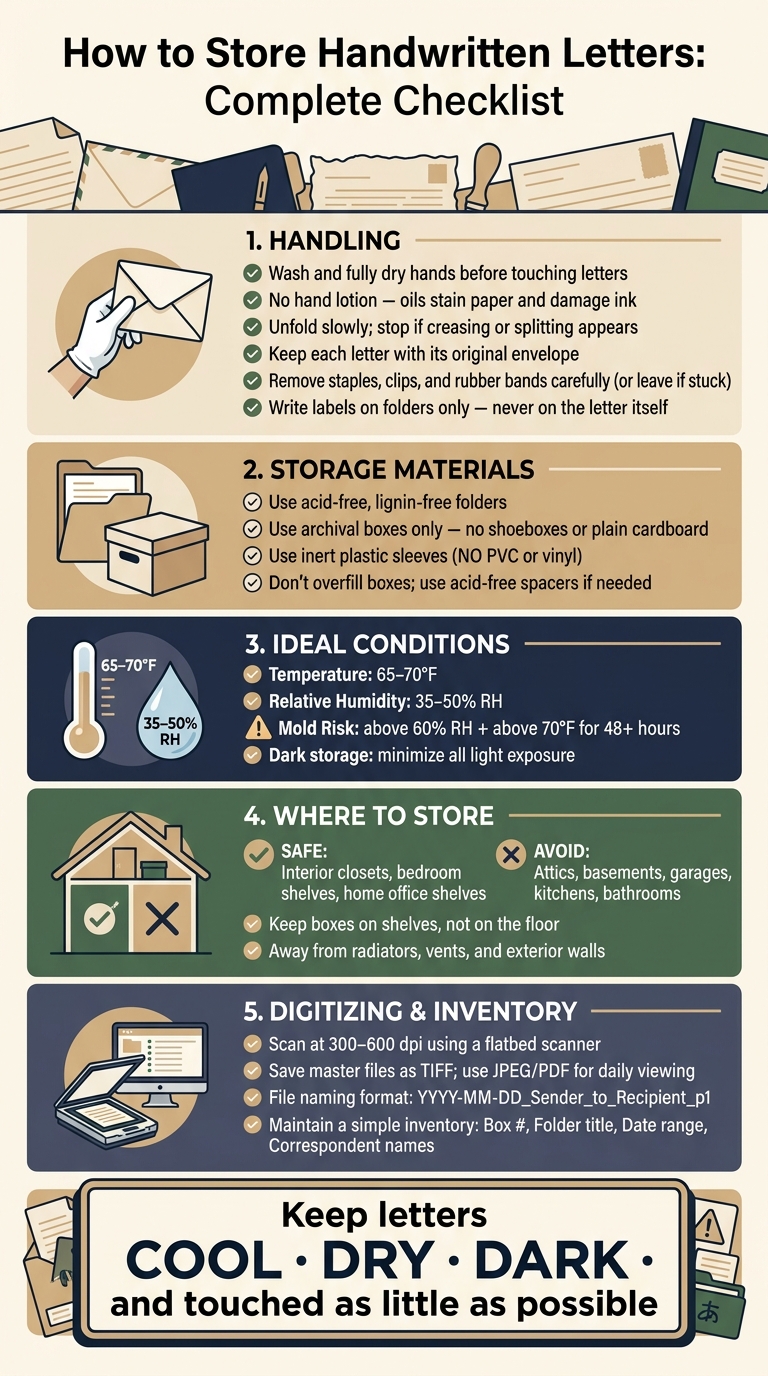
How to Store Handwritten Letters: Complete Checklist
Preserving Old Letters
sbb-itb-1dd4fe9
How to Handle Letters Safely Before Storing Them
How you handle a letter before storage matters just as much as the storage itself. If a letter goes away with a torn fold or a rust mark from a paper clip, that damage doesn’t just sit there - it can get worse with time. A few simple prep steps help you avoid adding new damage.
Set Up a Clean, Dry Workspace
Use a flat, clear table away from windows and direct sunlight. Wash your hands with mild soap, rinse well, and dry them all the way before touching any letter. Skip hand lotion. Oils and creams can transfer to paper, leave see-through stains, or react with water-based inks and cause feathering or smudging. Keep food and drinks far from the work area so you don’t risk spills or attract pests.
Soft indoor light is enough. Avoid working near a sunny window.
Open, Flatten, and Sort Without Stressing the Paper
Keep the letter fully supported on the table as you open it. Unfold it slowly, and use your other hand to support the paper close to the fold. If you see cracking, whitening, or a split starting along the crease, stop right there. That fold is too fragile to press flat. Instead, store the letter in a way that supports its current shape, like a properly sized folder or sleeve.
If a letter won’t lie flat but isn’t extremely brittle, put it under light, even weight for 24 to 48 hours. A book placed on top of a sheet of clean paper works well.
Keep each letter with its original envelope. Postmarks, return addresses, and handwritten notes add context, and once that gets separated, it’s gone. Place the letter behind the envelope in the same folder. That makes the next step - picking a safe folder or sleeve - much simpler.
Remove Harmful Fasteners and Label Carefully
Rusty staples, paper clips, rubber bands, and old tape can do a lot of harm in storage. Rust moves into paper fibers and leaves brown stains. Rubber bands dry out and stick to the surface. Old tape yellows, stops sticking, and leaves brittle residue that can damage the paper underneath.
Only remove fasteners when you can do it safely:
- For staples, open the prongs from the back with a blunt tool and slide the staple out while supporting the paper.
- Ease paper clips open a little, then slide them off without dragging them across the surface.
- Cut rubber bands with blunt-ended scissors instead of pulling them off.
- If a fastener is stuck in place or the paper starts to tear, leave it alone and check with a paper conservator.
Write on the folder or box, never on the letter itself. Use a soft graphite pencil. Permanent markers can bleed through. Handle fountain pen letters as little as possible, and move them into cool, dark storage soon after. Once everything is prepared, place each letter in an acid-free folder or archival sleeve.
How to Choose Safe Folders, Sleeves, and Boxes
After handling your letters, the next step is picking enclosures that guard them from acid, dust, and moisture before they go into long-term storage.
Use Acid-Free Folders for Flat, Unfolded Storage
Choose acid-free, lignin-free folders. Lignin is a natural part of wood pulp that breaks down into acid over time, which can make paper yellow and brittle.
For most handwritten correspondence, buffered folders are a solid pick. They help neutralize acids. Store letters flat and unfolded so you don't put extra stress on old creases.
You can sort folders in a way that makes sense for your collection, such as by:
- sender
- date
- correspondence thread
Choose Archival Boxes Over Shoeboxes or Regular Cardboard
Use archival boxes instead of shoeboxes or regular cardboard. Plain cardboard can absorb moisture and harm letters over time.
Stick with acid-free, lignin-free archival boxes, and don't overfill them. Too much pressure inside a box can warp the papers. If the box isn't full, add acid-free spacers or filler boards to hold folders upright and stop them from slumping or curling.
Use Only Inert Plastic Sleeves
Plastic sleeves can help with letters you handle often. But use inert plastic sleeves only, and skip PVC and vinyl completely.
PVC can off-gas plasticizers as it ages. Those chemicals can transfer onto paper and ink, which may lead to staining, stickiness, and damage that can't be reversed.
Once the letters are boxed, the next safeguard is choosing a stable place to keep them.
Where to Store Letter Boxes in Your Home
Once your letters are boxed, put them in the most stable room in the house. The goal is simple: cool, dry, and steady. For home storage in the United States, a good target is about 65–70°F with 35–50% relative humidity (RH). The big thing isn't hitting a perfect number every day. It's keeping conditions as steady as you can.
Avoid Basements, Attics, Garages, Kitchens, and Bathrooms
These are some of the worst places to store letters. Attics go through sharp temperature swings, which can make paper brittle and cause ink to fade. Basements and garages often bring damp air, pests, and moisture. Kitchens and bathrooms are trouble too, since humidity jumps every time you cook or take a shower. Over time, that can lead to warped paper and mold.
Use Interior Closets, Bedrooms, or Home Office Shelves
The safest storage spots are usually the parts of the house connected to everyday heating and cooling. An interior closet, bedroom shelf, or home office shelf or cabinet set away from exterior walls will often stay closest to the target range when your HVAC system is running as usual.
A few placement rules help a lot:
- Keep boxes on shelves, not on the floor.
- Store them away from radiators, baseboard heaters, and air vents.
- Don't place them against walls that back up to a bathroom or kitchen, where plumbing leaks are more likely.
Floor storage adds risk from small leaks, spills, and pests that move along baseboards.
Limit Display Time and Watch the Environment
Light damage adds up, and it can't be undone. Even indoor lighting slowly fades ink and weakens paper, so letters should spend most of their life in dark, closed storage.
If you want to display a special letter, use acid-free matting and UV-filtering glazing. Hang it on an interior wall away from windows, and keep display time short, from a few weeks to a couple of months each year, before putting it back into archival storage.
It also helps to use a digital thermometer-hygrometer to check the space during seasonal changes. After you pick the storage spot, keep a simple inventory so you can find letters without opening boxes more than you need to.
How to Build and Maintain a Home Letter Archive
Set Up a Simple Filing System and Inventory
Once the letters are boxed, set them up so you can find what you need without opening every folder. Pick one system and stick with it: chronological, by correspondent, or by family branch/topic.
Chronological filing makes it easy to follow a timeline. Filing by correspondent keeps every letter from one person in one place. Family branch or topic works well if your collection is large and spread across many people or subjects.
Create a simple inventory with one row per folder. Include:
- Box number
- Folder title
- Date range
- Correspondent names
For example: "Box 2, Folder 4: Letters from John to Mary, 1965–1972." If you place brittle letters in labeled inert sleeves, note that in the inventory and add a cross-reference so you can track them fast.
Digitizing Letters and Keeping Your Desk Organized
Digitize the letters you use most, along with fragile originals you want to stop handling. Scanning cuts down on wear and gives you a readable copy to use day to day.
Use a flatbed scanner, not a sheet-feed roller, at 300 dpi minimum or 600 dpi for faint or small handwriting. Scan the front and back of every page, and both sides of envelopes too. That way, stamps and postmarks stay part of the record. Save one high-quality master file - TIFF is a good choice for long-term storage - and keep a JPEG or PDF version for regular viewing.
Use a steady file-naming format like 1968-04-12_JohnSmith_to_MaryJones_p1. It sounds small, but it saves a lot of hassle later because files sort in the right order and stay easy to search.
After letters are digitized, you can read and share the digital copies and leave the originals alone unless you need them.
Keep fountain pens in protective cases or on stands to help stop leaks, and keep them away from light and heat. Digital copies also make the archive easier to use because you won’t need to pull out the paper every time.
Conclusion: The Safest Home Setup for Handwritten Letters
The core principles are simple: handle paper gently, use acid-free folders and archival boxes, choose inert sleeves only when needed, and keep stored letters in dark, stable indoor spaces. A simple inventory, steady storage, and minimal handling help keep letters readable for years. The aim is a stable archive that stays easy to use.
FAQs
What if a letter is too brittle to unfold?
If a letter is too brittle to unfold, don’t force it. Fragile paper can crack or tear with very little pressure, and that kind of damage is permanent.
If the letter has high monetary value or means a lot to you, talk to a professional paper conservator who can humidify and unfold it safely. Doing it yourself can lead to damage you can’t undo.
How can I tell if a plastic sleeve is safe?
Avoid sealed plastic bags. They can trap moisture and acidic gases, which may harm handwritten letters over time.
Instead, use acid-free storage materials made for preservation.
If you’re not sure about a storage sleeve, go with one that helps shield your correspondence from light, heat, and moisture.
What should I do if my storage room gets too humid?
Keep humidity between 40% and 60% when you can. If the space tends to feel damp, add silica gel packets to help pull extra moisture out of the air.
Airflow matters too. Pick a spot that's well-ventilated, and skip airtight containers that can trap moisture and harmful gases. A cool, dark area works best, away from windows, basements, and bathrooms.