

The best daily writing setup is simple: write by hand for 10–30 minutes at the same time each day, use a pen that feels good, pair it with easy-to-clean ink and fountain-pen-friendly paper, and keep the bar low enough that you can still write on bad days.
I’d boil the whole guide down to this: pick one time, one format, and one ready-to-go setup. A 2025 research review cited in the article says handwriting supports memory, attention, and comprehension more than typing. That matters if I want writing time to feel calm instead of scattered.
Here’s the short version:
- Keep the habit small: one paragraph, half a page, or 10 minutes
- Use one repeatable time: like 6:30–7:00 a.m., 12:15–12:30 p.m., or 9:00–9:30 p.m.
- Stick to one writing format: morning pages, a dated journal entry, timed freewriting, or a short draft
- Choose easy daily tools: a fine or medium nib, dye-based blue/black ink, and 80–100+ gsm paper
- Do basic pen care: cap the pen, wipe the nib after long sessions, and flush it every 4–6 weeks
- Keep momentum on hard days: one line still counts, and a 5–10 minute timer can get me started
If I want a writing habit that lasts, the goal is not more pages. The goal is showing up often enough that writing becomes part of my day.
Daily Journaling with a Fountain Pen
sbb-itb-1dd4fe9
Set Up a Simple Daily Writing Routine
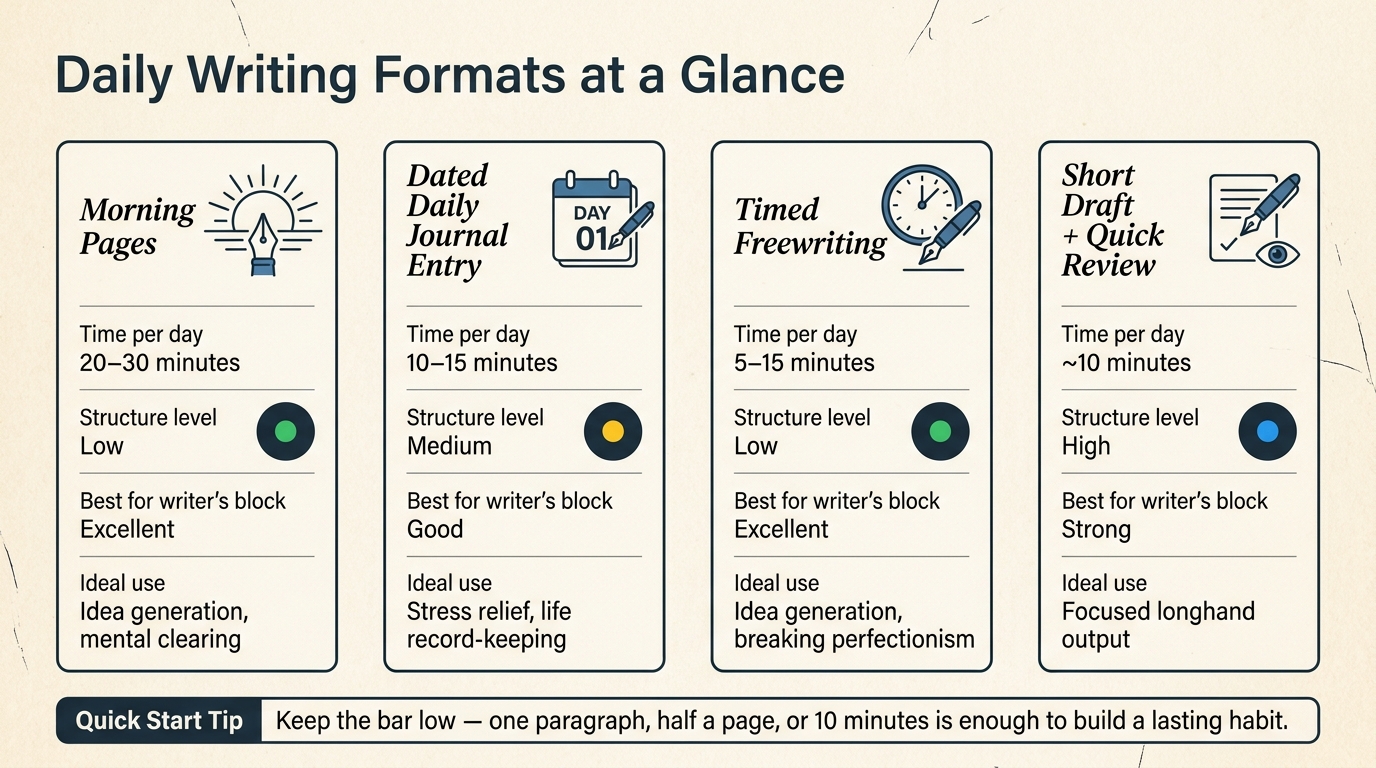
Daily Writing Formats for Fountain Pen Journaling: Quick Comparison Guide
Pick one fixed time and keep it short. Three common U.S. options are before work or school (around 6:30–7:00 a.m.), during a lunch break (12:15–12:30 p.m.), or as part of an evening wind-down (9:00–9:30 p.m.). Try each one for a few days, then stick with the slot you can repeat without a fight. Write that time on a sticky note and leave it next to your pen and notebook. Then connect it to a cue that already happens every day.
Set the bar LOW enough that you can still hit it on a rough day - one paragraph, half a page, or 10 minutes. If the words are flowing, keep going. If the day feels heavy, stop at the minimum. Anything extra counts as a bonus.
Choose a Writing Format You Can Use Every Day
Choose one format and stay with it. Morning pages, popularized by Julia Cameron, involve writing three longhand pages of stream-of-consciousness thought right after waking - no editing, no rereading. A dated daily journal entry gives you more structure: start with the date and time, such as September 15, 2026 – 7:05 a.m., then write about what happened or how you feel. Timed freewriting is even simpler. Set a 5–15 minute timer and keep the pen moving no matter what.
Morning pages and timed freewriting both focus on unedited output. The big difference is length.
| Format | Typical Time per Day | Structure Level | Best for Writer's Block |
|---|---|---|---|
| Morning pages | 20–30 minutes | Low | Excellent |
| Dated daily journal entry | 10–15 minutes | Medium | Good |
| Timed freewriting | 5–15 minutes | Low | Excellent |
| Short draft + quick review | ~10 minutes | High | Strong |
Match the format to the job you want it to do. Morning pages or timed freewriting work well for idea generation. A dated journal entry fits stress relief or keeping a life record. A short draft plus quick review helps build focused longhand output. After that, make the setup as easy as possible.
Connect the Habit to Your Tools and Daily Routine
Tie writing to something you already do so you don't have to rely on memory. For example, after you pour your coffee at 7:00 a.m., sit at the kitchen table and write one paragraph before you check your phone. Or after you brush your teeth at night, write a short journal entry on the couch. The routine becomes the cue.
Keep your inked pen, notebook, and a small sheet of blotting paper together in one fixed spot - a tray on the desk, a corner of the kitchen table, or a bedside stand. When everything is ready, you can start in seconds. That small bit of prep can make all the difference on low-motivation days. Then you're in a better spot to choose a pen, ink, and paper you can keep using with ease.
Choose Pens, Ink, and Paper for Daily Writing
Pick tools that work day after day without much hassle. Start with the pen. Then pair it with ink and paper that make writing easy, clean, and readable.
Pick a Pen That Feels Good for 10 to 30 Minutes
For daily writing, comfort matters more than appearance. A medium-light pen - often around 15 to 25 grams uncapped - can help cut hand fatigue during longer sessions. It also helps to choose a pen with a center of gravity close to the grip, a grip that narrows gently, and smooth transitions between the barrel and grip section.
For the nib, a smooth fine or medium steel nib is a smart pick for everyday use. Fine nibs are a safe bet on regular copy paper. Medium nibs also work well for day-to-day writing. In both cases, look for a pen with steady, moderate ink flow so the line stays even whether you’re writing fast or taking your time.
A cartridge/converter pen is often the easiest option for daily use. Cartridges are quick to replace, and converters give you access to bottled ink. If you write several pages a day, a piston filler holds more ink, but it takes more time to flush when you want to switch colors.
Once the pen feels right in your hand, move on to ink that dries neatly and cleans out without a fight.
Use Everyday Inks That Fit Your Writing Goals
For notes, journaling, and planning, blue, black, or blue-black dye-based inks are usually the best fit. They make dark, easy-to-read lines on white or off-white paper, work well for school or office use, and usually flush out with plain water. Medium-saturation inks also tend to dry faster and smear less, which is helpful when you’re writing in a hurry or flipping notebook pages.
| Ink Type | Dry Time | Maintenance | Readability | Best For |
|---|---|---|---|---|
| Fast-drying (dye-based) | Fast | Simple | Excellent | Meeting notes, planners, left-handed writers |
| Shading-focused | Slower | Similar to standard dye-based inks; works best on smoother paper | Good | Evening journaling, creative practice |
| Water-resistant | Moderate | More diligent cleaning | Strong | Archival notes, outdoor planners |
A simple setup works well for most people: keep a fast-drying blue or blue-black ink in your main pen, then use a shading ink if you like journaling on better paper. Save water-resistant inks for pages that may face spills or need to last for years. Just clean those pens on a regular basis so residue doesn’t build up.
After ink, the next piece is paper that keeps the line sharp and lets you use both sides of the page.
Choose Paper That Works Well with Fountain Pen Ink
Paper weight is one of the first things to check. Paper in the 80 to 100+ gsm range usually does a better job with bleed-through and show-through than standard copy paper. That matters a lot if you write on both sides. Paper made for fountain pens is also worth seeking out, since it often has surface treatment that helps keep lines crisp and reduces feathering.
Here’s a quick way to match paper to how you like to write.
| Format / Surface | Control | Dry Time | Show-Through | Writing Feel |
|---|---|---|---|---|
| Lined | High - good for baseline and letter-size control | Standard | Moderate | Structured, easy to review |
| Dot grid | Medium-high - subtle alignment without visual clutter | Standard | Low | Flexible; works for writing and diagrams |
| Blank | Low - best once spacing is consistent | Standard | Depends on paper weight and ink behavior | Free-form; ideal for creative sessions |
| Smooth surface | High glide, low friction | Slower | Low | Comfortable for long sessions; shows shading well |
| Lightly textured | More feedback under nib | Faster | Low to moderate | Better control for small print or precise lettering |
For most beginners, a lined or dot grid notebook in the 80 to 90 gsm range with a smooth-to-moderate surface is an easy place to start. It’s forgiving, practical, and works for most daily tasks. Test a page with the pen and ink you use most. If the lines stay sharp and dry in about 15 to 20 seconds, the paper will likely do the job well.
Care for Your Fountain Pen Between Writing Sessions
Once your routine and supplies are in place, the next step is simple: keep your pen ready between writing sessions. Fountain pen care doesn't need to turn into a chore. In most cases, it comes down to three habits: cap the pen when you pause, wipe it after long use, and flush it on a regular schedule.
Use a Basic Daily and Monthly Care Routine
The daily routine is short. It usually takes about 1 to 3 minutes. If you stop writing for more than a minute, cap the pen firmly and make sure the cap is fully sealed. That small step helps keep the nib from drying out.
After a longer writing session, wipe the nib and grip section with a soft, lint-free cloth or tissue. This clears away ink residue before it builds up.
For pens used often with standard dye-based inks, a light water flush every 4 to 6 weeks is a common maintenance schedule. Do the same any time you switch inks. Remove the cartridge or converter, flush the nib and feed with clean room-temperature water until it runs clear, and let all parts air-dry all the way before you ink the pen again.
If you won't use the pen for a month or longer, clean it fully and store it empty. That helps stop dried ink buildup and feed clogs.
| Factor | Daily-Use Pen | Occasional-Use Pen |
|---|---|---|
| Cleaning frequency | Flush every 4–6 weeks | Flush every 6–8 weeks, or before a long break |
| Time required | ~1–3 min of daily care; ~10–15 min for a full flush | ~10–15 min for a full flush |
| Key benefit | Fewer hard starts and more consistent flow | Less risk of dried ink, clogs, and staining |
| Storage between uses | Capped, horizontal or nib-up | Clean and store empty for breaks over a month |
Store Pens Safely and Prevent Common Problems
Wiping helps, but storage matters just as much. Between sessions, store pens horizontal or nib-up. That helps keep ink spread through the feed and lowers the chance of leaks into the cap. Leaving a pen nib-down for long periods can cause ink to collect at the tip and make a mess inside the cap.
Indoor conditions in many U.S. homes and offices can also cause trouble. Dry air from winter heating or heavy air conditioning can speed up evaporation at the nib, which often leads to hard starts. Heat is another common problem. Never leave a fountain pen in a parked car. Temperatures in cars or near sunny windows can climb past 90°F, which may cause ink to expand, leak, or dry out faster. For the same reason, keep pens away from radiators, heating vents, and direct sunlight.
A pen stand or case can help with the everyday stuff too. It keeps a pen from rolling off your desk, getting knocked around in a bag with keys, or sitting uncapped by mistake. Fountain Pen Revolution's pen stands and cases can keep a daily writer protected and easy to grab.
Keep Going and Work Through Writer's Block
Once your routine and tools are set, the next hurdle is showing up when the day feels crowded or your mind feels empty.
Set a Low Bar on Busy Days and Track Your Progress
On busy days, one line still counts. So does one paragraph. So do five minutes on the page. The point is to keep the habit alive and keep your fountain pen in use, performing basic pen maintenance when needed, not to force polished work.
Date every page in U.S. format: mm/dd/yyyy. For example, 09/15/2026. Add a plain label like journal or freewrite. Then do a short check-in once a week on Sunday evening.
Once a month, write a quick note like this: Wrote most days, usually 5–10 minutes. Handwriting feels smoother. Fewer stalls. Small reviews like that make progress easier to see, even when each session feels tiny.
If you're still stuck, switch gears. Use a prompt or set a timer.
Use Simple Prompts and Timed Sessions to Get Started
When the page feels blank, set a timer for 5 to 10 minutes and write whatever comes up. Don't stop to edit. A short freewriting session can loosen things up and get ideas moving.
If freewriting feels too loose, start with something concrete. Describe what's on your desk right now. Or answer a prompt like Today I noticed... or One thing I learned this week was... You're not trying to make the writing pretty. You're just keeping your hand moving.
| Method | Setup Time | Structure | Best Use for Writer's Block |
|---|---|---|---|
| Freewriting | Very low | Loose and open-ended | Breaking through perfectionism and generating raw ideas |
| Prompts | Low | Moderate | Starting when the page feels blank and you need a direction |
| Copying or letter practice | Very low | High | Easing in with a calm, mechanical warm-up when ideas are scarce |
When you miss a day or lose momentum, go back to the smallest session you can manage.
Conclusion: Build a Writing Habit You Can Keep
Measure success by consistency, not volume. One sentence on a hard day beats skipping the page. Over time, those small sessions become part of your day, and writing starts to feel like something you naturally return to.
FAQs
How do I choose the best writing time for my schedule?
Pick a time you can stick with, instead of waiting for the perfect moment. One simple way to do that is habit stacking: tie writing to something you already do, like right after your morning coffee or during lunch.
Some people do their best writing in a quiet morning. Others like a calm evening. Either way, the best schedule is the one you can keep day after day.
Start small with 5- to 10-minute sessions. If that feels easier, split the time into two shorter sessions.
What should I do if my fountain pen skips or dries out?
Start by getting the ink moving. Twist the converter or gently squeeze the cartridge until you see a small drop of ink at the nib. Then test the pen on scrap paper. As you write, hold the pen at about a 40 to 55 degree angle with the nib’s top side facing up.
If the pen still skips, flush it with cool or room-temperature water until the water runs clear. If the clog won’t budge, use a mild mix of water and dish soap, then rinse the pen well.
How can I stay consistent if I miss a day?
If you miss a day of practice, don't stress. Just pick it back up the next day.
The main thing is to avoid missing two days in a row. When life gets busy or your day goes sideways, do a mini-session instead. Write one sentence or jot down a short note. That keeps the habit going without adding extra pressure.