

When searching for a budget-friendly fountain pen, focus on three key factors: materials, nib performance, and craftsmanship. These elements determine durability, comfort, and writing smoothness. Pens under $100 can deliver excellent quality if you know what to look for. Here's a quick breakdown:
- Materials: Look for durable options like ABS plastic, aluminum, or acrylic. Stainless steel nibs with iridium tips ensure longevity.
- Nib Performance: A well-tuned nib should write smoothly without skipping or scratching. Test for consistent ink flow and proper alignment.
- Craftsmanship: Check for tight cap seals, balanced weight, and sturdy clips. Features like secure caps and ergonomic grips enhance usability.
For filling systems, cartridges are convenient, while converters and piston fillers offer flexibility and higher ink capacity. Transparent pens (demonstrators) add visual appeal but require regular cleaning to avoid staining. Prioritize pens with seamless construction and reliable components for a better experience.
Affordable options like the Lamy Safari, Pilot Metropolitan, and TWSBI ECO are great starting points. Look for pens that feel balanced in your hand, write effortlessly, and suit your personal style.
Materials and Build Quality
Common Materials in Budget Pens
The materials used in pens play a big role in their durability and overall feel. ABS plastic is a standout choice for affordable fountain pens. It's lightweight, tough, and perfect for everyday use - models like the Lamy Safari are prime examples of this material in action. If you're after something with a bit more heft and a professional touch, aluminum is a great option. Pens like the Pilot Metropolitan and Lamy AL-Star use aluminum to provide a sturdier build while remaining relatively lightweight.
For those who love vibrant designs, resin and acrylic are hard to beat. These materials, seen in pens like the TWSBI ECO, offer eye-catching colors and natural grip but tend to be less durable than ABS plastic. When it comes to nibs, stainless steel is the go-to for budget-friendly pens. While it doesn't provide the flex or line variation of pricier gold nibs, stainless steel is reliable and long-lasting. Many steel nibs also feature a tiny iridium ball at the tip, ensuring smooth writing and resistance to wear over time.
Weight Distribution and Grip Comfort
Beyond materials, a pen's weight distribution can make or break the writing experience. A well-balanced pen feels natural in your hand, almost like an extension of it. Ideally, the balance point should be near the pen's center, even when the cap is posted on the back of the barrel. To test this, rest the pen lightly between your thumb and index finger - if the weight feels evenly spread, you've got a winner.
"A well-balanced pen will feel as if it is an extension of your hand, making writing effortless and enjoyable." - Inkstable
The grip section is another key factor. Pens with triangular or contoured grips, such as the Lamy Safari or Pilot Kakuno, naturally guide your fingers into a proper tripod grip, making them great for newcomers. If you prefer flexibility in how you hold your pen, smooth cylindrical grips might be more your style. The material of the grip matters too: plastic and resin offer a warm, secure hold, while polished metal can sometimes feel cold or slippery. For those prone to slipping, a rubberized or soft-touch grip is a safer choice than metal.
Cap Security and Clip Durability
A good cap does more than just cover the nib - it also prevents your ink from drying out. Many quality pens include an inner cap made of plastic or rubber, which creates an airtight seal over the nib. When evaluating a pen, ensure the cap closes snugly without any noticeable gaps or wiggle. Screw-on caps provide the best leak protection, making them ideal for travel, while snap-on caps are quicker to use, perfect for jotting down notes on the go.
Don't overlook the clip, either. A good clip should snap back into place when lightly tugged, without bending. It needs to be strong enough to secure the pen in your pocket or notebook but flexible enough to avoid breaking under pressure. High-quality clips often include spring-loaded mechanisms, allowing them to open wider while maintaining tension. Both secure caps and durable clips are small details that speak volumes about a pen's overall craftsmanship.
sbb-itb-1dd4fe9
TOP 10 Best Beginner Fountain Pens On A BUDGET - All Under $35
Nib Performance and Writing Quality
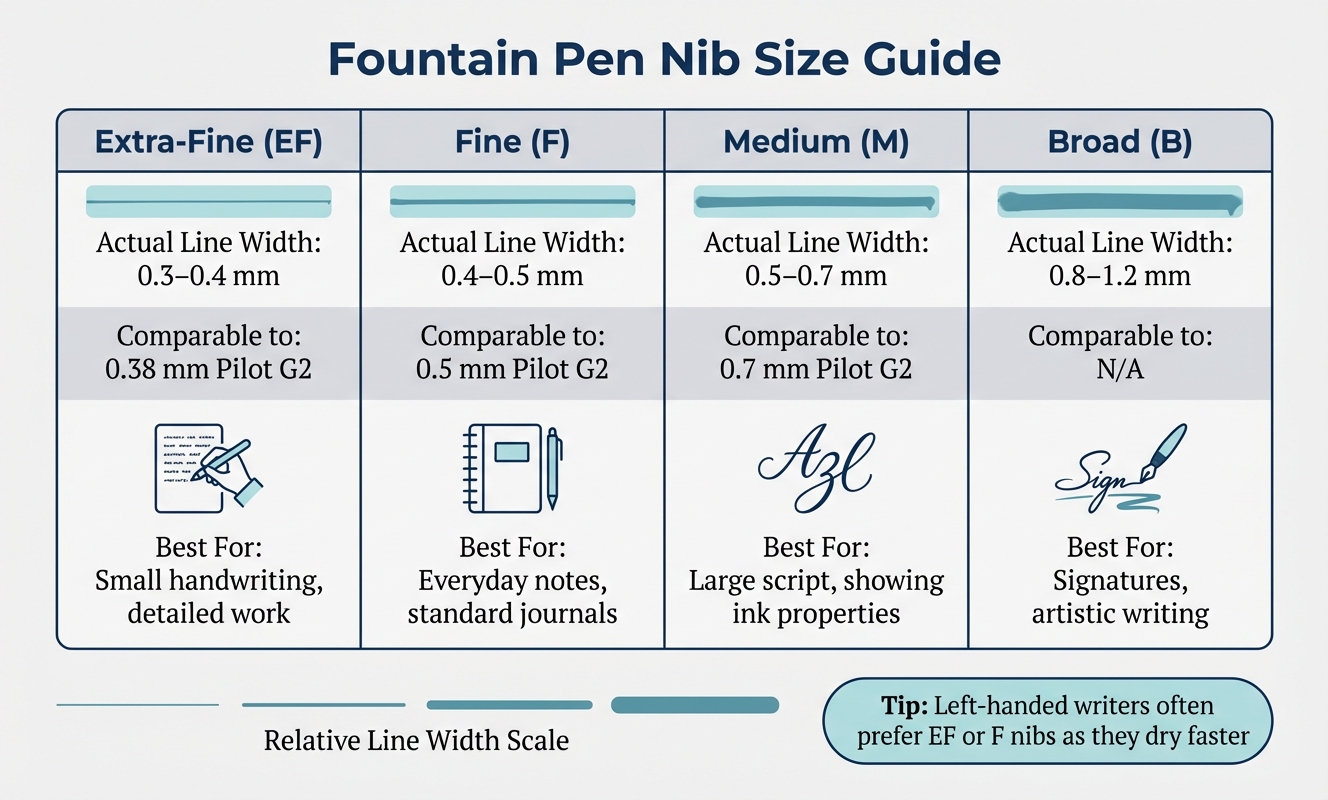
Fountain Pen Nib Sizes Comparison Chart: Line Widths and Best Uses
Testing for Smoothness and Feedback
The nib is where the magic happens - it’s the bridge between metal and paper. To ensure it performs well, start by examining it closely under magnification. Look for a centered slit, evenly distributed tipping material, and aligned tines. Misaligned tines often cause roughness in one direction, or you might notice a sharp edge on the grind.
A simple way to test smoothness is by drawing figure-eights or infinity symbols on scrap paper. This helps reveal whether the nib delivers consistent ink flow and smooth performance from every angle. A well-made nib should glide effortlessly, no matter the direction.
"You shouldn't have to press to get a line that doesn't skip in any direction." – Anthony, Editor, UK Fountain Pens
It’s also important to differentiate between feedback and scratchiness. Feedback refers to the nib picking up the paper’s texture, much like a pencil does, and is common with extra-fine nibs. Scratchiness, on the other hand, is a flaw - it happens when the nib catches or digs into the paper fibers. A properly tuned nib should create a steady line under its own weight, without requiring extra pressure. Applying too much pressure can spread the tines apart, potentially causing permanent damage.
Once you’ve confirmed the nib’s smoothness, it’s time to check if the ink flow matches this performance.
Checking Ink Flow
Ink flow is what separates a pen that’s a joy to use from one that’s frustrating. A good pen should write the moment it touches the paper, with no need for taps or extra pressure. To test this, try writing continuously for at least half a page. This ensures the feed maintains a proper vacuum and consistently delivers ink. If the ink fades or stops during this test, it’s likely the feed isn’t replenishing ink effectively.
Another quick check: Hold the nib up to a light source. You should see a thin "flash of daylight" between the tines, narrowing toward the tip. If no light passes through, the tines may be too tightly spaced, restricting ink flow. On the flip side, if the pen leaks, drips, or delivers too much ink when gently shaken, it could indicate a poorly fitted nib or feed. Stuttering or difficulty starting after uncapping might also point to issues like a "baby’s bottom" grind or overly tight tines, which may require troubleshooting your fountain pen.
Understanding Nib Sizes
Once you’ve ensured smoothness and reliable ink delivery, consider how nib size fits your writing style. Fine (F) nibs are a popular choice for everyday use, offering a balance of precision and smoothness. If you write small or use absorbent paper like standard printer sheets, Extra-Fine (EF) nibs are a great option - they use less ink, which helps prevent smearing and bleed-through. Medium (M) nibs, on the other hand, are better for more expressive writing but may feel cramped on narrow-ruled paper.
Here’s a quick comparison of nib sizes:
| Nib Size | Line Width | Comparable to Rollerball | Best For |
|---|---|---|---|
| Extra-Fine (EF) | 0.3–0.4 mm | 0.38 mm Pilot G2 | Small handwriting, detailed work |
| Fine (F) | 0.4–0.5 mm | 0.5 mm Pilot G2 | Everyday notes, standard journals |
| Medium (M) | 0.5–0.7 mm | 0.7 mm Pilot G2 | Large script, showing ink properties |
| Broad (B) | 0.8–1.2 mm | N/A | Signatures, artistic writing |
When testing a new pen, stick to paper and ink you’re familiar with. This way, you can focus on the pen’s performance without other factors getting in the way. Hold the pen at a 45° angle to the paper, making sure both tines rest evenly on the surface - twisting the pen can cause skipping. Left-handed writers often prefer finer nibs (EF or F) since they dry faster, helping to avoid smudging as the hand moves across the page.
Filling Systems and Ink Capacity
A smooth-writing nib is essential, but an efficient filling system is what keeps your pen running without interruptions. How a pen holds and delivers ink not only determines how often you’ll need to refill but also impacts everyday convenience. After nib performance, understanding filling systems is crucial for uninterrupted, enjoyable writing sessions. Most budget-friendly fountain pens come with one of several filling systems, each offering its own set of advantages and trade-offs.
Many budget pens rely on cartridges or converters. Standard International cartridges, available in short (38 mm) and long (72 mm) sizes, are popular for their portability and ease of use. They’re clean and convenient, making them ideal for beginners or travel. On the other hand, converters allow you to explore a greater variety of inks but typically hold only 0.5–0.7 mL of ink. It’s worth checking whether a pen uses Standard International cartridges or brand-specific proprietary ones (like those from Pilot or Lamy), as proprietary systems limit you to their refills. Even if a converter isn’t included in the box, many budget pens are compatible with one.
For those seeking higher ink capacity, piston fillers are an excellent choice. These pens integrate the filling mechanism directly into the barrel, eliminating the need for a separate converter. Proper maintenance is key, so learning how to lubricate fountain pen pistons can extend the life of your pen. Models like the Wing Sung 698 are popular examples. Piston fillers can hold significantly more ink, making them perfect for long writing sessions. However, they do require bottled ink for refilling, which might not be as convenient on the go.
If maximum ink capacity is your goal, eyedropper conversions are the way to go. By filling the entire barrel with ink, these pens can hold more ink than any other system. Some cartridge pens, like the Platinum Preppy, can be easily converted to eyedroppers by adding a silicone-enhanced seal. The downside? Eyedropper pens are prone to "burping" - as the ink level drops, expanding air can push ink out through the nib. To avoid this, it’s a good idea to refill the pen when it’s about three-quarters empty.
| Filling System | Ink Capacity | Best For | Key Consideration |
|---|---|---|---|
| Cartridge | Low | Travel, beginners | Limited color options; brand-specific refills |
| Converter | 0.5–0.7 mL | Daily use, ink variety | Often sold separately from the pen |
| Piston | Medium-High | Long writing sessions | Requires bottled ink |
| Eyedropper | Maximum | Extended writing endurance | Risk of burping and potential leaks |
When traveling, it’s wise to store pens either completely empty or fully filled (with the nib facing up) to prevent leaks. Pens with built-in ink windows are especially handy for keeping an eye on ink levels.
Design and Construction Details
When it comes to pens, the design and construction are just as important as the internal mechanisms. Even budget-friendly pens can surprise you with thoughtful details and reliable craftsmanship that enhance the writing experience.
Grip Design and Appearance
The grip is where the magic happens - it's where your fingers rest, making comfort non-negotiable. Most affordable pens use plastic grips for their lightweight feel, but some step it up with rubber or metal for added comfort and a secure hold. The shape of the grip matters too. Take the Lamy Safari, for instance: its triangular grip encourages the proper tripod writing position, while smoother or cylindrical grips give you more freedom to adjust your hand placement. Grip sizes also vary, catering to different hand sizes and writing styles.
"The grip section plays such a vital role in your overall experience... writing with a fountain pen should feel natural and effortless especially during long writing sessions." - Pen Heaven
Another detail to look for is the cap and clip. A high-quality clip, ideally metal, should be sturdy and well-aligned to securely attach to fabric without bending or breaking.
Transparent Bodies and Demonstrators
Transparent pens, or demonstrators, have a special charm. They let you see the ink levels and admire the inner workings, like piston or vacuum systems, which is why both collectors and casual users love them. Models such as the TWSBI Eco and Lamy Vista bring this feature to an affordable price range.
"The clear barrel lets you admire the ink as it swirls around while you write." - Stephanie, JetPens
When choosing a demonstrator, pay attention to the material. Premium options often use durable acrylics or resins that resist fingerprints and scratches, giving them a polished, long-lasting finish. Some, like the TWSBI Diamond 580AL, even feature faceted barrels that play with light, making the ink appear more vibrant - almost jewel-like. However, keep in mind that while ABS plastic is tough, acrylics and resins can be more fragile and prone to cracking if dropped.
One of the coolest things about demonstrators is how they expose the pen's internal design. This transparency makes it easier to spot any issues before you start writing. Many quality demonstrators also include maintenance tools, like wrenches and silicone grease, to simplify cleaning and disassembly. Just be aware that clear pens can stain when used with highly pigmented inks, so cleaning them regularly is key.
Packaging and Product Verification
The way a pen is packaged can tell you a lot about its quality. Even budget pens often come in protective boxes or cases, which is a step up from flimsy plastic bags. Well-made pens should have parts that fit seamlessly, with no visible gaps.
"A high-quality pen will have a seamless assembly, with all parts fitting together without any gaps." - Inkstable
When unboxing, check that the cap seal is intact and the nib is well-protected. Some pens, like the Platinum Preppy and Plaisir, feature clever "Slip & Seal" cap technology, which prevents the nib from drying out for months. This means your pen is ready to write whenever you are. Also, confirm whether the pen includes a converter or just cartridges, and make sure any advertised features - like ink windows or interchangeable nibs - are present and functional. For non-transparent pens, a small ink window is a thoughtful touch that lets you monitor ink levels without taking the pen apart.
Lastly, consider the pen's weight and balance. A well-balanced pen feels natural in your hand, almost like an extension of it. Avoid pens that are too light or feel hollow, as they can cause hand fatigue during extended writing sessions.
Conclusion
Affordable fountain pens that deliver quality and style are easier to find than you might think - if you know what to look for. Prioritize pens made from sturdy materials like ABS plastic or premium acrylic, nibs with iridium tipping for smooth writing, and filling systems that align with your needs. Pay attention to thoughtful design details, ensuring all components fit together seamlessly.
"A high-quality pen is engineered to feel natural in the hand, with a weight that is substantial yet not overbearing." - Inkstable
When evaluating a fountain pen, check that the nib is properly centered, the cap seals tightly, and the pen feels balanced in your hand for effortless writing. These simple checks can help you find a pen that not only writes beautifully but also stands the test of time.
With these tips, you’re ready to pick a pen that combines quality and value without stretching your budget. If you're looking for a selection of affordable yet reliable options, check out Fountain Pen Revolution at https://fprevolutionusa.com. It’s a great starting point to build or enhance your fountain pen collection.
FAQs
Why use a converter instead of cartridges in an affordable fountain pen?
Using a converter with your fountain pen opens up the world of bottled ink, offering a nearly endless selection of colors and specialty options to choose from. Beyond the creative possibilities, it’s often a more budget-friendly choice compared to cartridges, as bottled ink generally costs less per milliliter. Plus, filling your pen this way can improve the ink flow, resulting in smoother, more consistent writing - making every stroke feel just right.
How can I check if a fountain pen nib is smooth and properly aligned?
To check if a fountain pen nib is smooth and properly aligned, start with a close visual inspection. Grab a magnifying glass and examine the nib carefully. The slit should run straight down the center, the ink feed should line up perfectly with the breather hole, and the tipping should have an even shape. Also, make sure the tines are the same length with a small gap between them - this is key for good ink flow.
Once you've done the visual check, move on to a writing test. Fill the pen with ink, clean the nib and feed, and try writing on plain paper. A well-aligned nib should glide effortlessly across the page without scratching, skipping, or catching. If it feels rough or inconsistent, some adjustments might be necessary.
By following these steps, you can evaluate the performance of your fountain pen, including models from Fountain Pen Revolution, and enjoy a smooth, satisfying writing experience.
What are the advantages and drawbacks of using a transparent demonstrator fountain pen?
A transparent demonstrator fountain pen lets you peek into the mechanics of your pen in a way that's both functional and visually striking. With its clear barrel and cap, you can easily keep an eye on your ink levels and appreciate the intricate internal components. For many pen enthusiasts, this design is a standout, especially when paired with vibrant accents or unique finishes that add to its modern charm.
That said, there are a few trade-offs to consider. The clear material is more susceptible to scratches and tends to show ink stains or residue, meaning you'll need to clean it more often. Ink can also sometimes creep into tricky spots, requiring a bit of extra effort to keep it looking pristine. While these pens are undeniably appealing and practical, they might not be the best fit if you're looking for something that's easier to maintain.