

I recommend a professional assessment if your pen still writes poorly after cleaning and basic checks. First, flush it, check the ink supply, and troubleshoot common writing issues on smooth paper with light pressure. Change one thing at a time.
These 5 signs tell me it’s time to ask a nib specialist for help:
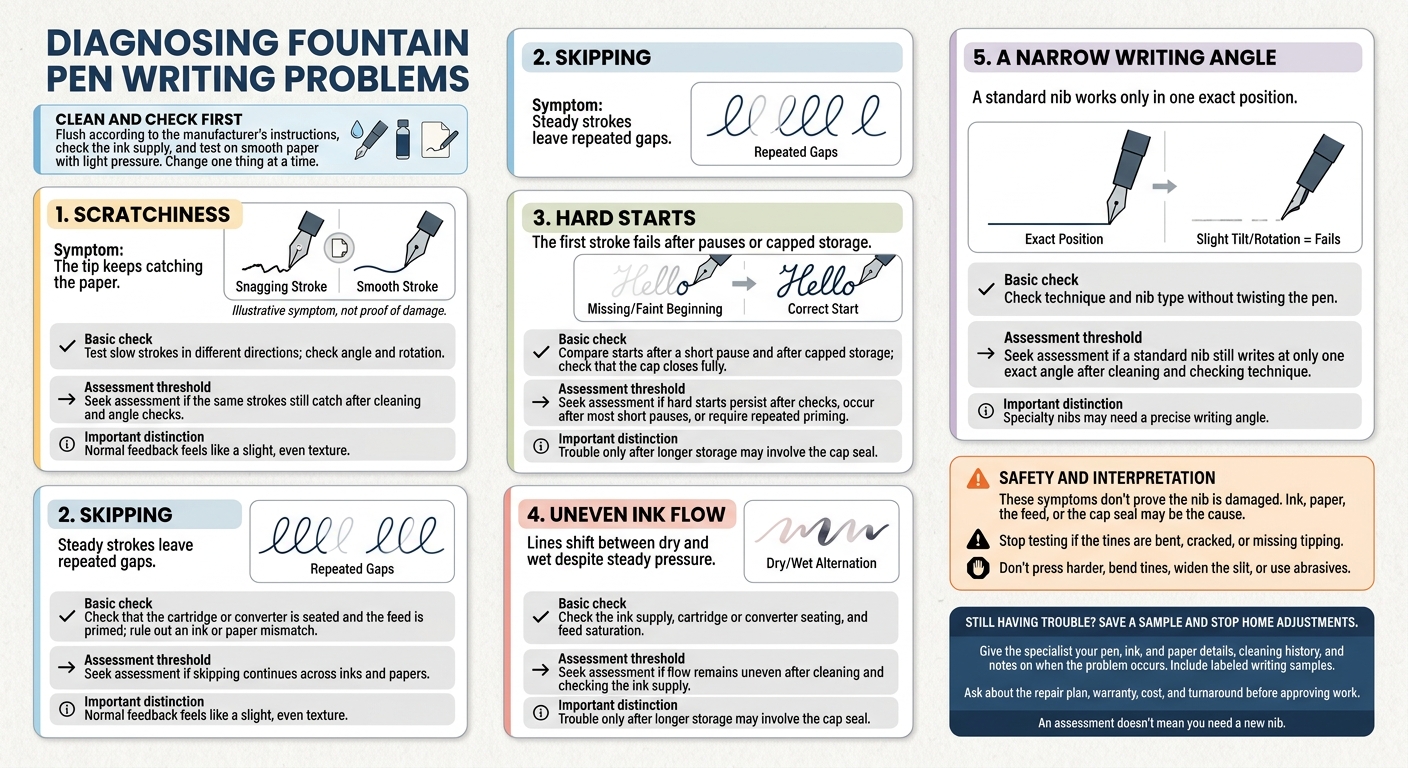
- Scratchiness: The tip keeps catching the paper.
- Skipping: Steady strokes leave repeated gaps.
- Hard starts: The first stroke fails after pauses or capped storage.
- Uneven ink flow: Lines shift between dry and wet despite steady pressure.
- A narrow writing angle: A standard nib works only in one exact position.
These symptoms don’t prove the nib is damaged. Ink, paper, the feed, or the cap seal may be the cause. Specialty nibs may also need a precise writing angle.
My next step: <u>save a writing sample and stop home adjustments</u>. Give the specialist your pen, ink, and paper details, plus notes on cleaning and when the problem occurs. Ask about the repair plan, warranty, cost, and turnaround before approving work - not every problem calls for a new nib.
5 Signs Your Fountain Pen Needs Professional Nib Tuning
Clean and Check Your Pen First
Start with the manufacturer’s flushing instructions. Remove the cartridge or converter, then flush the nib and feed with cool water until it runs mostly clear. Avoid hot water, alcohol, bleach, acetone, and household cleaners. They can damage seals, finishes, and feed materials. If the pen still misbehaves after cleaning, check alignment and ink flow.
Let the section dry completely before testing. Trapped water can dilute the ink and make the flow seem weak. Fill the pen fully, then blot the nib. Don’t shake the pen or press down to force it to start.
Use compatible fountain-pen ink - not India ink or drawing ink. Keep the logo facing up and the feed underneath. Hold the pen at about 40°–55° to the page, then adjust for comfort without rolling it onto one tine. Specialty nib grinds may need a different angle.
Under bright light, check that the nib sits centered on the feed, the tines are even, and there’s no visible debris, bent tip, or shifted feed. Don’t pry the tines, twist the nib, or force anything back into alignment.
Normal feedback feels like a slight, even texture. Scratchiness catches or snags, often in one direction. Test again on a second smooth sheet. Avoid micromesh, nail files, brass shims, and tine bending during these checks. Removing tipping material or changing the tine shape can make the problem worse.
If the pen has trouble starting after capped storage, note how long it sits before drying out and whether the cap closes fully.
sbb-itb-1dd4fe9
1. Scratchiness That Persists After Basic Checks
Recognizable symptom
A fine nib can feel pencil-like. What calls for attention is repeated drag when writing with light pressure on smooth paper, especially if the tip feels sharp or catches the page. Extra-fine nibs may feel more textured, but they shouldn't dig into the paper.
If cleaning doesn't resolve the drag, check whether it happens in only one direction.
basic checks before service
Make slow strokes up, down, left, right, and diagonally, noting which directions catch. Then slightly change the pen's angle and rotation. If a lighter hand or a corrected angle removes the roughness, that alone doesn't mean the nib needs tuning.
Possible nib or feed causes
Catching in one direction usually points to misaligned tines. Damaged tipping or feed alignment can also play a part. If the same scratch marks persist, the nib needs professional alignment.
When to seek professional assessment
Seek professional tuning if the same strokes still catch after cleaning and angle checks. Stop testing if the tines are bent, cracked, or missing tipping.
2. Repeated Skipping With a Clean, Primed Feed
Recognizable symptom
A pen can stop feeling scratchy and still leave gaps. Repeated skipping leaves blank sections during steady strokes, even when the nib stays on the paper. A single gap may come from the paper, your writing angle, or a brief air bubble. Repeated breaks across different papers and writing directions need a closer look.
Basic checks before service
After cleaning, refill the pen with a compatible fountain pen ink and let the feed fully prime. Make sure the cartridge or converter is seated. If you use a converter, advance just enough ink to wet the feed once.
With the feed facing down, draw slow, continuous lines and loops on smooth, moderately absorbent paper. Check your nib position: writing on its side or back can look like skipping.
If the pen skips with only one ink or paper, rule out that mismatch first. Skipping that continues after these checks likely points to common nib issues or feed problems.
Possible nib or feed causes
Persistent skipping usually comes down to tine alignment, slit closure, or ink delivery through the feed. The tines may be misaligned, or the slit may close too tightly at the tip. Other possible causes include poor contact between the nib and feed, an off-center feed, or blocked feed channels.
When to seek professional assessment
If skipping continues across inks and papers, stop adjusting the pen at home and seek professional tuning. Ask the specialist to check ink delivery, tine alignment, and contact between the nib and feed.
Include a writing sample, the ink name, the paper type, and details of any recent cleaning or disassembly. Avoid home adjustments or tools that could bend the tines.
3. Hard Starts After Pauses or Capped Storage
Recognizable symptom
Hard starts often appear after a pen has rested. A hard start is a delayed first stroke. Test the pen after a short pause and again after capped storage. Trouble after short pauses suggests an ink-delivery problem; trouble after longer storage may mean ink is drying inside the cap.
Basic checks before service
Once the pen is clean, fill it completely with familiar fountain pen ink. Using a reliable fountain pen ink ensures the test isn't skewed by poor ink flow. Hold the nib tip down for 30–60 seconds to help saturate the feed. Make sure the cap closes fully, then repeat both tests using light pressure. Record whether the first stroke is blank, faint, or delayed.
Possible nib or feed causes
Hard starts after short pauses can stem from tight tine spacing, a restricted or uneven slit, or poor nib-feed contact. An overly rounded tip (“baby’s bottom”) can prevent ink from reaching the paper at normal writing pressure. Don’t press harder to compensate. If starts fail only after longer storage, a poor cap seal may be letting the nib dry out.
When to seek professional assessment
Seek an assessment if hard starts persist after these checks, occur after most short pauses, or require repeated priming. Ask the specialist to inspect tine spacing, tipping shape, the slit, and nib-feed contact, then test starts after short pauses and capped storage. Note how long the pen was stored and its position to help the specialist check for cap-seal trouble.
If the pen also skips or has uneven flow, have all three issues tested together.
4. Uneven Ink Flow After Cleaning
Recognizable symptom
If your pen no longer skips or hard-starts but the line still varies in density, ink flow is the issue. The pen writes continuously, yet shifts between pale, dry strokes and wetter, darker ones. Line width may change despite steady pressure, or the ink may fade as you write a paragraph. Check consistency - not just darkness - because paper, pressure, and writing speed can affect the result.
Basic checks before service
If you used shimmer or heavily pigmented ink, flush the pen until the water runs clear, then retest before judging the nib. Check the ink level and make sure the cartridge or converter is seated properly. If your pen has a shutoff valve, open it. Give the feed time to saturate before assessing flow.
Test on smooth paper with light pressure, without rotating the pen. Try a second compatible ink only if flow remains uneven after that first test.
Possible nib or feed causes
Tight or uneven tine spacing can restrict ink delivery. This may cause fading or inconsistent marks when you change stroke direction. Poor nib-to-feed contact can interrupt flow, while too large a gap can make the pen write too wet or leave blots. A wetter ink may help flow, but it won't correct misalignment.
When to seek professional assessment
If flow remains uneven after cleaning and checking the ink supply, ask a specialist to inspect tine spacing, alignment, and nib-to-feed fit and assess whether tuning is needed. Save a writing sample, note the ink and paper used, and mark where the line starts to fade. Don't adjust the nib at home.
5. Writing Only at a Very Narrow Angle
Recognizable symptom
The pen writes at only one exact angle. A slight tilt or rotation makes it skip or feel scratchy. If the line is otherwise even, the problem may be nib geometry rather than ink flow. A standard round nib should handle ordinary grip changes, as long as the tipping stays in contact with the paper.
Basic checks before service
Start with a relaxed grip at your normal writing angle. Slowly write vertical and horizontal strokes, loops, and cursive movements without twisting the pen. Check the nib type, too: stub, italic, architect, and other specialty nibs may need a more precise orientation.
If small angle changes still cause trouble, the nib may need alignment or the feed may need adjustment.
Possible nib or feed causes
Uneven tine height, uneven tipping, or a shifted feed can limit the angles at which the pen writes. Under magnification, look for level tines, even tipping, and a centered feed. Do not adjust the nib at home.
When to seek professional assessment
Seek assessment if a standard nib still writes at only one exact angle after cleaning and checking your technique. Ask the specialist to check alignment, tipping shape, and nib-feed positioning. Include a writing sample that shows which strokes fail.
What to Tell a Nib Specialist
If basic checks don’t solve the problem, give the specialist a full record - not just a description of the symptom. Include the exact pen brand, model, filling system, and nib size and type. State whether the nib is original, a replacement, or previously adjusted. Add the ink brand and color, paper used, approximate writing angle, and any visible damage, drops, or past repairs. Send clear photos of the whole pen, plus views of the nib from above and from the front. This information helps separate nib problems from ink, paper, or cap-seal issues.
Include the last cleaning date, how you flushed the pen, and whether you removed or took apart any parts. Describe what changed after cleaning and whether switching ink or paper helped.
Send dated, labeled writing samples showing normal writing, loops, figure eights, and vertical, horizontal, and diagonal strokes. Mark where the nib catches or stops laying down ink. Explain when the trouble starts: immediately, after an uncapped pause, after capped storage, or during continuous writing. Note whether re-priming the feed helps.
Then ask for a clear service plan, including checks of tine alignment, tipping symmetry, slit spacing, and nib–feed contact. The pen may need tuning, a feed adjustment, replacement, or manufacturer service. Before approving work, check warranty coverage and get a written estimate, turnaround time, and return-shipping terms.
If a replacement is needed, confirm exact nib compatibility before ordering any part.
Conclusion: Seek Help When Basic Checks Do Not Work
If problems continue after cleaning and basic checks, the nib may need tuning. If any of the five signs persists, stop adjusting and get a professional assessment.
Keep your symptom notes and writing sample for the specialist. Don’t bend the tines, widen the slit, or smooth the nib with abrasives. These changes can damage alignment or remove tipping.
An assessment doesn’t mean you need a new nib. The fix may involve tuning, feed work, or filling-system repair - not more smoothing.
FAQs
Can nib tuning fix several writing problems at once?
Yes, professional nib tuning can fix several writing problems at once. Persistent scratchiness, skipping, hard starts, and uneven ink flow often stem from the same issues, such as misaligned tines or poor contact between the nib and feed.
In a single session, a specialist typically aligns the tines, adjusts ink flow, and smooths the tipping material. Fixing these underlying problems can help the pen write reliably again, resolving several symptoms together.
How much does professional nib tuning cost?
The search results don’t list a standard price for professional nib tuning. Costs depend on the specialist and the repair needed, so contact a professional nibmeister for a quote. For some low-cost steel nibs, replacing the nib may cost less than having it professionally repaired.
Can nib tuning change my pen’s line width?
Yes. Adjusting the gap between the tines changes ink flow, which can make lines thicker or thinner. Unexpected changes may mean you’ve adjusted the nib too far or removed too much tipping material. Removing tipping material is permanent.
Professional nibmeisters use specialized grinds to change line width and shape to suit your writing angle. Incorrect or excessive DIY tuning can lead to uneven ink flow, leaks, or damage that can’t be repaired.